The Origin of Christmas: History, Traditions & Modern Celebrations
Look around any American living room in December, the tree, the stockings, the ugly sweater someone’s aunt insists on wearing to dinner, and you’re looking at roughly seventeen centuries of borrowed customs stacked on top of each other. Ask most people where any of it came from and you’ll get a shrug, maybe something about Jesus, maybe something about a Roman god, maybe just “it’s always been like this.”
It hasn’t. The origin of Christmas isn’t a single event you can point to on a calendar. It’s a layered history: Roman midwinter festivals, an early Christian church that settled on December 25 for reasons nobody fully wrote down, a stretch when Massachusetts literally outlawed the holiday, and a Victorian reinvention that helped popularize the decorated tree, the Christmas card, and the family-centered version of Christmas many Americans recognize today. Santa, Rudolph, and yes, the ugly sweater, came later still, some of them within living memory.
This guide walks through that timeline in order, distinguishes documented history from popular legend, and ends with direct answers to the questions people actually search for.
Editorial note: The historical dates and disputed claims in this guide were checked against institutional, archival and scholarly sources, including the Library of Congress, the Congressional Research Service, and the Victoria and Albert Museum. Where a widely repeated claim lacks solid documentation, we’ve said so rather than presenting it as settled fact.
What Is the Origin of Christmas?
Where Did Christmas Come From?
Christmas is a Christian celebration of the birth of Jesus, though the Bible never records his actual birth date. The Library of Congress states plainly that the holiday’s origins are uncertain, and that by the year 336, the Christian church in Rome was already observing the Feast of the Nativity on December 25. From there, the holiday absorbed customs from Roman winter festivals, took on new meaning across the Middle Ages, was banned outright in Puritan New England, and was reshaped in major ways by Victorian Britain before spreading across America as a commercial and family holiday.
Is Christmas Based on One Ancient Festival?
No, and this is exactly where a lot of popular explanations go wrong. It’s common to see Christmas described as a simple rebranding of Saturnalia, the Roman winter festival. Saturnalia genuinely shaped the cultural backdrop and possibly some of the festive spirit that carried into later midwinter customs, but historians are more cautious than pop-culture explainers tend to be. The Library of Congress itself only goes as far as noting that Christmas in the fourth century coincided approximately with the winter solstice and Saturnalia, not that one caused the other in any documented way. Yule, the Germanic and Norse midwinter festival, contributed its own layer in Northern Europe, on a largely separate track. Christian liturgical history also has its own internal explanations for the date, so the development of Christmas cannot be reduced to the simple adoption of a pagan festival.
The Short Answer to Christmas Origins
Christmas has no single origin. The modern holiday developed through early Christian religious observance, the establishment of December 25 in the fourth-century Roman church, medieval European customs, a period of Puritan suppression, Victorian reinvention, and later American commercial culture. Each layer added something the earlier one didn’t have.
The Christmas History Timeline at a Glance
| Period | Key development |
|---|---|
| Ancient Rome | Saturnalia and other midwinter festivals provide part of the cultural backdrop for December feasting, gift-giving, and candlelight |
| Pre-Christian Northern Europe | Yule and related midwinter traditions shape customs later associated with the Christmas season |
| 1st to 3rd centuries | Early Christians focus primarily on Easter; Jesus’s birth date is not fixed or widely marked |
| AD 336 | The Christian church in Rome observes the Feast of the Nativity on December 25 |
| Middle Ages | Christmas grows into a major religious and community festival across Christian Europe |
| 1659 to 1681 | The Massachusetts Bay Colony formally bans public Christmas observance |
| 1843 | Charles Dickens publishes A Christmas Carol; the first commercial Christmas card is produced in England |
| 1848 | An engraving of Queen Victoria and Prince Albert around a Christmas tree popularizes the custom in Britain and, soon after, America |
| 1870 | Christmas becomes a legal holiday for federal employees in Washington, D.C. |
| Late 19th to 20th centuries | Santa Claus imagery, department store gift culture, and family traditions expand nationally |
| Modern era | Religious, secular, and pop-culture traditions coexist worldwide |
The Five Turning Points That Shaped Christmas
Five moments carry most of the weight of this story: the Roman winter festivals that set the seasonal backdrop, the fourth-century Christianization of December 25, the medieval expansion into a full festival season, the Victorian reinvention that produced the tree and the greeting card, and the twentieth-century wave of commercial and pop-culture additions that shaped Santa, holiday movies, and modern gift-giving into their current form.
Before Christmas: Ancient Winter Festivals
Christianity didn’t invent the idea of celebrating in the darkest weeks of the year. Rome and Northern Europe already had their own midwinter traditions, and those traditions shaped the atmosphere Christmas would later inherit.
Saturnalia and Its Connection to Christmas
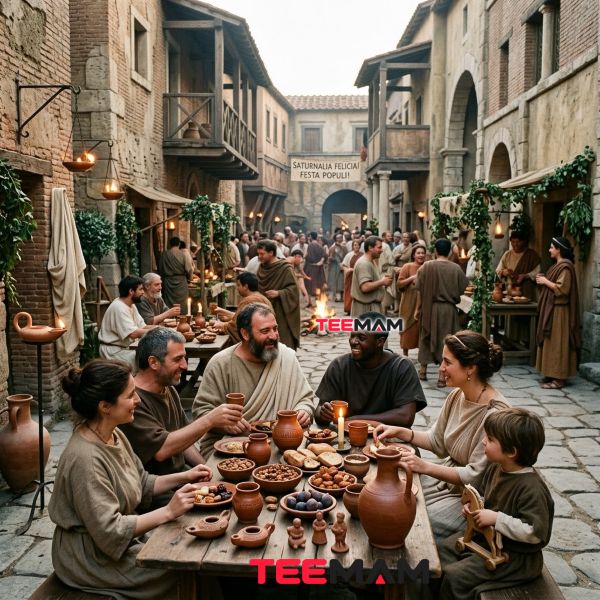
Saturnalia was a Roman festival honoring Saturn, held in mid-December. HISTORY describes it as a period of feasting, gift-giving, candle-lighting, and decorating homes with greenery, along with a temporary loosening of normal social roles between masters and enslaved people. For a few days, ordinary Roman social order was turned upside down: gambling was allowed openly, gifts changed hands, and public business paused for feasting.
The similarities explain why Saturnalia is often presented as Christmas’s direct predecessor, but the historical evidence does not support such a simple lineage. Saturnalia influenced the cultural environment in which Christmas later developed; it did not get renamed or replaced. The Christian celebration of Jesus’s birth grew out of its own theological and liturgical history, one that happened to land on a calendar date already associated with midwinter festivity across the Roman world.
Yule and Northern European Midwinter Traditions
Separately from Rome, Germanic and Norse peoples marked Yule, a cluster of midwinter observances tied to the winter solstice. Sources associate Yule with midwinter feasting, fires and other seasonal observances. Later Christmas traditions also absorbed or developed around some northern European customs involving evergreen plants and the Yule log, although the exact historical connections vary by region. As Christianity spread through Northern Europe over several centuries, some of these customs became intertwined with local Christmas practice. The process was gradual and varied by region, not a simple, one-to-one replacement of Yule with Christmas.
Winter Solstice Traditions and the Meaning of Light
It’s not a coincidence that so many cultures built festivals around the darkest point of the year. Light, fire, and evergreen plants show up again and again in midwinter traditions across very different societies, from Rome to Scandinavia to parts of the Middle East, because the solstice marks a turning point: the days stop getting shorter and slowly start getting longer again. That doesn’t mean every Christmas custom directly descends from paganism, but it explains why candles, lights, and greenery feel so at home in the season regardless of which tradition they originally came from.
From Early Christianity to December 25
The date of December 25 is where Christmas history gets oversimplified the most. The surviving evidence tells us when the Roman church began observing the Nativity, but it doesn’t hand us a tidy, single explanation for why that date was chosen.
Why Did Early Christians Not Celebrate Christmas Immediately?
For the first two centuries of Christianity, the birth of Jesus wasn’t a major focus of religious life. Easter, marking his death and resurrection, held far more theological weight, and it still does in most Christian traditions today. There was also no consistent record of Jesus’s actual birth date. Early Christian communities used different calendars and different theological reasoning to eventually settle on dates for the Nativity, and for a stretch, Jesus’s birth was folded into the Feast of the Epiphany on January 6 rather than marked separately.
When Was Christmas First Celebrated?
Two dates matter here, and it’s worth keeping them separate. The Library of Congress notes that by AD 336, the Christian church in Rome was observing the Feast of the Nativity on December 25. The earliest surviving physical document that actually names the date, however, is the Chronography of 354, an illustrated Roman calendar compiled almost two decades later for a wealthy Christian named Valentinus. Under the entry for December 25, it reads “natus Christus in Betleem Iudeae”: Christ was born in Bethlehem of Judea. The Chronography of 354 provides one of the earliest surviving documentary records of that observance in Rome.
The evidence establishes the Roman observance, not the date’s original rationale or its immediate adoption across all Christian communities. Adoption of the date varied: some Eastern Christian traditions continued to emphasize January 6 for the Nativity, and even today, several Eastern Orthodox churches that still follow the older Julian calendar observe Christmas on a day that falls on January 7 on the modern Gregorian calendar, not because they mark a different theological date, but because their calendar itself is offset by about two weeks.
Why Is Christmas Celebrated on December 25?
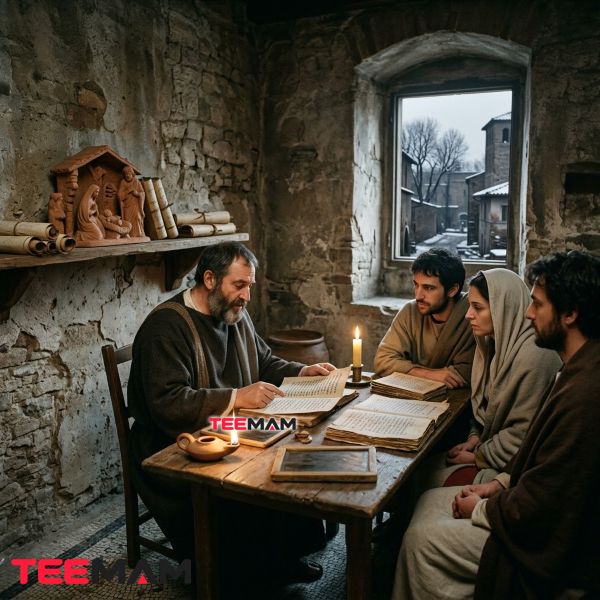
Nobody knows for certain, and it’s worth saying that plainly rather than picking a favorite theory and presenting it as settled fact. Two explanations dominate the historical discussion. One ties the date to existing Roman winter festivals, particularly Sol Invictus, “the Unconquered Sun.” The Chronography of 354 also records games associated with the “Unconquered One” on December 25, a reference commonly connected with Sol Invictus and celebrations tied to the sun god’s cult under Emperor Aurelian. Because Sol Invictus and the Christian Nativity landed on the same date in the same Roman calendar, some historians argue the church deliberately positioned Christmas to overshadow it. Others, including scholars writing in Biblical Archaeology Review, are skeptical that the fourth-century church would have built a major feast around absorbing a pagan holiday so directly, and point instead to a calculation-based theory: some early Christian writers worked backward from March 25, which they believed was the date of Jesus’s conception, and arrived at December 25 nine months later. Neither theory has been proven, and serious historians present both as competing explanations rather than settled history.
Modern scholarship often groups these explanations into two broad approaches, summarized below.
| Theory | What it argues | Confidence |
|---|---|---|
| Sol Invictus / history-of-religions theory | December 25 aligned Christmas with an existing Roman solar festival and calendar | Debated among historians |
| Calculation theory | December 25 resulted from calculating nine months after March 25, a traditional date for Jesus’s conception | Debated among historians |
| Simple Saturnalia-replacement theory | Christmas was a direct rebranding of Saturnalia | Considered an oversimplification |
Did Pope Julius I Choose December 25?
This is one of the most repeated claims about Christmas history, and it deserves a careful answer. Some popular accounts state, as though it were settled fact, that Pope Julius I personally selected December 25 as the date of Jesus’s birth. Britannica notes that Julius I is “traditionally credited” with confirming the date, reportedly using Roman census records, though some dispute over the date remained even at the time. The surviving evidence does not provide a clear official record showing that Julius I personally selected December 25; the date was already associated with the Roman Nativity celebration by the mid-fourth century. Catholic historical sources go further, stating that no official reason has been handed down in ecclesiastical documents for the choice of this date.
In other words, the Julius I story is a tradition, not a documented fact with a clear paper trail. The honest version is that the Roman church had settled on December 25 by around 336, the reasoning behind that specific date was never officially recorded, and later tradition attached a specific pope’s name to a decision whose real origins are murkier than the popular version suggests.
What’s Actually Certain, What’s Debated, and What’s Myth
Most confusion about the origin of Christmas comes from treating every claim as equally solid. It isn’t. Here’s how the strength of the evidence breaks down.
| Claim | Historical confidence |
|---|---|
| Christmas commemorates the birth of Jesus | Well established as the holiday’s Christian origin |
| The Roman church observed December 25 by AD 336 | Strong documentary evidence |
| Jesus was born on December 25 | Not established; the Bible gives no date |
| Pope Julius I personally chose December 25 | Traditional attribution, not officially documented |
| Christmas is simply a renamed Saturnalia | Oversimplified; Saturnalia is context, not a direct source |
| Yule directly became Christmas | Cultural overlap over centuries, not a one-to-one replacement |
| Victorian Britain reshaped the modern holiday | Strong historical evidence |
| Alabama was the first U.S. state to legalize Christmas, in 1836 | Widely repeated but disputed; the underlying legislative record is unverified |
| Rudolph and the Elf on the Shelf are ancient customs | False; both are 20th- and 21st-century inventions |
What We Know vs. What Historians Still Debate
| Question | What the evidence shows |
|---|---|
| When was Christmas first observed in Rome? | By AD 336, per surviving Roman records |
| Was Jesus born on December 25? | No historical evidence confirms it |
| Why December 25? | Still debated between the Sol Invictus theory and the calculation theory |
| Did Saturnalia become Christmas? | No evidence of a direct, deliberate replacement |
| Did Pope Julius I choose the date? | Traditional attribution, not officially documented |
| Did Victorian Britain invent Christmas? | No, but it reshaped many of the customs recognized today |
| Is Santa an ancient Christmas figure? | No; his modern form developed gradually over centuries |
| Are Rudolph and the Elf on the Shelf ancient traditions? | No, both are modern, commercially created characters |
How Christianity Shaped the Christmas Celebration
The Nativity Story and Christian Meaning
For Christians, Christmas centers on the Nativity, the biblical account of Jesus’s birth to Mary in Bethlehem, with Joseph present, shepherds arriving after being told of the birth by angels, and Magi later arriving with gifts. This story carries deep theological weight as the moment Christians believe God became human, and it remains the religious core of the holiday regardless of how many secular customs have attached themselves to it over the centuries.
Christmas in the Early Christian Calendar
Christmas sits within a broader liturgical season that includes Advent, traditionally the period of preparation leading up to Christmas, and Epiphany, traditionally associated with January 6 and, in many traditions, the visit of the Magi. Easter remains the older and, in most Christian traditions, theologically more central holiday, but Christmas grew over the centuries into the second major feast of the Christian calendar.
How Christmas Spread Through Europe
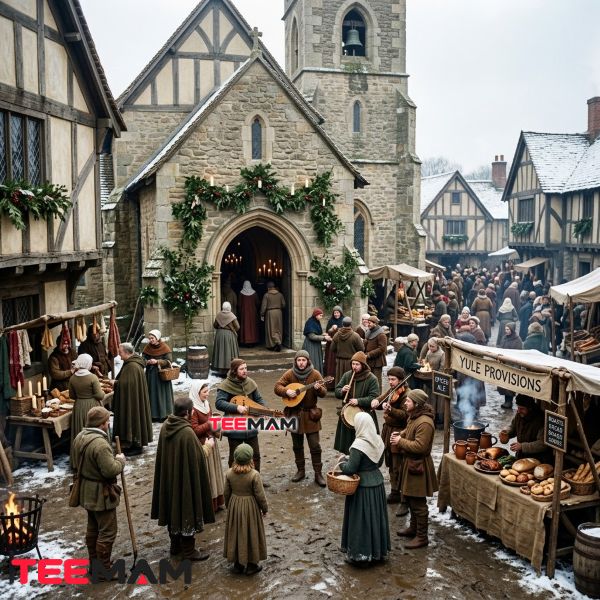
As Christianity expanded across Europe, Christmas took on different local flavors depending on which pre-existing customs a region already had in place. Scandinavian communities folded Yule practices into their Christmas celebrations. Germanic regions developed their own tree and evergreen customs centuries before those customs reached Britain or America. Southern European Catholic regions emphasized Nativity scenes and religious processions more heavily than northern Protestant regions did. There was never one uniform European Christmas, which is part of why so many different customs eventually converged into the modern holiday.
Medieval Christmas: Religion, Feasting and Community
Christmas Becomes a Major Medieval Festival
By the Middle Ages, Christmas had grown well beyond a single day of religious observance. It became the center of an extended festival season that combined church services with public feasting, music, and community gatherings, particularly among the nobility and in monastic communities that could afford elaborate celebrations.
Feasting and Public Celebration
Medieval Christmas feasts were often lavish, multi-day affairs, especially in wealthier households and royal courts. Food, drink, music, and games featured heavily, and Christmas became one of the few times in the year when social hierarchies loosened somewhat, echoing, though not directly descending from, the temporary role reversals of Roman Saturnalia.
Christmas Plays, Music and Storytelling
Religious mystery plays reenacting the Nativity story became common in medieval towns, performed by local guilds and community groups. Carols, originally a broader term for seasonal dance-songs, gradually became associated specifically with Christmas hymns and folk songs celebrating the season.
The Twelve Days of Christmas
Medieval Christmas wasn’t a single day. It stretched from December 25 through January 5, the night before Epiphany, a period known as the Twelve Days of Christmas. Feasting, gift exchanges, and celebrations were spread across this window rather than concentrated on December 25 alone, a structure broken down day by day in the meaning of the Twelve Days.
From Religious Observance to Social Festival
By the late medieval period, Christmas had become as much a social and community event as a religious one, a duality that would cause real tension during the Reformation, when reform-minded Christians began pushing back against what they saw as excessive, non-biblical festivity attached to the holiday.
The Reformation, Puritans and the Christmas Ban
Not every chapter of Christmas history is about the holiday growing bigger. For roughly a generation, large parts of the English-speaking Christian world actively rejected it.
Why Did Some Christians Oppose Christmas?
Protestant reformers, particularly Puritans in England and later New England, objected to Christmas for several reasons. One was that the Bible never specifies December 25 as Jesus’s birth date, so celebrating it on that day had no direct scriptural basis. Another was their opposition to the accumulated medieval customs, feasting, drinking, and general revelry, which they associated with excess and disorder rather than genuine religious devotion.
Why Did Puritans Dislike Christmas?
After Puritans overthrew King Charles I in England in 1649, Parliament banned Christmas celebrations, declaring December 25 a day of fasting rather than feasting. Puritans who later settled in New England carried the same hostility across the Atlantic.
Was Christmas Really Banned in America?
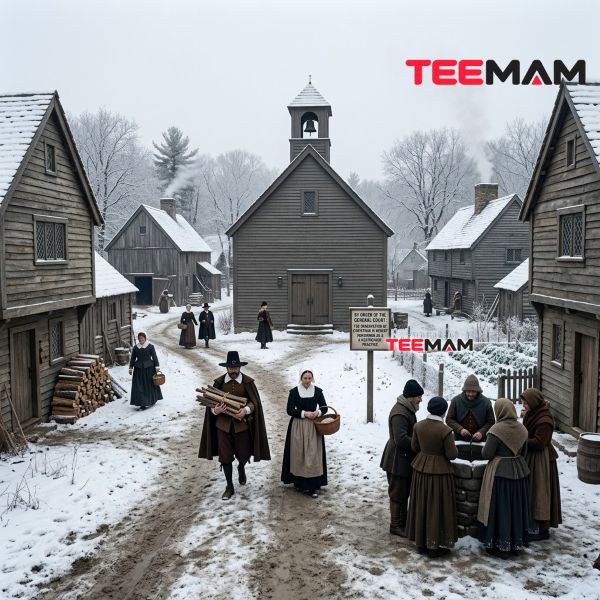
Yes, and the Massachusetts ban is an important reminder that Christmas was not universally accepted in colonial America. On May 11, 1659, the General Court of the Massachusetts Bay Colony passed a law fining anyone five shillings for “observing any such day as Christmas or the like,” whether through skipping work, feasting, or any other form of celebration. HISTORY’s research into the period notes that the law appears to have been aimed at preventing public disorder rather than policing private, quiet observance, and no known prosecutions survive in the record. The ban was repealed in 1681, although Christmas remained culturally unpopular in parts of New England for years afterward; Massachusetts did not formally adopt Christmas as a state holiday until 1856.
Christmas After the American Revolution
Christmas’s associations with England didn’t help its popularity in the newly independent United States either. For decades after independence, observance varied enormously by region. Southern states, with stronger ties to Anglican tradition and a more festive social calendar, are often credited with embracing Christmas earlier. Alabama is often cited as the first state to recognize Christmas as a legal holiday in 1836, with Louisiana and Arkansas following in 1838, although the underlying legislative record for the 1836 date is disputed and has not been substantiated in Alabama’s own state archives. Whatever the exact first mover, Southern states as a group did move earlier than most of New England, where the Puritan inheritance made adoption slower.
The Victorian Era: The Birth of Modern Christmas
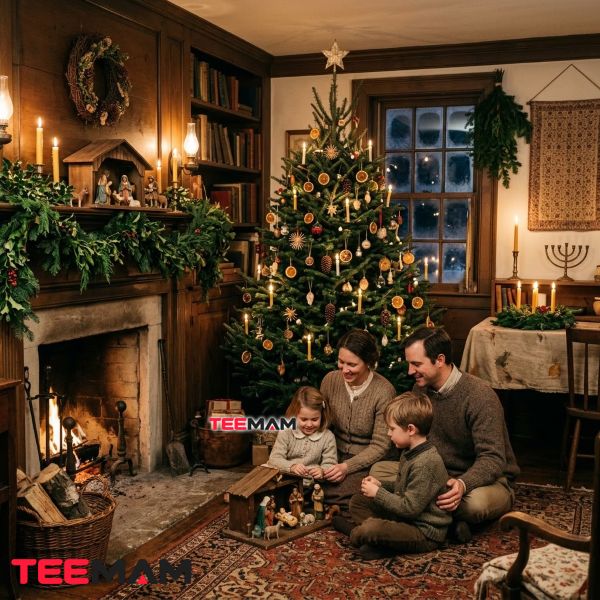
If any single period deserves credit for the Christmas most Americans recognize today, it’s the Victorian era. This is the point where the holiday shifts from a religious and community observance into the warm, domestic, family-centered occasion built around a decorated tree, exchanged cards, and children at the center of the celebration.
Queen Victoria and Prince Albert
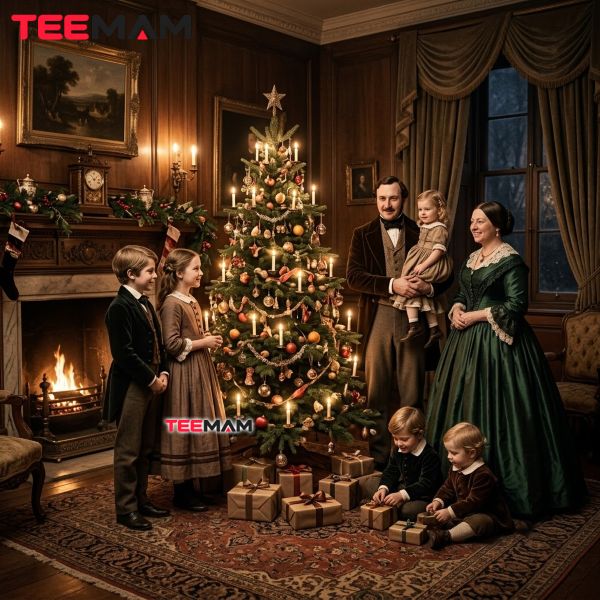
The decorated indoor Christmas tree didn’t start with Prince Albert, even though he usually gets the credit. According to the Victoria and Albert Museum, the German-born Queen Charlotte, wife of King George III, brought a decorated yew tree into the English royal court as early as 1800, decades before Victoria was born. What Albert and Victoria actually did was make the custom famous well beyond the royal court. In December 1848, the Illustrated London News published an engraving of Queen Victoria, Prince Albert, and their children gathered around a decorated Christmas tree at Windsor Castle, and the image spread quickly through British society. Two years later, an adapted version of the royal image appeared in Godey’s Lady’s Book, the most widely read women’s magazine in the United States at the time, helping carry the Christmas tree image to American readers. Over the following decades, the Christmas tree moved from a practice associated mainly with German-speaking communities into a much broader American Christmas tradition.
Charles Dickens and A Christmas Carol
In 1843, the same year the first commercial Christmas card appeared, Charles Dickens published A Christmas Carol. The story of Ebenezer Scrooge’s transformation from miser to generous neighbor did more than entertain readers. It helped popularize a specific vision of Christmas built around charity, family warmth, and personal redemption, themes that fit neatly with the emerging Victorian emphasis on domestic life and social responsibility toward the poor.
The Rise of the Christmas Card
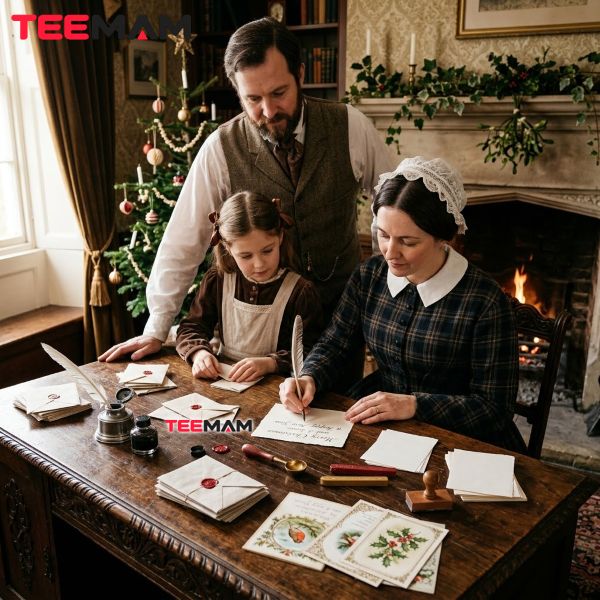
The first commercially produced Christmas card was created in 1843 by Sir Henry Cole, a British civil servant and postal reformer who, according to the Smithsonian’s National Postal Museum, was simply too busy that December to keep up with individually written holiday letters to friends. Cole commissioned the artist John Callcott Horsley to design a card showing a Victorian family celebrating at the table, flanked by scenes of people helping the poor and needy. A London printer produced 1,000 copies; Cole sent what he needed and sold the remainder for a shilling each. The timing wasn’t accidental: Britain’s new Penny Post, introduced just a few years earlier, had made sending mail across the country cheap and easy for the first time, and the Christmas card rode that new infrastructure into mainstream popularity within a few decades.
Christmas Becomes More Child-Centered
Victorian culture placed a growing emphasis on childhood and domestic family life, and Christmas absorbed that shift directly. Toys, stockings, and gift-giving aimed specifically at children became central to the holiday in a way they hadn’t been in earlier centuries, when Christmas was more of a communal, adult-oriented feast.
Gifts, Toys and the Family Christmas
By the second half of the nineteenth century, the pieces of the modern Christmas were largely in place: a decorated tree, exchanged cards, charitable giving, and a domestic celebration built around children. What remained was for these customs to fully take root in America and for a specific gift-bringing figure to take on the recognizable form we know today.
How American Christmas Became a National Tradition
Christmas in 19th-Century America
Through the first half of the 1800s, American Christmas was a patchwork of regional customs, shaped by whichever immigrant communities dominated a given area. It took the combined influence of Victorian British culture, waves of European immigration, and eventually federal recognition to turn Christmas into something close to a unified national holiday.
When Did Christmas Become a Federal Holiday?
This is another point where popular explanations tend to overstate the facts. On June 28, 1870, Congress passed legislation, signed by President Ulysses S. Grant, that made New Year’s Day, Independence Day, Christmas Day, and any day the president designated for public fasting or thanksgiving into legal holidays within the District of Columbia. According to the Congressional Research Service, this legislation applied specifically to federal employees in Washington, D.C., not to the entire country, and it wasn’t even a paid holiday at the time; paid federal holiday treatment came through later legislation. There was no single act of Congress that made Christmas a nationwide holiday for every American worker. Individual states adopted Christmas as a legal holiday at very different points; Oklahoma, admitted to the Union in 1907, is commonly cited as the last state to formally recognize it, doing so the same year it became a state, though that claim is best treated as a widely repeated historical marker rather than an uncontested fact.
Immigration and the Blending of Christmas Customs
Much of what feels distinctly “American” about Christmas actually arrived with specific immigrant communities. German immigrants brought Christmas trees and certain baking traditions. Dutch settlers contributed the Sinterklaas figure that would eventually evolve into Santa Claus. British customs shaped caroling and general holiday etiquette. Scandinavian immigrants brought their own Yule-adjacent food and decoration customs. Over the nineteenth century, these separate traditions blended into something that didn’t belong to any single culture anymore, which is part of why American Christmas can feel so different from Christmas in any one European country.
How Christmas Became an American Family Holiday
By the end of the nineteenth century, the combination of Victorian domestic ideals, department store gift culture, and a fully formed Santa Claus mythology had turned Christmas into the centerpiece of the American holiday calendar, a position it has held ever since.
The Origins of Santa Claus
Who Was Saint Nicholas of Myra?
The historical root of Santa Claus is Saint Nicholas of Myra, a fourth-century Christian bishop in what is now Turkey, remembered for his generosity, particularly toward children and the poor. Stories about Nicholas secretly giving gifts spread through Christian Europe over the following centuries and formed the basis of gift-giving traditions associated with his feast day, December 6, in many European countries.
From Saint Nicholas to Sinterklaas
In the Netherlands, devotion to Saint Nicholas evolved into Sinterklaas, a gift-bringing figure celebrated on December 5 and 6, distinct from the later Christmas Day gift-giving common in English-speaking countries. Dutch settlers carried this tradition to colonial New York, laying the groundwork for what would eventually become the American Santa Claus.
How Santa Claus Came to America
The Dutch Sinterklaas tradition mixed with British and German influences once it reached America, gradually shifting from a December 6 saint’s day figure into a Christmas Eve visitor.
Washington Irving and Early American Santa Imagery
Washington Irving’s early nineteenth-century writing helped popularize a jolly, pipe-smoking version of Saint Nicholas among American readers, moving the figure further from its solemn religious roots and closer to a folk character.
Clement Clarke Moore and the Modern Santa
The 1823 poem widely known as “A Visit from St. Nicholas,” commonly attributed to Clement Clarke Moore, gave American culture much of the Santa Claus imagery still in use today: a sleigh, eight reindeer, and a chimney-descending visitor delivering gifts on Christmas Eve.
How Illustrators Shaped Santa’s Image
Nineteenth-century illustrators, especially political cartoonist Thomas Nast, expanded and standardized many of the visual features associated with Santa, helping establish the plump, bearded figure that became familiar by the early twentieth century.
Santa Claus in 20th-Century Popular Culture
Advertising, department stores, and later film and television further standardized and commercialized Santa’s image throughout the twentieth century. One of the traditions that grew up alongside Santa’s modern image is the history of Santa’s naughty list, a device used to frame children’s behavior in the weeks leading up to Christmas. Britain’s own gift-bringing figure, Father Christmas, followed a related but separate historical path, detailed in how Father Christmas evolved over time, before eventually merging in the public imagination with the American Santa Claus.
Christmas Symbols and Where They Came From
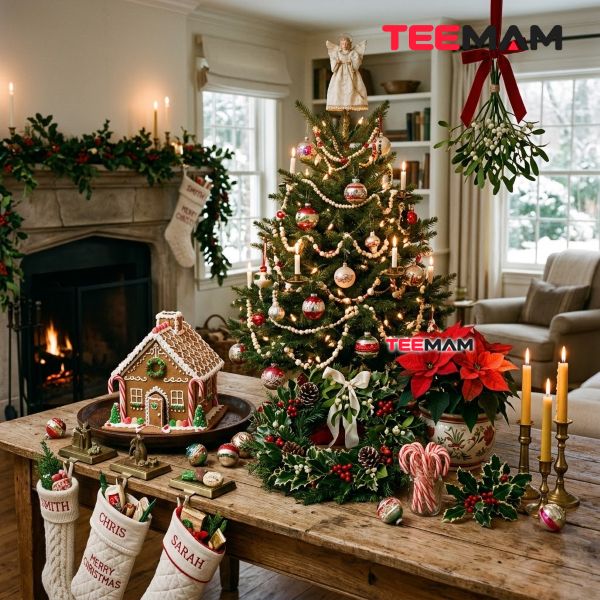
Most of what fills a living room in December carries its own traceable backstory, and few of those objects mean what people assume they mean. For a broader look at how Christmas symbols developed across all these traditions, the overview below covers the individual pieces.
The Christmas Tree
As covered above, the Christmas tree’s popularization in Britain and America traces back to Queen Charlotte’s early royal court tradition, then to the 1848 engraving of Victoria and Albert that spread the custom through Victorian society on both sides of the Atlantic.
Christmas Wreaths
Evergreen wreaths belong to a much older European tradition of using greenery to symbolize continuing life through the cold season, present in both Roman and Northern European winter festivals long before Christianity adopted it. The modern Christmas wreath, though, developed through later Christian and folk customs rather than descending directly from any single ancient source.
Mistletoe
Mistletoe accumulated layers of folklore and symbolism, including from Norse mythology, long before the specific custom of kissing under it became a fixture of Victorian Christmas parties. The exact line connecting ancient mistletoe lore to that party game isn’t fully documented, but the plant’s association with protection, fertility, and romance runs deep in European folk tradition, a tangled backstory covered in why mistletoe became a Christmas tradition.
Holly
Holly’s sharp leaves and bright red berries made it a natural winter decoration long before Christmas adopted it, and various Christian interpretations later attached religious symbolism to its shape and color, a connection explained further in the symbolism of Christmas holly.
Poinsettias
Poinsettias became a distinctly American Christmas symbol during the nineteenth century, even though the plant itself, native to Mexico, has no historical connection to the holiday’s European origins. The full backstory, tracing how the plant known in Mexico as cuetlaxóchitl became a U.S. holiday fixture, is in why poinsettias represent Christmas.
Christmas Stockings
Several competing legends explain the origin of hanging stockings for Santa to fill, most tied loosely back to Saint Nicholas folklore. None of these stories has firm documentary evidence behind it, so it’s worth treating them as folklore rather than settled history.
Gingerbread Houses
Gingerbread houses became especially associated with German-speaking baking traditions, while the popularity of the Brothers Grimm fairy tale “Hansel and Gretel” likely reinforced the cultural appeal of the edible-house motif, a history laid out in the history of gingerbread houses.
Christmas Traditions and Their Surprising Origins
Where Did Christmas Gift-Giving Come From?
Gift-giving at Christmas draws on multiple sources at once: Roman Saturnalia gift customs, the Magi’s gifts to the infant Jesus in the Nativity story, and Saint Nicholas’s legendary generosity toward children and the poor.
Why Do People Kiss Under the Mistletoe?
The custom likely developed from older European folk beliefs about mistletoe’s protective and romantic symbolism, later absorbed into Victorian Christmas party etiquette as a lighthearted seasonal game, a tradition explored further in why mistletoe became a Christmas tradition.
Why Do We Decorate Christmas Trees?
Modern tree decoration blends German folk custom with the specific Victorian aesthetic popularized after 1848, layered over centuries-older evergreen symbolism from both Roman and Northern European winter traditions.
Why Are Christmas Cookies and Gingerbread So Popular?
Baking traditions tied to Christmas developed regionally across Europe long before mass production made cookies and gingerbread a universal December staple, with German gingerbread traditions carrying particular influence in America.
How Did the Candy Cane Become a Christmas Symbol?
The exact origin of the modern candy cane is uncertain. Its familiar white-and-red striped form emerged gradually over time, and several later stories attempting to tie its shape and colors to specific religious symbolism appear to have been attached well after the candy itself already existed. The more grounded history, and the competing legends, are unpacked in how candy canes became festive symbols.
Why Do Children Make Christmas Wish Lists?
Wish lists are a relatively modern addition, growing out of nineteenth- and twentieth-century department store advertising and the broader child-centered shift in Victorian and American Christmas culture. Families looking for a starting point can browse ideas for a Christmas wish list for inspiration.
Christmas Characters Created by Modern Popular Culture
Some Christmas traditions Americans now treat as timeless are surprisingly recent. Rudolph and the Elf on the Shelf, for example, were created in the twentieth and twenty-first centuries as commercial and popular-culture additions to the holiday.
Rudolph the Red-Nosed Reindeer

Rudolph didn’t exist until 1939, when he was created for a promotional booklet distributed by the department store chain Montgomery Ward. The full story behind how Rudolph became a Christmas icon traces the character’s path from an advertising mascot to a permanent fixture of American Christmas.
The Elf on the Shelf
This tradition is even more recent, originating with a 2005 picture book and matching doll. Its popularity is a useful reminder that Christmas culture is still being created, not simply inherited, a point explored further in how Elf on the Shelf works.
Christmas Movies and the Modern Holiday Experience
Films and television specials have become one of the primary ways Christmas customs get passed down and reinforced today, arguably rivaling older oral and religious traditions in their cultural influence. Families building an annual watch list often turn to roundups of Christmas movies for family viewing.
From Victorian Dress to Modern Christmas Apparel
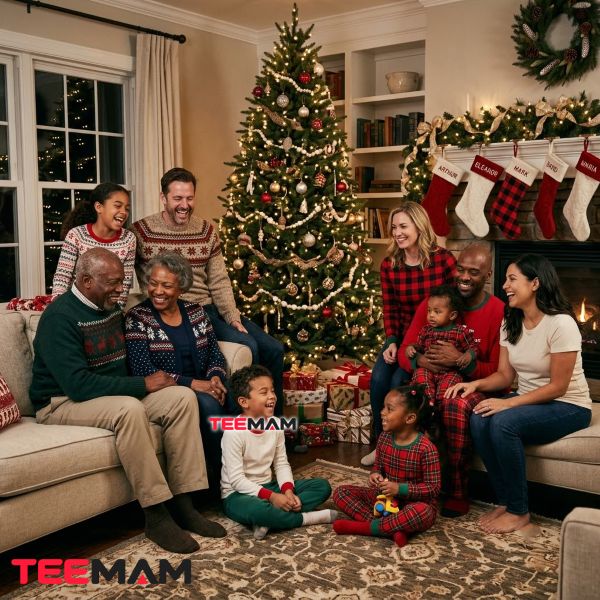
Christmas clothing has changed with the holiday itself. Formal Victorian portrait dress gave way over time to family photography, themed party wear, novelty sweaters and, more recently, coordinated family outfits, each reflecting how families of the era chose to mark the occasion.
The Rise of the Ugly Christmas Sweater
If the nineteenth century gave Christmas the tree and the card, the late twentieth century gave it a wearable inside joke. Loud, clashing holiday knitwear was genuine, unironic fashion in the 1980s, showing up in department store catalogs and on sitcoms. It fell out of favor almost entirely by the 1990s, then came back in the early 2000s as a deliberately ironic party costume, popularized in large part by themed parties that grew into ticketed events in cities like Vancouver, Canada, by the mid-2000s. What started as an office-party joke is now central to modern holiday gatherings, right alongside the mistletoe. Readers planning their own can find both how to make an ugly sweater yourself and creative ugly sweater ideas for inspiration. Christmas culture continues to evolve, just as it has throughout its history, and the ugly sweater is one of the more recent additions to that pattern.
How Modern Families Celebrate Christmas
Religious Christmas Celebrations
For practicing Christians, Christmas remains centered on church services, Nativity scenes, and the theological meaning of Jesus’s birth, much as it has been since the fourth century, even as the surrounding customs have multiplied.
Secular Christmas Celebrations
For many other families, Christmas functions as a cultural and family holiday detached from specific religious observance, built instead around gathering, gift-giving, and shared traditions passed down within the family itself.
Family Traditions
Every family tends to develop its own small rituals: a specific meal, a particular ornament, a movie watched every year on the same night. These personal traditions are, in miniature, the same process that built the larger history of Christmas: customs accumulating and changing generation by generation. Many families also lean on shared meaningful Christmas quotes for the holidays to set the tone for cards, toasts, or gift tags.
Food, Music and Movies
Holiday meals, carols, and annually rewatched films form much of the emotional texture of modern Christmas, often mattering more to individual families than the historical details behind any single custom.
Gift Exchanges and Secret Santa
Secret Santa exchanges offer a lower-cost, more personal alternative to buying gifts for an entire extended family or office, and creative Secret Santa gift ideas covers ways to make the exchange feel less random.
Christmas Parties and Community Celebrations
Beyond individual households, Christmas remains a major occasion for community gatherings, from church events to office parties to neighborhood traditions, echoing the communal feasting that defined the holiday back in the Middle Ages. No modern office party is complete without some funny Christmas jokes for celebrations or a round of Christmas puns for holiday fun to keep things light.
The Meaning Behind “Merry Christmas”
What Does “Merry Christmas” Mean?
“Merry” is an older English word for joyful or festive, and its pairing with Christmas dates back centuries as a standard seasonal greeting, a history and comparison to “Happy Christmas” covered in what Merry Christmas really means.
Why “Merry” Became Associated With Christmas
“Merry” carried more of a connotation of boisterous, communal celebration in earlier English, which fit the feasting, drinking, and public festivity associated with the holiday for much of its history, distinguishing it from the more solemn “happy” used in some other contexts.
How the Greeting Changed Across Cultures
Other English-speaking regions, notably parts of Britain, have historically preferred “Happy Christmas” over “Merry Christmas,” a small but persistent regional variation in how the same holiday gets verbally marked.
Christmas as a Global Celebration
Christmas never developed in one place under one cultural system, and that history explains why a Christmas Eve dinner in Italy, a summer barbecue in Australia, and a family gathering in the United States can look completely different while still belonging to the same holiday.
Why Christmas Looks Different Around the World
Because Christmas absorbed so many regional customs on its way to becoming a global holiday, it looks meaningfully different depending on where it’s celebrated, shaped by local religious practice, climate, and pre-existing cultural traditions. Even the date itself isn’t universal: most Eastern Orthodox churches that still follow the older Julian calendar mark Christmas on a day that falls on January 7 on the modern Gregorian calendar, rather than December 25.
Religious and Secular Traditions
Some countries maintain strongly religious Christmas observances centered on Midnight Mass and Nativity scenes, while others treat the holiday as largely secular and commercial, and many blend both approaches within the same country or even the same family.
Food, Decorations and Local Customs
Christmas meals vary widely by country, from seafood-centered Christmas Eve meals in parts of Italy to outdoor summer gatherings in Australia and highly commercialized Christmas dining traditions in Japan. Decorating traditions vary just as much. Red and green became the dominant American Christmas color palette gradually, reinforced by holly, poinsettias, and Victorian decorating trends rather than any single decree, a fuller explanation available in what traditional Christmas colors mean.
How American Christmas Influenced Global Pop Culture
American film, television and advertising exported a very specific, commercially shaped version of Christmas, complete with snow, Santa and department-store gift culture, to countries where the climate and cultural context were often very different.
Christmas Today: Tradition, Identity and Commercial Culture
Has Christmas Become Too Commercial?
This is a genuinely contested question rather than one with an obvious right answer. Critics point to the scale of retail spending and advertising built around the holiday as evidence that its original meaning has been diluted. Others argue that commercial elements such as gift-giving and seasonal shopping have been part of Christmas culture since at least the Victorian era, and that today’s spending is a scaled-up version of that same pattern rather than an entirely new corruption of the holiday.
Why Old Traditions Continue to Survive
Despite enormous change over seventeen centuries, some elements of Christmas, including candlelight, evergreen decoration and communal feasting, have persisted in some form since ancient winter festivals, suggesting these customs answer something fairly basic about how people want to mark the darkest part of the year.
Why New Traditions Keep Appearing
At the same time, entirely new Christmas customs keep emerging: Rudolph in 1939, the Elf on the Shelf in 2005, the ironic ugly sweater party in the 2000s, and whatever a given family invents this year. A custom can start in one household, spread through relatives or a community, and eventually become familiar enough to feel much older than it really is.
Common Questions About the Origin and History of Christmas
What is the origin of Christmas? Christmas began as a Christian celebration of the birth of Jesus, first documented in Rome by the year 336, and later absorbed customs from Roman winter festivals, medieval European culture, and Victorian reinvention to become the holiday celebrated today.
Was Christmas originally a pagan holiday? Not exactly. Christmas is a Christian holiday that happened to be set on a date already associated with Roman and Northern European winter festivals. Some customs carried over from those older traditions, but Christmas itself developed as a distinct Christian observance rather than a simple rebranding of an existing pagan festival.
Why is Christmas celebrated on December 25? The exact historical reason is debated. Leading theories point either to existing Roman winter festivals or to early Christian calendar calculations based on the believed date of Jesus’s conception. No single explanation is universally accepted by historians.
Was Jesus actually born on December 25? The Bible does not record a specific date for Jesus’s birth, and most historians consider December 25 a date chosen through church tradition rather than a documented historical fact.
Did Pope Julius I choose December 25? Popular tradition credits Julius I with confirming the date, but historical sources note that no official record survives explaining the reasoning. It’s more accurate to describe this as a traditional attribution than a documented fact.
What was Saturnalia and how is it related to Christmas? Saturnalia was a Roman festival honoring Saturn, held in mid-December with feasting, gift-giving, and social role reversal. It shaped the cultural backdrop against which Christmas developed but did not directly become Christmas.
What is the connection between Yule and Christmas? Yule was a separate Germanic and Norse midwinter festival featuring evergreen decoration, fire, and feasting. Many of its customs blended into European Christmas practice over centuries as Christianity spread through Northern Europe.
Why did Puritans ban Christmas? Puritans objected to Christmas because it lacked scriptural basis for its December 25 date and had become associated with excessive feasting and disorder. The Massachusetts Bay Colony formally banned public observance from 1659 to 1681.
When did Christmas become a federal holiday in the United States? Christmas became a legal holiday for federal employees in Washington, D.C. on June 28, 1870. It did not become a uniform nationwide legal holiday through a single act; individual states adopted it separately, over a period spanning several decades, with Oklahoma commonly cited as the last to do so, in 1907.
How did the Victorian era change Christmas? The Victorian era popularized the Christmas tree, introduced the commercial Christmas card, and shifted Christmas toward a domestic, family-and-child-centered celebration, largely through the influence of Queen Victoria, Prince Albert, and Charles Dickens.
Where did Santa Claus come from? Santa Claus developed from Saint Nicholas, a fourth-century Christian bishop known for generosity, filtered through Dutch Sinterklaas traditions, American literary works, and nineteenth-century illustrators who shaped his now-familiar image.
The Origin of Christmas in One Complete Timeline
Ancient winter traditions gave way to early Christianity, which by AD 336 had settled on December 25 in Rome. Medieval Europe expanded Christmas into a full festival season, only for the Reformation and Puritan New England to suppress it for a generation in the seventeenth century. Victorian Britain then reshaped the holiday in ways still visible today: the tree, the card, the family-centered warmth. Twentieth-century Santa mythology and commercial culture layered modern gift-giving and pop-culture characters on top of everything that came before, and that layering hasn’t stopped.
Final Takeaway: Why Christmas Has Never Had Just One Origin
Christmas is better understood as a historical layering than as a single invention. December 25 carries genuine historical complexity, and its exact selection is still debated rather than settled by any one documented decision. The Christian meaning of the holiday has remained central for believers since the fourth century, even as cultural traditions much older than Christianity itself attached themselves to the season along the way, and Victorian Britain later reshaped the family-centered version most Americans grew up with. Christmas culture continues to evolve: every family that adds its own small ritual, a specific meal, a matching sweater, a movie watched every December, is still adding to a tradition that was never really finished to begin with.
At TeeMam, we see holiday apparel as one of the newest ways families make seasonal traditions visible. Matching pajamas, novelty sweaters and family tees are part of the modern layer of a holiday that has always evolved with the people celebrating it. Readers interested in that modern side of Christmas can explore Christmas apparel for holiday celebrations.
Sources
This guide’s key historical dates and disputed claims were checked against the following institutional and archival sources:
- Library of Congress: “Today in History – December 25”
- Victoria and Albert Museum: “Victorian Christmas Traditions”
- Congressional Research Service: “Federal Holidays”

Hi, I’m Olivia Bennett, a fashion and lifestyle writer at TeeMam with 6 years of experience creating content about fashion, outfits, and lifestyle trends. I enjoy sharing practical style ideas for everyday wear, game days, holidays, and special occasions, helping readers find looks that feel comfortable, fun, and uniquely their own.