What Does “Merry Christmas” Actually Mean? The History Behind the Holiday Greeting
If you’re looking for the Merry Christmas meaning in a single sentence: it’s a wish for a joyful, cheerful, and festive Christmas. The word “merry” leans toward gaiety and celebration, which gives the greeting a slightly livelier feel than the broader, calmer “happy.” What’s more interesting than the definition is how those two words picked up so much cultural weight. The phrase turns up in a Tudor prisoner’s letter, a Charles Dickens novella, and a hand-colored Victorian card, long before it ever landed on a sweater or a gift tag.
What Does “Merry” Mean in “Merry Christmas”?

“Merry” traces back to the Old English myrge and Middle English mery, words tied to pleasantness and good humor. Merriam-Webster defines the word as being “full of good humor and good spirits” and “marked by gaiety or festivity,” an outward, active kind of cheer rather than a quiet internal one.
Merry vs. Happy: Is There a Difference?
The two words aren’t perfect synonyms, even though they get used that way in casual conversation. Understanding that distinction also gets at the heart of the Merry Christmas meaning, since “merry” often emphasizes the festive character of the celebration while “happy” is broader.
- Merry often points to lively, communal celebration: the energy of caroling, toasting, and noisy family dinners.
- Happy describes a broader sense of contentment or well-being, whether shared or private.
When someone says “Merry Christmas,” they’re expressing a wish for that cheerful, festive kind of day. “Happy Christmas” carries essentially the same good wish. The two expressions just developed different regional associations over time, which is worth keeping in mind before assuming one is more “correct” than the other.
It’s also worth clearing up a myth: “merry” doesn’t simply mean “drunk.” Some 19th-century English clergy did associate the word with rowdy, tavern-style celebration, and that association shaped how certain social classes used it. But that’s a historical connotation attached to the word, not its actual definition.
When Does “Merry Christmas” First Appear in the Written Record?
The earliest widely cited written record of “Merry Christmas” dates to December 22, 1534, when Bishop John Fisher used the phrase in a letter to Thomas Cromwell. A possibly earlier example, dated December 1533 and attributed to a Tudor official named Thomas Mayhew, has also surfaced in historical research, though it’s far less widely cited in general reference sources than the Fisher letter. Either way, this early evidence matters: the Merry Christmas meaning was already tied to a recognizable seasonal greeting in Tudor England, not something invented by Victorian Christmas culture three centuries later.
John Fisher’s 1534 Letter

Fisher, the Bishop of Rochester, had been imprisoned in the Tower of London since April 1534 for refusing to recognize Henry VIII as head of the Church of England. By December, he was writing to Cromwell to beg for basic necessities: clothing, food, and a priest to hear his confession. He closed the letter with a seasonal greeting that would become one of the best-known early written examples of “Merry Christmas”: “And this our Lord God send you a mery Christmas, and a comfortable, to your heart’s desire.” Fisher was executed the following June, at the age of 66.
Was There an Earlier Example?
According to research into Tudor-era correspondence, a December 18, 1533 letter from an official named Thomas Mayhew, also addressed to Cromwell, closed with a similar wish for a merry Christmas. Mayhew’s letter isn’t part of the standard trivia repeated in most Christmas explainers, but its existence is a useful reminder that Fisher’s letter should be read as the earliest widely documented use of the phrase, not necessarily its true origin. By the mid-1530s, “merry Christmas” already appears as a natural, unremarkable sign-off in correspondence, suggesting the expression may have circulated more broadly in spoken English before either letter was written.
How Charles Dickens Helped Popularize Christmas Cheer
Charles Dickens published A Christmas Carol in December 1843. Scrooge’s transformation from miser to merrymaker gave readers a template for what a festive Christmas was supposed to look like: full tables, open doors, and generosity extended beyond your own household. The novella helped reinforce the association between Christmas and the kind of warmth and cheer captured by the word “merry,” rather than inventing that association outright. That distinction is part of what shaped the modern Merry Christmas meaning: a greeting that carries both a wish for happiness and a distinctly festive sense of celebration.
It’s tempting to credit Dickens with singlehandedly popularizing the modern Christmas greeting, but that overstates his role. He was writing at a time when Christmas traditions were already being reshaped around family gatherings, charity, gift-giving, and domestic celebration, a broader Victorian shift that his fiction reflected as much as it drove. For the fuller, pre-Victorian backstory, our guide to Christmas origins and history covers the traditions that predate both Dickens and the Christmas card.
How the 1843 Christmas Card Changed Holiday Greetings
Henry Cole and John Callcott Horsley
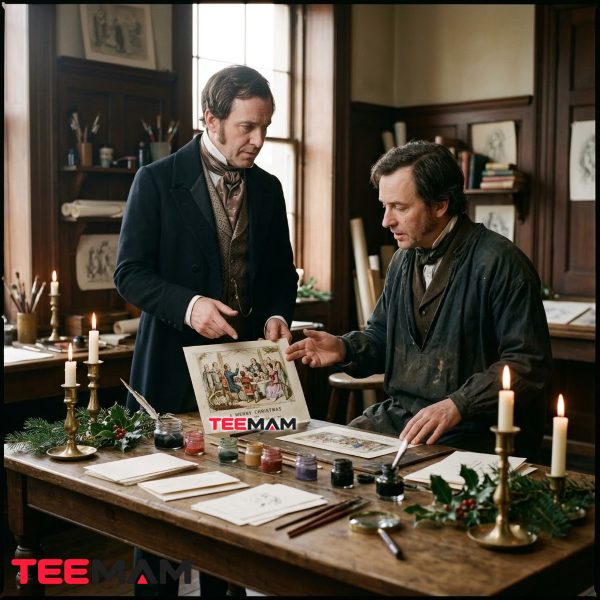
The same year A Christmas Carol was published, a civil servant named Henry Cole had a scheduling problem. He was too busy to handwrite his usual round of Christmas letters, so he commissioned the painter John Callcott Horsley to design something he could send instead. Cole later became the first director of the South Kensington Museum, the institution that evolved into today’s Victoria and Albert Museum.
Horsley’s design, dated “Xmasse 1843,” showed three generations of a family raising a toast in the center panel, flanked by scenes of charitable giving: food and clothing handed to the poor. Beneath the illustration ran the line “A Merry Christmas and a Happy New Year to You.” According to the Victoria and Albert Museum, which now holds a copy of the card in its permanent collection, Cole had about 1,000 copies printed and hand-colored, then sold the ones he didn’t send himself for a shilling each.
That price turned out to be a problem. The V&A itself notes that the card was expensive for its time and that the venture was judged a commercial flop, and it would be five more years before a second Christmas card design appeared on the market. What mattered in the long run wasn’t the card’s sales figures, though; it was the format. The card gave the Merry Christmas meaning a physical form, turning a seasonal wish into something people could print, reproduce, and eventually display. Cole’s project helped demonstrate how a Christmas greeting could move from a handwritten message to a printed, reproducible format, an early and important step in the development of the commercial greeting-card tradition.
From Greeting to Graphic Design
This is where the history gets genuinely interesting for anyone who cares about holiday design, not just holiday history. “Merry Christmas” stopped being only something people said and became something they could print, hand-color, and display. Once the phrase existed as a design element, set in ornamental type and wrapped around illustrations of holly and firelit rooms, it started doing double duty as both a message and a piece of seasonal typography, a role it still plays on gift tags and mantel banners today.
“Merry Christmas” vs. “Happy Christmas”: What’s the Difference?
Both phrases express the same basic wish for a joyful holiday, and in that sense the Merry Christmas meaning isn’t fundamentally different from “Happy Christmas.” Which one feels natural to you usually comes down to where you grew up.
| Greeting | Common association | Meaning |
|---|---|---|
| Merry Christmas | Especially common in American English | A wish for a joyful, festive Christmas |
| Happy Christmas | Particularly associated with British English | A wish for a happy Christmas |
Neither greeting is inherently more correct. The difference is mainly regional and cultural, not a difference in meaning.
Why “Merry Christmas” Is Common in American English
“Merry Christmas” became the dominant Christmas greeting in American English, while “Happy Christmas” remained more closely tied to British usage. Several cultural factors may have reinforced that preference over time, including Dickens’ popularity in the U.S. and the growing circulation of Christmas cards that used the phrase, contributing factors rather than a single cause.
Why “Happy Christmas” Is Common in British English
“Happy Christmas” became strongly associated with British English, and royal Christmas broadcasts helped give the phrase a highly visible place in British public life. King George V’s first Christmas radio broadcast in 1932, written by Rudyard Kipling, closed with the line “To all, to each, I wish a Happy Christmas.” Later royal Christmas broadcasts continued to make the phrase familiar to British audiences, including throughout much of Queen Elizabeth II’s reign, though royal usage alone doesn’t fully explain why “Happy Christmas” became more common in Britain.
Some explanations connect Britain’s preference for “Happy Christmas” with older associations around the word “merry” and rowdy, drink-fueled celebration, but there’s no single, firmly established explanation for the regional difference. What’s clear is that the two phrases settled into different regions of English, not that one is friendlier or more formal than the other by definition.
How “Merry Christmas” Became a Modern Holiday Symbol
Nearly five centuries after Fisher’s letter, “Merry Christmas” shows up almost everywhere except handwritten letters: on cards, gift tags, doormats, mugs, string lights, family photo backdrops, and, increasingly, Christmas sweaters and printed apparel. That evolution is part of the modern Merry Christmas meaning: the phrase now communicates not just a spoken wish, but a recognizable visual idea of Christmas, functioning as shorthand for the season as much as a greeting.
Why the Phrase Works in Holiday Design

Its visual appeal is partly practical. “Merry Christmas” is short, familiar, and easy to fit onto a card, sign, sweater, ornament, or gift tag without losing legibility. Designers have been leaning on that same rhythm since Horsley’s 1843 card, just on different materials. That versatility is part of why the phrase still works across everything from traditional paper goods to modern apparel and home décor.
How Does “Merry Christmas” Appear in Modern Holiday Traditions?
The greeting rarely stands alone in holiday design. It’s typically paired with the rest of the season’s visual vocabulary: Santa or Father Christmas, reindeer, evergreen trees, ornaments, and vintage-style lettering that still echoes Victorian card design. If you want to trace one of those companion traditions to its own origin, you can read about the history of Father Christmas or Rudolph’s original Christmas story, both of which developed alongside the modern greeting rather than before it.
How Can You Use “Merry Christmas” in Modern Holiday Messages?
The phrase still does real work in cards, gift notes, family texts, and social captions, mostly because it packs warmth, celebration, and tradition into two words without sounding stiff. It reads just as naturally handwritten on a card as it does printed across a sweater or stitched onto an ornament.
At TeeMam, we see that same evolution in modern holiday design, where classic Christmas wording moves naturally from cards and ornaments to apparel and personalized gifts.
More Christmas Words, Stories, and Traditions to Explore
If the language of the season is what you’re after, you can browse classic Christmas quotes and greetings for cards, captions, or gift tags that go beyond the standard two words.
What Does “Merry Christmas” Really Say?
The Merry Christmas meaning is simple at its core: it’s a wish for a joyful, festive Christmas, with “merry” adding a sense of lively celebration that “happy” doesn’t quite carry on its own. The phrase appears in the written record by 1534, in a letter from an imprisoned bishop who had far more urgent things on his mind than holiday etiquette. Victorian England, through Dickens’ fiction and Henry Cole’s printed card, didn’t invent the greeting but gave it its modern shape and its first taste of commercial reproduction. “Merry Christmas” and “Happy Christmas” still mean the same good wishes today; which one feels natural mostly comes down to where you’re standing. And somewhere along the way, those two words stopped being only something you say and became something you can see, on a card, a sweater, or a string of lights.

Hi, I’m Olivia Bennett, a fashion and lifestyle writer at TeeMam with 6 years of experience creating content about fashion, outfits, and lifestyle trends. I enjoy sharing practical style ideas for everyday wear, game days, holidays, and special occasions, helping readers find looks that feel comfortable, fun, and uniquely their own.