The Poinsettia: How a Winter Flower Became a Christmas Icon
Why Do Poinsettias Feel Like Christmas?
There’s a particular smell of pine and cinnamon that means Christmas has arrived, and right next to it, on porches and mantels and church altars, sits a plant with leaves the color of a fire engine. The poinsettia is so tangled up with the holiday that most people never stop to ask an obvious question: this is a subtropical plant. It doesn’t come from anywhere near snow, sleighs, or Nordic pine forests. It comes from the warm hillsides of Mexico and Central America.
The story of poinsettias for Christmas is really the story of how a Mexican plant became part of a much larger holiday tradition. It runs through five very different chapters: Indigenous Mexican custom, a Christian legend told on Christmas Eve, a 19th-century American diplomat with a taste for botany, a Southern California horticultural family with a gift for marketing, and finally, decades of the plant simply showing up on television sets and greeting cards until it became visual shorthand for the season itself.
None of that happened by accident, and the full story is more interesting than “it’s just a Christmas flower.”
What Is a Poinsettia, Really?
The Red “Petals” Are Actually Bracts
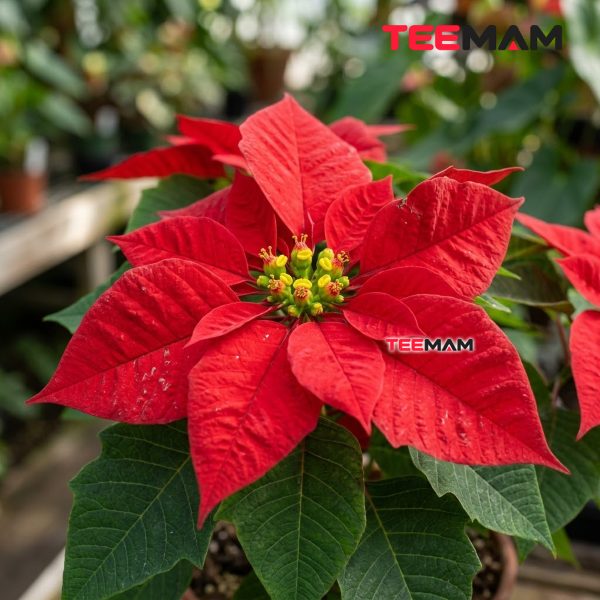
Here’s the detail that surprises almost everyone: those brilliant red “petals” aren’t petals at all. The poinsettia’s botanical name is Euphorbia pulcherrima, Latin for “very beautiful,” and what looks like a flower is actually a cluster of modified leaves called bracts. The true flowers, called cyathia, are the small, yellow-green structures clustered at the center of each bract rosette, easy to miss next to the color surrounding them.
That distinction matters for one practical reason: the bracts, not the tiny cyathia, are what give the plant its unmistakable visual presence in holiday displays. A cluster of true flowers this size wouldn’t carry a room the way a full ring of scarlet bracts does, which is a large part of why poinsettia decorations work so well for the holiday in the first place.
Why Does the Poinsettia Turn Red?
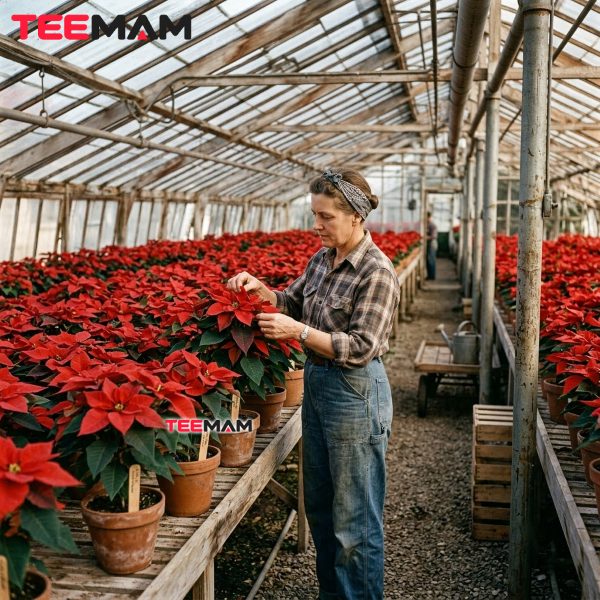
The color change is tied to day length. Poinsettias are short-day plants, meaning their bracts only develop color after an uninterrupted stretch of darkness each night, roughly 12 hours or more, according to university extension horticulturists. In the wild, that threshold is naturally crossed as nights lengthen after the fall equinox in late September, with bracts typically reaching full color by early December. Commercial growers use the same biology deliberately, covering greenhouse benches with blackout cloth to control exactly when a crop reaches peak color, which is how millions of poinsettias for Christmas end up on shelves right on schedule every year rather than by chance.
Cuetlaxochitl: The Aztec Roots of the Poinsettia
What Did the Aztecs Call the Poinsettia?
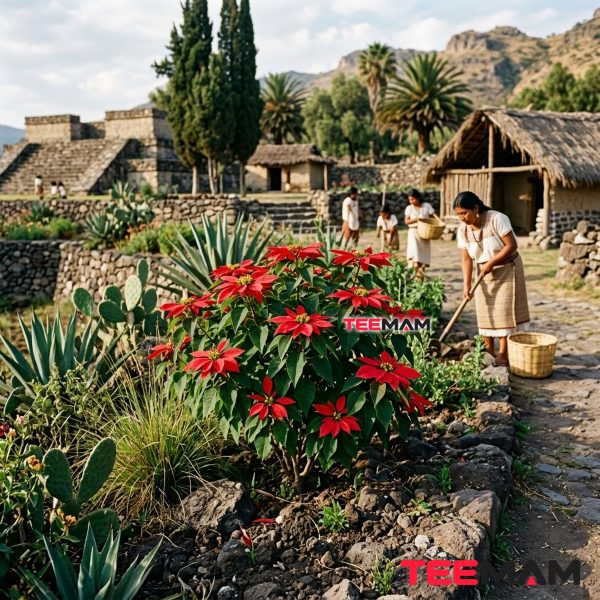
Long before this plant had anything to do with Christmas, it had a name and a purpose in Mesoamerica. The Aztecs called it cuetlaxochitl, a Nahuatl name generally translated as “flower that withers, mortal flower that perishes like all that is pure.” Smithsonian Gardens notes that the plant was first cultivated by the Aztecs and was prized by the emperor Montezuma, who reportedly had it shipped into Mexico City because it didn’t grow well at that altitude. Extension and horticultural sources also describe the Aztecs extracting a reddish-purple dye from the bracts and using the plant’s sap in preparations to treat fever.
More Than a Christmas Decoration
That history matters because the poinsettia had a cultural life in Mexico for centuries before it became a Christmas decoration in the United States. It wasn’t invented as a holiday prop. It was adopted into a holiday tradition much later, layered on top of an Indigenous history that already had its own meaning, uses, and symbolism.
That lineage, from Aztec Mexico, to cuetlaxochitl, to Euphorbia pulcherrima, to the red bracts sold every winter, is the throughline of the entire poinsettia story, and it’s the part most quick holiday explainers skip.
How the Poinsettia Became Part of Christmas in Mexico
The Christmas Eve Connection
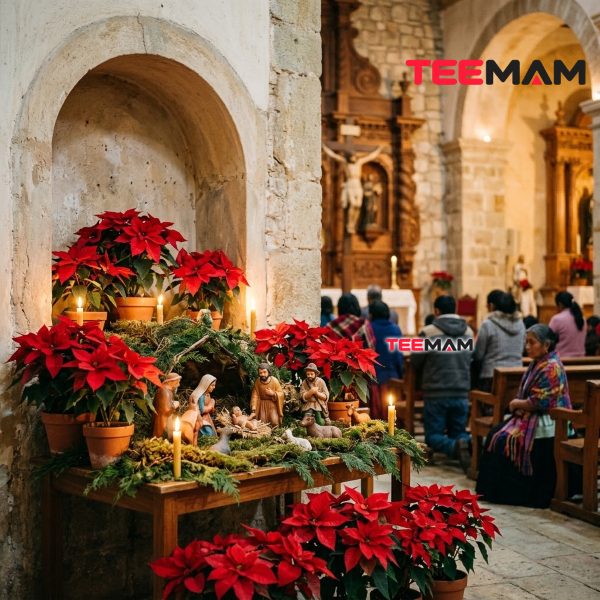
In Mexico, the plant is traditionally known as Flor de Nochebuena, the Christmas Eve flower. By the 17th century, Franciscan friars in parts of Mexico were incorporating the plant into Christmas and nativity observances, and its natural blooming window, which lines up with December, made it a practical and visually striking choice for church and home decoration during the holiday. That kind of slow religious adoption is a common thread running through the origins of Christmas traditions more broadly, where folk custom and Christian observance blend together over centuries rather than being invented all at once.
The Legend of Pepita and the Christmas Offering
Mexican folklore offers a gentler explanation, and it should be told as exactly that: a legend, not documented history. In the most common version, a young girl named Pepita has nothing to bring as a gift to a nativity display on Christmas Eve. Too poor to buy flowers, she gathers a bundle of roadside weeds instead, embarrassed by how plain they look. When she sets them at the manger, the weeds transform into brilliant red blooms.
The legend has helped frame poinsettias for Christmas as a symbol of generosity and humility in retellings of the plant’s Mexican holiday tradition, but it should be read as folklore passed down through storytelling, not a verified historical event.
Joel Roberts Poinsett and the Journey to the United States
Who Was Joel Roberts Poinsett?
The plant’s English name comes from a real historical figure: Joel Roberts Poinsett, a South Carolina-born physician, amateur botanist, and diplomat who served as the first United States Minister to Mexico in the late 1820s. According to Smithsonian Gardens, Poinsett encountered the plant while living in Mexico and, in 1825, took cuttings back with him to his greenhouse in South Carolina, where he continued to grow and share it.
Poinsett went on to a long and, by modern standards, deeply controversial career, including a term as U.S. Secretary of War. He was also an organizer of the National Institute for the Promotion of Science and the Useful Arts, an early American scientific society that pushed to use James Smithson’s bequest to fund a national museum, an effort that forms part of the institutional prehistory of the Smithsonian. Poinsett died on December 12, 1851, a date that later became significant to the plant’s story in the United States.
Why Is the Poinsettia Named After Him?
As the plant gained popularity and familiarity in the U.S. through the 1830s, nurserymen began marketing it under Poinsett’s name, and “poinsettia” stuck as the common English term, even though its formal botanical name, Euphorbia pulcherrima, was assigned separately by German botanist Johann Friedrich Klotzsch. It’s an unusual case of a plant’s popular name and its scientific name coming from two completely different sources.
From Botanical Curiosity to America’s Christmas Flower
The Ecke Family Changed the Poinsettia Business
For decades after Poinsett’s cuttings reached South Carolina, the plant remained a garden curiosity rather than a retail phenomenon. That changed with the Ecke family. Albert Ecke, a German immigrant, began growing poinsettias commercially in the Los Angeles area in the early 1900s, and his son Paul Ecke Sr. expanded the business after taking it over in 1919, eventually relocating operations to Encinitas, California. Under the Ecke family, poinsettia breeding became a serious horticultural pursuit, aimed at producing fuller, more compact, more visually dramatic plants than the leggy wild shrub found in Mexico. Their patented grafting techniques went on to give the family a dominant position in U.S. poinsettia production for decades.
Why Poinsettias for Christmas Became So Easy to Sell
Breeding a better plant solved only half the problem. Growers also needed to make poinsettias for Christmas practical and appealing as a seasonal retail product, which had as much to do with timing as with marketing.
Unlike a purely decorative object, a poinsettia arrives already carrying its own seasonal calendar: its bracts color up naturally as days shorten in the fall, right when Christmas shopping begins. Ecke-bred varieties were compact enough to sell as attractive potted plants rather than unruly outdoor shrubs, which made them practical for tabletops and mantels instead of just gardens. And the finished product already matched an established holiday color palette. Those three traits together, natural timing, retail-friendly form, and a built-in red-and-green look, made the poinsettia unusually easy to turn into a repeatable seasonal product, long before a single ad campaign got involved.
Paul Ecke Jr., who later ran the family business, pushed that advantage further through television. He reportedly sent free poinsettias to studios to decorate sets between Thanksgiving and Christmas, and he appeared on programs such as The Tonight Show to talk about the plant to a national audience. That kind of screen exposure has a long half-life; much of what still reads as classic Christmas iconography today, from decorated mantels to a poinsettia by the tree, got reinforced for decades through Christmas movies for family nights replaying the same visuals for a new audience every year. Every one of those choices compounded over the following decades: better plants, easier retail, free screen time, and years of repetition, until the sight of a poinsettia became visually synonymous with the season, the same way a certain shade of red and green already was.
Why Are Poinsettias Associated With Christmas?
The popularity of poinsettias for Christmas grew from several overlapping factors rather than any single event: Mexican religious tradition gave the plant its first Christmas identity, its natural blooming period lines up with December, and American cultivation and marketing later turned it into a mass-market holiday product. No one person or moment created that connection; it built up over roughly two centuries.
Seasonal timing. As nights lengthen in fall, poinsettias naturally develop colorful bracts, a response growers can time precisely so plants reach peak color for the Christmas season.
Religious and cultural symbolism. From Flor de Nochebuena to the legend of Pepita, Mexican Christmas tradition gave the plant its first Christmas identity long before it reached American shelves.
Red-and-green aesthetics. The plant’s color palette slots directly into existing Christmas visual language.
American commercialization. Poinsett’s introduction and the Ecke family’s decades of breeding and promotion turned a wild Mexican shrub into one of the country’s most successful flowering potted plants.
The Poinsettia’s Journey to Christmas: A Quick Timeline
| Period | What Happened |
|---|---|
| Pre-Columbian Mexico | Aztec cultivation of cuetlaxochitl for dye, medicine, and ceremonial use |
| 17th century | Franciscan friars begin incorporating the plant into Christmas and nativity traditions in Mexico |
| 1825 | Joel Roberts Poinsett takes cuttings from Mexico to his greenhouse in South Carolina |
| 1830s | “Poinsettia” becomes established as the plant’s common English name |
| Early 1900s | The Ecke family begins commercial poinsettia cultivation in Southern California |
| Mid-20th century | Television and retail promotion, including Paul Ecke Jr.’s media appearances, expand the plant’s visibility |
| 2002 | The U.S. House of Representatives formally recognizes December 12 as National Poinsettia Day |
Laid out this way, the rise of poinsettias for Christmas looks less like a single invention and more like a two-hundred-year relay, with each era passing the plant on to the next.
What Does the Poinsettia Symbolize at Christmas?
Modern interpretations tend to lean on themes of celebration, hope, giving, and renewal, drawing partly on the Pepita legend and partly on the plant’s dramatic seasonal transformation from green to red. Much of this symbolism is a modern, informal layer added on top of the plant’s documented history rather than an ancient tradition in its own right, and it’s worth reading it that way. The star-like shape of the bract cluster invites comparisons to the Christmas Star, but that’s an interpretation viewers have drawn from the plant’s appearance rather than a historical reason the plant was originally used.
Beyond the familiar red, poinsettia varieties are now cultivated in white, pink, marbled, and even gold tones, giving the plant a far broader design range than the single shade most people picture when they hear the word “poinsettia.”
From Christmas Plant to a Timeless Holiday Design Motif
Why Poinsettia Prints Work So Well in Holiday Design
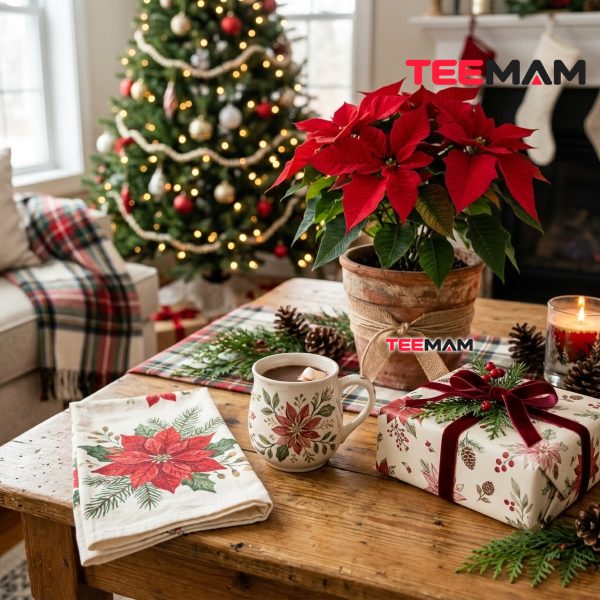
From a design standpoint, the poinsettia is unusually easy to recognize even when reduced to a simple outline. Its layered bracts form a strong, symmetrical central shape, and the red-and-green palette signals “Christmas” almost instantly, without needing any other seasonal cues around it. That combination, a bold silhouette plus an already-loaded color story, is why the motif keeps working across everything from vintage botanical illustration to clean, modern line art, without ever looking dated or overdone. It’s a similar arc to plenty of other Christmas decorations that started out somewhere completely unrelated to the tree or the mantel; the story behind gingerbread houses is a good example of a European baking tradition that turned into a full-blown holiday centerpiece.
How Poinsettias Appear in Modern Holiday Design
Today, poinsettias for Christmas appear far beyond pots and church displays. Their recognizable shape shows up on holiday apparel, mugs, tumblers, wall art, blankets, ornaments, wrapping paper, and greeting cards, because the silhouette stays legible even when it’s simplified down to a few shapes and two colors. That’s a harder trick than it sounds: plenty of holiday motifs turn into visual noise once they’re stripped down, but the Christmas poinsettia’s structure holds up. The same cards and packaging that lean on a poinsettia print often lean on a bit of seasonal humor too, which is exactly the territory covered by playful Christmas wordplay ideas for anyone looking to pair the visual with something to actually read.
How Poinsettias Fit Into Christmas Decorating
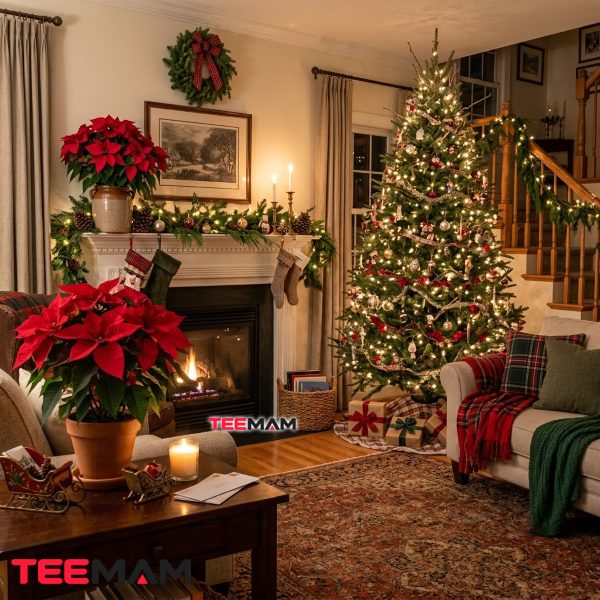
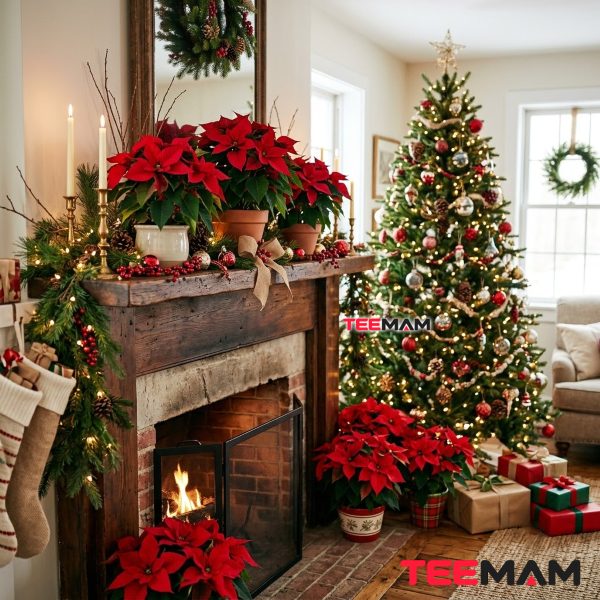
Beyond apparel and prints, the plant itself remains one of the simplest ways to bring the season into a room. A mantel, an entryway table, or the base of the Christmas tree are the classic spots for a potted arrangement, and a cluster of two or three plants tends to read as more intentional than a single lonely pot. Because the color already does most of the visual work, poinsettias for Christmas pair easily with greenery, candles, or plaid without needing much else, which is a large part of why they remain a go-to choice for last-minute holiday decorating, not just a plant people think about historically.
Three broad aesthetic directions tend to recur in poinsettia-themed design:
- Traditional botanical style: classic red poinsettias, deep green foliage, warm wood tones, and heirloom-style ornaments.
- Vintage poinsettia style: muted reds, old botanical illustration techniques, and antique-inspired typography, closer to a mid-century holiday card than a modern print.
- Modern poinsettia style: minimalist line art, neutral backgrounds, and a single strong botanical silhouette instead of a busy repeating pattern.
That range is part of why the poinsettia has stayed relevant as a design motif for so long: it adapts to whatever holiday aesthetic a home, a card, or a piece of apparel is going for, without losing the visual cues that make it read as Christmas in the first place.
Poinsettia Facts at a Glance
| Fact | Answer |
|---|---|
| Scientific name | Euphorbia pulcherrima |
| Native region | Mexico and Central America |
| Aztec (Nahuatl) name | Cuetlaxochitl |
| Mexican Christmas name | Flor de Nochebuena |
| Named after | Joel Roberts Poinsett |
| Introduced to the U.S. | 1825, by Joel Roberts Poinsett |
| Key commercial breeder | The Ecke family (Encinitas, California) |
| Common Christmas color | Red |
| Red “petals” | Bracts (modified leaves); true flowers are called cyathia |
| U.S. observance | National Poinsettia Day, December 12 (established 2002) |
Questions People Ask About Poinsettias at Christmas
Why are poinsettias associated with Christmas? The connection built up over roughly two centuries, combining Mexican Christmas tradition, the plant’s natural December bloom window, and later American cultivation and marketing that turned poinsettias for Christmas into a retail staple.
How did the poinsettia become the Christmas flower? Mexican religious tradition gave the plant its first Christmas identity as Flor de Nochebuena. Joel Roberts Poinsett then introduced it to the United States in 1825, and the Ecke family’s breeding and marketing turned it into a mass-market holiday product during the 20th century.
What did the Aztecs call the poinsettia? Cuetlaxochitl, a Nahuatl name generally translated as “flower that withers, mortal flower that perishes like all that is pure.”
Is a poinsettia actually a flower? Not the colorful part. What looks like petals are bracts, or modified leaves. The true flowers, called cyathia, are the small structures at the center of each bract cluster.
What does a poinsettia symbolize at Christmas? Modern interpretations point to celebration, hope, and giving, drawing partly from the Mexican legend of Pepita’s Christmas Eve offering, though much of this symbolism is a later, informal addition rather than a documented ancient tradition.
When did poinsettias become popular in the United States? Poinsett introduced the plant in 1825, but it didn’t become a true commercial phenomenon until the 20th century, when the Ecke family’s breeding and marketing, including television promotion from the 1950s onward, turned it into a household holiday staple.
Why are poinsettias red at Christmas? The color shift is triggered by longer, uninterrupted nights beginning around the fall equinox, a photoperiodic response that happens to line up closely with the Christmas shopping season.
Why the Poinsettia Still Feels Like Christmas
The plant’s journey is longer and stranger than most Christmas explainers let on. It began as cuetlaxochitl in Aztec Mexico, gained a place in Christian tradition as Flor de Nochebuena, crossed into the United States through Joel Poinsett’s greenhouse in 1825, and was eventually reshaped into a mass-market holiday plant by American growers and marketers a century later.
No single person or tradition created the modern link between poinsettias for Christmas. It evolved through Indigenous history, Mexican religious culture, botanical exchange, American horticulture, and decades of holiday storytelling stacked one on top of another.
At TeeMam, we see that evolution as a reminder that the most enduring holiday designs are usually rooted in stories, symbols, and traditions that have traveled across generations, which is exactly why a two-hundred-year-old flower still shows up on everything from front porches to wrapping paper every December.
Sources: Smithsonian Gardens, “Poinsettias – Oh So Beautiful”; Smithsonian Magazine, “The Poinsettia: How a Winter Flower Became a Christmas Icon
Why Do Poinsettias Feel Like Christmas?
There’s a particular smell of pine and cinnamon that means Christmas has arrived, and right next to it, on porches and mantels and church altars, sits a plant with leaves the color of a fire engine. The poinsettia is so tangled up with the holiday that most people never stop to ask an obvious question: this is a subtropical plant. It doesn’t come from anywhere near snow, sleighs, or Nordic pine forests. It comes from the warm hillsides of Mexico and Central America.
The story of poinsettias for Christmas is really the story of how a Mexican plant became part of a much larger holiday tradition. It runs through five very different chapters: Indigenous Mexican custom, a Christian legend told on Christmas Eve, a 19th-century American diplomat with a taste for botany, a Southern California horticultural family with a gift for marketing, and finally, decades of the plant simply showing up on television sets and greeting cards until it became visual shorthand for the season itself.
None of that happened by accident, and the full story is more interesting than “it’s just a Christmas flower.”
What Is a Poinsettia, Really?
The Red “Petals” Are Actually Bracts
Here’s the detail that surprises almost everyone: those brilliant red “petals” aren’t petals at all. The poinsettia’s botanical name is Euphorbia pulcherrima, Latin for “very beautiful,” and what looks like a flower is actually a cluster of modified leaves called bracts. The true flowers, called cyathia, are the small, yellow-green structures clustered at the center of each bract rosette, easy to miss next to the color surrounding them.
That distinction matters for one practical reason: the bracts, not the tiny cyathia, are what give the plant its unmistakable visual presence in holiday displays. A cluster of true flowers this size wouldn’t carry a room the way a full ring of scarlet bracts does, which is a large part of why poinsettia decorations work so well for the holiday in the first place.
Why Does the Poinsettia Turn Red?
The color change is tied to day length. Poinsettias are short-day plants, meaning their bracts only develop color after an uninterrupted stretch of darkness each night, roughly 12 hours or more, according to university extension horticulturists. In the wild, that threshold is naturally crossed as nights lengthen after the fall equinox in late September, with bracts typically reaching full color by early December. Commercial growers use the same biology deliberately, covering greenhouse benches with blackout cloth to control exactly when a crop reaches peak color, which is how millions of poinsettias for Christmas end up on shelves right on schedule every year rather than by chance.
Cuetlaxochitl: The Aztec Roots of the Poinsettia
What Did the Aztecs Call the Poinsettia?
Long before this plant had anything to do with Christmas, it had a name and a purpose in Mesoamerica. The Aztecs called it cuetlaxochitl, a Nahuatl name generally translated as “flower that withers, mortal flower that perishes like all that is pure.” Smithsonian Gardens notes that the plant was first cultivated by the Aztecs and was prized by the emperor Montezuma, who reportedly had it shipped into Mexico City because it didn’t grow well at that altitude. Extension and horticultural sources also describe the Aztecs extracting a reddish-purple dye from the bracts and using the plant’s sap in preparations to treat fever.
More Than a Christmas Decoration
That history matters because the poinsettia had a cultural life in Mexico for centuries before it became a Christmas decoration in the United States. It wasn’t invented as a holiday prop. It was adopted into a holiday tradition much later, layered on top of an Indigenous history that already had its own meaning, uses, and symbolism.
That lineage, from Aztec Mexico, to cuetlaxochitl, to Euphorbia pulcherrima, to the red bracts sold every winter, is the throughline of the entire poinsettia story, and it’s the part most quick holiday explainers skip.
How the Poinsettia Became Part of Christmas in Mexico
The Christmas Eve Connection
In Mexico, the plant is traditionally known as Flor de Nochebuena, the Christmas Eve flower. By the 17th century, Franciscan friars in parts of Mexico were incorporating the plant into Christmas and nativity observances, and its natural blooming window, which lines up with December, made it a practical and visually striking choice for church and home decoration during the holiday. That kind of slow religious adoption is a common thread running through the origins of Christmas traditions more broadly, where folk custom and Christian observance blend together over centuries rather than being invented all at once.
The Legend of Pepita and the Christmas Offering
Mexican folklore offers a gentler explanation, and it should be told as exactly that: a legend, not documented history. In the most common version, a young girl named Pepita has nothing to bring as a gift to a nativity display on Christmas Eve. Too poor to buy flowers, she gathers a bundle of roadside weeds instead, embarrassed by how plain they look. When she sets them at the manger, the weeds transform into brilliant red blooms.
The legend has helped frame poinsettias for Christmas as a symbol of generosity and humility in retellings of the plant’s Mexican holiday tradition, but it should be read as folklore passed down through storytelling, not a verified historical event.
Joel Roberts Poinsett and the Journey to the United States
Who Was Joel Roberts Poinsett?
The plant’s English name comes from a real historical figure: Joel Roberts Poinsett, a South Carolina-born physician, amateur botanist, and diplomat who served as the first United States Minister to Mexico in the late 1820s. According to Smithsonian Gardens, Poinsett encountered the plant while living in Mexico and, in 1825, took cuttings back with him to his greenhouse in South Carolina, where he continued to grow and share it.
Poinsett went on to a long and, by modern standards, deeply controversial career, including a term as U.S. Secretary of War. He was also an organizer of the National Institute for the Promotion of Science and the Useful Arts, an early American scientific society that pushed to use James Smithson’s bequest to fund a national museum, an effort that forms part of the institutional prehistory of the Smithsonian. Poinsett died on December 12, 1851, a date that later became significant to the plant’s story in the United States.
Why Is the Poinsettia Named After Him?
As the plant gained popularity and familiarity in the U.S. through the 1830s, nurserymen began marketing it under Poinsett’s name, and “poinsettia” stuck as the common English term, even though its formal botanical name, Euphorbia pulcherrima, was assigned separately by German botanist Johann Friedrich Klotzsch. It’s an unusual case of a plant’s popular name and its scientific name coming from two completely different sources.
From Botanical Curiosity to America’s Christmas Flower
The Ecke Family Changed the Poinsettia Business
For decades after Poinsett’s cuttings reached South Carolina, the plant remained a garden curiosity rather than a retail phenomenon. That changed with the Ecke family. Albert Ecke, a German immigrant, began growing poinsettias commercially in the Los Angeles area in the early 1900s, and his son Paul Ecke Sr. expanded the business after taking it over in 1919, eventually relocating operations to Encinitas, California. Under the Ecke family, poinsettia breeding became a serious horticultural pursuit, aimed at producing fuller, more compact, more visually dramatic plants than the leggy wild shrub found in Mexico. Their patented grafting techniques went on to give the family a dominant position in U.S. poinsettia production for decades.
Why Poinsettias for Christmas Became So Easy to Sell
Breeding a better plant solved only half the problem. Growers also needed to make poinsettias for Christmas practical and appealing as a seasonal retail product, which had as much to do with timing as with marketing.
Unlike a purely decorative object, a poinsettia arrives already carrying its own seasonal calendar: its bracts color up naturally as days shorten in the fall, right when Christmas shopping begins. Ecke-bred varieties were compact enough to sell as attractive potted plants rather than unruly outdoor shrubs, which made them practical for tabletops and mantels instead of just gardens. And the finished product already matched an established holiday color palette. Those three traits together, natural timing, retail-friendly form, and a built-in red-and-green look, made the poinsettia unusually easy to turn into a repeatable seasonal product, long before a single ad campaign got involved.
Paul Ecke Jr., who later ran the family business, pushed that advantage further through television. He reportedly sent free poinsettias to studios to decorate sets between Thanksgiving and Christmas, and he appeared on programs such as The Tonight Show to talk about the plant to a national audience. That kind of screen exposure has a long half-life; much of what still reads as classic Christmas iconography today, from decorated mantels to a poinsettia by the tree, got reinforced for decades through Christmas movies for family nights replaying the same visuals for a new audience every year. Every one of those choices compounded over the following decades: better plants, easier retail, free screen time, and years of repetition, until the sight of a poinsettia became visually synonymous with the season, the same way a certain shade of red and green already was.
Why Are Poinsettias Associated With Christmas?
The popularity of poinsettias for Christmas grew from several overlapping factors rather than any single event: Mexican religious tradition gave the plant its first Christmas identity, its natural blooming period lines up with December, and American cultivation and marketing later turned it into a mass-market holiday product. No one person or moment created that connection; it built up over roughly two centuries.
Seasonal timing. As nights lengthen in fall, poinsettias naturally develop colorful bracts, a response growers can time precisely so plants reach peak color for the Christmas season.
Religious and cultural symbolism. From Flor de Nochebuena to the legend of Pepita, Mexican Christmas tradition gave the plant its first Christmas identity long before it reached American shelves.
Red-and-green aesthetics. The plant’s color palette slots directly into existing Christmas visual language.
American commercialization. Poinsett’s introduction and the Ecke family’s decades of breeding and promotion turned a wild Mexican shrub into one of the country’s most successful flowering potted plants.
The Poinsettia’s Journey to Christmas: A Quick Timeline
| Period | What Happened |
|---|---|
| Pre-Columbian Mexico | Aztec cultivation of cuetlaxochitl for dye, medicine, and ceremonial use |
| 17th century | Franciscan friars begin incorporating the plant into Christmas and nativity traditions in Mexico |
| 1825 | Joel Roberts Poinsett takes cuttings from Mexico to his greenhouse in South Carolina |
| 1830s | “Poinsettia” becomes established as the plant’s common English name |
| Early 1900s | The Ecke family begins commercial poinsettia cultivation in Southern California |
| Mid-20th century | Television and retail promotion, including Paul Ecke Jr.’s media appearances, expand the plant’s visibility |
| 2002 | The U.S. House of Representatives formally recognizes December 12 as National Poinsettia Day |
Laid out this way, the rise of poinsettias for Christmas looks less like a single invention and more like a two-hundred-year relay, with each era passing the plant on to the next.
What Does the Poinsettia Symbolize at Christmas?
Modern interpretations tend to lean on themes of celebration, hope, giving, and renewal, drawing partly on the Pepita legend and partly on the plant’s dramatic seasonal transformation from green to red. Much of this symbolism is a modern, informal layer added on top of the plant’s documented history rather than an ancient tradition in its own right, and it’s worth reading it that way. The star-like shape of the bract cluster invites comparisons to the Christmas Star, but that’s an interpretation viewers have drawn from the plant’s appearance rather than a historical reason the plant was originally used.
Beyond the familiar red, poinsettia varieties are now cultivated in white, pink, marbled, and even gold tones, giving the plant a far broader design range than the single shade most people picture when they hear the word “poinsettia.”
From Christmas Plant to a Timeless Holiday Design Motif
Why Poinsettia Prints Work So Well in Holiday Design
From a design standpoint, the poinsettia is unusually easy to recognize even when reduced to a simple outline. Its layered bracts form a strong, symmetrical central shape, and the red-and-green palette signals “Christmas” almost instantly, without needing any other seasonal cues around it. That combination, a bold silhouette plus an already-loaded color story, is why the motif keeps working across everything from vintage botanical illustration to clean, modern line art, without ever looking dated or overdone. It’s a similar arc to plenty of other Christmas decorations that started out somewhere completely unrelated to the tree or the mantel; the story behind gingerbread houses is a good example of a European baking tradition that turned into a full-blown holiday centerpiece.
How Poinsettias Appear in Modern Holiday Design
Today, poinsettias for Christmas appear far beyond pots and church displays. Their recognizable shape shows up on holiday apparel, mugs, tumblers, wall art, blankets, ornaments, wrapping paper, and greeting cards, because the silhouette stays legible even when it’s simplified down to a few shapes and two colors. That’s a harder trick than it sounds: plenty of holiday motifs turn into visual noise once they’re stripped down, but the Christmas poinsettia’s structure holds up. The same cards and packaging that lean on a poinsettia print often lean on a bit of seasonal humor too, which is exactly the territory covered by playful Christmas wordplay ideas for anyone looking to pair the visual with something to actually read.
How Poinsettias Fit Into Christmas Decorating
Beyond apparel and prints, the plant itself remains one of the simplest ways to bring the season into a room. A mantel, an entryway table, or the base of the Christmas tree are the classic spots for a potted arrangement, and a cluster of two or three plants tends to read as more intentional than a single lonely pot. Because the color already does most of the visual work, poinsettias for Christmas pair easily with greenery, candles, or plaid without needing much else, which is a large part of why they remain a go-to choice for last-minute holiday decorating, not just a plant people think about historically.
Three broad aesthetic directions tend to recur in poinsettia-themed design:
- Traditional botanical style: classic red poinsettias, deep green foliage, warm wood tones, and heirloom-style ornaments.
- Vintage poinsettia style: muted reds, old botanical illustration techniques, and antique-inspired typography, closer to a mid-century holiday card than a modern print.
- Modern poinsettia style: minimalist line art, neutral backgrounds, and a single strong botanical silhouette instead of a busy repeating pattern.
That range is part of why the poinsettia has stayed relevant as a design motif for so long: it adapts to whatever holiday aesthetic a home, a card, or a piece of apparel is going for, without losing the visual cues that make it read as Christmas in the first place.
Poinsettia Facts at a Glance
| Fact | Answer |
|---|---|
| Scientific name | Euphorbia pulcherrima |
| Native region | Mexico and Central America |
| Aztec (Nahuatl) name | Cuetlaxochitl |
| Mexican Christmas name | Flor de Nochebuena |
| Named after | Joel Roberts Poinsett |
| Introduced to the U.S. | 1825, by Joel Roberts Poinsett |
| Key commercial breeder | The Ecke family (Encinitas, California) |
| Common Christmas color | Red |
| Red “petals” | Bracts (modified leaves); true flowers are called cyathia |
| U.S. observance | National Poinsettia Day, December 12 (established 2002) |
Questions People Ask About Poinsettias at Christmas
Why are poinsettias associated with Christmas? The connection built up over roughly two centuries, combining Mexican Christmas tradition, the plant’s natural December bloom window, and later American cultivation and marketing that turned poinsettias for Christmas into a retail staple.
How did the poinsettia become the Christmas flower? Mexican religious tradition gave the plant its first Christmas identity as Flor de Nochebuena. Joel Roberts Poinsett then introduced it to the United States in 1825, and the Ecke family’s breeding and marketing turned it into a mass-market holiday product during the 20th century.
What did the Aztecs call the poinsettia? Cuetlaxochitl, a Nahuatl name generally translated as “flower that withers, mortal flower that perishes like all that is pure.”
Is a poinsettia actually a flower? Not the colorful part. What looks like petals are bracts, or modified leaves. The true flowers, called cyathia, are the small structures at the center of each bract cluster.
What does a poinsettia symbolize at Christmas? Modern interpretations point to celebration, hope, and giving, drawing partly from the Mexican legend of Pepita’s Christmas Eve offering, though much of this symbolism is a later, informal addition rather than a documented ancient tradition.
When did poinsettias become popular in the United States? Poinsett introduced the plant in 1825, but it didn’t become a true commercial phenomenon until the 20th century, when the Ecke family’s breeding and marketing, including television promotion from the 1950s onward, turned it into a household holiday staple.
Why are poinsettias red at Christmas? The color shift is triggered by longer, uninterrupted nights beginning around the fall equinox, a photoperiodic response that happens to line up closely with the Christmas shopping season.
Why the Poinsettia Still Feels Like Christmas
The plant’s journey is longer and stranger than most Christmas explainers let on. It began as cuetlaxochitl in Aztec Mexico, gained a place in Christian tradition as Flor de Nochebuena, crossed into the United States through Joel Poinsett’s greenhouse in 1825, and was eventually reshaped into a mass-market holiday plant by American growers and marketers a century later.
No single person or tradition created the modern link between poinsettias for Christmas. It evolved through Indigenous history, Mexican religious culture, botanical exchange, American horticulture, and decades of holiday storytelling stacked one on top of another.
At TeeMam, we see that evolution as a reminder that the most enduring holiday designs are usually rooted in stories, symbols, and traditions that have traveled across generations, which is exactly why a two-hundred-year-old flower still shows up on everything from front porches to wrapping paper every December.
Sources: Smithsonian Gardens, “Poinsettias – Oh So Beautiful”; Smithsonian Magazine, “How Joel Poinsett, the Namesake for the Poinsettia, Played a Role in Creating the Smithsonian”.

Hi, I’m Olivia Bennett, a fashion and lifestyle writer at TeeMam with 6 years of experience creating content about fashion, outfits, and lifestyle trends. I enjoy sharing practical style ideas for everyday wear, game days, holidays, and special occasions, helping readers find looks that feel comfortable, fun, and uniquely their own.