The Meaning Behind Christmas Colors: Why Red and Green Became Traditional
Christmas colors didn’t come from one person, one company, or one culture. The result was cumulative: ancient winter greenery supplied the seasonal imagery, Christian traditions layered on new symbolism, Victorian printing and illustration spread that imagery widely for the first time, and 20th-century advertising reinforced it further.
This piece walks through that layered history in order — what’s documented, what’s popular myth, and what actually explains why red and green still show up on everything from wreaths to wrapping paper.
Why Are Christmas Colors Red and Green?

Short answer: Green traces back to evergreen plants, which stayed visibly alive through the darkest part of winter and became a natural symbol of life continuing when everything else looked dead. Red developed more gradually, picking up religious, seasonal, and cultural associations over hundreds of years before 19th- and 20th-century visual culture — Christmas cards, illustrated Santas, and later advertising — locked the pairing into place.
There is no single tradition that explains both colors. Green has a fairly clean explanation rooted in plant biology. Red is a composite — several overlapping sources reinforcing each other rather than one clean origin.
The Ancient Roots of the Christmas Color Palette
Evergreen Plants and Winter Traditions

Long before Christmas existed as a holiday, people across colder parts of Europe brought greenery indoors in winter. Holly, ivy, and evergreen boughs kept their color while deciduous trees went bare, which made them stand out as a visible sign that life hadn’t stopped. It’s common for holiday blog posts to trace this directly to specific Celtic rituals, but the historical record on what pre-Christian Celtic communities actually did with holly and ivy is considerably thinner than that popular version suggests. What’s better documented is the broader pattern: evergreen plants carried winter symbolism across several northern European cultures well before Christianity arrived. The exact ritual details, though, are where the evidence gets speculative rather than solid.
Roman Saturnalia and Winter Festivities
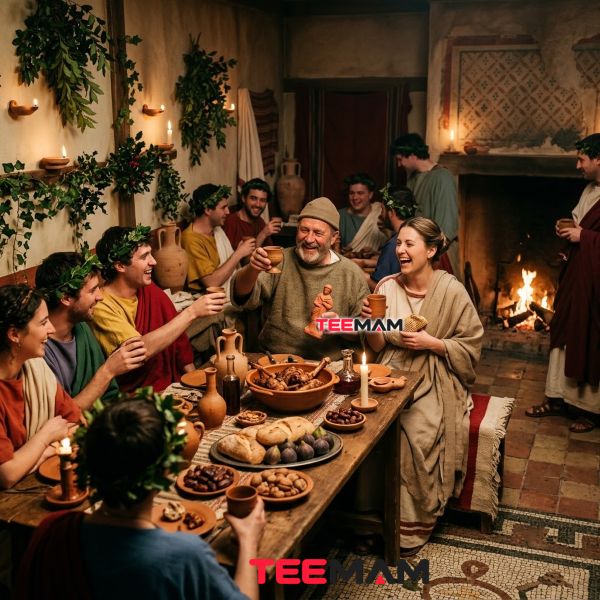
Ancient Rome had its own midwinter celebration: Saturnalia, held in honor of the god Saturn. It began on December 17, and its duration changed over time — a single day in its earliest form, later stretching across several days in subsequent periods, with December 17 through 23 commonly used as the festival’s range. Saturnalia involved public sacrifice and feasting, greenery and gifts, and a temporary loosening of normal social roles, with schools and courts closing for the duration. Calling it “Christmas before Christmas” makes for a catchy headline, but it blurs an important distinction: Saturnalia honored Saturn under an entirely different religious system, on a different calendar logic, with no connection to the birth of Christ. It shared a season and a few decorating habits with what came later — nothing more definitive than that.
Readers who want the fuller timeline behind these winter customs, and how they connect to the holiday as a whole, can find more detail in this Christmas origin and history guide.
How Christianity Reshaped the Meaning of Christmas Colors

As Christianity spread through Europe, Christian communities encountered existing seasonal customs and, in some regions, incorporated or reinterpreted familiar symbols such as evergreen greenery. This wasn’t one universal event — it played out differently by region and by period, over a long stretch of time rather than all at once. Evergreen branches, already tied to survival through winter, picked up added meaning in Christian contexts: endurance, renewal, and life continuing. The Christmas tree tradition, which developed in German-speaking Europe over subsequent centuries, drew on several of these overlapping winter and Christian associations rather than descending cleanly from any single source.
Red’s religious meaning is messier still. Holly berries, red vestments in religious art, and later interpretations linking red to the blood of Christ all fed into the color’s symbolism, but none of these is “the” origin. The blood-of-Christ reading in particular is one interpretation that took hold within certain Christian traditions — not a documented historical fact with a clear starting point. Symbolism like this tends to accumulate over generations rather than get assigned all at once, and it’s worth being upfront about that distinction rather than presenting one popular explanation as settled history.
More on how this kind of layered meaning shows up elsewhere in Christmas language is covered in what Merry Christmas really means.
The Victorian Era and the Rise of the Traditional Christmas Look
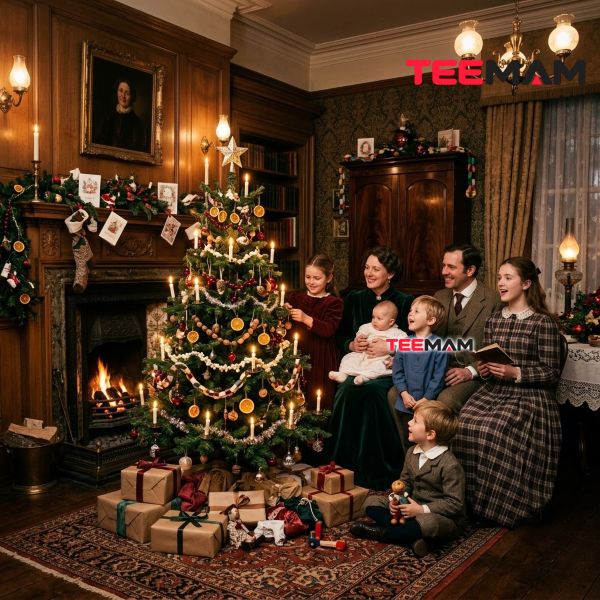
This part of the history of Christmas colors gets skipped in many articles about the topic, which is a shame, because it was one of the biggest forces shaping the Christmas imagery that still feels familiar today. Here’s roughly how it unfolded:
- 1843 — Civil servant Henry Cole, too busy that December to write his usual round of holiday letters, commissioned artist John Callcott Horsley to design a card he could simply sign and send. A thousand copies were printed. It’s generally credited as the first commercially produced Christmas card, according to London’s Victoria and Albert Museum.
- 1848 — An engraving of Queen Victoria and Prince Albert gathered with their children around a decorated Christmas tree at Windsor Castle ran in the Illustrated London News. The image spread quickly on both sides of the Atlantic and helped popularize the decorated Christmas tree far beyond the royal household.
- 1850s–1880s — Christmas card production had become a major commercial industry in Britain and the United States, with mass-produced cards, wreaths, and illustrated books repeating the same handful of colors — red, green, gold, and white — across cheap, widely distributed printed material for the first time.
Charles Dickens’s A Christmas Carol, published that same year as the first Christmas card, 1843, added its own sentimental, family-centered image of the holiday to this mix. By the time 20th-century advertisers got involved, this visual language — red and green repeated across cards, trees, and wreaths — was already decades old.
Did Coca-Cola Really Invent Red Santa?

The Haddon Sundblom Santa Myth
No — Coca-Cola did not invent the red Santa suit. This is one of the most persistent myths in holiday history, and it’s worth correcting directly. Illustrator Thomas Nast had been shaping the American image of Santa Claus since the 1860s in his illustrations for Harper’s Weekly, gradually settling on the rounder, bearded figure most people picture today. By the time of his well-known 1881 illustration “Merry Old Santa Claus,” that figure was already wearing red — five decades before Coca-Cola’s advertising campaign began.
What Coca-Cola did was commission illustrator Haddon Sundblom, starting in 1931, to paint a warm, grandfatherly Santa for its advertising, drawing inspiration from the poem often attributed to Clement Clarke Moore, “A Visit from St. Nicholas,” first published anonymously in the Troy Sentinel in 1823. (Moore’s authorship, worth noting, has long been debated by scholars, though he’s the name most commonly credited.) Sundblom created Haddon Sundblom’s Santa illustrations for the company from 1931 to 1964, and those images ran in magazines, on billboards, and on store displays for decades. The red suit already existed. What Coca-Cola’s campaign did was standardize one specific version of it and put it in front of an enormous audience, year after year, until it became the version most people picture.
Why the Coca-Cola Story Still Matters
That distinction tells us something useful about Christmas colors: cultural familiarity doesn’t always come from invention. Sometimes sheer repetition is enough to make an existing symbol feel like it was created from scratch. Coca-Cola’s real contribution was amplification and reach, not origination — a more interesting story than “a soda company invented Santa’s outfit,” and a more accurate one.
History vs. Popular Myths About Christmas Colors
The history of Christmas colors attracts more folklore than most holiday topics, partly because so much of it gets repeated without a second look. Here’s a quick reality check on the claims that come up most often:
| Popular claim | What the evidence actually supports |
|---|---|
| Coca-Cola invented Christmas red | No — red Santa imagery, via Thomas Nast, predates Coca-Cola’s advertising by roughly 50 years. |
| Christmas colors trace to one ancient tradition | No single origin is established; evergreen symbolism and Christian meaning developed along separate, overlapping tracks. |
| Red has always meant Christ’s blood | This is one Christian interpretation that developed over time, not a documented historical starting point. |
| Saturnalia was an early version of Christmas | No — Saturnalia honored the god Saturn under a separate religious system, though it shared the season with later Christmas customs. |
What Do the Other Traditional Christmas Colors Mean?

Red and green dominate the conversation, but a handful of supporting colors round out the traditional Christmas color palette. Meanings here vary by region and tradition, so treat this as common association rather than fixed rule:
| Christmas color | Common associations | Historical/cultural context |
|---|---|---|
| Green | Life, renewal, endurance | Evergreen plants |
| Red | Celebration, warmth, religious symbolism | Holly, Christian imagery, modern culture |
| Gold | Light, celebration, royalty | Religious and festive decoration |
| White | Snow, purity, peace | Winter imagery and Christian symbolism |
| Silver | Winter sparkle, elegance | Modern decorative traditions |
Why Red and Green Still Define Christmas Today

Christmas colors stick around for reasons that go beyond symbolism. Part of why this pairing has lasted is straightforward visual logic. Red tends to read as warm and energetic; green is closely tied to nature and growth. Placed side by side, the two create strong contrast — the kind that’s easy to spot from across a room, which matters a lot on a tree, a wreath, or a store shelf. But repetition has probably done more work than any inherent psychological pull. Generations of trees, cards, wreaths, Santa illustrations, and ornaments have paired red and green often enough that the combination reads as “Christmas” almost automatically, independent of anyone knowing the history behind it.
How the Classic Christmas Color Palette Shows Up in Holiday Apparel

The practical lesson for holiday apparel isn’t to treat red and green as mandatory. It’s to use them as visual anchors and then adjust saturation, contrast, and proportion depending on whether a design is meant to feel classic, playful, or understated. For printed apparel specifically, this traditional pairing also gives designers a real practical advantage: true red and evergreen green both create strong visual contrast against common shirt colors such as white, cream, charcoal, and heather gray — which is part of why the combination keeps showing up on matching family shirts, holiday sweaters, and pajama sets year after year, long after Victorian card printers and Coca-Cola’s ad department did their part to popularize it.
That’s the approach we take at TeeMam: use the traditional palette as a starting point, then adjust it for the mood and design instead of treating red and green as mandatory. For a related seasonal tradition that shows up often in holiday apparel design, the gingerbread house tradition is worth a look too.
How to Use Traditional Christmas Colors Without Looking Outdated
For Classic Christmas Style
Stick with red, evergreen, and white, using gold sparingly as an accent rather than a third main color.
For a Modern Christmas Look
Swap true red for a muted or brick red, pair it with forest green and cream, and add just a touch of metallic — silver or gold — instead of covering everything in it.
For Family Holiday Apparel
Pick one color to dominate and let the other act as an accent. Nobody needs to match exactly; a shared color family reads as coordinated without looking like a uniform. If the outfits need personality beyond the color scheme, a few fun Christmas puns and wordplay on a shirt design usually does more than another plain red sweater.
A Simple Christmas Color Palette for Decorations and Outfits

- Classic: red + evergreen + white — the safest, most recognizable option for family photos and home décor
- Elegant: burgundy + forest green + gold — works well for holiday parties and dressier occasions
- Minimal: cream + evergreen + muted red — a quieter look for apartments or smaller spaces
- Playful: bright red + traditional green + white — closest to the classic Santa-and-candy-cane look
For more ideas on turning these palettes into actual outfits rather than just decor, see these traditional Christmas outfit ideas.
Common Questions About Christmas Colors
What are the traditional Christmas colors?
Red and green are the two core Christmas colors, with gold, white, and silver typically playing secondary roles in decorations and apparel.
Why are Christmas colors red and green?
Green comes from evergreen plants that stayed visibly alive through winter. Red built up gradually through religious symbolism, seasonal association, and later popular media — the two colors didn’t originate from a single tradition, and no one source explains both of them.
Did Coca-Cola invent the red Santa suit?
No. Illustrator Thomas Nast had already drawn Santa in a red suit decades earlier, in the 1860s through 1880s. Coca-Cola’s 1931 campaign, painted by Haddon Sundblom, popularized and standardized a specific version of that image — it didn’t create it.
What does green symbolize at Christmas?
Evergreen, endurance, and life continuing through winter, with the specific symbolism varying somewhat by tradition and region.
What does red symbolize at Christmas?
Celebration and warmth, along with several religious and cultural associations built up over centuries. No single interpretation is universally agreed upon, including the popular “blood of Christ” reading.
What are the most popular modern Christmas color combinations?
Red and green remain the default, but red and white, green and gold, burgundy and forest green, and cream and evergreen are all common modern variations.
Where Christmas Colors Came From, in Order
Evergreen plants gave ancient winter customs a symbol that made visual sense — something green in a world gone gray. Christian communities layered new meaning onto that symbol over centuries, unevenly and by region. Victorian printing turned red, green, gold, and white into a shared visual vocabulary through Christmas cards and illustrated trees, decades before any single brand entered the picture. And 20th-century advertising, Coca-Cola included but hardly alone, spread that vocabulary further and faster than any earlier era could have managed. No single part of that story explains the full history of Christmas colors on its own — which is exactly what makes the whole version worth knowing, whether you’re decorating a tree or picking out this year’s family photo outfits.

Hi, I’m Olivia Bennett, a fashion and lifestyle writer at TeeMam with 6 years of experience creating content about fashion, outfits, and lifestyle trends. I enjoy sharing practical style ideas for everyday wear, game days, holidays, and special occasions, helping readers find looks that feel comfortable, fun, and uniquely their own.