Why Holly Is One of Christmas’s Oldest Symbols
There’s a reason a sprig of holly can make a room feel like Christmas before a single string of lights goes up. The glossy green leaves, the sharp little points, and the berry-like red fruit create a look most of us recognize instantly, even without stopping to ask where it came from. Christmas with holly goes back further than almost any other piece of the holiday’s visual language, long before Christmas trees, wrapping paper, or greeting cards existed.
In short: Holly became linked to Christmas because it stays green and produces bright red fruit in winter, which made it a natural choice for seasonal decoration in parts of Europe. Christian tradition later layered its own symbolism onto the plant, while Victorian Christmas cards helped establish the familiar holiday imagery we recognize today.
Understanding Christmas with holly means looking at several layers of history rather than searching for one single origin. Roman winter customs, European folklore, Christian symbolism, and Victorian design all played a part in how holly became associated with the holiday.
Why Were Evergreen Plants Important in Winter?
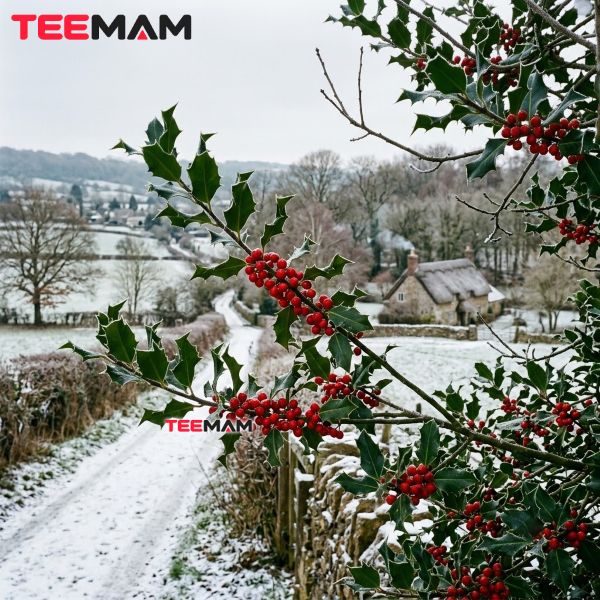
Before modern heating and grocery stores stocked year-round, a European winter meant bare trees and brown fields for months at a stretch. Holly stood out against that. It kept its leaves. It carried fruit into the cold months when almost nothing else did. That seasonal contrast is well documented: the Royal Botanic Gardens, Kew notes that Ilex aquifolium is one of the few British woody flowering plants to keep its leaves through winter, with bright red fruit appearing late in the season, which is exactly what made it useful for decoration long before anyone attached a specific religious meaning to it.
Holly also had a visual quality that plainer evergreens like ivy didn’t share to the same degree: a sharp combination of deep green and vivid red that reads clearly even from a distance. That contrast is still doing the same work today. It’s the reason a single sprig on a door or a card says “Christmas” without needing anything else around it.
How Did Christmas With Holly Become a Tradition?
Christmas with holly developed through several overlapping traditions rather than one documented starting point. Holly was already associated with winter before Christmas became the holiday recognized today, and different cultures gave the plant their own meanings along the way.
Holly in Roman and Druidic Traditions
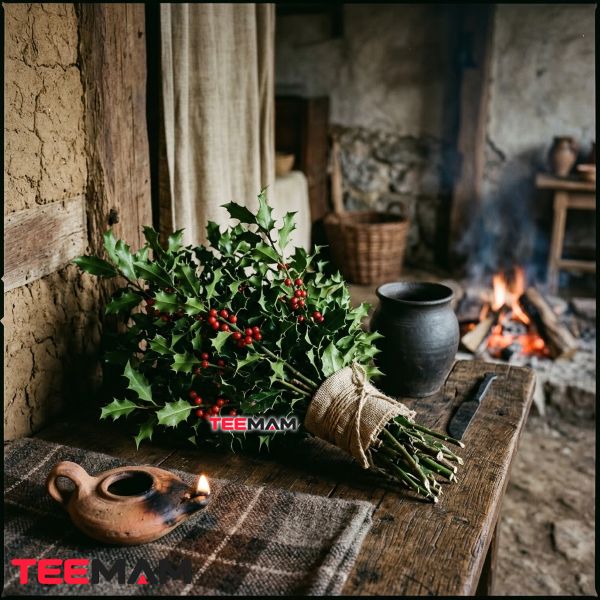
Holly’s connection to midwinter celebration predates Christmas by a long stretch, and it isn’t tied to just one culture. Holly was given as a gift during the Roman winter festival of Saturnalia, according to Kew. Separately, later accounts of Druidic tradition associate holly with fertility, protection, and continued life through winter, though these traditions developed on their own paths rather than as one continuous line leading into Christmas. These traditions predate the development of Christmas as the Christian feast familiar today. As Christianity spread across Europe in the centuries that followed, some existing winter greenery customs continued in parallel with newer Christian interpretations, rather than being replaced outright.
What Is the Christian Meaning of Holly?
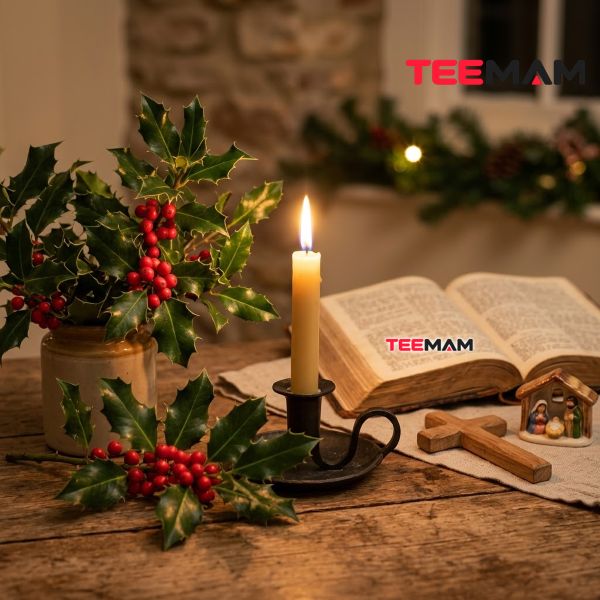
Within Christian tradition, holly picked up a second, more specific layer of symbolism. Its spiny leaves came to represent Christ’s crown of thorns, and its red fruit was read as a symbol of his blood, tied to a piece of folklore holding that the berries were originally white before turning red. Kew records this same tradition directly: in Christian tradition, holly fruit was said to have originally been white, but dyed red from the blood of Christ. Its evergreen nature, meanwhile, was interpreted as a reminder of eternal life.
This is why the history of Christmas with holly is best understood as a layering of meanings rather than one clean story. Earlier winter associations remained part of the plant’s cultural background, while Christian communities added their own religious significance on top of it.
Holly, Mistletoe, and Other Christmas Evergreens: What’s the Difference?
Holly, mistletoe, ivy, and pine often show up in the same wreaths and garlands, which makes it easy to lump them together. Understanding how they differ also helps explain why Christmas with holly developed such a distinctive visual identity of its own. They come from different traditions, and carry different associations worth knowing if you’re decorating with some intention behind it.
| Symbol | Visual identity | Traditional association | Modern Christmas use |
|---|---|---|---|
| Holly | Glossy, spiny green leaves with red fruit | Protection, Christian symbolism | Wreaths, cards, holiday apparel |
| Mistletoe | Pale, waxy leaves with white berries | Kissing custom, older fertility folklore | Doorway decoration |
| Ivy | Trailing evergreen vine | General winter greenery | Garlands |
| Fir / Pine | Needle-covered branches | Winter greenery, life through cold | Christmas trees |
Mistletoe is best known today for the custom of kissing beneath it, though its older symbolism reaches further back and predates that specific tradition. Holly’s meaning, by contrast, leans more directly on Christian reinterpretation and centuries of use as a protective household plant.
How the Victorian Era Turned Holly Into a Christmas Icon
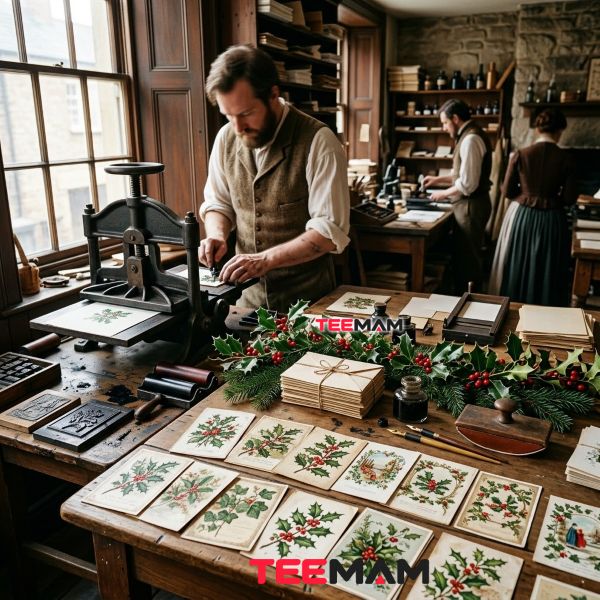
Holly had already been part of European winter decoration for centuries, but the 19th century gave it a much stronger foothold in Christmas imagery specifically. In 1843, civil servant Henry Cole asked the artist John Callcott Horsley to design a Christmas card he could send to the people on his correspondence list. Cole would later become the founding director of the V&A. According to the museum, the printer he commissioned produced a thousand copies of Horsley’s design, which could be personalized with a handwritten greeting, and that card is widely recognized as the first of its kind. Around the same period, postal reforms such as the Uniform Penny Post, together with improvements in printing, made sending seasonal cards increasingly practical and affordable.
From there, the habit spread. As printing techniques improved through the second half of the century, Christmas cards became cheaper and more elaborate, and Victorian illustrators filled them with a now-familiar cast of images. The V&A’s own collection confirms holly’s place in that cast directly: this period established the now-familiar iconography of Christmas, including winter scenes of robins, holly, evergreens, country churches, and snowy landscapes. Holly wasn’t the only motif Victorian card makers used, but it became one of the recurring visual elements associated with the holiday. That’s a large part of what shaped the version of Christmas with holly that still feels familiar today: green leaves, red fruit, and winter greenery appearing again and again in cards, decorations, and later holiday designs.
Holly also turns up repeatedly in Victorian portrayals of Father Christmas himself. The Library of Congress notes that in illustrations from the period, although Father Christmas often wears a hood, it’s common for him to also wear a holly or yew garland on top of it. For more on how that figure took shape, see our piece on the Father Christmas origin story.
From Wreaths and Cards to Modern Holiday Design

That Victorian visual vocabulary never really left. Christmas with holly still reads instantly on a card, a gift tag, a wreath, or a shop window, because the combination of green leaves and red fruit has stayed remarkably consistent for well over a century.
Classic Holly Colors and Patterns
Modern holly styling tends to land in a few recognizable lanes: the classic deep green and red associated with traditional Christmas decorating, softer white and cream palettes for something more understated, and hand-drawn botanical illustrations that lean into the plant’s old-fashioned character rather than smoothing it out.
Wreaths, Cards, and Home Decor
Around the house, holly earns its place in a handful of specific spots: a wreath or garland framing the front door, a few sprigs worked into a table centerpiece, a repeating print on wrapping paper, or a subtle accent in a family photo, like a wreath in the background rather than head-to-toe styling. It also tends to share the frame with other familiar Christmas symbols on cards and wrapping paper, candy canes among them, even though the two come from very different places: one a botanical symbol with centuries of layered meaning, the other a much newer confectionery tradition. If you’re curious how that one developed, the story behind candy canes covers it in more detail.
Holly in Holiday Apparel
Its simple leaf-and-fruit shape also translates naturally into holiday apparel, since it stays recognizable even reduced to a small repeating pattern, which is why it turns up so often on sweaters and matching family sets. Moving the motif from wreaths onto clothing is a fairly natural extension of the same visual habit; for readers who want to explore that side of the tradition, DIY ugly Christmas sweater ideas has practical ways to work holly and other classic Christmas motifs into a design that still feels personal. At TeeMam, we see holly and motifs like it as part of that same visual language, one that has carried seasonal meaning from Victorian parlors all the way to modern holiday tables and closets.
What History Can Confirm About Christmas With Holly
The history of Christmas with holly is easier to understand when documented evidence is separated from later folklore and interpretation. For the fuller picture of how customs like these came together into the holiday recognized now, how Christmas traditions began is a good place to start, since holly is really just one thread in a much longer story.
Several parts of the story are well supported. European holly is an evergreen that produces fruit specifically in winter, which gave it practical value as decoration long before any symbolism was attached. Sources connect holly with Roman Saturnalia and with later accounts of Druidic tradition, although these traditions developed separately rather than as one continuous path. Christian communities subsequently attached religious symbolism to the plant’s leaves, fruit, and evergreen character. And by the Victorian era, Christmas cards were using holly alongside other recurring seasonal motifs, which helped establish the visual language that’s still familiar today.
What’s less certain is any version of the story that claims one group invented the tradition outright. Saying the Druids “invented Christmas holly,” for example, collapses several centuries of cultural change into one unsupported origin story. The more accurate picture is layered: holly was a distinctive winter evergreen, different European traditions gave it symbolic meaning, Christian communities added their own interpretation, and Victorian Christmas imagery turned those associations into a recognizable design tradition.
Holly’s place in Christmas makes more sense once its history is seen as layers rather than one clean story. Christmas with holly began with the practical and symbolic importance of evergreen greenery in winter, gained additional meaning through Christian tradition, and became firmly embedded in modern holiday imagery through Victorian Christmas cards and design. That history explains why the same simple combination of green leaves and red fruit still appears on wreaths, cards, decorations, family photos, and holiday apparel today. Holly may look like a simple Christmas decoration, but its place in the holiday reflects centuries of changing traditions and interpretations.
Questions People Still Ask About Holly at Christmas
Why is holly associated with Christmas? Christmas with holly developed from the plant’s long association with winter greenery, followed by Christian symbolism and Victorian Christmas imagery. Holly’s evergreen leaves and winter fruit made it a natural seasonal decoration, while later traditions gave it additional religious meaning.
What does holly symbolize at Christmas? In Christian tradition, holly’s spiny leaves are said to represent Christ’s crown of thorns and its red fruit his blood, while its evergreen nature is read as a symbol of eternal life. In earlier European customs, it was also associated with protection through the winter months.
Is holly a pagan Christmas symbol? Christmas with holly has connections to pre-Christian winter customs, but modern Christmas holly can’t accurately be described as purely pagan. Roman and European traditions predate Christmas, while Christian communities later gave holly additional religious symbolism.
What is the difference between holly and mistletoe? Holly has spiny green leaves and red fruit and carries Christian symbolism and older protective folklore. Mistletoe has pale, waxy leaves and white berries and is known today mainly for the custom of kissing beneath it.
When did holly become a popular Christmas decoration? Holly had been used in European winter customs for centuries, but the Victorian era played an important role in strengthening its association with Christmas specifically, as Henry Cole’s 1843 Christmas card helped launch a tradition that illustrators filled with recurring seasonal motifs, holly among them.
Why are holly leaves green and berries red in Christmas decorations? That’s simply the plant’s natural look. English holly (Ilex aquifolium) keeps its glossy green leaves through winter and produces bright red fruit around the same season, and that natural contrast is exactly what made it so useful for winter decoration and, later, for Victorian card printing.
Why do people use holly on Christmas wreaths? Holly’s evergreen leaves and vivid fruit made it a practical, eye-catching choice for winter greenery before the modern Christmas wreath became a familiar holiday decoration, and its later Christian symbolism and long decorative history helped the association endure.

Hi, I’m Olivia Bennett, a fashion and lifestyle writer at TeeMam with 6 years of experience creating content about fashion, outfits, and lifestyle trends. I enjoy sharing practical style ideas for everyday wear, game days, holidays, and special occasions, helping readers find looks that feel comfortable, fun, and uniquely their own.