Candy Cane Lane Christmas Lights and the Sweet History Behind Them
There’s a particular kind of quiet that falls over a neighborhood once the lights go up. Porches glow red and white, kids press their noses to car windows, and somewhere in a coat pocket there’s a candy cane slowly going soft from body heat.
Every December, families go looking for candy cane lane christmas lights, and the search usually means one of two things: a specific street with a decades-long reputation for its display, or any nearby block that’s gone all-in on red-and-white decorations for the season. For many families, candy cane lane christmas lights are less about finding one perfect house and more about experiencing a neighborhood that’s turned Christmas decorating into a shared, walkable event.
But before candy canes were something you strolled past under string lights, they were a plain sugar stick with a murkier backstory than most articles let on. This piece separates what’s documented from what’s folklore, and gets into how a small striped candy ended up naming entire neighborhoods.
What Is a Candy Cane, and Why Christmas?

A candy cane is a hard sugar candy shaped like a shepherd’s crook, traditionally white with red spiral stripes and flavored with peppermint. It became part of the season’s visual culture over the 19th and 20th centuries, first as a Christmas tree ornament and later as a mass-produced holiday confection sold mostly in the weeks around the holiday. That same red-and-white identity is exactly what later gave neighborhood candy cane lane christmas lights displays their name.
Peppermint is the flavor most people picture, though wintergreen, cinnamon, and fruit versions exist too. Once peppermint became the dominant flavor around the turn of the 20th century, the candy tied itself even more tightly to a season already associated with mint, evergreen, and cold weather. For the fuller picture of how these seasonal customs layered on top of each other, our guide to explore Christmas history and origins walks through that broader timeline.
Where Did the Candy Cane Tradition Begin?

The most famous origin story dates to 1670 in Cologne, Germany, where a choirmaster is said to have handed children bent sugar sticks during a Living Crèche ceremony, shaping them like shepherds’ crooks. It’s the story the National Confectioners Association repeats, and it’s also, by most food historians’ own admission, unverifiable. No contemporary written record from 1670 confirms the choirmaster, the date, or the event. Food historian Susan Benjamin of True Treats Historic Candy has said the cane shape more likely emerged gradually among German confectioners in the 17th century as pulled-sugar sticks grew popular, rather than through one documented moment.
What’s better documented: early candy sticks were straight, plain white, with no stripes and no peppermint, and hanging sweets on Christmas trees was already a German custom by the 18th century. America’s introduction to the candy cane is often traced to August Imgard, a German immigrant credited with decorating a Christmas tree in Wooster, Ohio, in 1847 with candy canes, per the National Confectioners Association. The record is genuinely mixed, though: a 1938 newspaper account of a ceremony honoring Imgard, attended by his descendants, described the tree’s ornaments as paper chains and kuchen, a German cake, not candy canes, according to Smithsonian Magazine. So while 1847 is the date most cited, what actually hung on that tree is less settled than the popular version suggests.
No one is documented as inventing the red stripe, either. Christmas cards from before 1900 generally show plain white candy sticks; cards from after 1900 begin showing the red-and-white striped version. Sometime around the turn of the century, American confectioners settled on stripes and peppermint as the standard, with no recorded inventor or reason why. That long, quietly evolving history is part of why the pattern eventually moved beyond the tree and into candy cane lane christmas lights, lawn decorations, and entire neighborhood displays.
How Manufacturing Turned a Treat Into an Industry
For most of the candy cane’s early life, someone bent each one by hand while the sugar was still warm, which limited output. That changed thanks to Bob McCormack, who’d run a candy company in Albany, Georgia, since 1919. In the 1950s, his brother-in-law, a priest named Father Gregory Harding Keller, built a machine that automated forming the candy’s curved end, later patented in 1960 as the Keller Machine, according to CBS News. Automation scaled output from thousands of handmade pieces to millions a day, and McCormack’s business, later Bobs Candies, became one of the world’s leading candy cane manufacturers. Neither man “invented” the candy cane the way the Cologne legend implies; they turned a regional handmade treat into an industrial one, which is arguably the better-documented, more consequential part of the story.
That industrial-scale production is also what made candy canes cheap and plentiful enough to eventually show up by the hundreds in yard displays, the same ones that give candy cane lane christmas lights their scale today.
What Do the Red and White Stripes Mean?
There’s a well-known Christian reading of the colors: white for purity, red for the blood of Christ. There’s also the claim that the hook stands for the letter J, for Jesus. Both are meaningful to people who hold them, but the historical record doesn’t show either as the documented reason behind the candy’s original shape or colors; they appear to have been added well after white, and later striped, candy canes already existed. The hook is more plausibly tied to a shepherd’s-crook motif, or just as likely to the practical need to hang the candy from a tree branch.
| Popular Claim | What History Supports |
|---|---|
| The candy cane was created as a Christian symbol | No 17th-century evidence supports this |
| The hook represents the letter J for Jesus | A modern interpretation, not documented original intent |
| Stripes were originally religious symbolism | Stripes appear on cards only after 1900, with no rationale recorded at the time |
| Peppermint was part of the earliest canes | Not supported; early sugar sticks were plain and unflavored |
None of this makes the religious reading meaningless to people who use it today. It means the symbolism was attached after the shape and coloring already existed, which is a different claim than saying it explains the origin.
Candy Cane Lane Christmas Lights: From Neighborhood Tradition to Holiday Attraction
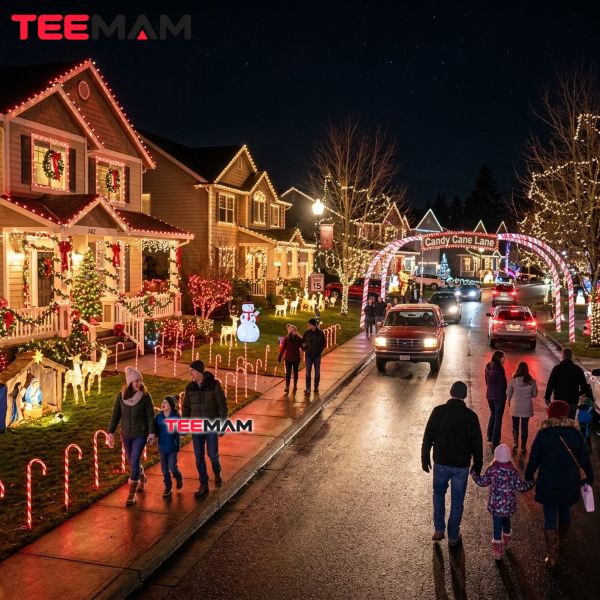
Somewhere along the way, the candy cane got yard-sized. Candy cane lane christmas lights aren’t tied to one national attraction; the phrase can describe a specific, long-running neighborhood event with its own name, or it can be used generally for any street where several homes coordinate red-and-white lights and candy cane décor.
What Is Candy Cane Lane?
There is no single, official Candy Cane Lane in the United States. In some cities it’s a proper name for a specific street or event; in others it’s just a nickname locals use for whichever block goes all-in on the theme that year. Many are run informally by neighbors, some are organized around a charity, and the experience can mean walking, driving, or both, depending entirely on the neighborhood.
Is Candy Cane Lane a Real Place?
Sometimes, yes, quite literally. In Woodland Hills, California, residents near Oxnard Street and Lubao Avenue have decorated their block since 1952; the display now spans about eight square blocks, with posted viewing hours (10 p.m. weeknights, 11 p.m. weekends) to keep the neighborhood livable. In West Allis, Wisconsin, streets between 92nd and 96th have run their own Candy Cane Lane since the mid-1980s, when a few neighbors started dressing as Santa and handing out candy canes; it’s since grown to more than 300 participating homes and raised millions of dollars for a children’s cancer charity along the way. Neither is “the” original. They’re two of several established, independently run traditions that happen to share a name.
Why “Candy Cane Lane”?
The name usually comes from the visual theme, not the candy itself. When homeowners line yards with oversized candy cane stakes or repeat that same peppermint color scheme across several houses, the street tends to earn the nickname on its own, sometimes formally and sometimes by word of mouth. In Woodland Hills and West Allis, the name became part of the neighborhood’s identity, and in West Allis’s case, its fundraising brand. It’s a similar pattern to how other Christmas customs got their names and rules; the Naughty or Nice List origin is a good example of a tradition that grew the same informal, word-of-mouth way.
Finding Candy Cane Lane Christmas Lights Near You

Candy cane lane christmas lights turn up in different communities, and the experience varies widely: some are a few blocks of neighbors quietly coordinating, others have run as established attractions for 40 years with posted hours or donation points. There’s no single nationwide Candy Cane Lane, so the name can point to a completely different neighborhood depending on the city, which is exactly why local sources work better than a generic search: city holiday calendars, neighborhood association pages, tourism sites, and community social media groups.
What to Expect, and Walk or Drive?
A typical candy cane lane christmas lights display includes oversized candy canes, wrapped trees, illuminated arches, and coordinated lawns, with families out taking photos on the sidewalk. Woodland Hills is built around a slow drive-through; West Allis is walkable or drivable, with a donation point for its charity. Either way, these are private homes, not public parks, so it’s worth keeping noise down, staying off lawns, and respecting posted hours or “no photos” signs.
Before heading out, check the display’s posted hours if it has any, since arriving during the busiest stretch can turn a short walk into a long wait for parking. Dress for the outdoor cold rather than the car ride, and bring a little cash if the neighborhood collects donations for a cause, as several long-running candy cane lanes do.
The Candy Cane Aesthetic Beyond the Candy

Candy cane stripes have become a visual shorthand for Christmas well outside anywhere the actual candy is sold, from wrapping paper and string lights to coffee cups. Red and white together reads as “Christmas” almost as fast as green and red do, which is part of why the same pattern that decorates candy cane lane christmas lights also shows up on ornaments and holiday apparel.
Striped scarves, sweaters, and pajama sets built around the pattern show up everywhere from office parties to family photos by the tree. At TeeMam, we see holiday apparel as part of the celebration itself. A red-and-white sweater or festive pajama set fits naturally into family photos, parties, and an evening spent looking at neighborhood lights, and if you’re putting a look together this year, you can find festive Christmas apparel built around that same seasonal styling.
Fun Ways to Bring the Tradition Home
Paper candy canes or a garland strung from mini candy canes are simple enough for kids to help with, and none of it needs to look store-bought to feel festive. A candy cane theme also works for a low-key Christmas evening: wear something striped, make peppermint hot chocolate, walk a local light display, and save the family photos for the brightest stretch of the route.
For a party, a candy cane tasting table or a photo corner built around a striped backdrop are low-cost ways to add a theme. The striped pattern also fits neatly into the deliberately over-the-top world of ugly Christmas sweaters, and there’s no shortage of ways to lean into it if you’d rather browse playful ugly sweater ideas than go the classic route. If the group leans toward jokes over crafts, you can add humor to Christmas celebrations if you want a few ready to go.
What We Know, and What We Can Still Enjoy
The modern candy cane developed gradually rather than being invented by one documented person; its shape, stripes, flavor, and mass-production methods each appeared at different points across roughly 250 years.
What we know: plain sugar sticks were a German Christmas tree decoration by the 18th century. The red-and-white, peppermint version emerged gradually in the U.S. around 1900. Father Keller’s machine automated the difficult bending step in the 1950s and made large-scale candy cane production far more practical. HISTORY has cited an estimate of roughly 1.76 billion candy canes produced annually in the United States, with most sales concentrated between Thanksgiving and Christmas, according to HISTORY.
What remains uncertain: no single inventor is documented, the “J for Jesus” reading has no paper trail, the religious meaning attached to the stripes came after the pattern already existed, and what exactly decorated Imgard’s 1847 tree is less settled than most retellings suggest.
Why it matters anyway: none of that uncertainty makes the candy cane feel less like Christmas. It still works as an ornament, a stocking gift, a lawn decoration, and a decent excuse to put on a striped sweater and go stand outside in the cold looking at lights with people you like.
Questions Christmas Shoppers and Families Often Ask
Who Invented the Candy Cane?
No single person is credited. The cane shape likely developed gradually among German confectioners in the 17th century, while Bob McCormack built one of the first major U.S. candy cane companies, and his brother-in-law, Father Gregory Keller, later invented the machine that made mass production possible.
When Did It Become a Christmas Tradition?
Candy sticks were a German tree decoration by the 1700s, and Imgard’s 1847 tree is often cited as the earliest documented American appearance. By the early 1900s, the red-and-white, peppermint version had become standard in American Christmas celebrations.
Why Are Candy Canes Red and White?
No single documented reason. Cards show plain white canes before 1900 and striped ones after, suggesting the pattern caught on around the turn of the century without a recorded inventor.
Does It Have a Religious Meaning?
Many interpret white as purity and red as Christ’s blood, and the hook as a shepherd’s crook or the letter J. These are meaningful, widely held readings, but not the documented reason for the candy’s original shape or colors.
What Is a Candy Cane Lane?
It has two common uses: the established name of a specific Christmas light neighborhood or charity event, like the long-running displays in Woodland Hills, California, or West Allis, Wisconsin, or an informal nickname for any street where homes coordinate candy cane décor. That’s why a search for candy cane lane christmas lights can turn up very different local experiences depending on where you live.
How Can I Find One Near Me?
If you’re looking for candy cane lane christmas lights near you, start with local holiday event calendars, neighborhood association pages, tourism sites, and community social media groups, since most displays are organized locally rather than tracked in one national directory.
From a Simple Candy to a Lasting Christmas Tradition
The candy cane’s history is less tidy than the familiar Cologne Cathedral story suggests. What can actually be traced is a gradual evolution: plain sugar sticks, a slow shift to red-and-white peppermint candy around 1900, mass production once the Keller Machine made automation possible in the 1950s, and, eventually, decorations, apparel, and entire neighborhoods that built a tradition, and sometimes a charity, around the name. Every walk down a candy cane lane christmas lights display is really just the newest chapter of a tradition that’s been reshaping itself for well over a century.
What part of the candy cane tradition feels most like Christmas to you: the sweet treat, the decorations, or the lights?

Hi, I’m Olivia Bennett, a fashion and lifestyle writer at TeeMam with 6 years of experience creating content about fashion, outfits, and lifestyle trends. I enjoy sharing practical style ideas for everyday wear, game days, holidays, and special occasions, helping readers find looks that feel comfortable, fun, and uniquely their own.