Father Christmas and the North Pole: Where the Legend Comes From
Why Does Father Christmas Live at the North Pole?
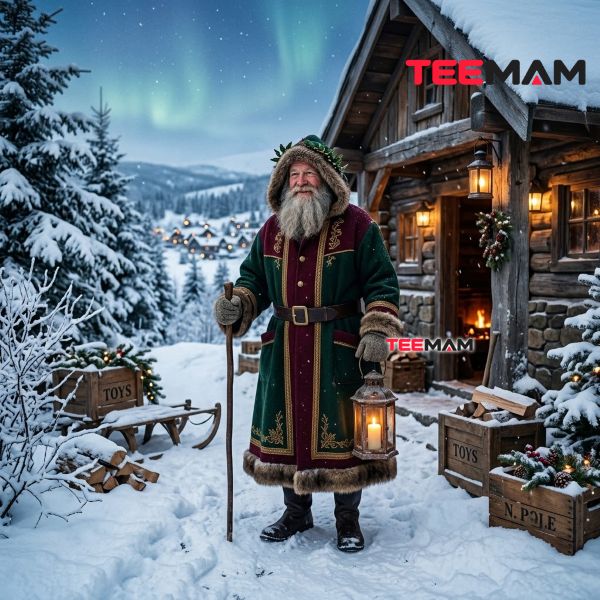
Picture the modern Santa: red suit, reindeer, a sleigh cutting across the sky, and a workshop somewhere in the frozen north. It’s such a fixed image that most of us never stop to ask where any of it came from. But Father Christmas and the North Pole weren’t always connected. The earliest English Father Christmas wasn’t a gift-giver hurrying down chimneys with a toy sack. He was closer to a personification of the Christmas season itself, the kind of figure who presided over a feast rather than ran a workshop.
So how did a British holiday spirit end up with a home at the top of the world? That’s the real story behind the North Pole Father Christmas legend. The modern Santa Claus emerged from several traditions that developed at different times and places, including Saint Nicholas, Dutch Sinterklaas, English Father Christmas, and 19th-century American literature and illustration, and the North Pole was one of the last pieces to click into place.
Who Was the Original Father Christmas?
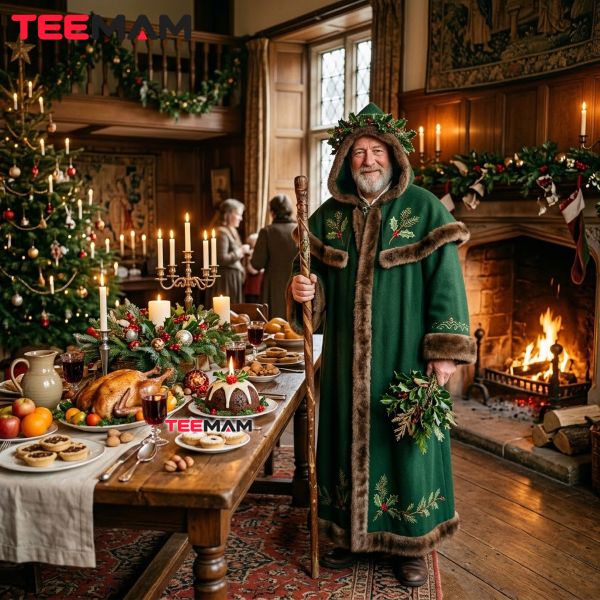
Long before he delivered presents to sleeping children, Father Christmas represented the spirit of the season in English tradition: hospitality, feasting, and the return of light in the darkest part of the year. He was more closely tied to adult celebration than to child-focused gift giving, and his appearance varied widely across periods and illustrations: green or fur-trimmed robes, holly, winter greenery, and a general sense of warmth pushing back against the cold. Those workshop, elf, and North Pole elements belong to the later American Santa tradition rather than the older English Father Christmas tradition. They’re part of a North Pole Father Christmas story that, at this point, hadn’t been written yet.
Father Christmas never had one official color. Green shows up often in older illustrations because it fits naturally with holly, ivy, and other evergreens long tied to British Christmas custom. English Heritage’s history of Christmas greenery traces this tradition back to medieval church records, though the specifics have always varied by region and era. It’s a mistake to assume he “always” wore green the way modern Santa always wears red; his look shifted from illustrator to illustrator well before the North Pole Father Christmas costume we picture today became standard.
For more on how these older symbols developed, our Christmas origins and history guide goes deeper into where they came from.
When Did Father Christmas Become Associated With Santa Claus?
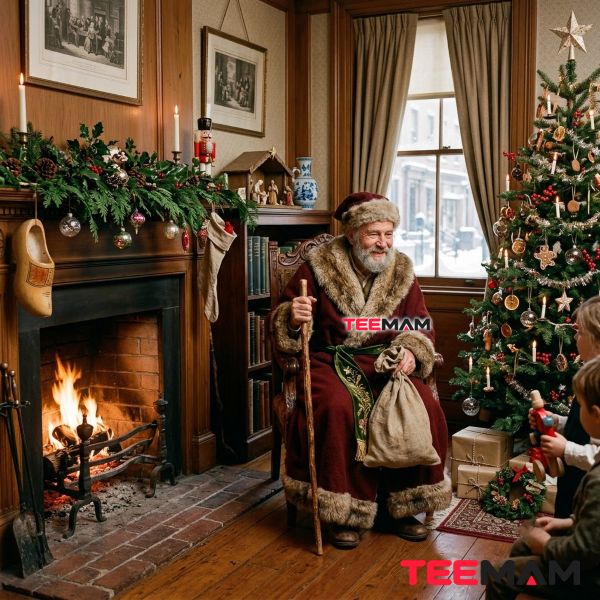
The story shifts with Saint Nicholas, a historical fourth-century bishop of Myra, in what is now Turkey, whose later legends became tied to generosity and gift giving. In the Netherlands, traditions surrounding Saint Nicholas developed into the figure known as Sinterklaas, a December gift-giver whose customs crossed the Atlantic with Dutch settlers to New Amsterdam. The Library of Congress’s account of 19th-century Santa Claus print describes Santa Claus as an amalgamation of Father Christmas from England, Kris Kringle from Germany, the Julenisse from Scandinavia, and Sinterklaas from the Netherlands, several separate traditions that began converging in 19th-century America.
New York became an important place where several of these traditions began to converge. Washington Irving’s satirical A History of New York helped popularize Saint Nicholas as a patron figure of the city, and Clement Clarke Moore’s 1823 poem “A Visit from St. Nicholas” helped popularize the sleigh, the eight reindeer, and the jolly gift-giving image later associated with Santa. Around the same time, Victorian Britain was reshaping Christmas into a warmer, family-centered holiday. Charles Dickens’s A Christmas Carol (1843) is the best-known example, and it helped cement an image of Christmas built around generosity and gathering rather than strict religious observance. By century’s end, Santa had become a cheerful visitor who brought toys to children, rather than a figure tied strictly to Saint Nicholas’s religious traditions.
How Did the North Pole Become Santa’s Home?
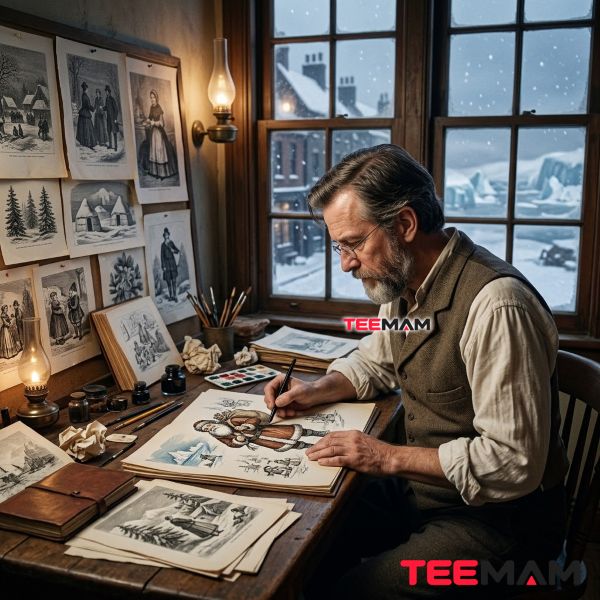
The North Pole became associated with Santa Claus during the 19th-century development of American Santa imagery. It wasn’t part of the original English Father Christmas, nor of the earliest Saint Nicholas or Sinterklaas traditions. The modern North Pole Father Christmas image is an American addition, and one artist is credited with putting it on the map: Thomas Nast, a political cartoonist for Harper’s Weekly.
Nast’s first major Santa image for Harper’s Weekly appeared in the issue dated January 3, 1863, depicting Santa visiting Union troops during the 1862 Christmas season, according to the Metropolitan Museum of Art. Over the following decades he returned to the character again and again, and it was across these later illustrations that a workshop, helper elves, a behavior ledger, and a home in the far north all began appearing. The Delaware Art Museum credits Nast’s illustrations with the first known references to Santa living at the North Pole and keeping a toy workshop.
It’s worth not overstating his role. Nast didn’t invent Santa from nothing, and he leaned on Moore’s poem and the Saint Nicholas and Germanic folk imagery he grew up with in Germany. What he did was give the character a consistent visual identity that stuck, laying the groundwork for the North Pole Father Christmas imagery families still recognize.
Why the North Pole specifically? Nast was working at a time when Arctic exploration was attracting considerable public attention in the U.S. and Europe; expeditions toward the pole made regular headlines, and large parts of the Arctic remained difficult for the public to access and poorly understood. It was a place people talked about constantly but knew almost nothing about firsthand: cold, distant, unmapped, essentially mythic in the popular imagination.
The choice also fit the mood of the emerging Santa story. It was remote, difficult to reach, and mysterious enough to place Santa outside the ordinary world. A workshop tucked somewhere unreachable protects the mystery of Christmas morning in a way a workshop in, say, upstate New York never could.
Father Christmas vs. Santa Claus: What Is the Difference?
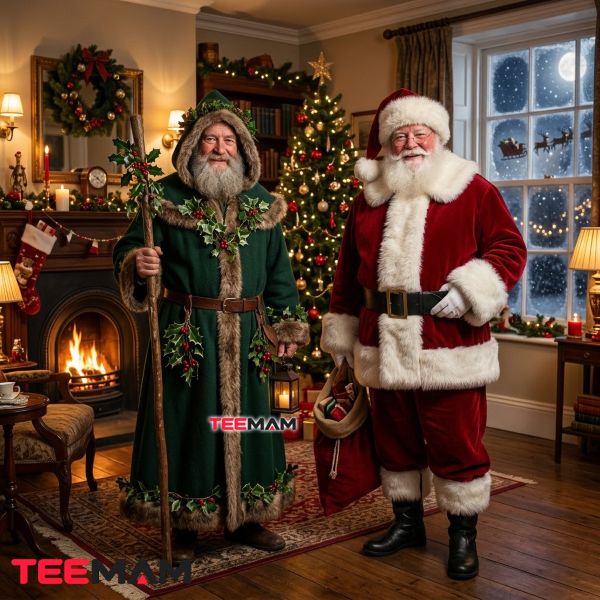
| Feature | Father Christmas | Santa Claus |
|---|---|---|
| Cultural roots | British | American, shaped by several European traditions |
| Early role | Personification of the Christmas season | Gift-giving figure for children |
| Traditional imagery | Green or varied robes, holly | Red suit, sleigh, reindeer |
| North Pole connection | Later association | Major feature of modern Santa mythology |
| Modern identity | Often used interchangeably with Santa | Global Christmas icon |
The North Pole Father Christmas merge wasn’t a single event; it was a slow convergence across the Victorian era, driven by illustrated books, greeting cards, and mass media crossing the Atlantic both ways. By the 20th century, Father Christmas and Santa Claus were increasingly treated as versions of the same figure in popular culture, though the name “Father Christmas” has remained especially common in Britain. The two names still carry genuinely different histories.
Common Santa Myths vs. What the Historical Record Shows
Christmas folklore tends to flatten a complicated history into one tidy story. Set side by side, the popular version of the North Pole Father Christmas legend and the historical record don’t always match:
| Popular belief | Historical record |
|---|---|
| Father Christmas always wore green | His appearance varied widely across periods and illustrations |
| Thomas Nast invented Santa Claus | Nast shaped the American visual identity, building on earlier traditions |
| Santa has always lived at the North Pole | The North Pole link developed in the 19th century and was strongly reinforced by Nast’s illustrations |
| Coca-Cola invented the red Santa suit | Red Santa imagery predates Coca-Cola’s first Santa ad by decades |
Why Is Santa Usually Red Today?
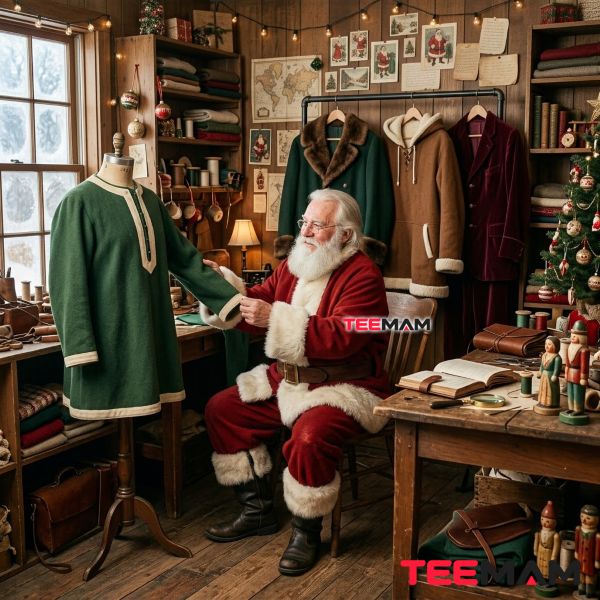
Father Christmas wasn’t always red. Illustrations from the 1800s show him and early Santa figures in red, green, brown, and other tones, with no fixed uniform until American illustration gradually standardized the North Pole Father Christmas look we know today.
The Coca-Cola myth is one of the most repeated Christmas claims, and it doesn’t hold up. Red Santa imagery existed decades before Coca-Cola’s first major Santa campaign; Nast’s later illustrations already included Santa in red, while Haddon Sundblom’s Coca-Cola Santa debuted in 1931. Coca-Cola helped popularize that now-familiar red-and-white version, but the company did not invent the red suit or the Santa Claus legend. Coca-Cola’s own historical materials confirm this directly: the company didn’t invent the idea of a red-suited Santa, though the color happened to suit its branding.
How the North Pole Legend Became Part of Modern Christmas
Once the North Pole workshop became part of Santa’s imagery, later storytellers had a ready-made setting to build on. Elves, letters to Santa, and novelty North Pole postmarks could all fit naturally around that fictional home, reinforcing the North Pole Father Christmas mythology families know today. A simplified way to visualize the story: Saint Nicholas traditions, Sinterklaas, English Father Christmas, and 19th-century American literature and illustration all fed into the modern Santa Claus, and Thomas Nast’s illustrations then helped make the North Pole, toy workshop, and other familiar imagery part of that mythology.
Nast’s illustrations also included a ledger tracking children’s behavior, an idea that fit naturally with older moral traditions tied to Saint Nicholas. We’ve traced that thread further in our piece on naughty-or-nice list origins. Nast also drew on German folk imagery of elves, helping connect those figures with the emerging American Santa tradition; later Christmas stories turned elves into lasting fixtures of the North Pole Father Christmas mythology. Our guide to the history of Elf on the Shelf picks up where that idea led next.
How Families Can Bring the North Pole Story Into Christmas
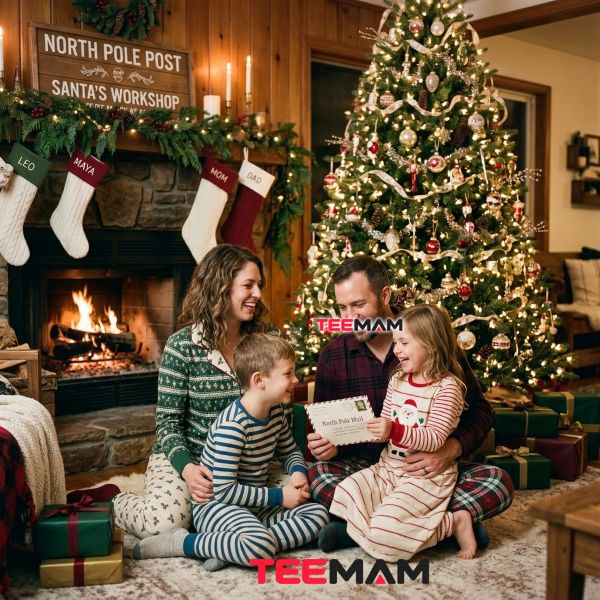
Knowing where these traditions came from is one thing. Using that history to make your own celebration feel a little richer is another. A vintage look translates well into a modern home: forest green, burgundy, cream, and gold instead of the standard red-and-white palette, paired with natural wood and holly rather than a polished 20th-century look.
This is also where vintage-inspired imagery works its way naturally into what a family wears: old-fashioned Father Christmas graphics, North Pole postmark motifs, matching pieces that feel more like a keepsake than a costume. At TeeMam, we approach seasonal apparel as a way to turn familiar holiday stories and vintage-inspired imagery into something families can enjoy wearing together, whether that’s cozy Christmas Eve pajamas or graphic tees that nod to Santa’s older, greener look.
A few easy ways to bring the legend home: tell kids both versions of the story side by side, make a homemade “North Pole” postmark for outgoing letters, and use creative Secret Santa ideas to make the gift exchange part of the tradition.
Key Facts About the Father Christmas and North Pole Legend
- Father Christmas began as a British personification of the Christmas season, not a gift-giving character.
- Santa Claus developed through the convergence of Saint Nicholas traditions, Sinterklaas, Father Christmas, other European folklore, and 19th-century American storytelling and illustration.
- Thomas Nast’s 19th-century illustrations provided some of the earliest known references to Santa living at the North Pole, helping establish the setting as a major part of American Santa mythology, at a time when large parts of the Arctic remained difficult for the public to access and poorly understood.
- Today’s North Pole Father Christmas figure is a composite, shaped across countries and centuries rather than invented whole by one person or company.
Common Questions About Father Christmas and the North Pole
Is Father Christmas the same as Santa Claus? In modern usage, most people treat the names as interchangeable. Historically they came from different traditions: Father Christmas from British folk culture, Santa Claus from a blend of Saint Nicholas, Sinterklaas, and American illustration.
Why does Father Christmas live at the North Pole? The North Pole Father Christmas connection comes from 19th-century American Santa illustrations, particularly Thomas Nast’s, not from the earliest English legend. It stuck because a remote, largely unmapped location fit the magical character being built around him.
When did the North Pole become Santa’s home? The idea took shape gradually across Nast’s Harper’s Weekly illustrations between the 1860s and 1880s, when the North Pole remained a remote and mysterious place in the public imagination.
Did Thomas Nast create the North Pole Santa? He shaped it more than invented it, building on Moore’s poem and earlier Saint Nicholas imagery rather than starting from scratch.
Was Father Christmas always green? No, green was a recurring choice tied to winter greenery, not a fixed rule. Older illustrations show a range of colors.
Did Coca-Cola create the modern Santa Claus? No. The red-suited Santa predates Coca-Cola’s first ad by decades; the company popularized an existing image starting in 1931.
A Legend That Keeps Evolving
Trace the story back far enough and modern Santa looks less like a single invention than a character assembled over centuries. English Father Christmas traditions, European Saint Nicholas customs, Victorian storytelling, and American illustration all contributed to the figure families recognize today. The North Pole gave that character a fictional home, and it stuck because it kept him just outside the reach of ordinary geography.
What keeps the North Pole Father Christmas story alive isn’t historical precision. It’s how easily each generation reshapes it. A vintage green-robed Father Christmas and a red-suited North Pole Santa are really just two chapters of the same tale, and most families end up blending both without ever noticing. Which version feels more magical to your family: the older Father Christmas, or the North Pole Santa everyone grew up with?

Hi, I’m Olivia Bennett, a fashion and lifestyle writer at TeeMam with 6 years of experience creating content about fashion, outfits, and lifestyle trends. I enjoy sharing practical style ideas for everyday wear, game days, holidays, and special occasions, helping readers find looks that feel comfortable, fun, and uniquely their own.