The Mistletoe Tradition: Why We Kiss Under It at Christmas
There’s a particular kind of hush that falls over a room the moment two people realize they’re standing under the same little sprig of green leaves and white berries. Someone laughs, someone blushes, and a holiday party turns, for a few seconds, into something out of an old story. There isn’t a single moment when mistletoe suddenly became a Christmas mistletoe kissing tradition. Older European beliefs about the plant came first, a Norse myth added another layer, and English writers only began recording the kissing custom itself centuries later. The full picture is messier than the version most people repeat at parties, and more interesting for it.
What Is the Christmas Mistletoe Tradition?

The Christmas mistletoe tradition is a holiday custom in which people kiss when they find themselves standing beneath a hanging sprig of mistletoe. The plant’s older symbolism, tied to fertility, healing, and winter vitality, comes from European folklore, while the specific kissing custom is documented in England from the 1780s and later became popular in the United States through 19th-century writing.
Mistletoe itself is an evergreen parasitic plant that grows in rounded clumps on the branches of host trees, staying green through the coldest months even as its host goes bare. The species most closely tied to the European custom is European mistletoe, Viscum album; in the United States, the plant sold at Christmas markets is more often American mistletoe, Phoradendron leucarpum, a similar-looking relative native to the eastern and southern states, according to University of Illinois Extension.
It helps to separate two things that often get blurred together: the older symbolism attached to mistletoe, and the specific modern habit of kissing beneath it at Christmas. Those are different layers of the same tradition, and standing under a sprig today doesn’t come with any real obligation. It’s a lighthearted holiday custom, not a rule.
Where Did the Mistletoe Tradition Come From?
Celtic and Druid Connections: Why Was Mistletoe Sacred?

Long before Christmas trees or stockings existed, mistletoe already held a special place in European folklore. The Roman writer Pliny the Elder described how Druids in Gaul ceremonially harvested mistletoe whenever they found it growing on oak, a tree they revered. Nineteenth-century antiquarians later read this account as evidence that the same rituals had taken place in Britain, and at Christmastime specifically, but Pliny himself mentioned neither Britain nor the season, according to English Heritage’s history of Christmas greenery. That gap between what Pliny actually wrote and how later writers used his account is worth keeping in mind any time a “Druids invented mistletoe kissing” claim shows up online.
What the ritual doesn’t include, in any version, is a kiss. Because mistletoe stayed green and bore fruit while its host tree stood bare, it read to early observers as a small act of defiance against winter, which is likely why it carried associations with vitality and fertility for centuries before anyone attached romance to it. For readers curious how this fits into the wider season, the history behind Christmas traces how customs like this one accumulated over time.
The Norse Myth of Baldur and Frigg
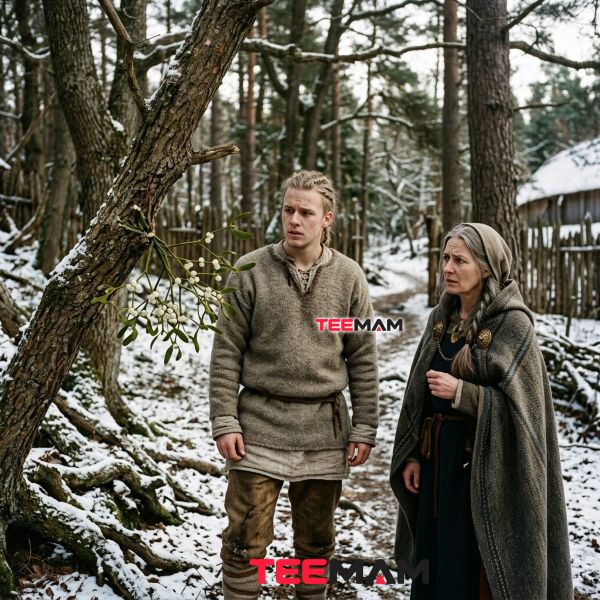
If mistletoe has one origin story people actually tell each other at parties, it’s this one. In Norse mythology, Baldur, son of the goddess Frigg, began having premonitions of his own death. In the familiar retelling, Frigg sought to protect him by asking every living thing on earth not to cause him harm. One plant was overlooked: mistletoe, since it grew not from the ground but from the branches of a tree, and so had never been asked to make the promise.
Loki, the trickster god, discovered the gap. He fashioned a dart from mistletoe and guided the hand of Baldur’s blind brother, Hodr, so the dart struck and killed him. According to Dr. Johnathan Dalzell, a plant-parasite researcher at Queen’s University Belfast, the myth scatters into several versions after Baldur’s death: some describe Frigg’s tears becoming the plant’s white berries, and describe her later declaring mistletoe a symbol of love rather than grief.
The Baldur story explains why later retellings connect mistletoe with love, but the myth itself doesn’t document a holiday kissing custom. It’s Norse legend, and there’s genuine debate over whether the romantic ending reflects an authentic Norse belief or a later, more romanticized addition.
How Mistletoe Became Part of English Christmas

The written trail for mistletoe’s Christmas connection is easier to date than the folklore, even if it explains less about how the custom actually began. Poet Robert Herrick is the earliest known writer to link mistletoe directly with Christmas, in his 17th-century poem describing greenery, rosemary, bay leaves, and mistletoe among them, taken down at the end of the season. What isn’t clear, per English Heritage, is whether that association started with Herrick’s generation or simply went unrecorded earlier.
Separately, English households had long hung “kissing boughs,” rounded frames covered in greenery, apples, ribbons, and mistletoe, as a gesture of goodwill toward visitors. Kissing boughs are often considered to have been popular by the Tudor period, though exactly when they were first introduced isn’t certain, and by the Georgian era they had grown noticeably more elaborate. The specific rule tied to mistletoe kissing traveled with the bough: a gentleman could pluck a berry from it with each kiss, and once the berries ran out, so did the privilege. The kissing custom under mistletoe specifically is thought to have first been recorded in an English comic opera from 1784. By the early 1800s, American author Washington Irving described the custom during a stay at an English country house, writing that young men had “the privilege of kissing the girls under it, plucking each time a berry from the bush,” a privilege that ceased once the berries were gone. Irving’s account is widely credited with popularizing the custom in the United States, and by 1837 it was familiar enough to appear in Charles Dickens’s The Pickwick Papers, illustrated with a scene of Mr. Pickwick kissing a lady under a mistletoe bough.
What History Can and Cannot Tell Us About Mistletoe
| What we know | What remains uncertain |
|---|---|
| Pliny the Elder described Druids in Gaul harvesting mistletoe from oak | He never mentioned Britain or Christmas in that account |
| Robert Herrick linked mistletoe with Christmas greenery in the 1600s | Whether that link began with him or was simply unrecorded earlier |
| Kissing boughs were popular English decorations by the Tudor period | The exact date they were first introduced isn’t documented |
| Mistletoe kissing appears in English writing from 1784 | The precise moment the custom began remains unknown |
| Washington Irving described the practice in England around 1820 | He popularized it in America; he didn’t invent it |
A Quick Timeline of the Mistletoe Tradition
| Period | Mistletoe’s Role |
|---|---|
| Ancient and classical Europe | Sacred plant tied to Celtic ritual, described by Pliny the Elder |
| Norse mythology | Central to the Baldur and Frigg legend |
| 17th-century England | First known written link to Christmas greenery, via Robert Herrick |
| Tudor to Georgian England | Woven into kissing boughs hung for the holidays |
| 1784 | Earliest known English reference to mistletoe kissing specifically |
| Early 1800s | Popularized in the US through Washington Irving’s writing |
| Today | Decoration, party tradition, humor, and holiday apparel |
Why Do We Kiss Under the Mistletoe?
By the time kissing under mistletoe became an established Christmas custom, the plant was carrying several older associations at once: fertility, vitality, protection, and eventually romance and goodwill. None of those associations, on their own, fully explains why a kiss became the specific gesture. What’s clearer is the sequence: older reverence for mistletoe came first, documented in Celtic and Norse tradition, and the specific, recognizable “stand under it, get kissed” custom developed centuries later in England, only crossing the Atlantic afterward with figures like Washington Irving. So when someone calls mistletoe kissing a thousands-of-years-old tradition, the more accurate version is that the plant’s symbolism is ancient, while the kissing custom built on top of it is closer to two or three hundred years old.
What Were the Traditional Rules of a Mistletoe Kiss?
Did You Have to Kiss Someone Under Mistletoe?
Earlier versions of the custom carried an expectation that doesn’t sit well with modern norms: a young man was traditionally permitted to kiss a woman caught standing beneath the mistletoe, with refusal sometimes treated as inviting bad luck. That framing belongs to its own era. A better way to carry the tradition forward is simpler: it historically offered an opportunity for a kiss, and a good modern version treats a kiss as something both people actually want, not something one person is owed.
What Happens When the Mistletoe Berries Are Gone?
The traditional rule wasn’t just “stand under it and kiss.” Each kiss came with plucking a single white berry from the sprig, and once every berry was gone, the kissing privilege for that particular bough ended, per both English Heritage’s account of Georgian kissing boughs and Washington Irving’s own description of the custom. It turned a piece of decoration into a built-in, self-limiting party game, which is part of why a full, berry-heavy sprig was so prized for holiday gatherings.
How Mistletoe Became a Christmas Decoration
By the 18th century, mistletoe was firmly part of English Christmas greenery, first as an ingredient in the larger kissing bough, and eventually as the simpler standalone sprig most people associate with Christmas mistletoe today, tied with ribbon and hung above a doorway or mantel. Many modern homes use artificial mistletoe instead of fresh cuttings. Some mistletoe species carry compounds that can cause illness if eaten, and European mistletoe is generally considered more toxic than the American species commonly sold in the US; exposure studies on American mistletoe have found that most cases involving a few berries or leaves produced no serious symptoms, but keeping fresh sprigs away from children and pets is still the safer default, according to Illinois Extension’s review of the research. The plant is one of several evergreens, alongside holly, pine, and the poinsettia, that carry their own layered symbolism; the poinsettia followed a very different path into Christmas culture, one explored in the meaning behind the poinsettia.
How Americans Celebrate the Mistletoe Tradition Today

Mistletoe at Christmas Parties
In the US, Christmas mistletoe shows up wherever families and friends gather for the holidays: hung in a doorway at a family dinner, dangled over the punch bowl at an office party, or used as a prop when couples pose for photos by the tree. It’s rarely a serious ritual anymore, more of a shared joke everyone is in on, a small, low-stakes excuse for affection during the holiday season.
Mistletoe in Christmas Humor and Pop Culture
The plant has also become a reliable source of holiday humor, from “kiss me under the mistletoe” cards and ornaments to running jokes in Christmas movies and social posts every December, the kind of playful territory explored further in funny Christmas humor ideas.
From Doorway Decoration to Holiday Style
The symbol behind Christmas mistletoe has also moved off the doorway and onto holiday apparel, from a sprig printed on a Christmas T-shirt to matching couple’s pajamas built around the “kiss me” theme, sweaters, ornaments, and greeting cards. At TeeMam, we see holiday symbols like mistletoe as more than decoration; they give familiar designs a story people already recognize and enjoy sharing during the season. If your own take on the tradition runs more toward the playful side, there’s a lot to explore in creative ugly sweater inspiration for the season.
How to Use Mistletoe in a Modern Christmas Celebration
The classic spots for hanging a sprig still work best: a doorway between rooms, an entryway where guests arrive, or a corner near the tree that doubles as a photo spot, somewhere people naturally pass through rather than somewhere that forces the moment. A modern mistletoe tradition also works better when nobody feels cornered by it. Treating it as an invitation rather than an expectation, keeping it low-key around kids and extended family, and using a lighter touch at office parties than at a living room full of close friends all help. Plenty of hosts now use mistletoe purely as decoration, with no kissing expectation attached at all, which is a perfectly good way to keep the custom alive without the old pressure built into it.
What Does Mistletoe Symbolize at Christmas?
| Symbol | Traditional Association |
|---|---|
| Love | Later romantic folklore, especially the Frigg legend |
| Fertility | Older Celtic and European associations |
| Life | Staying green and bearing fruit through winter |
| Peace | Folklore linking the plant to reconciliation and goodwill |
| Good fortune | Traditional protective associations |
| Celebration | Modern Christmas décor and party culture |
Mistletoe Tradition Questions People Still Ask
Why Do People Kiss Under Mistletoe at Christmas?
The custom draws on several layers of folklore and later English Christmas practice. Older traditions linked the plant to vitality, fertility, and protection, while the specific romantic kissing custom developed much later and is best documented in England from the late 1700s onward.
When Did People Start Kissing Under Mistletoe?
The custom is documented in England by the late 18th century, with a notable reference appearing in an English comic opera from 1784. Washington Irving later described the practice during a visit to an English country house in the early 1800s, and his writing helped popularize it in the United States.
Where Did the Christmas Mistletoe Tradition Begin?
Mistletoe’s symbolic roots trace to Celtic and Norse folklore, but the documented kissing custom is most strongly tied to England, with written references appearing from the 1780s before the tradition spread to the United States in the early 19th century.
Is the Story of Baldur and Mistletoe Real?
It’s Norse mythology, not documented history. The Baldur, Frigg, and Loki story explains why mistletoe became linked with love in folklore, but there’s no historical record connecting the myth directly to the modern kissing custom, which developed independently, and much later, in England.
Do You Have to Kiss Someone Under Mistletoe?
No. It’s a playful, optional Christmas tradition, and any modern version of it should only involve a kiss both people actually want.
Can You Use Artificial Mistletoe for Christmas?
Yes, and plenty of households prefer it. Real mistletoe can cause illness if eaten, and toxicity varies by species, so artificial mistletoe is a practical, reusable option that avoids the issue while still capturing the look of the tradition.
Why the Mistletoe Tradition Still Matters
The Christmas mistletoe tradition has lasted because two different histories now meet in the same small symbol. Its older folklore, Celtic reverence and the Baldur myth, gives the plant meaning. Its much newer documented custom, first recorded in Georgian-era England and popularized in America not long after, gives it a place in modern Christmas celebrations. Families don’t need to know any of that history to enjoy the moment under a sprig of mistletoe, but knowing it tends to make the tradition a little richer.
Does your family still hang mistletoe every December, or has it quietly disappeared from your own holiday traditions?
Sources and Further Reading
- University of Illinois Extension: Kissing Under the Mistletoe
- Queen’s University Belfast: Why Do We Kiss Under the Mistletoe?
- English Heritage: A Short History of Christmas Greenery

Hi, I’m Olivia Bennett, a fashion and lifestyle writer at TeeMam with 6 years of experience creating content about fashion, outfits, and lifestyle trends. I enjoy sharing practical style ideas for everyday wear, game days, holidays, and special occasions, helping readers find looks that feel comfortable, fun, and uniquely their own.