The Ultimate History of the Dallas Cowboys: Heritage, Legends & America’s Team Story
The Dallas Cowboys were founded in 1960 and have won five Super Bowls across three distinct eras of dominance: the Tom Landry years, the Jimmy Johnson-Barry Switzer dynasty of the 1990s, and a modern era still chasing its next title under Dak Prescott and Brian Schottenheimer. Few franchises carry the weight of expectation that follows the Cowboys onto the field every Sunday, and understanding why means tracing the history of the Dallas Cowboys back to a cold January afternoon in 1960, when the NFL awarded Dallas its 13th franchise. Along the way, the Cowboys became something more than a football team — they became a media phenomenon, a merchandising machine, and, for better or worse, “America’s Team.” This guide moves chronologically, era by era, so you can see how a 0-11-1 expansion season eventually produced the most valuable sports franchise on the planet.
What Is the History of the Dallas Cowboys?
The Dallas Cowboys were founded on January 28, 1960, as an NFL expansion franchise built around general manager Tex Schramm and head coach Tom Landry. After a winless first season, Landry’s defensive innovations and the emergence of Roger Staubach at quarterback helped Dallas reach five Super Bowls during the 1970s, winning two. Jerry Jones purchased the franchise in 1989 and, alongside Jimmy Johnson, built the Troy Aikman-Emmitt Smith-Michael Irvin “Triplets” core that won three Super Bowls in four seasons during the 1990s. Since then, the history of the Dallas Cowboys has followed a cycle of on-field rebuilding — under quarterbacks like Tony Romo and now Dak Prescott — paired with commercial growth that has made Dallas the NFL’s most valuable franchise for two decades running.
Quick Historical Timeline
| Era | Key development |
|---|---|
| 1960s | Franchise founded; Tom Landry and Tex Schramm build the organization from scratch |
| 1970s | Landry era peaks — Doomsday Defense, five Super Bowl trips, two championships |
| 1980s | Aging roster, Landry’s final seasons, then Jerry Jones buys the team in 1989 |
| 1990s | Jimmy Johnson’s rebuild, the Triplets, and a three-title dynasty |
| 2000s | Bill Parcells rebuild, Tony Romo’s rise, playoff frustration |
| 2010s | Dak Prescott and Ezekiel Elliott usher in a new core; CeeDee Lamb arrives |
| 2020s | Micah Parsons traded, Brian Schottenheimer era, record franchise valuation |
How the Dallas Cowboys Were Founded in 1960
What Year Were the Dallas Cowboys Founded?
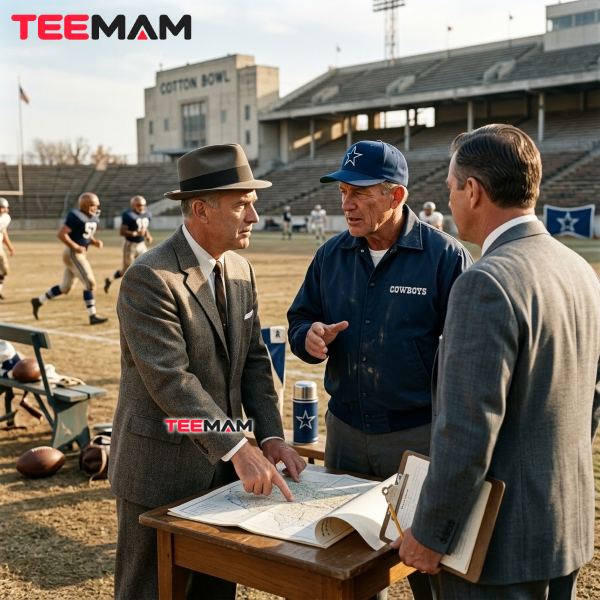
The Dallas Cowboys were founded on January 28, 1960, when NFL owners awarded an expansion franchise to a Dallas ownership group led by oilman Clint Murchison Jr. Dallas became the league’s 13th team and its first successful expansion franchise since the collapse of the All-America Football Conference a decade earlier. Murchison led the ownership group alongside his brother John, who together held the controlling stake, with Bedford Wynne, Toddie Lee Wynne, and William R. Hawn rounding out the minority partners.
Clint Murchison Jr. and the Fight to Bring NFL Football to Dallas
Getting there wasn’t simple. Washington Redskins owner George Preston Marshall held an unofficial monopoly on NFL football in the American South and blocked expansion into Dallas for years. Murchison had even tried to buy the Redskins outright in 1958 with the intention of relocating them to Texas; that deal collapsed when Marshall changed the terms at the last minute. Murchison got his revenge, and his franchise, through an unlikely piece of leverage: he acquired the rights to “Hail to the Redskins,” Washington’s fight song, and threatened to pull it from Marshall’s broadcasts unless Marshall dropped his opposition to a Dallas team. Marshall folded, the song was returned, and Dallas was granted its franchise on January 28, 1960 — a story the Dallas Cowboys founding story covers in full detail. The team briefly considered names like the Dallas Steers and Dallas Rangers before settling on “Cowboys” that March, partly to avoid confusion with a minor-league baseball club of the same name.
Tex Schramm and Tom Landry Build the Franchise
Murchison’s first move as owner set the tone for everything that followed: he hired Tex Schramm as general manager. Schramm, in turn, brought in Tom Landry as head coach and Gil Brandt as personnel director, a trio the Pro Football Hall of Fame credits with turning Dallas into “the NFL’s first successful new team” since the AAFC folded. That structure, not just a roster being assembled but an entire organizational philosophy invented in real time, is why Cowboys history reads less like a typical expansion story and more like a case study in front-office design. Schramm pushed the league toward computerized scouting and instant replay years before either was standard practice; Landry brought a defensive mind that had helped the New York Giants reach multiple championship games as a player and assistant coach.
The Cowboys’ First Season and Early Struggles
Reality set in immediately. Playing home games at the Cotton Bowl, the 1960 Cowboys finished 0-11-1, their lone non-loss a 31-31 tie against the New York Giants. Patience was the operating strategy from day one — Dallas didn’t post a winning record until its sixth season, 1965. But the foundation Schramm and Landry laid during those lean years, disciplined roster building and a defensive system built on structure over pure aggression, became the blueprint for what came next. From 1966 through 1985, Dallas produced an NFL-record 20 consecutive winning seasons, a streak the Pro Football Hall of Fame’s team history still cites among the most remarkable runs of sustained competence in professional sports — one that remains unbroken to this day.
The Tom Landry Era: Building the Cowboys Identity
Tom Landry’s Coaching Philosophy
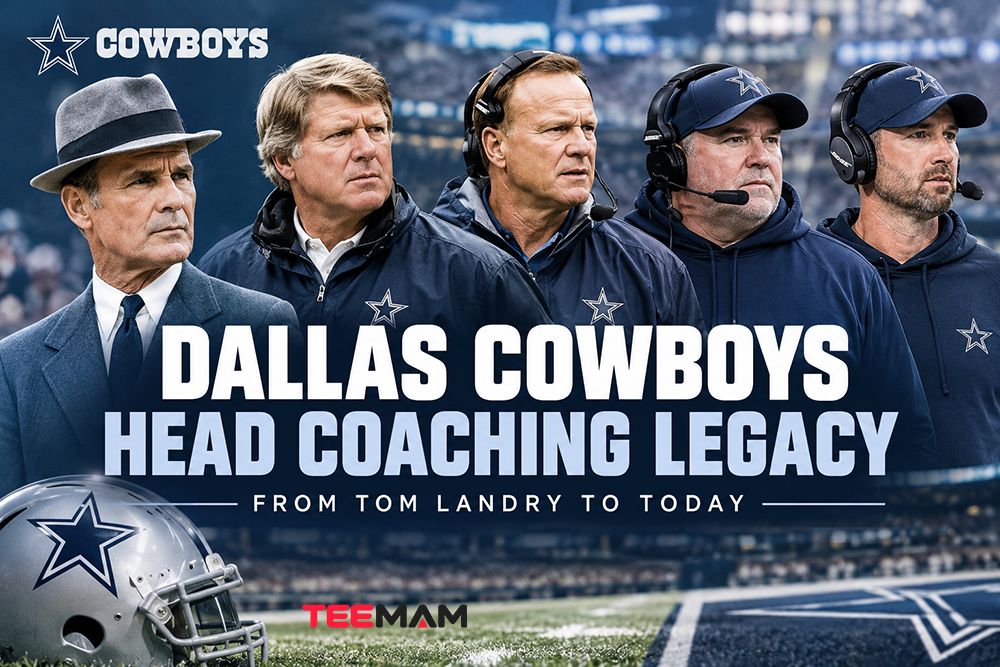
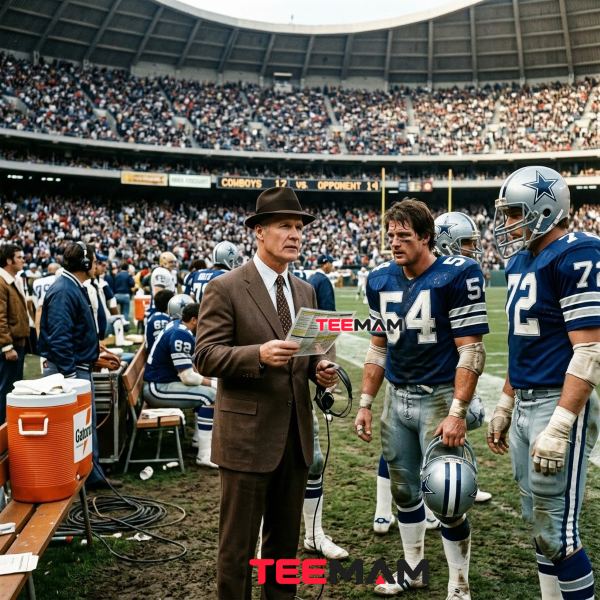
Tom Landry served as the Dallas Cowboys’ head coach from 1960 through 1988 — the only coach the franchise had for its first 29 seasons and the defining figure of its early identity. He finished with a 270-178-6 record, five NFC titles, and 20 career playoff wins, a total that ranks third in NFL history, behind only Bill Belichick’s 31 and Andy Reid’s 28. Landry’s reputation rested on preparation bordering on obsession: he was among the first coaches to break down game film systematically, and he treated offensive and defensive schemes as engineering problems rather than instinct-driven art. The fedora became as much a part of Cowboys visual identity as the star on the helmet, a detail fans still associate with the franchise’s founding decades. Our Dallas Cowboys coaching legacy traces the full coaching arc from Landry through Brian Schottenheimer.
The Flex Defense and the Birth of Doomsday
Landry’s defining schematic contribution was the Flex Defense, a system that asked defensive linemen to read and react rather than simply attack upfield, taking away the gaps that offenses built on misdirection depend on. Anchored by future Hall of Famer Bob Lilly at defensive tackle, alongside Randy White, Harvey Martin, George Andrie, Chuck Howley, Mel Renfro, and Cliff Harris, this unit became so feared that fans and media started calling it the Doomsday Defense — a nickname that outlived the scheme itself and still gets attached to any dominant Cowboys defensive era.
Roger Staubach and the Rise of a Championship Team
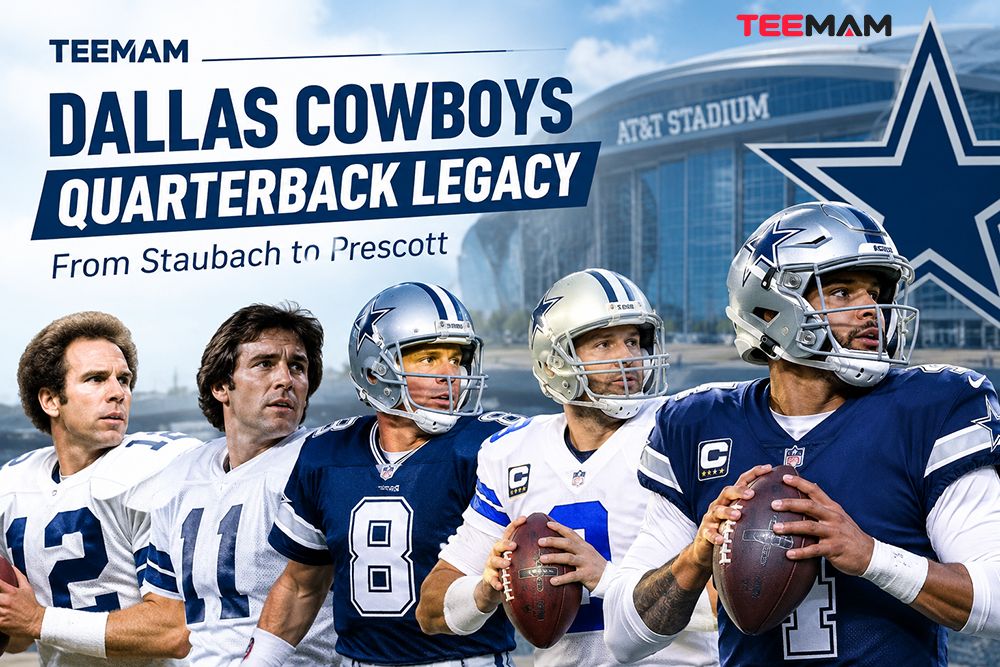
On offense, Roger Staubach gave the Cowboys a reputation for winning close games late, built on a series of dramatic fourth-quarter comebacks that earned him the nickname “Captain Comeback.” Paired with deep threat Bob Hayes — an Olympic gold-medal sprinter before he ever caught an NFL pass — Staubach turned Dallas into a real offensive threat rather than just a defensive curiosity. Doomsday gave the Cowboys their backbone; Staubach gave the offense a quarterback who could turn a broken play into a scoring drive. That combination carried Dallas from perennial also-ran to legitimate contender by the early 1970s. Our Dallas Cowboys quarterback legacy covers that progression from Staubach through Aikman, Romo, and Prescott.
From Perennial Contender to NFL Power
By 1970, Dallas had become the team everyone expected to break through, and the team that kept coming up just short in the biggest moments. That tension between talent and title-game heartbreak defined the next chapter.
Dallas Cowboys Super Bowl History Begins
Super Bowl V and the First Championship Setback
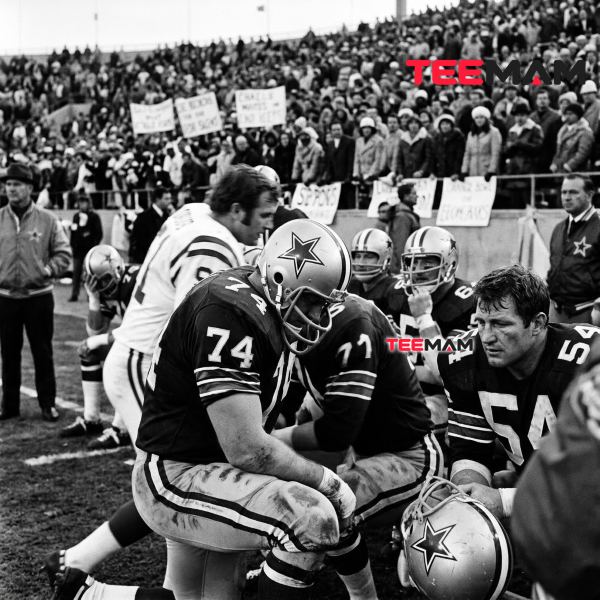
Super Bowl V, played January 17, 1971, ended in a 16-13 loss to the Baltimore Colts on a last-second field goal, with Craig Morton starting at quarterback before Staubach took over full-time the following season. The game is remembered for one strange footnote: Cowboys linebacker Chuck Howley was named Super Bowl MVP despite playing for the losing team — the only time in Super Bowl history that has happened. It stung, but it also proved Dallas belonged on that stage.
Super Bowl VI: The First Cowboys World Championship
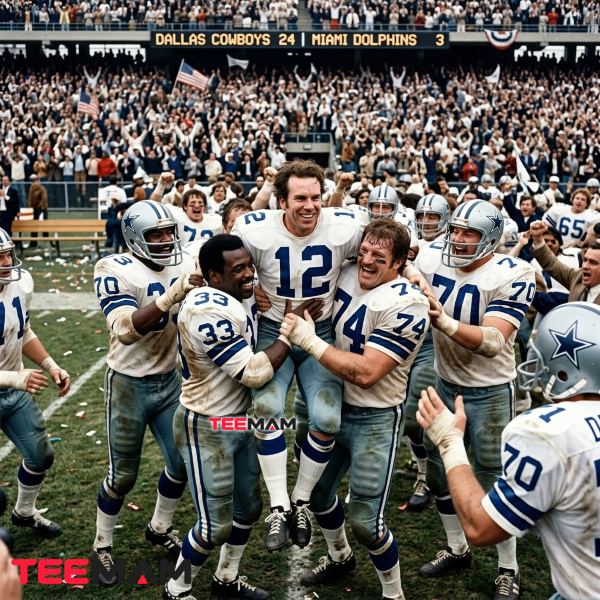
A year later, on January 16, 1972, with Staubach now the full-time starter, the Cowboys beat the Miami Dolphins 24-3 in Super Bowl VI, holding Miami without an offensive touchdown in a defensive shutdown that remained historically rare for decades. Staubach was named Super Bowl MVP, and Dallas had its first world championship.
Super Bowl XII and the Doomsday Defense
The Doomsday Defense delivered its signature performance on January 15, 1978, dominating the Denver Broncos 27-10 in Super Bowl XII. Randy White and Harvey Martin shared Super Bowl MVP honors, a fitting tribute to a unit built on collective discipline rather than individual stardom.
Super Bowl XIII and XIV: Close Calls in the Landry Era
Dallas returned to the Super Bowl the following season but lost 35-31 to the Pittsburgh Steelers in a shootout still considered one of the best-played Super Bowls of the era. The Cowboys-Steelers rivalry — two dynasties colliding twice in four seasons — became the defining storyline of 1970s football and cemented Dallas as a nationally relevant franchise even in defeat. Full details on every Cowboys Super Bowl trip live in our Dallas Cowboys Super Bowl history.
Why the Cowboys Became “America’s Team”
When Did the Cowboys Become America’s Team?
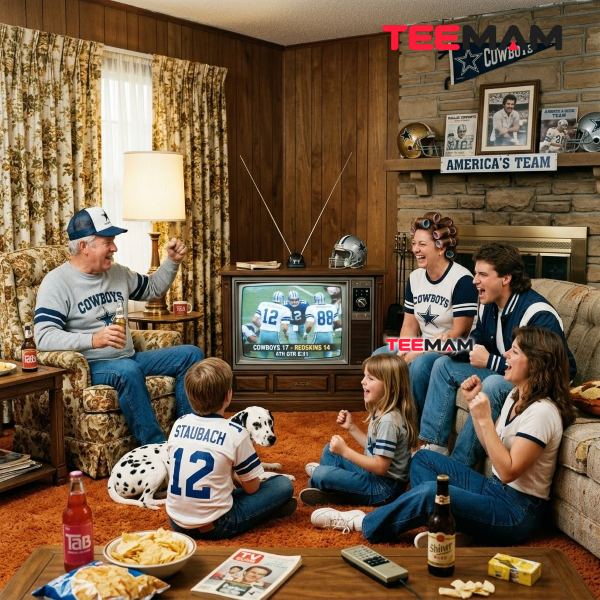
The nickname traces to 1978, when NFL Films produced that season’s highlight reel under the title “America’s Team,” built around the observation that Cowboys games consistently drew large national television audiences regardless of which market was airing them. The label stuck because it matched something real: Dallas was appearing on national TV more often than almost any other team, and Staubach, Landry, and a roster full of recognizable stars gave casual fans outside Texas a reason to tune in.
What Did “America’s Team” Actually Mean?
The nickname was never an official NFL designation — league owners never voted on it, and fan bases from Philadelphia to Pittsburgh have spent decades actively rejecting it. What it captured accurately was a media phenomenon: a franchise whose visibility outpaced its geographic fan base, turning Cowboys fandom into something people could adopt regardless of where they grew up. Our full breakdown of why Dallas became America’s Team covers how that reputation took hold and why it’s stayed polarizing ever since.
How Television Changed the Cowboys’ National Image
NFL Films’ cinematic style did as much for the Cowboys’ brand as anything that happened on the field. Combined with a regular Thanksgiving broadcast slot and a run of telegenic stars, television turned Dallas into a franchise people felt they knew personally, even from a thousand miles away.
Rivalries That Shaped Cowboys History
No franchise history is complete without its rivals. The Cowboys-Redskins (now Commanders) feud dates back to the very founding of the franchise and the fight-song standoff described above. The Cowboys-49ers rivalry produced some of the tensest NFC Championship football of the 1970s, 1980s, and 1990s, including San Francisco’s 1981 NFC title-game win over Dallas on Dwight Clark’s touchdown catch, a play still known simply as “The Catch.” And the NFC East rivalry with the Philadelphia Eagles has intensified in the current era as both teams have traded division titles and playoff runs. These rivalries aren’t a footnote — they’re part of why Cowboys games have carried national weight for more than five decades.
The Dallas Cowboys Star, Uniforms, and Visual Heritage
The Origin and Evolution of the Cowboys Star Logo
The five-point star has represented the Cowboys since the franchise’s founding in 1960, evolving from a simple blue emblem into one of the most recognized logos in global sports. Its color treatment shifted over the decades through variations of navy, royal blue, metallic silver, and white, but the basic geometry has stayed remarkably consistent — a rare example of a sports logo that didn’t need a dramatic rebrand to stay relevant. Its connection to Texas identity gives it meaning beyond football; it reads as regional pride first and team logo second, part of why it translates so easily onto stadium architecture and fan apparel alike. The full design evolution is covered in Dallas Cowboys star logo history.
Why Do the Cowboys Wear White Jerseys at Home?
This is one of the most-searched Cowboys trivia questions, and the credit usually goes to the wrong person. It wasn’t Tom Landry’s call — it was general manager Tex Schramm, who established the tradition of wearing white jerseys at home in the 1960s. Schramm’s public explanation was that he wanted Cowboys fans to see the different colors visiting teams wore around the league, rather than a steady diet of blue versus white every week. There was a practical angle too: playing at the open-air Cotton Bowl and later Texas Stadium, white jerseys ran cooler in the Texas heat, and it forced road teams into hot, dark uniforms. Longtime Cowboys personnel executive Gil Brandt later admitted the competitive advantage was the real motivation, even if the “let fans see the league’s colors” line was the public reasoning.
The Navy Jersey Lore and the “Blue Jersey Curse”
Fans have long claimed the Cowboys perform worse in navy jerseys than in white, a superstition that resurfaces every time Dallas loses in blue. It’s fan folklore, not a documented statistical pattern, and it should be treated as color commentary rather than football history.
Jersey Numbers That Became Cultural Symbols
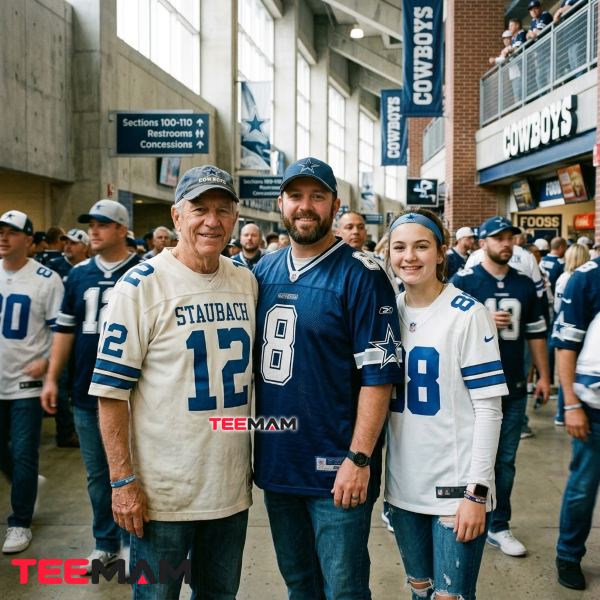
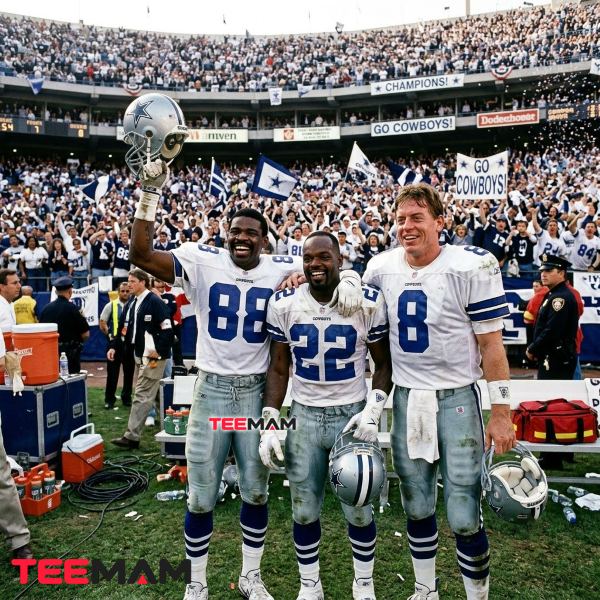
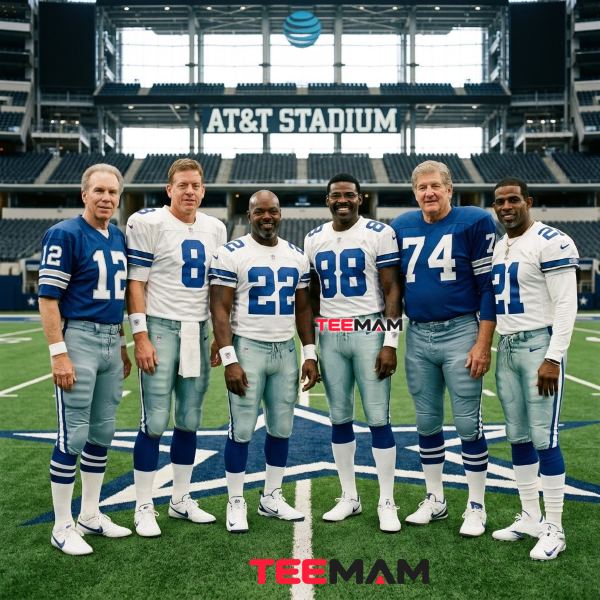
Certain numbers carry meaning independent of any single game. Roger Staubach’s No. 12, Troy Aikman’s No. 8, Emmitt Smith’s No. 22, and Michael Irvin’s No. 88 are recognized by casual fans who couldn’t necessarily name the season those players broke through. No. 88 carries an extra layer of history: Drew Pearson wore it in the 1970s before Irvin made it iconic again in the 1990s, which is why the Cowboys’ Ring of Honor display actually features two separate No. 88 markers. A full rundown of every number’s backstory lives in our Dallas Cowboys jersey numbers guide.
From Gameday Uniforms to Fan Apparel
Cowboys jerseys crossed over from on-field gear to closet staple as the roster’s biggest names became recognizable outside football circles entirely. Vintage-cut jerseys, graphic tees referencing specific championship seasons, and retro caps built around older logo treatments keep older eras of Cowboys history visible on game days decades after the players themselves retired. Our guide to Dallas Cowboys apparel heritage breaks down what to look for, era by era, if you’re building a collection that spans generations of the franchise.
The 1980s: Transition, Challenges, and the Road to Reinvention
The Final Years of the Landry Era
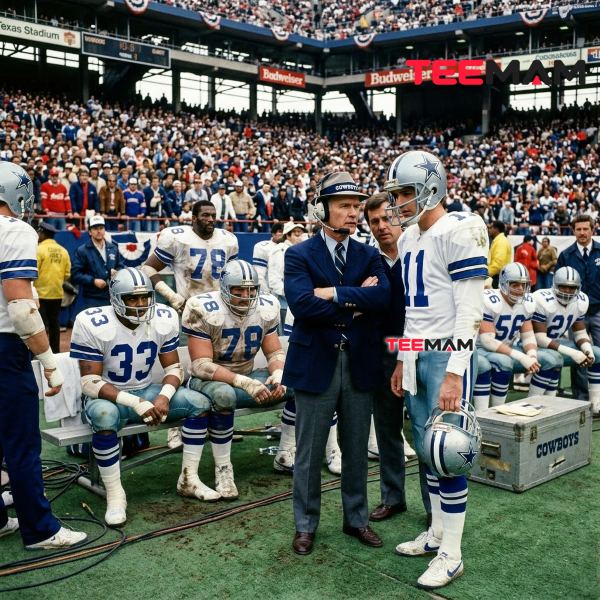
The NFL changed faster than Dallas’s roster did in the mid-1980s. Free agency didn’t yet exist in its modern form, but the league’s overall talent distribution was shifting, and the Cowboys’ championship core aged out without a clean succession plan in place. Landry’s final seasons produced diminishing results, and by 1988 the once-dominant franchise had fallen to the bottom of the NFC East.
Jerry Jones Buys the Cowboys in 1989
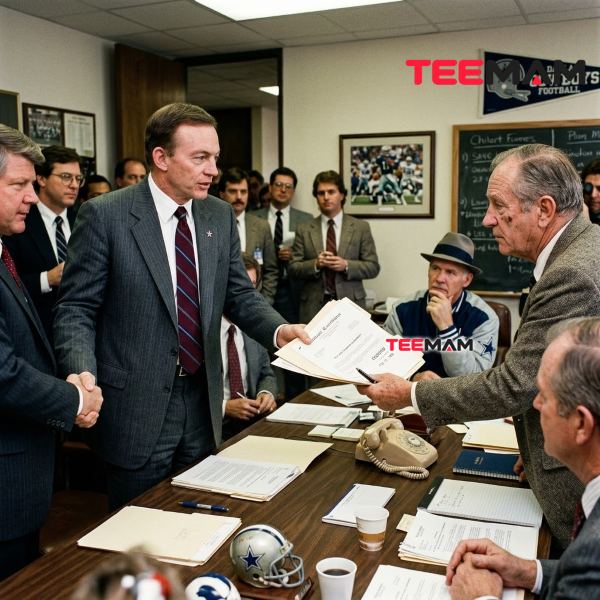
On February 25, 1989, Arkansas oil businessman Jerry Jones purchased the Dallas Cowboys and the lease rights to Texas Stadium from H.R. “Bum” Bright for $140 million — at the time, the largest sale price in professional sports history. Jones’ very first act as owner was controversial: he fired Tom Landry, the only head coach the Cowboys had ever known, and replaced him with Jimmy Johnson, his former Arkansas Razorbacks teammate who had just won a national championship at the University of Miami. Longtime general manager Tex Schramm resigned shortly after, and Jones assumed full football operations control himself, a structure the organization still runs under today. Jones changed the franchise’s ownership and football-operations model in a single afternoon, creating the template Dallas has followed for decades since; that full arc is covered in Dallas Cowboys ownership history.
Jimmy Johnson’s Rebuild
Jones and Johnson’s first draft pick together was quarterback Troy Aikman, taken first overall in 1989. The team’s record that year, 1-15, was the worst mark in franchise history outside the inaugural 1960 season, but the rebuild was already underway beneath the surface. The most consequential move of the era came on October 12, 1989, when Dallas traded veteran running back Herschel Walker to the Minnesota Vikings in exchange for five players and a package of draft picks that eventually included multiple future first- and second-round selections. The trade mattered because its value extended across multiple drafts rather than being tied to a single player or season — it’s remembered as one of the most lopsided deals in NFL history for exactly that reason. Our Dallas Cowboys draft history walks through how those accumulated picks turned into championship-caliber talent.
The 1990s Cowboys Dynasty
The Herschel Walker Trade and the Rebuilding Blueprint
The Walker trade sent Minnesota a proven veteran chasing a Super Bowl window that never opened, while Dallas converted the return into a wave of young talent, most notably safety Darren Woodson and, through subsequent draft picks, running back Emmitt Smith. It remains the clearest example of Jones and Johnson building a long-term roster strategy rather than chasing short-term wins.
Troy Aikman Becomes the Franchise Quarterback
Aikman’s rookie season was rough by any measure, but his development over the next two years matched the young talent accumulating around him. By 1991 he was directing a genuinely dangerous offense; by 1992 he was a Super Bowl champion.
The Triplets: Aikman, Emmitt Smith, and Michael Irvin
Aikman, Smith, and wide receiver Michael Irvin became known collectively as “the Triplets,” a nucleus whose complementary skill sets — a precise pocket passer, a bruising and durable workhorse back, and a physical possession receiver — gave offensive coordinator Norv Turner a system that dictated matchups rather than reacting to them. Their production made them one of the NFL’s most recognizable offensive trios of the 1990s. Read the full story of how their partnership was built in Dallas Cowboys Triplets era.
Super Bowl XXVII and XXVIII
Dallas routed the Buffalo Bills 52-17 in Super Bowl XXVII on January 31, 1993, with Aikman earning MVP honors. The two teams met again the following year in Super Bowl XXVIII, and Dallas won again, 30-13, this time behind an MVP performance from Emmitt Smith, who played through a separated shoulder late in the regular season and carried that toughness into the postseason.
Super Bowl XXX and the End of the Dynasty’s Championship Run
Jimmy Johnson departed after the second title amid a well-documented falling-out with Jones, and Barry Switzer took over as head coach. Under Switzer, Dallas won a third championship in four seasons, beating the Pittsburgh Steelers 27-17 in Super Bowl XXX on January 28, 1996, with cornerback Larry Brown, who intercepted two passes in the game, taking home MVP honors. It was the franchise’s fifth Super Bowl title and, to date, its most recent.
Jerry Jones and Jimmy Johnson: A Complicated Partnership
Jones and Johnson’s split remains one of the more scrutinized front-office breakups in NFL history. Both men have offered their own account of who deserved more credit for the era’s success, and neither version fully lines up with the other’s. What’s not in dispute is the result: two championships together, a third without Johnson, and a roster-building framework that outlasted the partnership itself.
Dallas Cowboys History: The Turning Points That Shaped the Franchise
Zoom out far enough and the history of the Dallas Cowboys comes down to five decisions, each of which reshaped everything that followed.
1960 — Hiring Schramm, Landry, and Brandt. Rather than build around a single star, Murchison assembled an organizational structure first, a decision that gave the franchise institutional stability outlasting individual coaches and players.
1966 — The start of the 20-season winning streak. The streak gave Dallas sustained competitive credibility and coincided with the franchise’s growing national television exposure, laying the groundwork for the branding moment that followed a decade later.
1978 — The “America’s Team” media moment. NFL Films’ highlight reel converted on-field success into a national brand, separating Cowboys popularity from the team’s actual geographic footprint for the first time.
1989 — Jones, Johnson, and the Walker trade. A single offseason replaced the franchise’s entire leadership structure and set up, three years later, a return to championship contention.
2025 — The Micah Parsons trade. Whatever you think of the deal itself, it marked a shift toward the modern Cowboys’ approach to roster construction: leveraging draft capital and cap flexibility over holding onto individual stars at any cost.
Each of these moments changed not just a season, but the operating model the Cowboys used for the decade that followed.
The Cowboys’ Greatest Players and Their Historical Legacy
Quarterbacks Who Defined Different Eras
Roger Staubach, Troy Aikman, Tony Romo, and Dak Prescott each represent a distinct chapter of Cowboys quarterback play: Staubach’s improvisational comebacks, Aikman’s efficient dynasty-building precision, Romo’s high-variance brilliance, and Prescott’s decade of statistical consistency as the starter.
Offensive Legends
Emmitt Smith retired as the NFL’s all-time leading rusher. Michael Irvin’s physicality reshaped how defenses had to plan for the Cowboys’ passing attack. Offensive lineman Larry Allen is widely regarded as one of the most powerful linemen ever to play the position, and tight end Jason Witten’s fifteen-year run of reliability made him a fixture of the offense across three different head-coaching regimes.
Defensive Icons
Bob Lilly, Randy White, and Charles Haley anchor the earlier defensive lineage, while Deion Sanders brought a level of individual star power to the secondary the franchise hadn’t seen before. More recently, Micah Parsons became one of the Cowboys’ most prominent defensive players of the post-2000 era before being traded to the Green Bay Packers in August 2025. See the full ranked breakdown in Greatest Cowboys players ever.
Deion Sanders and the Cowboys’ 1990s Identity
Sanders signed with Dallas in 1995, adding another elite defensive playmaker to a roster already built around Aikman, Smith, Irvin, and a deep supporting cast. His arrival is still cited as one of the clearest examples of a team adding a single player specifically to close a championship window. That brief but consequential run in Dallas is covered in Deion Sanders Cowboys legacy.
The 2000s: Rebuilding After the Dynasty
From Dave Campo to Bill Parcells
The years immediately following the dynasty were rough, and head coach Dave Campo couldn’t sustain the roster’s previous success. Jones brought in Bill Parcells in 2003, whose no-nonsense program restored a baseline level of competitiveness and returned Dallas to relevance, if not championship contention.
The Tony Romo Era Begins
Tony Romo went undrafted out of Eastern Illinois in 2003 and spent years on the practice squad before an in-season quarterback change in 2006 handed him the starting job. His chemistry with tight end Jason Witten and, briefly, wide receiver Terrell Owens gave Dallas one of the more explosive offenses in the league, even as the postseason continued to elude the franchise.
The Cowboys’ Playoff Frustrations
The list of near-misses grew long during this stretch: a 2006 wild-card loss in Seattle defined by a botched field-goal snap, further postseason exits through the late 2000s, a rare playoff win in January 2010 under head coach Wade Phillips, and a run of three consecutive 8-8 finishes from 2011 through 2013 that became a running joke among fans and analysts alike.
The Final Years at Texas Stadium
Texas Stadium’s signature architectural quirk, an open hole in the roof famously described as letting “God watch His favorite team play,” became as much a part of Cowboys identity as anything happening on the field. The stadium hosted its final Cowboys game in 2008 and was demolished in 2010, closing a 38-year chapter of franchise history that included every Super Bowl appearance from the mid-1970s through the mid-1990s.
The 2010s: Tony Romo, Dak Prescott, and a New Generation
The 2014 Breakthrough and the Dez Bryant Catch Controversy
Dallas made a genuine playoff push in 2014, but a divisional-round loss at Green Bay turned on a reversed catch call involving Dez Bryant that remains one of the most argued-over officiating decisions of the decade. The play helped push the league toward later clarifications of the catch rule.
The 2016 Rookie Breakthrough
An injury to Romo opened the door for fourth-round rookie Dak Prescott in 2016, and paired with first-round rookie running back Ezekiel Elliott, the Cowboys posted a 13-3 record, one of the best rookie-quarterback seasons in league history, before falling to the Green Bay Packers in the divisional round.
Dak Prescott Becomes the Franchise Quarterback
Prescott’s transition from surprise rookie to unquestioned franchise quarterback wasn’t linear. He battled injuries, including one that ended his 2020 season early, but continued setting career and franchise statistical marks while taking on a larger leadership role within the organization.
CeeDee Lamb and the Next Offensive Generation
Wide receiver CeeDee Lamb, drafted in the first round in 2020, developed into the focal point of the Cowboys’ passing game, setting a franchise single-season receiving record with 135 catches for 1,749 yards in 2023 and earning consecutive Pro Bowl selections.
AT&T Stadium, The Star, and the Modern Cowboys Brand
Why AT&T Stadium Changed the Cowboys Experience
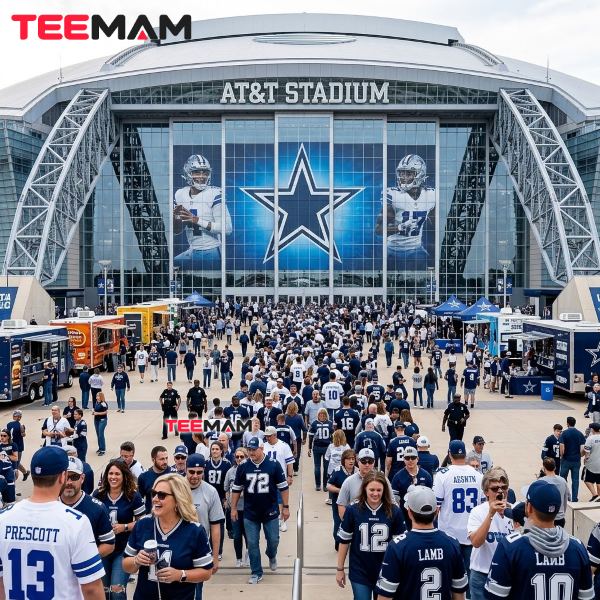
AT&T Stadium opened in Arlington in 2009, replacing Texas Stadium with a modern facility built around a retractable roof and one of the largest video boards in sports at the time of construction. The building quickly became a tourist destination independent of gameday, hosting concerts, college football’s biggest neutral-site matchups, and even a Super Bowl of its own. For first-time visitors, the stadium’s scale makes advance seating research worthwhile before buying tickets — our AT&T Stadium tour guide covers what to expect on arrival.
From Texas Stadium to “Jerry World”
Fans nicknamed the new building “Jerry World,” a half-affectionate, half-mocking nod to Jones’ hands-on approach to every detail of the franchise’s business operations. It’s a fan-generated label, not an official one, but it captures the era accurately: the Cowboys’ business ambitions had outgrown their previous home.
The Star in Frisco and the Modern Training Complex
The Cowboys relocated their headquarters and practice facilities to The Star in Frisco, a mixed-use development opened in 2016 that combines team offices, practice fields, and public-facing retail and entertainment space, a physical embodiment of the franchise’s shift from pure football operation to year-round entertainment brand.
How the Cowboys Became a Global Sports Brand
Between national broadcast exposure, a merchandising operation among the largest in professional sports, and a stadium experience built as a destination rather than just a venue, Dallas has extended its reach well beyond football-specific audiences, both domestically and internationally.
The Cowboys Today: A Franchise in Transition
Current roster references below are accurate as of September 2026. Because rosters and contracts change quickly, treat these figures as a snapshot rather than a permanent record.
The Micah Parsons Trade and a Changing Defense
One of the defining roster moves of the recent Cowboys era was the August 2025 trade of All-Pro edge rusher Micah Parsons to the Green Bay Packers in exchange for defensive tackle Kenny Clark and two future first-round draft picks, completed just days before the start of the 2025 season after a prolonged contract standoff. It reshaped the roster overnight and forced Dallas to reshape its defensive personnel during first-year head coach Brian Schottenheimer’s inaugural season. Dallas finished 2025 at 7-9-1, and the organization brought in first-time coordinator Christian Parker to lead the defense into 2026 after the unit ranked among the league’s worst in points allowed the previous year.
Dak Prescott and the Cap Management Era
Dak Prescott remains Dallas’ starting quarterback after the Cowboys restructured his contract alongside those of CeeDee Lamb and offensive lineman Tyler Smith in March 2026 to manage the salary cap. It’s a useful illustration of how differently rosters get built now compared to the 1990s: modern Cowboys teams are shaped by a constant cycle of extensions, restructures, and cap maneuvering rather than the more straightforward drafting and trading that defined the Triplets era.
CeeDee Lamb, George Pickens, and the Evolution of Cowboys Offense
Wide receiver George Pickens, acquired from Pittsburgh via trade in 2025, produced a breakout first season in Dallas — 93 catches for 1,429 yards and nine touchdowns across 17 games, a stat line that outpaced Lamb’s own 2025 numbers (75 catches, 1,077 yards, three touchdowns) as Lamb played through injury for part of the season. The Cowboys retained Pickens on the 2026 franchise tag, a one-year, $27.3 million deal, giving Prescott two established targets heading into the new season.
What Has Changed Since the 1990s?
The comparison is stark. Salary-cap management, analytics-driven roster building, and free agency now shape nearly every front-office decision, replacing the simpler draft-and-develop model that built the Triplets. Media coverage has multiplied too, with a team-produced Netflix docuseries sitting alongside traditional broadcast coverage, extending Cowboys visibility to entirely new audiences much the way NFL Films did in the 1970s.
The Cowboys’ Thanksgiving Tradition
When Did the Cowboys Start Playing on Thanksgiving?
Dallas first hosted a Thanksgiving Day game in 1966, when general manager Tex Schramm volunteered the Cowboys for a second holiday game the NFL was struggling to schedule. The gamble paid off immediately — the Cowboys drew a franchise-record crowd of more than 80,000 and beat the Cleveland Browns 26-14. Dallas hosted every Thanksgiving from 1966 through 1974, sat out 1975 and 1977 when the league experimented with rotating the game to the St. Louis Cardinals, and has hosted it every year since 1978 after those Cardinals broadcasts underperformed and the NFL asked Dallas to take the slot back permanently.
Why Thanksgiving Became Part of Cowboys Identity
National holiday scheduling reinforced the “America’s Team” brand in a literal way: millions of households watching football over a holiday meal were, more often than not, watching Dallas. That built-in national audience is part of why the Thanksgiving slot became self-reinforcing, familiarity breeding more familiarity. The full breakdown of the tradition’s origins and its relationship to the Detroit Lions’ own Thanksgiving history is covered in Dallas Cowboys Thanksgiving tradition.
Thanksgiving Football and America’s Team
The connection between Thanksgiving and national identity isn’t incidental. It’s arguably the single most consistent driver of the “America’s Team” label decade after decade, more durable than any individual championship run.
The Ring of Honor and How the Cowboys Preserve Their History
What Is the Dallas Cowboys Ring of Honor?
The Dallas Cowboys Ring of Honor is a permanent display, first installed at Texas Stadium and now encircling AT&T Stadium, that recognizes former players, coaches, and executives for their contributions to the franchise. It was created by Tex Schramm and unveiled on November 23, 1975, with defensive tackle Bob Lilly becoming its first inductee during a halftime ceremony billed as the team’s first-ever alumni reunion.
Why the Ring of Honor Matters
Unlike many team halls of fame that induct large classes on a regular schedule, the Cowboys’ Ring has stayed deliberately exclusive. Its importance comes partly from that selectivity: induction is controlled by the organization, first Schramm and later Jerry Jones, rather than through a large annual voting class, which keeps each addition feeling significant rather than routine.
The Most Important Names in Cowboys History
Tom Landry, Roger Staubach, the Triplets, and Bob Lilly all hold places in the Ring, alongside contributors whose impact was organizational rather than statistical, such as Schramm himself. The Ring functions as the franchise’s own internal verdict on who mattered most, decade by decade.
From Players to Cheerleaders: The Cowboys’ Broader Cultural Legacy
The Dallas Cowboys Cheerleaders and American Sports Culture
The Dallas Cowboys Cheerleaders, formalized in their modern form in the mid-1970s, became a cultural phenomenon nearly independent of the football team itself, influencing how NFL franchises approached gameday entertainment and sideline branding across the entire league. More on their role and evolving place in the organization is available in Dallas Cowboys Cheerleaders role.
From Football Sidelines to Television
That cultural footprint eventually crossed into television, with documentary coverage exploring the audition process, training, and public image built around the squad. For a closer look at how that story has been told on screen, see America’s Sweethearts documentary, and for a broader look at how the franchise’s history has been captured on film over the decades, see our best Dallas Cowboys documentaries roundup.
The Business History Behind America’s Team
How the Cowboys Became One of Sports’ Most Valuable Franchises
Forbes valued the Dallas Cowboys at an estimated $17 billion in its 2026 rankings, keeping Dallas atop the NFL’s valuation list for a 20th consecutive year. That figure illustrates how strongly the franchise’s commercial performance can remain elevated even during a championship drought stretching back to the 1995 season. The full financial picture, including how media rights, sponsorship, and stadium revenue combine to drive that number, is broken down in Dallas Cowboys franchise valuation.
Tex Schramm’s Legacy Beyond the Field
Schramm’s influence stretched well past personnel decisions. He helped pioneer instant replay review, championed the Cowboys Cheerleaders as a marketing asset, and pushed the league toward the kind of television-first broadcasting strategy that eventually made “America’s Team” a viable brand in the first place.
From Football Franchise to Entertainment Brand
The clearest way to describe the Cowboys’ business trajectory is as a documented sequence: national broadcast exposure in the 1970s created the America’s Team brand, that brand generated merchandising and sponsorship revenue disproportionate to the roster’s on-field results in later decades, and that revenue eventually funded a stadium and headquarters built explicitly as entertainment destinations rather than pure football facilities.
The Cowboys Through the Numbers: A Historical Reference
Dallas Cowboys Super Bowl Record
| Super Bowl | Date | Opponent | Result | Game MVP |
|---|---|---|---|---|
| Super Bowl V | Jan 17, 1971 | Baltimore Colts | Loss, 13–16 | Chuck Howley (LB) |
| Super Bowl VI | Jan 16, 1972 | Miami Dolphins | Win, 24–3 | Roger Staubach (QB) |
| Super Bowl X | Jan 18, 1976 | Pittsburgh Steelers | Loss, 17–21 | — |
| Super Bowl XII | Jan 15, 1978 | Denver Broncos | Win, 27–10 | Randy White (DT) & Harvey Martin (DE) |
| Super Bowl XIII | Jan 21, 1979 | Pittsburgh Steelers | Loss, 31–35 | — |
| Super Bowl XXVII | Jan 31, 1993 | Buffalo Bills | Win, 52–17 | Troy Aikman (QB) |
| Super Bowl XXVIII | Jan 30, 1994 | Buffalo Bills | Win, 30–13 | Emmitt Smith (RB) |
| Super Bowl XXX | Jan 28, 1996 | Pittsburgh Steelers | Win, 27–17 | Larry Brown (CB) |
Dallas is 5-3 in Super Bowl appearances. Those five championships are tied for second-most in NFL history, behind only the Pittsburgh Steelers and New England Patriots, who have six apiece.
Franchise Win-Loss Record
Across 66 seasons, the Cowboys have built one of the strongest all-time winning percentages in the NFL, a legacy anchored by Landry’s 20-year streak of winning seasons and tracked in detail by Pro-Football-Reference’s franchise database. For a complete year-by-year breakdown built specifically for fans, see Dallas Cowboys all time record.
Championship Timeline
- 1971 — Super Bowl VI title
- 1977 — Super Bowl XII title
- 1992 — Super Bowl XXVII title
- 1993 — Super Bowl XXVIII title
- 1995 — Super Bowl XXX title
How Cowboys History Shaped Fan Identity
Why Fans Still Wear the Stars of Earlier Generations
Cowboys fandom skews multigenerational compared to many other historic franchises. Grandparents who watched Staubach often pass down jerseys, opinions, and gameday rituals to grandchildren who grew up watching Prescott. Vintage apparel featuring older numbers can function as a kind of wearable family history, keeping older eras visible on modern gamedays.
Cowboys Nation Across Generations
The “America’s Team” identity helped Dallas develop a fan base well beyond North Texas. That national reach remains visible today, with Cowboys apparel and gameday traditions appearing far outside the team’s home market, reinforced rather than diminished by the rise of online fan communities and social media.
Gameday as a Living History Lesson
Cowboys game-day culture often puts different generations of the franchise side by side: vintage Staubach or Aikman jerseys, 1990s championship references, and current Prescott or Lamb gear can all appear in the same fan setting, a visual reminder that this franchise treats its own history as something worth carrying forward rather than filing away.
How Cowboys History Lives On Through Fan Style
How Historical Eras Influence What Fans Wear
Fashion choices at Cowboys games often function as a kind of era selection. Fans leaning into Landry-era nostalgia gravitate toward simpler, vintage color-blocking; those honoring the 1990s dynasty reach for Aikman, Smith, or Irvin jerseys; and younger fans increasingly build outfits around Prescott, Lamb, or Pickens gear.
Choosing a Historical-Inspired Gameday Look
Rather than chasing a single “right” look, most longtime fans build a rotation: a vintage-inspired tee for casual tailgates, an authentic jersey for the biggest games, and layered outerwear for the genuinely cold late-season matchups Texas occasionally produces.
At TeeMam, we approach fan-inspired apparel as another way these visual traditions continue across generations — the eras, jersey numbers, and star-logo history fans have carried with them for decades of watching this team.
Dallas Cowboys Tickets and Experiencing the Franchise in Person
Planning a Visit to AT&T Stadium
The video board alone dwarfs most fans’ expectations on a first trip, and the building’s sheer size makes advance seating research worthwhile before committing to a section. Our Dallas Cowboys ticket buying guide covers seating tiers, pricing patterns, and what to expect on arrival.
Experiencing Cowboys History Beyond Game Day
Beyond the game itself, AT&T Stadium and The Star both offer historical displays and tour access that let visitors engage with Cowboys history even outside the regular season.
Which Era of Cowboys History Should You Explore First?
There’s no single correct entry point into this franchise’s past. Start with the 1960s for the franchise’s origins, the 1970s for Landry and the Doomsday Defense, the 1990s for the Triplets dynasty, or the current Schottenheimer era for the story still being written. Recent documentary coverage, including team-produced series following current-day locker room dynamics, has added a layer of primary-source storytelling that complements older archival footage from the Landry and Johnson eras.
Frequently Asked Questions About Dallas Cowboys History
What year were the Dallas Cowboys founded?
The Dallas Cowboys were founded on January 28, 1960, when the NFL awarded an expansion franchise to a Dallas ownership group led by Clint Murchison Jr.
Who founded the Dallas Cowboys?
Clint Murchison Jr. led the ownership group that secured the Dallas NFL franchise in 1960, and his first move as owner was hiring Tex Schramm as general manager.
Why are the Dallas Cowboys called America’s Team?
The nickname originated from a 1978 NFL Films highlight reel titled “America’s Team,” which noted the Cowboys’ unusually consistent national television popularity compared to other franchises of the era.
How many Super Bowls have the Cowboys won?
The Cowboys have won five Super Bowls (VI, XII, XXVII, XXVIII, and XXX) out of eight total appearances, giving them a 5-3 all-time Super Bowl record.
Who was the Cowboys’ first head coach?
Tom Landry was the franchise’s first head coach, serving from the team’s inaugural 1960 season through 1988.
Who are the Dallas Cowboys’ Triplets?
Quarterback Troy Aikman, running back Emmitt Smith, and wide receiver Michael Irvin formed the offensive core known as the Triplets, driving three Super Bowl titles in the 1990s.
When did Jerry Jones buy the Dallas Cowboys?
Jerry Jones purchased the Cowboys and Texas Stadium’s lease rights from H.R. “Bum” Bright on February 25, 1989, for $140 million.
Why do the Cowboys wear white jerseys at home?
General manager Tex Schramm established the tradition in the 1960s, wanting fans to see the different colors visiting teams wore rather than blue versus white every week. The choice also carried a practical benefit in the Texas heat, since it forced visiting teams into darker, hotter uniforms.
What is the Dallas Cowboys Ring of Honor?
The Ring of Honor is a permanent tribute encircling AT&T Stadium that recognizes former players, coaches, and executives who made outstanding contributions to the franchise, created by Tex Schramm in 1975.
Where did the Cowboys originally play?
The Cowboys played their first eleven seasons at the Cotton Bowl in Dallas before moving to Texas Stadium in Irving in 1971, and later to AT&T Stadium in Arlington in 2009.
What was the Doomsday Defense?
The Doomsday Defense was the nickname given to Tom Landry’s dominant defensive units of the 1970s, built around the Flex Defense scheme and anchored by Bob Lilly, Randy White, and Harvey Martin.
Who are the most important players in Cowboys history?
Names most consistently cited across eras include Bob Lilly, Roger Staubach, Tom Landry (as coach), Troy Aikman, Emmitt Smith, Michael Irvin, Deion Sanders, and, more recently, Micah Parsons and Dak Prescott.
The Dallas Cowboys Historical Timeline at a Glance
| Year | Event | Why It Matters |
|---|---|---|
| 1960 | Franchise founded | Beginning of Cowboys history |
| 1966–1985 | 20 consecutive winning seasons | Still an NFL record |
| 1971 | Super Bowl VI | First championship |
| 1975 | Ring of Honor created | Franchise begins formally preserving its own legacy |
| 1977 | Super Bowl XII | Second championship |
| 1978 | “America’s Team” era begins | National identity takes shape |
| 1989 | Jerry Jones purchase | New ownership era |
| 1992 | Super Bowl XXVII | Dynasty begins |
| 1993 | Super Bowl XXVIII | Back-to-back title |
| 1995 | Super Bowl XXX | Fifth championship |
| 2009 | AT&T Stadium opens | Modern stadium era |
| 2016 | Dak Prescott emerges | New generation |
| 2025 | Micah Parsons traded to Green Bay | Defensive rebuild under Brian Schottenheimer |
What Makes Dallas Cowboys History Endure?
The history of the Dallas Cowboys lasts because several different stories overlap: organizational innovation under Landry and Schramm, championship teams built around two distinct generations of elite players, Jerry Jones’ transformation of the franchise into a commercial juggernaut, and a national identity that extends well beyond the scoreboard. Whether you came to this history through the 1970s Doomsday teams, the 1990s dynasty, or the Dak Prescott era currently unfolding under Brian Schottenheimer, the throughline is the same: this is a franchise that has always treated its own story as an asset, not just a record book.
Sources
This article draws on verified reporting and historical records from the following outlets:
- Pro Football Hall of Fame — Dallas Cowboys Team History
- Pro Football Hall of Fame — Moments in NFL History: Jerry Jones Purchases the Cowboys
- Dallas Cowboys Official Site — Cowboys Commemorate Team’s 60th Anniversary
- Pro-Football-Reference — Dallas Cowboys Head-to-Head Records

Hi, I’m Olivia Bennett, a fashion and lifestyle writer at TeeMam with 6 years of experience creating content about fashion, outfits, and lifestyle trends. I enjoy sharing practical style ideas for everyday wear, game days, holidays, and special occasions, helping readers find looks that feel comfortable, fun, and uniquely their own.