Dallas Cowboys Head Coaching Legacy: From Tom Landry to Today
Being the Dallas Cowboys head coach might be the hottest seat in American sports. The job comes with a national fan base, a hands-on owner who has run the front office since 1989, and a media market that treats every fourth-down decision like a referendum. Ten men have held the position since the franchise’s first season in 1960, and only three of them have ever coached the team to a Super Bowl championship. Tom Landry’s 29-season run still dwarfs everyone who came after him, and the franchise hasn’t won it all since the 1995 season. Every coach hired since has effectively been auditioning against that history.
The Dallas Cowboys head coach is the person responsible for running the team’s on-field operation: game planning, coaching-staff management, player development, and in-game decisions. Since entering the NFL in 1960, the Cowboys have employed 10 head coaches, and Tom Landry served the longest by a wide margin — 29 seasons, more than double anyone who followed him.
This guide traces the history of every Dallas Cowboys head coach, what each man actually built or inherited, why some of the most talented rosters in franchise history never returned to the Super Bowl, and how the job changed from Landry’s era to Brian Schottenheimer’s today.
Every Dallas Cowboys Head Coach at a Glance
| Coach | Years | Regular Season | Postseason | Super Bowl Titles |
|---|---|---|---|---|
| Tom Landry | 1960-1988 | 250-162-6 | 20-16 | 2 |
| Jimmy Johnson | 1989-1993 | 44-36 | 7-1 | 2 |
| Barry Switzer | 1994-1997 | 40-24 | 5-2 | 1 |
| Chan Gailey | 1998-1999 | 18-14 | 0-2 | 0 |
| Dave Campo | 2000-2002 | 15-33 | 0-0 | 0 |
| Bill Parcells | 2003-2006 | 34-30 | 0-2 | 0 |
| Wade Phillips | 2007-2010 | 34-22 | 1-2 | 0 |
| Jason Garrett | 2010-2019 | 85-67 | 2-3 | 0 |
| Mike McCarthy | 2020-2024 | 49-35 | 1-3 | 0 |
| Brian Schottenheimer | 2025-present | 7-9-1 | 0-0 | 0 |
Figures reflect games coached with Dallas only, drawn from Pro Football Hall of Fame biographical data, Pro Football Reference coaching records, and franchise season archives.
Who Has the Strongest Coaching Legacy in Cowboys History?
There isn’t a clean single-name answer here. Landry owns the case built on longevity, innovation, and sustained winning — he built the franchise from nothing and coached it for nearly three decades. Jimmy Johnson has the stronger case if the measure is speed of transformation: he took a 1-15 team to back-to-back championships in five seasons, faster than almost any rebuild in NFL history.
Who is the greatest Dallas Cowboys head coach? Tom Landry has the strongest overall case, having built the organization from an expansion team into a two-time champion over 29 seasons. Jimmy Johnson is the strongest alternative, on the strength of rebuilding a 1-15 roster into a back-to-back championship dynasty in half a decade. Most historical rankings treat the two as co-anchors of the franchise’s coaching legacy rather than picking one over the other.
Tom Landry Built the Original Cowboys Identity
Tom Landry (1960-1988): The Innovator in the Fedora
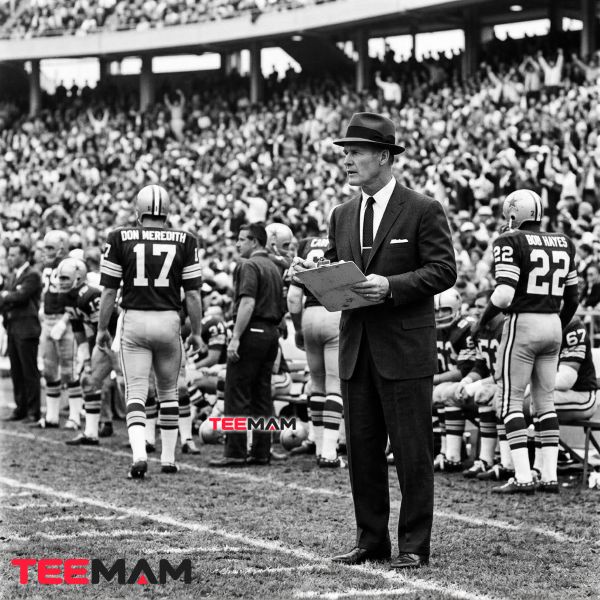
Landry didn’t inherit anything when he took the job in 1960. The Cowboys entered the NFL that year as an expansion franchise, with owner Clint Murchison Jr., general manager Tex Schramm, head coach Tom Landry, and personnel executive Gil Brandt forming the core of the organization that built the team from an 0-11-1 debut season. Landry spent five years grinding through losing records before Dallas posted its first winning season in 1966. What followed is still an NFL record: 20 consecutive winning seasons, from 1966 through 1985.
Landry’s flex defense, which shifted linemen off the ball to read plays before reacting, and his multiple offense, which mixed personnel and formations more aggressively than almost any team of the era, gave the Cowboys a schematic identity years ahead of the league. Dallas reached five Super Bowls under Landry and won two of them, a run that still defines what fans expect from a Cowboys head coach today.
How many Super Bowls did Tom Landry win? Two, Super Bowl VI following the 1971 season and Super Bowl XII following the 1977 season, out of five total Super Bowl appearances, according to the Pro Football Hall of Fame.
Landry finished with a 250-162-6 regular-season record and, counting the playoffs, 270 total wins, third-most in NFL history at the time he was fired. Jerry Jones completed his purchase of the Cowboys on February 25, 1989, and the change in ownership brought Landry’s 29-year tenure to an end. Landry’s tears at that final team meeting are part of Cowboys lore for a reason: nobody expected the most buttoned-up man in football to show that much emotion in public.
That formality — the suit, the tie, the fedora on the sideline in Texas heat — became inseparable from how an entire generation pictured the Cowboys. It’s a big part of why Dallas earned the nickname America’s Team in the first place, long before the star logo became a merchandising juggernaut.
Jimmy Johnson Turned the Cowboys Into a 1990s Dynasty
Jimmy Johnson (1989-1993): The Catalyst of a Championship Era
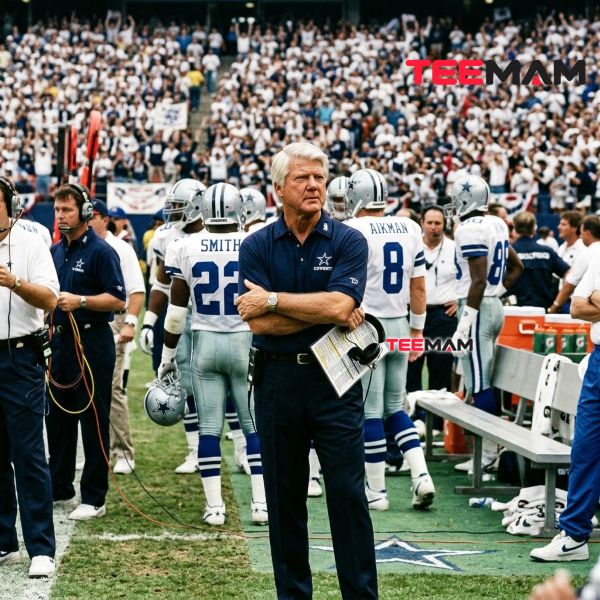
Jones hired his former Arkansas teammate Jimmy Johnson shortly after buying the team, making him the second man to hold the job. The early results were brutal. Dallas went 1-15 in Johnson’s first season, the worst record in the league, and the roster looked further from a title than at any point in franchise history.
Then came the trade that changed everything. Six games into that 1-15 season, Johnson and Jones shipped star running back Herschel Walker to the Minnesota Vikings for a package that eventually grew to 18 players and draft picks. Dallas turned that haul into Emmitt Smith, Darren Woodson, and Russell Maryland, and combined with Troy Aikman and Michael Irvin already on the roster, the Cowboys had a championship core in place within three seasons. That trio of Aikman, Irvin, and Smith became the on-field center of the transformation, a story we trace in more detail in our guide to the Dallas Cowboys Triplets era.
Dallas won Super Bowl XXVII after the 1992 season and repeated a year later against Buffalo in Super Bowl XXVIII. Johnson left with a 44-36 regular-season record and a dominant 7-1 mark in the playoffs.
Why did Jimmy Johnson leave the Cowboys? Johnson resigned in March 1994, roughly two months after his second straight championship, following a dispute with Jones over credit and personnel control. The two had been close friends since college, which made the split sting for fans watching a champion walk away at the height of its powers. Johnson didn’t take another NFL job until 1996 with Miami, and it took until 2023 for Jones to finally put him in the Cowboys Ring of Honor.
Barry Switzer Inherited a Championship Machine
Barry Switzer (1994-1997): Winning With Johnson’s Foundation
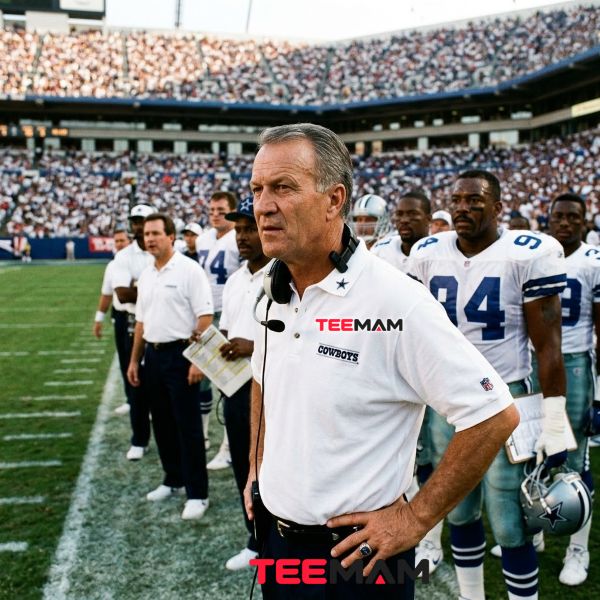
Switzer, a three-time national champion at Oklahoma, took over the job next, inheriting a locker room that had just won back-to-back Super Bowls. His first season ended with an NFC Championship loss to San Francisco, but in 1995 Dallas closed the deal, beating Pittsburgh 27-17 in Super Bowl XXX. That remains the franchise’s most recent Super Bowl appearance, three decades and counting.
Switzer finished his four years with a 40-24 regular-season record and a 45-26 mark including the playoffs. Where Johnson was famously exacting, Switzer leaned on the veteran leadership already in the building, which worked in 1995 but frayed as locker-room discipline slipped. He resigned after a 6-10 finish in 1997.
Switzer deserves full credit for navigating a championship roster through another title run. The reason his legacy remains more complicated than a Super Bowl ring suggests is that the core of that roster — Aikman, Irvin, Smith, and the rest — had already been assembled under Johnson.
The Cowboys Searched for Their Next Long-Term Identity
Chan Gailey and Dave Campo: The Post-Dynasty Transition
Chan Gailey took the job in 1998 and reached the playoffs in both of his seasons, going 18-14 in the regular season, but neither trip produced a postseason win as the Triplets core aged out. Gailey’s tenure is easy to overlook because it produced no playoff wins, but he inherited a roster already moving beyond its championship window and still kept the Cowboys in the postseason both years — his shortfall was less a sudden collapse than an organization searching for its next identity.
Dave Campo followed and finished 15-33 from 2000 through 2002, the worst stretch of losing the Cowboys had seen since the expansion years. The talent that had carried three championships was gone, and neither coach had the personnel to replace it fast.
Bill Parcells (2003-2006): Rebuilding Discipline and Expectations
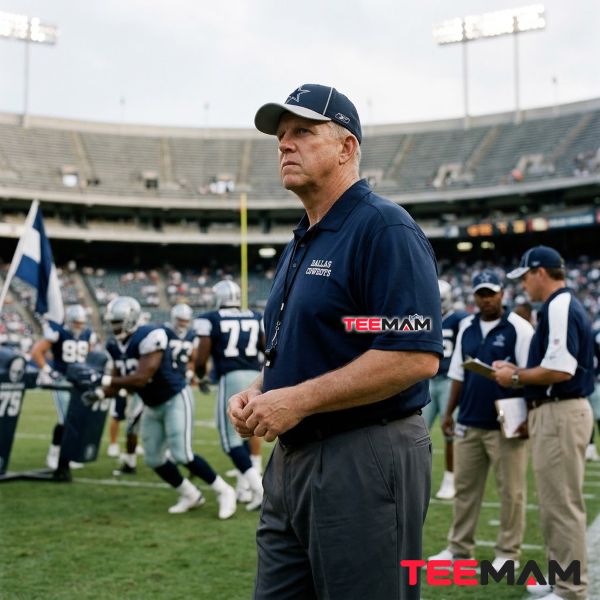
Jones brought in Bill Parcells, already a two-time Super Bowl champion with the Giants, hoping he could restore some order. It worked, to a point. Parcells made the playoffs in his first season and again in his fourth, and helped develop a young Tony Romo along the way. He finished 34-30 in the regular season with two first-round playoff exits, a 34-32 record overall.
Parcells never got Dallas back to a Super Bowl, but he restored structure and accountability to an organization that badly needed both. His legacy is easier to appreciate when the standard is organizational recovery rather than Lombardi Trophies. For a fuller look at how the franchise moved through this stretch and into the years that followed, see our guide to Dallas Cowboys history and heritage.
Wade Phillips (2007-2010): Winning Records, Playoff Frustration
Phillips took over in 2007 and immediately went 13-3, the franchise’s best regular season since the 1990s, only to lose in the divisional round to the Giants in a performance that drew criticism for the team’s preparation coming out of an extended layoff before the game. He finished 34-22 in the regular season and 1-2 in the playoffs before becoming the first Cowboys coach fired in the middle of a season, let go after a 1-7 start in 2010.
Jason Garrett Represented Stability Without a Championship Breakthrough
Jason Garrett (2010-2019): The Process Era
Garrett took over on an interim basis in 2010 after Phillips was fired, then held the job full time for nine more seasons, making him the second-longest-tenured coach in franchise history behind Landry. He finished 85-67 in the regular season, won three NFC East titles, and picked up NFL Coach of the Year honors in 2016.
Did Jason Garrett win a Super Bowl as Cowboys head coach? No. Garrett went 2-3 in the playoffs and never got past the divisional round, despite working with Romo and then a young Dak Prescott at quarterback, plus playmakers like Dez Bryant and Ezekiel Elliott. His era created a strange kind of familiarity for Cowboys fans: the team was good enough to stay relevant every fall but rarely dangerous enough in January to change the conversation around the franchise. That’s why his tenure can look stable on paper and frustrating in memory. Garrett’s “the standard is the standard” line became closely associated with his tenure among Cowboys fans. The Romo-to-Prescott handoff during his tenure is its own story, one we cover in our Dallas Cowboys quarterback legacy guide.
Jones parted ways with Garrett after an 8-8 finish in 2019, ending the longest coaching tenure the franchise had seen since Landry.
The Modern Cowboys Coaching Era
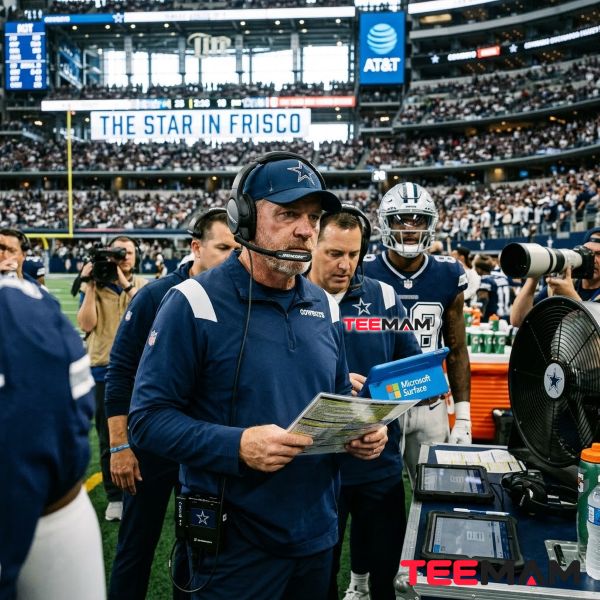
Mike McCarthy (2020-2024): Regular-Season Success, Playoff Frustration
Jones hired McCarthy in 2020, more than a decade after McCarthy had led Green Bay to a Super Bowl title, hoping a proven champion could finally push Dallas past the plateau. It worked in the regular season better than almost any stretch since the dynasty years: three straight 12-5 seasons from 2021 through 2023, Dallas’s best three-year regular-season run since Johnson and Switzer. McCarthy finished 49-35 overall in Dallas.
The playoffs told a different story. McCarthy went 1-3 in the postseason, including back-to-back home losses to the 49ers and the Packers, and the Cowboys never advanced past the divisional round. A 7-10 collapse in 2024, worsened by injuries to Prescott and several other starters, ended his run after five seasons. Jones moved on, and McCarthy is now the head coach of the Pittsburgh Steelers, a move confirmed by both teams in January 2026.
Brian Schottenheimer: The Current Dallas Cowboys Head Coach
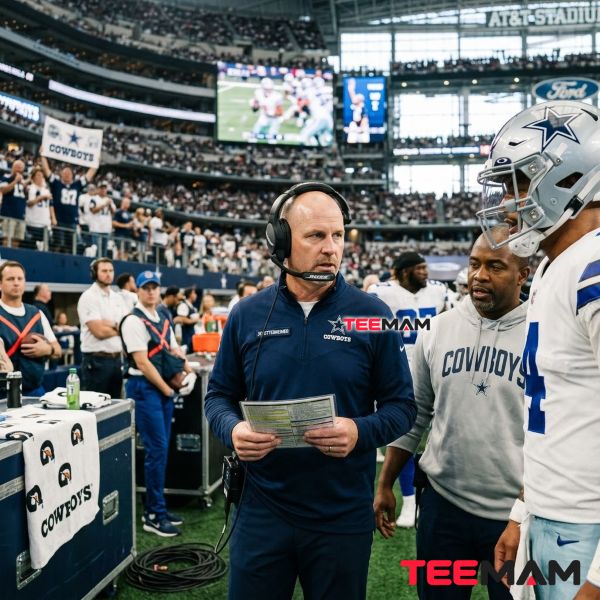
Brian Schottenheimer is the current Dallas Cowboys head coach, having taken over the position in 2025 after Mike McCarthy’s departure — officially the 10th head coach in franchise history. Jones promoted him from Dallas’s own offensive coordinator staff, a familiar internal hire rather than the kind of splashy outside name the Cowboys have often pursued in the past. His first season produced a 7-9-1 record and a second straight year outside the playoffs, complicated by the offseason trade of star pass rusher Micah Parsons to Green Bay in August 2025 and a defense that struggled badly to keep points off the board.
Entering 2026, the pressure has only gone up. Schottenheimer begins his second season with a largely intact offensive core, and the team overhauled its defensive staff, hiring Christian Parker as coordinator after one season with Matt Eberflus. Whether Schottenheimer settles into the job or becomes another short chapter is still an open question, and that question is really the whole story of this position: the roster in Dallas rarely lacks talent, but the runway to prove it usually runs short.
The Job Has Gotten Louder, Not Just Harder
Landry and Schottenheimer face the same basic scoreboard: win games, manage Jerry Jones, and hold a locker room together under a bright light. The difference is how fast the verdict arrives. Landry could lose on Sunday and have a week before the next round of scrutiny. A head coach today can read the Monday-morning quarterbacking in real time, often before the postgame media cycle has even settled.
How to Judge a Dallas Cowboys Head Coach: Inherited vs. Built
Super Bowl rings tell only part of the story. The harder — and more useful — question is what each coach inherited and what he actually changed.
| Head Coach | What He Inherited | What He Changed | Legacy |
|---|---|---|---|
| Landry | An expansion roster with no identity | Built the system and culture from scratch | Franchise foundation |
| Johnson | A 1-15 team | Rebuilt the roster through trades and the draft | 1990s dynasty |
| Switzer | A championship-ready roster | Maintained the veteran core | Fifth Super Bowl title |
| Gailey / Campo | An aging championship core | Little continuity or replacement talent | Post-dynasty decline |
| Parcells | An organization in disarray | Restored discipline and structure | Organizational reset |
| Phillips | A talented, veteran roster | Strong regular-season play, no deep playoff run | Winning records, playoff frustration |
| Garrett | An inconsistent roster in transition | Built long-term stability | Consistency without a breakthrough |
| McCarthy | An established Prescott-led offense | Elite regular-season production | Best three-year stretch since the 1990s, no playoff run |
| Schottenheimer | A talented but flawed 2024 roster | Still being written | Current chapter |
This is a more useful lens than ranking every coach on Super Bowl count alone: it separates the coaches who built something from the ones who managed what they were handed.
What Makes a Great Dallas Cowboys Head Coach?
Championship results aren’t the only measure. Playoff consistency, roster construction, and player development all shape how a tenure ages. Johnson gets credit for rebuilding a 1-15 team into a champion at remarkable speed. Switzer gets credit for closing the deal on a roster someone else built. Garrett and McCarthy both produced regular-season winners without ever solving the playoff problem, and that’s its own distinct kind of failure.
Comparing eras requires real context. Landry coached without free agency or a salary cap; every coach since has had to build and rebuild around constraints he never faced. That doesn’t make his 20 straight winning seasons less impressive, but it does mean a direct head-to-head with a modern coach isn’t quite fair to either side.
Being the Dallas Cowboys head coach is different from coaching almost anywhere else in the NFL. Jerry Jones has been both owner and general manager since 1989, and he’s never been shy about staying involved in personnel calls. Add in a national media market, decades of championship expectations, and a locker room that draws more outside attention than most others in the league, and calling plays is only part of the job description. That’s also why Cowboys history matters beyond coaching records — at TeeMam, we look at the traditions and fan stories behind each era because those details explain why different generations remember the franchise so differently.
How Coaching Legacy Shaped Cowboys Fan Culture
Every era left its own fingerprint on how fans remember game day. Landry’s formal sideline presence — the fedora, the suit — became shorthand for the franchise’s rise from expansion team to national institution. Johnson’s swagger and his “How ’bout them Cowboys” call after Super Bowl XXVII defined the 1990s in a completely different key: loud, confident, unapologetic. Switzer kept that momentum alive even as the tone shifted. Parcells brought a colder, more businesslike energy built around discipline. Garrett’s steady-hand approach became a running theme among fans who’d watched nine years of near-misses. Today’s coaches operate under a level of real-time scrutiny none of their predecessors had to survive.
Those sideline personalities aren’t trivia. A fan who grew up on Landry’s Cowboys remembers something entirely different from someone whose formative years came during the Triplets era, or during Garrett’s decade at Valley Ranch and later The Star in Frisco.
The Quarterbacks and Rosters Behind Each Era
Coaching legacy can’t be separated from the players a coach had to work with. Landry built his eras around Don Meredith, then Roger Staubach and Danny White. Johnson had Aikman, Irvin, and Smith. Switzer inherited that same core. Garrett coached Romo through his prime and then handed the offense to a young Prescott. Every future head coach in Dallas will ultimately be judged by how effectively he maximizes Prescott, CeeDee Lamb, and the rest of an offense that has rarely been the problem.
Johnson’s dynasty also shows why draft capital matters when judging a coach’s legacy — the Herschel Walker trade didn’t just produce individual players, it created a chain of draft assets that shaped multiple roster decisions for years afterward. Our Dallas Cowboys draft history and strategy guide follows that process in detail.
Which Cowboys Coach Left the Biggest Legacy?
| Measure | Coach to Highlight |
|---|---|
| Longevity and tactical innovation | Tom Landry |
| Rebuilding a losing team into a dynasty | Jimmy Johnson |
| Sustaining Super Bowl momentum | Barry Switzer |
| Restoring organizational discipline | Bill Parcells |
| Long-term regular-season stability | Jason Garrett |
| Best three-year regular-season stretch since the 1990s | Mike McCarthy |
Questions Fans Ask About Cowboys Coaching History
Who was the longest-serving Dallas Cowboys head coach?
Tom Landry, who held the job for 29 seasons from 1960 to 1988. Jason Garrett is a distant second, having coached parts of ten seasons including his 2010 interim stint.
How many Super Bowls did Tom Landry win?
Two, Super Bowl VI and Super Bowl XII, out of five total Super Bowl appearances with the Cowboys.
Which Dallas Cowboys head coach won the most Super Bowls?
No Cowboys coach has won more than two. Landry won Super Bowls VI and XII, and Jimmy Johnson won Super Bowls XXVII and XXVIII. Barry Switzer is the only other Cowboys coach with a title, winning Super Bowl XXX.
Why did Jimmy Johnson leave Dallas?
Johnson resigned in 1994 after a falling-out with Jerry Jones over credit and personnel control, just months after winning back-to-back Super Bowls.
Who has the strongest coaching legacy in Cowboys history?
Tom Landry has the strongest case on longevity, innovation, and sustained winning. Jimmy Johnson has the strongest case for rapid, dynasty-building transformation. Most historical rankings treat the two as co-anchors of the franchise’s coaching legacy rather than picking one over the other.
How has the Cowboys coaching job changed over time?
The core job — win games and manage Jerry Jones — hasn’t changed much. What’s different is the speed of scrutiny: 24-hour sports talk, social media, and real-time analytics mean a coach’s decisions get picked apart before the game is even over, something Landry and even Parcells never had to deal with.
From Landry’s Fedora to the Modern Sideline
Coaching eras leave a visible mark on how fans dress on game day. Landry’s formal look, suit and fedora even in Texas heat, still shows up in throwback gear decades later. Johnson’s championship years cemented the star logo and the silver-and-blue color scheme as symbols that go well beyond football. Coaching eras also shape the way fans express nostalgia: a vintage-inspired jacket, a classic cap, or an old-school game-day layer can evoke a specific Cowboys generation without turning the outfit into a costume, whether that’s the Landry years, the Triplets dynasty, or the Prescott-era teams filling AT&T Stadium today.
Why the Cowboys Coaching Legacy Still Matters
Landry built the identity from nothing. Johnson turned that foundation into a championship dynasty. Switzer closed out a fifth Lombardi Trophy with the same core. Parcells restored structure after the fall, and Garrett brought nine years of stability that never quite broke through. McCarthy delivered the best regular-season stretch since the 1990s and still couldn’t solve the playoffs. Whoever becomes the next Dallas Cowboys head coach — whether Schottenheimer holds the job for years or Jerry Jones eventually turns to someone new — inherits all of that history at once, and will be judged against a standard that Landry and Johnson set decades before they ever walked into The Star.
Sources
- Tom Landry, Pro Football Hall of Fame
- Dallas Cowboys team history, Pro Football Hall of Fame
- Dallas Cowboys Coaches, Pro Football Reference
- Rank’Em: Head coaches in Cowboys history, DallasCowboys.com
- Why Jerry Jones put Jimmy Johnson in the Cowboys Ring of Honor, ESPN
- Source: Mike McCarthy not expected to return as Cowboys coach, ESPN

Hi, I’m Olivia Bennett, a fashion and lifestyle writer at TeeMam with 6 years of experience creating content about fashion, outfits, and lifestyle trends. I enjoy sharing practical style ideas for everyday wear, game days, holidays, and special occasions, helping readers find looks that feel comfortable, fun, and uniquely their own.