Dallas Cowboys Quarterback Legacy: From Staubach to Prescott
Dallas has handed the football to five men who mattered: Roger Staubach, Danny White, Troy Aikman, Tony Romo, and Dak Prescott. Each inherited a different version of the franchise, and each left it changed. The Troy Aikman Dallas Cowboys era sits at the center of that story, not because the others don’t matter, but because no stretch of Cowboys football is quoted, replayed, and argued about more than the three championships he delivered in the 1990s.
Troy Aikman was Dallas’s starting quarterback from 1989 through 2000. He led the franchise to three Super Bowl victories in a four-season span (1992 through 1995) and was named MVP of Super Bowl XXVII. That single fact anchors almost every debate about the greatest quarterback in Cowboys history, even from fans who never saw him play. Most people searching Troy Aikman Dallas Cowboys history want to know exactly where he ranks among the other four men who have held the job.
For the fuller story of how the franchise got to that point, and where it has gone since, our Dallas Cowboys history and heritage guide covers the eras in more depth.
The Dallas Cowboys quarterback timeline at a glance
| Quarterback | Years with Dallas | Defining legacy | Super Bowl wins |
|---|---|---|---|
| Roger Staubach | 1969 to 1979 | Built the “America’s Team” identity | 2 (VI, XII) |
| Danny White | 1976 to 1988 | Carried the team through a hard transition | 0 as starter |
| Troy Aikman | 1989 to 2000 | Anchor of the 1990s dynasty | 3 (XXVII, XXVIII, XXX) |
| Tony Romo | 2003 to 2016 | Cowboys’ career touchdown-passing leader | 0 |
| Dak Prescott | 2016 to present | Cowboys’ career passing-yardage leader | 0 |
The five Super Bowl victories in Cowboys history divide between just two quarterbacks: Staubach won two, and Aikman won three. Nobody else on this list has won one.
Roger Staubach built the first modern Cowboys quarterback legacy
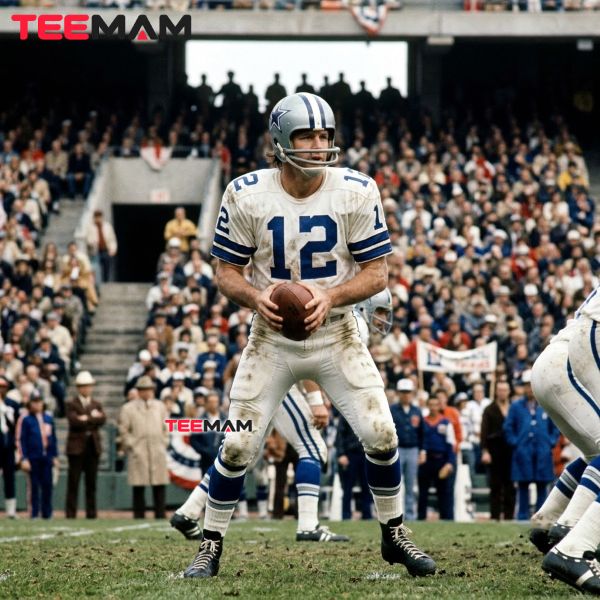
Staubach was drafted by Dallas in 1964, but he owed the U.S. Navy four years of service first, including a deployment to Vietnam, so he did not make his NFL debut until he was 27. He took the starting job in 1971 at age 29, carrying a military officer’s composure into a locker room of much younger players.
That background is why the nicknames stuck: “Captain America” for what he represented, “Captain Comeback” for what he did in the fourth quarter. Staubach led Dallas to four Super Bowls as a starter, winning Super Bowl VI over Miami and Super Bowl XII over Denver, and his touchdown pass to Drew Pearson against Minnesota in the 1975 playoffs helped popularize the term “Hail Mary” in football. When national broadcasters started calling Dallas “America’s Team” in the late 1970s, it was Staubach’s face behind the label. His No. 12 still functions in Cowboys circles as a piece of history rather than just a jersey number.
Danny White was the bridge between two Cowboys eras
Following a legend is one of the hardest assignments in sports, and Danny White drew it when Staubach retired after the 1979 season. White had already spent four years as Dallas’s punter and backup quarterback, so the transition wasn’t a shock to the locker room, but the results still lived in Staubach’s shadow.
White went 62-30 as a starter and guided Dallas to three straight NFC Championship Games from 1980 through 1982, losing all three, most painfully in 1981 against San Francisco on Dwight Clark’s “The Catch.” He never won a Super Bowl as the starting quarterback, which is the main reason his name rarely surfaces in greatest-of-all-time conversations. His years matter for a different reason: they explain exactly what kind of roster and culture Troy Aikman was walking into in 1989, after Dallas had slid from perennial contender to a team stuck at the NFC title-game ceiling under an aging Tom Landry. That decline, and the coaching change that ended it, is part of the larger Dallas Cowboys coaching legacy, since Jimmy Johnson’s arrival alongside Aikman in 1989 is where the rebuild actually begins.
Troy Aikman and the 1990s Cowboys dynasty
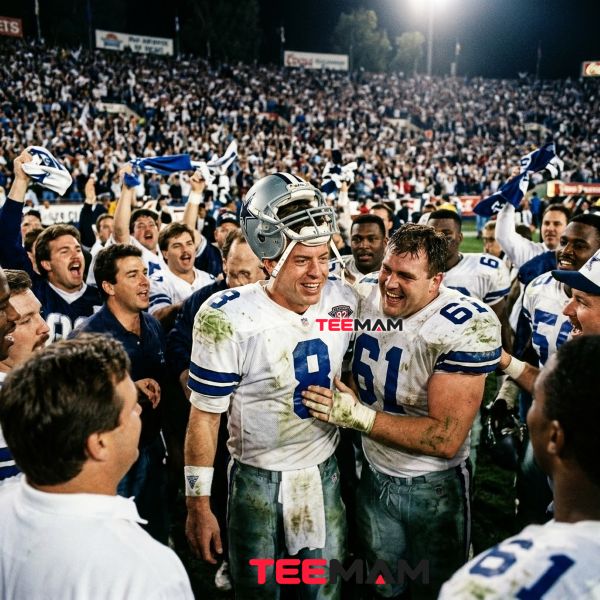
The Troy Aikman Dallas Cowboys story starts near the bottom, not the top. Aikman, a UCLA product, was the first overall pick in the 1989 NFL Draft, joining a team that had just fired longtime coach Tom Landry and hired Jimmy Johnson, who had built his reputation as head coach at the University of Miami. His rookie season could hardly have gone worse: Dallas finished 1-15, and Aikman went 0-11 as a starter, absorbing hits behind an unfinished offensive line.
How Aikman changed the Cowboys
The turnaround did not take long. Owner Jerry Jones and Johnson rebuilt the roster largely through the 1989 trade that sent star running back Herschel Walker to the Minnesota Vikings, a deal that gave Dallas a haul of draft picks and became the foundation of the roster rebuild around Aikman. In 1991, Johnson hired Norv Turner as offensive coordinator, and Turner built a downfield passing scheme around Aikman’s accuracy and arm strength, turning what had been one of the NFL’s worst offenses into one of its best within two seasons.
Troy Aikman, Emmitt Smith, and Michael Irvin
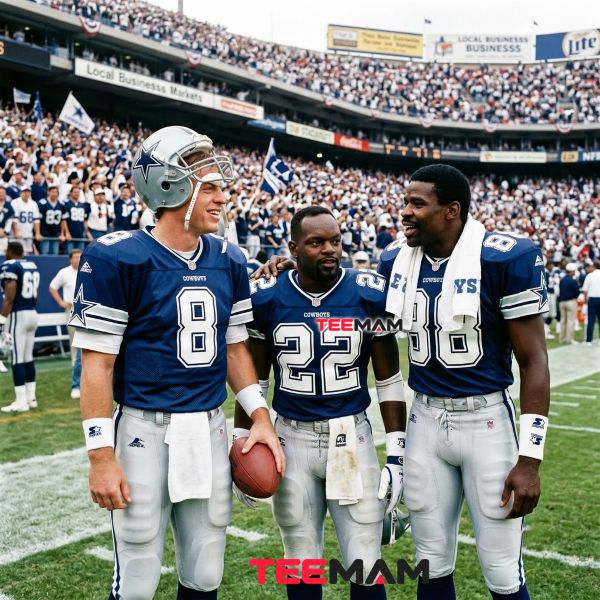
The “Triplets” nickname gets repeated so often that it can flatten how the three actually worked together. Aikman read defenses and distributed the ball on time. Emmitt Smith punished any defense that loaded the box, which opened passing lanes underneath. Michael Irvin won contested catches on the outside, pulling safety help away from tight end Jay Novacek in the middle of the field. None of it would have functioned without the offensive line known as the Great Wall of Dallas, built around Nate Newton, Mark Stepnoski, Mark Tuinei, and Erik Williams, who gave Aikman time that most quarterbacks of that decade never got. Our breakdown of the Dallas Cowboys Triplets era goes deeper into how that whole unit was constructed, not just the three stars whose names made the highlight reels.
Jimmy Johnson, who coached both Aikman and Hall of Fame passer Dan Marino during his career, put it simply: “When it came to throwing the football, he was as good as anybody I ever coached.”
The Super Bowl years that defined his legacy
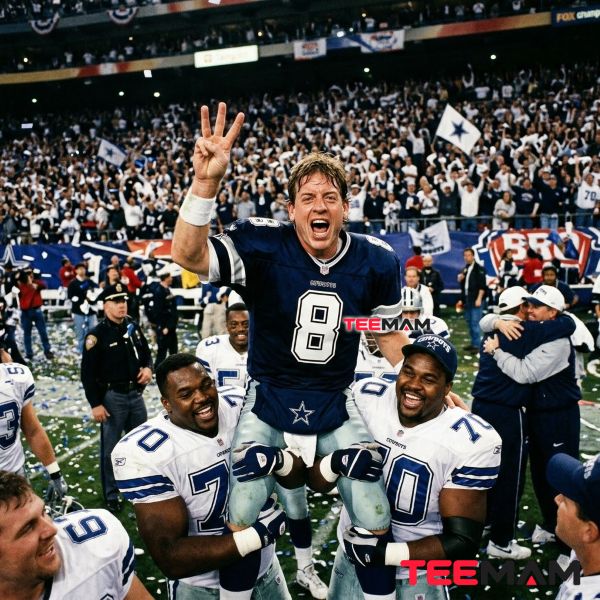
Dallas won three Super Bowls in four seasons, from 1992 through 1995. Super Bowl XXVII came after the 1992 season, a 52 to 17 rout of Buffalo in which Aikman threw four touchdowns and was named MVP. Super Bowl XXVIII followed the next year, a 30 to 13 rematch win over the same Bills team. Then, after Jimmy Johnson’s abrupt departure and a season under new head coach Barry Switzer, Dallas beat Pittsburgh 27 to 17 in Super Bowl XXX to close out the 1995 season. Aikman finished the decade with 90 regular-season wins, the most by any quarterback in any decade to that point in NFL history, and he retired with 32,942 passing yards and 165 touchdowns, both franchise records at the time, according to his Pro Football Hall of Fame profile.
Why No. 8 became a Cowboys cultural icon
Aikman’s No. 8, which the Cowboys have not formally retired, still carries a cultural weight that goes far beyond a typical jersey number. It shows up on throwback jerseys at Cowboys tailgates, worn by fans who were kids during the dynasty and now buy the same number for their own children. That is not really about the stat line. It is about what No. 8 represents: the last extended stretch of years when Dallas was unambiguously the best team in football. None of this happened because of one player. Jimmy Johnson’s roster construction, Norv Turner’s scheme, the Great Wall of Dallas up front, and a defense that included Charles Haley and Darren Woodson were essential parts of that dynasty alongside Aikman, not supporting details to be skipped past.
How Troy Aikman’s legacy compares with the other Cowboys quarterbacks
Aikman’s case becomes clearest when the five Cowboys quarterback eras are compared side by side. His advantage is postseason success; Staubach, Romo, and Prescott make stronger cases on other measures, whether that’s longevity, raw production, or historical context.
Aikman vs. Staubach. Staubach finished his career with 22,700 passing yards and 153 touchdowns; Aikman finished with 32,942 yards and 165 touchdowns. The two played in very different offensive eras, so the raw totals don’t settle much on their own. What does separate them is title count: Staubach won two Super Bowls in four trips over 11 seasons, Aikman won three in a tighter four-year window.
Aikman vs. Romo. That contrast between championship pedigree and raw production is central to any Troy Aikman Dallas Cowboys comparison with Tony Romo, who still holds the Cowboys’ career touchdown-passing record with 248, a mark Prescott has not yet caught. What Romo never got was a championship, or even a trip to the NFC Championship Game. The debate usually comes down to individual production against team success, and in Dallas, team success tends to win that argument.
Aikman vs. Prescott. Prescott plays under a hard salary cap, in a more pass-oriented modern NFL, and inside a media cycle that turns a single incompletion into a week of national debate. Raw stat comparisons between the two eras can mislead, because Aikman and Prescott operated in genuinely different versions of the league.
So, who was the best Dallas Cowboys quarterback? By championships, Troy Aikman has the strongest case: three Super Bowls in four seasons remains unmatched in franchise history. Staubach has the counterargument of four Super Bowl trips and the “America’s Team” identity he helped build. Romo and Prescott both own real statistical records, but neither has reached an NFC Championship Game as the Cowboys’ starting quarterback, which keeps them out of the top spot for most Cowboys fans.
Tony Romo kept the Cowboys relevant in a different era
Romo went undrafted out of Eastern Illinois in 2003, spent three seasons as a third-string quarterback and holder on field goals, and only took over as the starter in 2006 after Drew Bledsoe struggled. Once he had the job, he held it for a decade and finished his career as the franchise’s all-time leader in both passing yards and touchdown passes, a distinction he held until November 2025.
His postseason record is the harder part of the legacy to defend: Romo went 2-4 across six career playoff games and never advanced past the divisional round. Fans who watched him play mostly remember an improvisational, likable competitor who kept Dallas in the playoff conversation during years when the roster around him was often unfinished, whatever the win-loss column from January says.
Dak Prescott and the modern Cowboys quarterback era
Prescott inherited the starting job in 2016 almost by accident, stepping in as a fourth-round rookie after Romo’s preseason back injury, and never gave it back. He signed a four-year, $240 million extension in September 2024 and enters his 11th season with the franchise in 2026.
His place in the record book is still being written. On November 23, 2025, against Philadelphia, Prescott threw the pass that pushed him past Romo’s career mark of 34,183 passing yards, a milestone the Dallas Cowboys confirmed as he finished that game at 34,378 yards and the season at 35,989. He has not yet caught Romo in career touchdown passes, sitting at 243 to Romo’s 248, though the gap continues to close every season he starts. It is a fitting split: Prescott owns the yardage record, Romo still owns the touchdown record, and Aikman, whose 32,942 yards once looked untouchable, now sits third on that particular list.
None of that has translated into a trip back to the NFC Championship Game. Dallas has not reached that round since the 1995 season, a postseason drought that has now stretched across multiple coaching changes and roster rebuilds. The Troy Aikman Dallas Cowboys standard, three Super Bowls in four seasons, is one of the reasons Prescott’s career gets measured so harshly by comparison. He plays every fall under that weight while being evaluated in real time on social media and sports talk radio, a level of scrutiny Aikman’s dynasty seasons, consumed mostly through Monday-morning box scores and highlight reels, never had to withstand.
What the Cowboys quarterback legacy says about fan culture
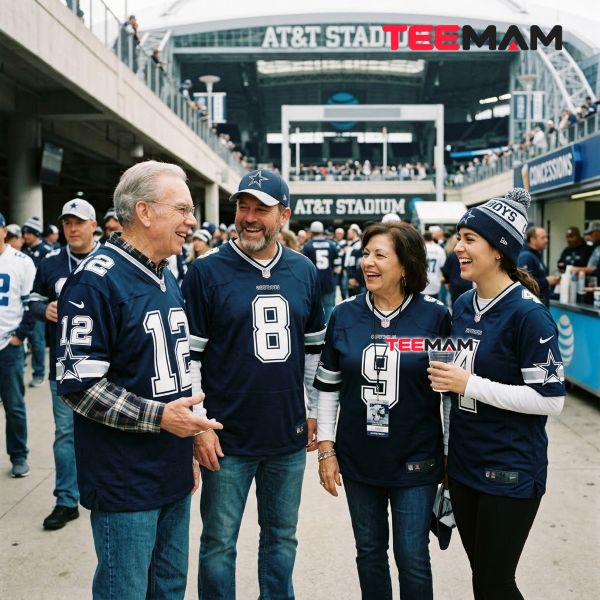
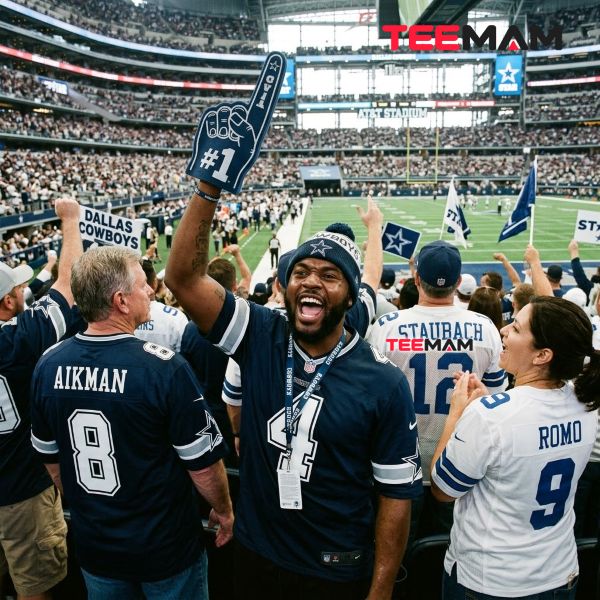
On Cowboys game days, the history is easy to see in the jerseys fans wear: a faded Staubach No. 12 beside a 1990s Aikman No. 8, a Romo No. 9 a few seats over, and Prescott’s No. 4 especially common among younger fans who grew up on the current era. Three generations of the same fanbase rarely agree on who the greatest was, and that disagreement is a fair summary of what this whole legacy is about.
Each era produced a different kind of fandom. Staubach represented tradition and grit. The Troy Aikman Dallas Cowboys years represent the franchise’s most recent sustained period of championship dominance, still the most reproduced piece of team nostalgia on game day. Romo represented personality and production without a ring to show for it. Prescott represents something closer to a modern athlete-brand, judged on availability, contract value, and weekly performance almost as much as on wins. Game-day style has followed the same arc, moving from classic 1970s looks to bold 1990s retro branding to the cleaner, modern cuts fans wear today, none of which changes who wins on Sundays but all of which signals which era a given fan belongs to. For a wider look at the players who shaped these eras beyond the quarterback position, see our list of the greatest Cowboys players in franchise history.
How to choose Cowboys apparel inspired by quarterback eras
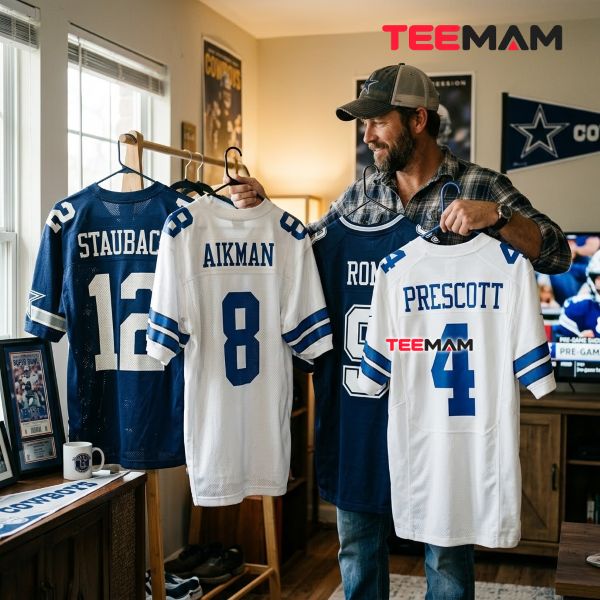
Fans tend to gravitate toward a specific look depending on which era hooked them.
| Fan preference | Style direction |
|---|---|
| Staubach era | Classic, vintage-inspired designs |
| Aikman era | 1990s retro colorways and graphics |
| Romo era | Mid-2000s Cowboys styling |
| Prescott era | Modern game-day fits |
| General Cowboys fan | Timeless navy, silver, and white staples |
A fan who grew up on Super Bowl XXX reruns usually wants something that echoes the 90s. A fan who started watching during the Romo years often prefers a cleaner, current look. We at TeeMam create print-on-demand apparel inspired by fan culture, team traditions, and the moments that make sports history meaningful. Fans who want to reflect a specific Cowboys era in what they wear can browse our Dallas Cowboys apparel by era collection.
The Cowboys quarterback legacy in one comparison
| Quarterback | Defining era | Biggest legacy | Fan identity |
|---|---|---|---|
| Staubach | 1970s | America’s Team | Tradition |
| White | 1980s | Transitional resilience | Underrated |
| Aikman | 1990s | Three Super Bowl wins | Dynasty |
| Romo | 2000s to 2010s | Franchise touchdown record | Personality |
| Prescott | 2016 to present | Franchise passing-yardage record | Modern scrutiny |
This is an editorial framework based on team success, individual records, and cultural impact. It is not an official league ranking.
The legacy Aikman leaves behind
Staubach set the standard for what a Cowboys quarterback should represent. White absorbed the pressure of following him without ever fully escaping his shadow. The Troy Aikman Dallas Cowboys teams of the 1990s turned that standard into three Super Bowls in four seasons, a run no Cowboys quarterback has come close to repeating since. Romo gave the franchise a different kind of connection, built on production and grit rather than rings. Prescott now carries all of that history into a league, and a media environment, that scrutinizes him more closely than it ever scrutinized Aikman.
Which Cowboys quarterback defined your favorite football era?
Questions Cowboys fans still ask about Troy Aikman and the QB legacy
When did Troy Aikman play for the Dallas Cowboys? Aikman played his entire 12-season NFL career with Dallas, from 1989 through 2000, after being selected first overall in the 1989 NFL Draft out of UCLA.
How many Super Bowls did Troy Aikman win with Dallas? Aikman won three Super Bowls with the Cowboys: Super Bowl XXVII, Super Bowl XXVIII, and Super Bowl XXX. He was named MVP of Super Bowl XXVII after throwing four touchdown passes against Buffalo.
Is Troy Aikman still the Cowboys’ all-time leading passer? No. Aikman held the franchise passing-yardage record after his retirement, but Tony Romo surpassed him, and Dak Prescott passed Romo for the yardage record in November 2025. Romo still holds the franchise record for career touchdown passes.
Was Troy Aikman the best Dallas Cowboys quarterback? By championships won, Aikman has the strongest claim of any quarterback in franchise history. Staubach’s four Super Bowl appearances and his role as the original “America’s Team” quarterback keep the debate closer than the trophy count alone suggests.
Who came after Troy Aikman in Dallas? Several quarterbacks started for Dallas in the years right after Aikman’s 2000 retirement before Tony Romo took over full-time in 2006 and became the franchise’s next long-term starter.
What made the 1990s Cowboys quarterback era special? The combination of Aikman’s decision-making, Emmitt Smith and Michael Irvin as complementary weapons, the Great Wall of Dallas offensive line, and Jimmy Johnson’s roster-building produced the Troy Aikman Dallas Cowboys dynasty fans still measure every era against: three Super Bowls in four seasons, a level of sustained success the franchise has not matched since.
Sources
- Troy Aikman | Pro Football Hall of Fame
- Dak Prescott Passes Tony Romo as Cowboys’ All-Time Leading Passer | Dallas Cowboys Official Site
- Cowboys’ Playoff Failures by the Numbers Since Last NFC Title Game Appearance | CBS Sports

Hi, I’m Olivia Bennett, a fashion and lifestyle writer at TeeMam with 6 years of experience creating content about fashion, outfits, and lifestyle trends. I enjoy sharing practical style ideas for everyday wear, game days, holidays, and special occasions, helping readers find looks that feel comfortable, fun, and uniquely their own.