Greatest Dallas Cowboys Players of All Time
Put two Cowboys fans in a room, ask them to name the best Dallas Cowboys players ever, and the argument will outlast the game on TV. The franchise joined the NFL in 1960 and has won five Super Bowls, and the Pro Football Hall of Fame counts 32 Hall of Famers tied to Dallas. This guide sticks to documented records and honors, and it treats “who is No. 1” as the open debate it is. Even the team’s own countdowns and national rankings disagree.
How We Define the Greatest Dallas Cowboys Players
There is no clean formula for comparing Dallas Cowboys players across six decades. A Super Bowl quarterback, a dominant defensive tackle and an all-time running back leave very different statistical footprints. The fairest comparison looks at championships, individual production, longevity, era context and a player’s lasting place in Cowboys history.
Championships and Postseason Impact
Dallas won Super Bowls VI, XII, XXVII, XXVIII and XXX along with eight NFC championships, so players who delivered in January get extra credit.
Individual Production and Era Context
Raw numbers can mislead across eras. Sacks did not become an official NFL statistic until 1982, so Bob Lilly’s era cannot be measured directly against DeMarcus Ware’s. Roger Staubach retired with an 83.4 passer rating, the best of any passer to that point, and Troy Aikman finished at 81.6, but they played in different eras, so a two-point gap settles nothing.
Longevity and Franchise Influence
Lilly started all 196 possible games in 14 seasons, Randy White missed one game in 14 years, and Jason Witten played a team-record 255. Among Dallas Cowboys players, availability is a skill.
Legacy Beyond the Stat Sheet
The Ring of Honor began in 1975 with Lilly, and the Pro Football Hall of Fame records show 32 Hall of Famers tied to the franchise.
The Cowboys Legends Who Defined the Franchise
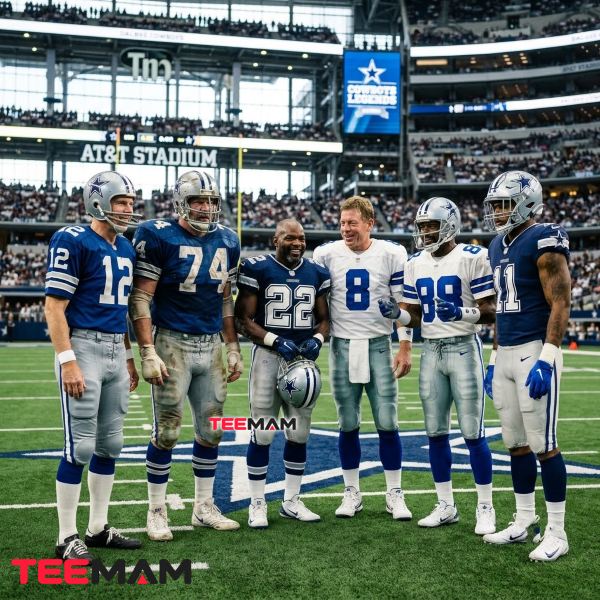
These twelve players cover the franchise’s most influential eras and positions, from the early defensive foundation to the 1990s dynasty and the modern era. The team’s official Top 50 countdown offers another point of comparison, though different methodologies produce different orders.
Emmitt Smith: The Cowboys’ All-Time Rushing Leader
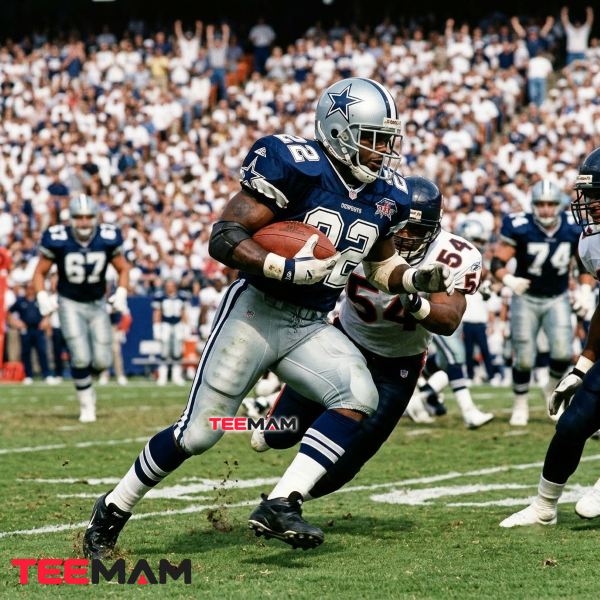
Smith gained 17,162 of his 18,355 career rushing yards in Dallas, and he passed Walter Payton as the NFL’s all-time leader against Seattle on Oct. 27, 2002. He won four rushing titles, the 1993 NFL MVP and Super Bowl XXVIII MVP, and strung together 11 straight 1,000-yard seasons. His 164 career rushing touchdowns were an NFL record at his retirement. He was the engine of the 1990s Cowboys dynasty.
Roger Staubach: The Quarterback Who Defined an Era
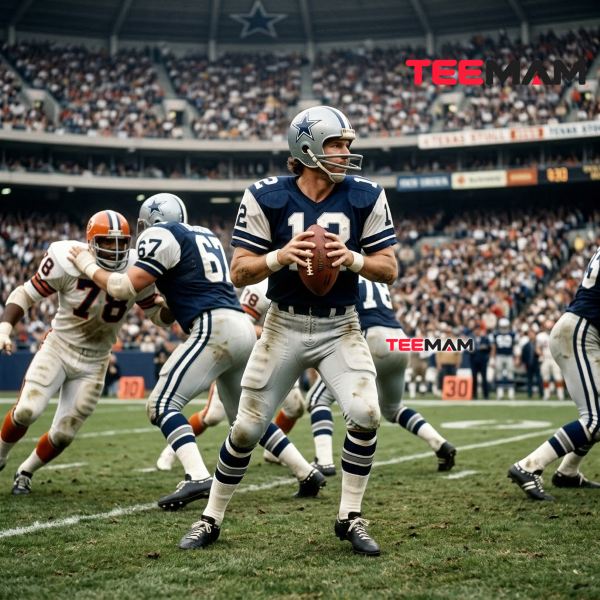
Staubach was 27 as a rookie in 1969 because of four years of Navy service, including Vietnam. With him in charge, Dallas played in six NFC title games, won four, and took Super Bowls VI and XII. His 1972 playoff rescue of San Francisco, two touchdown passes in the final 90 seconds for a 30-28 win, is still the template for late-game nerve, and the club credits him with 23 fourth-quarter comebacks. The Dallas Cowboys quarterback legacy starts with him.
Bob Lilly: The Foundation of the Doomsday Defense
Dallas made Lilly its first draft pick in 1961, and he became “Mr. Cowboy”: seven-time first-team All-Pro, 11-time Pro Bowler, 196 starts in 196 games. He was the first player who spent his entire career in Dallas to reach the Hall of Fame, in 1980. His 29-yard sack of Bob Griese in Super Bowl VI is the play people cite whenever the Doomsday Defense comes up.
Troy Aikman: The Quarterback of the 1990s Dynasty
Aikman’s rookie season in 1989 ended 1-15. By 1992 Dallas was 13-3, and he was Super Bowl XXVII MVP after going 22 of 30 for 273 yards and four touchdowns in a 52-17 win over Buffalo. Three titles in four seasons followed. He retired with 32,942 passing yards, 165 touchdowns and six Pro Bowls, and he was the winningest starting quarterback of any decade in NFL history.
Tony Dorsett: The Explosive Running Back of the 1970s
Dorsett won the 1976 Heisman at Pitt, took NFL Offensive Rookie of the Year in 1977, and scored the first touchdown of Super Bowl XII. His 99-yard run against Minnesota on Jan. 3, 1983 is an NFL record that can only be tied, and it happened with just ten Cowboys on the field because fullback Ron Springs missed the play call. Dorsett finished with 12,739 rushing yards and four Pro Bowls.
Michael Irvin: The Playmaker Behind the 1990s Dynasty
Irvin caught 750 passes for 11,904 yards and 65 touchdowns, made five straight Pro Bowls from 1991 to 1995, and set an NFL record with eleven 100-yard games in 1995 while piling up 1,603 yards on 111 catches. For a deeper look at how the Triplets offense fit together, the Dallas Cowboys Triplets era explained is a good next read.
Larry Allen: One of the NFL’s Most Dominant Offensive Linemen
Allen played every line spot except center across 12 Dallas seasons, made 10 Pro Bowls as a Cowboy (11 overall) and earned All-Pro honors seven straight years. He blocked for Smith’s Cowboys-record 1,773 yards in 1995. Jerry Jones called him “arguably the very best guard to ever play the game.”
Randy White: The Defensive Force of the 1970s
Drafted second overall in 1975, White spent his first two seasons being tested at linebacker before settling in at defensive tackle, where “The Manster” became the heart of the Doomsday Defense. He shared Super Bowl XII MVP honors with Harvey Martin, won NFC Defensive Player of the Year in 1978, and made nine straight Pro Bowls while missing one game in 14 seasons.
Mel Renfro: A Cornerstone of the Early Cowboys Defense
Renfro earned 10 Pro Bowl selections, spent six years at free safety and eight at cornerback, and still holds the team record with 52 interceptions. He played in four Super Bowls and entered the Hall of Fame in 1996.
Deion Sanders: The Superstar Who Joined the 1990s Cowboys
Sanders joined Dallas in 1995 after winning Defensive Player of the Year with San Francisco. He started at cornerback in Super Bowl XXX and caught a 47-yard pass that set up Dallas’s first touchdown in the 27-17 win over Pittsburgh. He played five seasons in Dallas, entered the Hall of Fame in 2011, and remains the only person to play in both a World Series and a Super Bowl. A fuller account lives in the Deion Sanders Cowboys legacy piece.
Jason Witten: The Modern-Era Cowboys Icon
Witten holds franchise records with 1,215 receptions, 12,977 receiving yards and 255 games played, and his 11 Pro Bowls tie Lilly for the team high. He missed exactly one game in his career, a rookie-year broken jaw. He was a first-year candidate for the 2026 Hall of Fame class and was not selected, so his Hall of Fame case remains unresolved.
DeMarcus Ware: The Modern Defensive Sack Leader
Ware’s 117 sacks in Dallas remain the franchise record, part of 138.5 career sacks. He led the NFL with 20 sacks in 2008 and 15.5 in 2010, earned four first-team All-Pro nods, and made seven Pro Bowls as a Cowboy and nine overall. Hall of Fame Class of 2023, then the Ring of Honor that October.
Other Cowboys Legends Worth Knowing
A dozen profiles still leave out names that any list of Cowboys all-time greats has to mention. Bob Hayes, the 1964 Olympic 100-meter champion, forced defenses into deep double coverage, according to the Hall of Fame. Chuck Howley was the first defensive player to win Super Bowl MVP and remains the only one from a losing team, after Super Bowl V. Rayfield Wright, a six-time Pro Bowl tackle, entered the Hall of Fame in 2006, and Cliff Harris played in five Super Bowls at safety before his own election in 2020. Harvey Martin shared the Super Bowl XII MVP with White, and Don Meredith led Dallas to its first winning season in 1966 and was named NFL Player of the Year.
Which Dallas Cowboys Legends Represent Each Era?
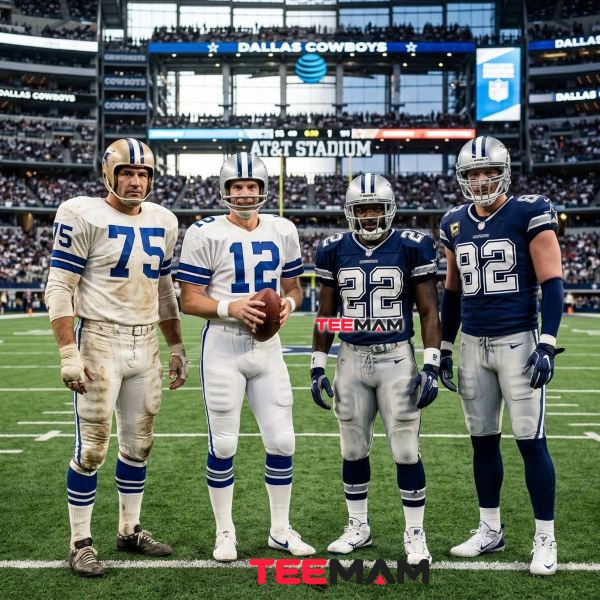
| Era | Representative players |
|---|---|
| 1960s | Bob Lilly, Mel Renfro, Bob Hayes, Don Meredith |
| 1970s | Roger Staubach, Randy White, Tony Dorsett, Cliff Harris |
| 1990s | Troy Aikman, Emmitt Smith, Michael Irvin, Larry Allen, Deion Sanders |
| 2000s to 2010s | Jason Witten, DeMarcus Ware, Tony Romo |
Which era produced the most famous Cowboys legends?
The 1970s and 1990s stand out for different reasons. The 1970s Cowboys were built on Tom Landry’s coaching, the Doomsday Defense and Staubach’s offense. The 1990s team won three Super Bowls in four seasons with Aikman, Smith and Irvin, plus Allen up front and Sanders in the secondary. The 2000s and 2010s produced record-setters such as Witten and Ware without another Super Bowl title. That context matters when comparing Dallas Cowboys players from different generations, and the Dallas Cowboys history and heritage guide fills in the seasons between these names.
The Cowboys Jersey Numbers That Became Part of NFL Culture
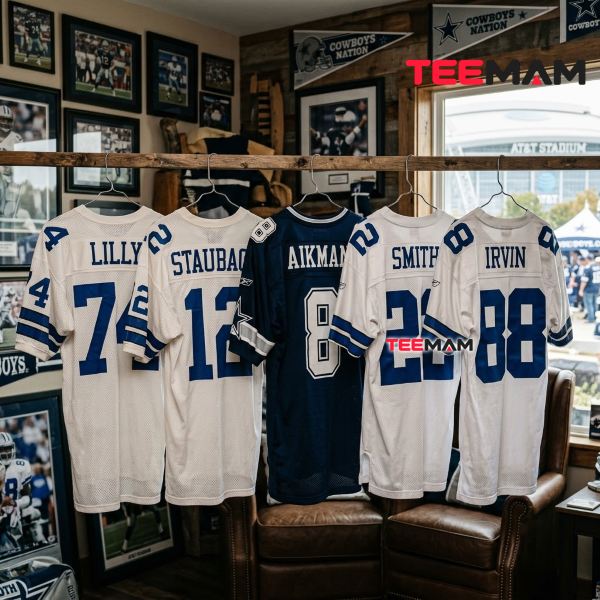
The Cowboys have never officially retired a number, but 8 (Aikman), 12 (Staubach), 22 (Smith) and 74 (Lilly) have stayed out of regular-season circulation for years, and Lilly’s 74 has appeared only in preseason. No. 88 works the other way: it has passed from Drew Pearson to Irvin, Dez Bryant and CeeDee Lamb. Historical weight and merchandise popularity are different things, and our Dallas Cowboys jersey numbers guide sorts out which numbers carry which stories.
Why Cowboys Player Numbers Still Matter to Fans
A number becomes a shortcut for a specific era of Cowboys football. A fan may inherit No. 12 from one generation, discover No. 22 through another, or associate No. 88 with several different receivers. That is part of why the numbers of Dallas Cowboys players from the 1970s and 1990s still show up next to current jerseys. Authentic jerseys, replicas and graphic tees each signal something different, from loyalty to one player to affection for an era.
From Throwback Jerseys to Everyday Fan Apparel
Some fans want a specific number, some want dynasty-era artwork, and others prefer Cowboys themes that reference an era without copying an official jersey. At TeeMam, we approach Cowboys-inspired apparel as a way to connect fan culture with the stories behind the players, eras and traditions that make the franchise recognizable. For fans exploring Cowboys-inspired apparel, the easiest starting point is often the era they connect with most, and these Dallas Cowboys fan apparel ideas are one way to browse.
How the Greatest Cowboys Players Changed the Franchise
Changing the Offense
Among Cowboys offensive legends, Staubach brought late-game poise, Aikman precision, Smith durability, Irvin toughness and Witten reliability.
Defining Defensive Identity
Among Dallas Cowboys players on defense, Lilly and White anchored the Doomsday Defense, Renfro set the standard in the secondary, Ware made the pass rush a weapon, and Sanders covered one side of the field in the 1990s.
Creating Generational Fan Memories
Fans who grew up on the 1970s, the 1990s or the modern era carry different names and highlights, and those memories get passed along in families. That helps explain why former Dallas Cowboys players stay in the conversation long after retirement.
Frequently Asked Questions About Cowboys Legends
Who Is Considered the Greatest Dallas Cowboy Ever?
There is no official consensus on the greatest Dallas Cowboy ever. Staubach, Smith, Lilly and Aikman are the most frequently cited candidates, but rankings vary with how much weight goes to championships, production, longevity or peak dominance. The team’s Top 50 countdown put Staubach first, a Sporting News ranking led with Smith, and NFL.com’s 2018 all-time XI listed Aikman first.
Who Are the Most Famous Dallas Cowboys Players?
Among the most recognizable Dallas Cowboys players are Staubach, Smith, Aikman, Irvin, Lilly, Dorsett and Sanders. Each is tied to a distinct identity, from comeback quarterback to Doomsday anchor.
Who Are the Best Cowboys Running Backs of All Time?
Smith is the clear franchise leader and the NFL’s career rushing leader with 18,355 yards. Dorsett is the explosive second option, with 12,739 career yards and the 99-yard run. Original-era back Don Perkins ranked 18th on the team’s Top 50 list.
Who Were the Cowboys Triplets?
Quarterback Troy Aikman, running back Emmitt Smith and receiver Michael Irvin formed the core of the 1990s offense that won Super Bowls XXVII, XXVIII and XXX. The three entered the Ring of Honor together on Sept. 19, 2005.
Which Cowboys Players Are in the Pro Football Hall of Fame?
The Hall of Fame lists 32 Hall of Famers for the franchise, including coaches, executives and players who spent only part of their careers in Dallas, such as Terrell Owens and Mike Ditka. Staubach, Lilly, Smith, Aikman, Irvin, Dorsett, White, Renfro, Allen, Sanders, Ware, Hayes, Wright, Harris and Howley are among the best-known players.
Which Cowboys Jersey Numbers Are Most Associated With Legends?
No. 8 is Aikman, No. 12 is Staubach, No. 22 is Smith, No. 74 is Lilly and No. 88 is the receiver tradition from Pearson through Irvin to Lamb.
A Legacy That Continues Across Generations
Cowboys history spans more than six decades, and greatness inside it is never only about statistics. Different Dallas Cowboys players represent different eras: Lilly’s Doomsday Defense, Staubach’s comebacks, the 1990s Triplets, the record-setting stretch of Witten and Ware. Championships, records, offense, defense and fan culture all feed the franchise’s identity, which is why the debate over its best will keep running.
Sources
- Pro Football Hall of Fame: Dallas Cowboys team page (franchise history, Super Bowl titles, Hall of Fame count)
- DallasCowboys.com: Cowboys Top 50 countdown (historical player rankings)
- DallasCowboys.com: Witten and the 2026 Hall of Fame class (Hall of Fame candidacy and result)

Hi, I’m Olivia Bennett, a fashion and lifestyle writer at TeeMam with 6 years of experience creating content about fashion, outfits, and lifestyle trends. I enjoy sharing practical style ideas for everyday wear, game days, holidays, and special occasions, helping readers find looks that feel comfortable, fun, and uniquely their own.