Dallas Cowboys Draft History: Iconic Picks That Shaped the Franchise
What Makes Dallas Cowboys Draft History So Important?
Every great NFL roster starts somewhere, and for Dallas, most of the big turning points trace back to a draft room. Some of the most important moments in Dallas Cowboys draft history happened in the first round, in plain sight. Others happened in the 10th round, when almost nobody was paying attention. A couple of the biggest wins in franchise history did not come from a draft pick at all. They came from a trade that quietly rewired how the team would build its roster for the next decade.
This guide breaks that Dallas Cowboys draft history into three pieces: the picks that became franchise cornerstones, the trade that turned into a pipeline of extra draft capital, and the late-round finds nobody projected. An iconic Cowboys draft pick, in the way we’re using the term here, is a selection whose career production and lasting influence on the roster outran where he was actually chosen.
Dallas Cowboys Draft History at a Glance
| Era | Player / Event | Draft Details | Franchise Impact |
|---|---|---|---|
| 1961 | Bob Lilly | Round 1, No. 13 overall | Franchise’s first-ever draft pick; Hall of Fame defensive tackle |
| 1964 | Roger Staubach | Round 10, No. 129 overall | Two-time Super Bowl champion, Hall of Fame QB |
| 1974 | Ed “Too Tall” Jones | Round 1, No. 1 overall | Cowboys’ first-ever No. 1 overall pick; Super Bowl XII champion |
| 1977 | Tony Dorsett | Round 1, No. 2 overall | Rookie of the Year, Super Bowl XII champion |
| 1988 | Michael Irvin | Round 1, No. 11 overall | Three-time Super Bowl champion, “The Playmaker” |
| 1989 | Troy Aikman | Round 1, No. 1 overall | Cowboys’ second No. 1 overall pick; three Super Bowl titles |
| 1989 | Herschel Walker trade | Multi-team trade, not a draft pick | Supplied the draft capital behind the 1990s dynasty |
| 1990 | Emmitt Smith | Round 1, No. 17 overall | NFL’s all-time leading rusher |
| 1991 | Russell Maryland | Round 1, No. 1 overall | Cowboys’ third No. 1 overall pick; three Super Bowl titles |
| 2016 | Dak Prescott | Round 4, No. 135 overall | Longtime starting quarterback, Offensive Rookie of the Year |
| 2020 | CeeDee Lamb | Round 1, No. 17 overall | Starting wide receiver and top offensive weapon |
| 2021 | Micah Parsons | Round 1, No. 12 overall | Traded to Green Bay in 2025 for two future first-round picks |
| 2026 | Caleb Downs | Round 1, No. 11 overall | First-round safety selected after Dallas traded up from No. 12 |
What Counts as an Iconic Cowboys Draft Pick?
An iconic Cowboys draft pick isn’t just a player who happened to go in the first round and worked out. It’s a selection whose career value and staying power on the roster outpaced his draft slot. Roger Staubach came off the board 128 picks after other quarterbacks who never sniffed his career. Dak Prescott was the third quarterback taken in his own draft class. Both ended up outproducing players picked far earlier, which is the whole point of studying draft slot in the first place: it tells you where a scouting department ranked a player on one weekend in one year. It doesn’t tell you what he’ll actually do with the opportunity.
How Cowboys Draft Decisions Create Long-Term Franchise Value
Looking across more than six decades of Cowboys personnel decisions, the biggest draft wins tend to fall into three broad categories.
Direct impact. A single pick becomes a foundational piece almost immediately. Troy Aikman, Tony Dorsett and Michael Irvin all fit here: high picks who played close to their draft billing from day one.
Compounding value. A trade generates draft capital that pays off over several future drafts rather than one draft night. The Herschel Walker trade is the clearest example in league history, not just Cowboys history.
Draft-position value. A player falls well past where his career output says he should have gone. Staubach and Prescott are the textbook cases, separated by more than 50 years but proving the same point.
Reading Dallas Cowboys draft history through these three lenses explains why the franchise’s best stretches were never about hitting on one big name. They were about stacking wins across all three categories at once, which is exactly what happened between 1988 and 1990.
The Draft Picks That Built the Cowboys’ Early Identity
Long before the 1990s dynasty, a run of picks across the 1960s and 1970s set the tone for how Dallas would approach the draft going forward.
Bob Lilly: Where It All Started
Dallas made its first-ever draft selection in 1961, taking TCU defensive tackle Bob Lilly with the 13th overall pick. Lilly became “Mr. Cowboy,” anchoring the Doomsday Defense for 14 seasons, making 11 Pro Bowls, and becoming the franchise’s first Pro Football Hall of Famer in 1980. That distinction is worth keeping straight when tracing Dallas Cowboys draft history: Lilly was the franchise’s first-ever draft pick, but he wasn’t a No. 1 overall selection. That milestone belonged to a different player, more than a decade later.
Roger Staubach: The Historic Late-Round Gamble
What round was Roger Staubach drafted by the Cowboys? The 10th round, 129th overall, in the 1964 NFL Draft. Staubach still owed the Naval Academy a service commitment and would not suit up for Dallas until 1969, five years after being drafted. Coach Tom Landry and personnel executive Gil Brandt were willing to burn a late-round pick on a player who might never take a single NFL snap. He led the Cowboys to four Super Bowl appearances, won two, and went into the Pro Football Hall of Fame in 1985. Few chapters of Dallas Cowboys draft history illustrate patience paying off as clearly as this one.
Ed “Too Tall” Jones and the Cowboys’ First No. 1 Overall Pick
In 1974, Dallas traded defensive end Tody Smith and receiver Billy Parks to the Houston Oilers for the right to pick first overall, then used it on Tennessee State defensive end Ed “Too Tall” Jones. It marked the first time in franchise history that Dallas held, and used, the top overall pick, and it remains the only time a player from a historically Black college or university has gone first overall in the NFL Draft. Jones played 15 seasons in Dallas, made three Pro Bowls, and helped the Cowboys win Super Bowl XII. He is the actual answer to a question that gets misremembered often: the Cowboys’ first-ever No. 1 overall pick predates Troy Aikman by 15 years.
Tony Dorsett and the 1977 Draft
A few years later, Dallas added a different kind of cornerstone. The Cowboys used the second overall pick in the 1977 NFL Draft on Heisman Trophy winner Tony Dorsett out of Pittsburgh. Dorsett started immediately, won NFL Offensive Rookie of the Year, and helped the Cowboys win Super Bowl XII in his rookie season. He finished his career with 12,739 rushing yards and a bust in Canton. Staubach, Jones and Dorsett built the 1970s Cowboys through three very different routes to the same result.
The Draft Decisions Behind the 1990s Cowboys Dynasty
No single decision explains Dallas’s three Super Bowl titles in four seasons. The run was built through a sequence: Irvin was already in place, Aikman arrived a year later as the top overall pick, a trade in the middle of that stretch quietly restocked the roster’s draft capital, and Emmitt Smith completed the group. Those moves make more sense read together than as four separate player profiles.
Michael Irvin: The Receiver Who Became a Cornerstone
The sequence starts in 1988, when Dallas took Michael Irvin 11th overall out of Miami, a year before Jimmy Johnson and Jerry Jones took over the franchise. Irvin led the NFC in receiving yards in 1991, made five straight Pro Bowls, and became the emotional center of the offense. For a fuller look at how this stretch fits into the team’s broader arc, from its 1960 founding through today, see the Dallas Cowboys history and heritage guide.
Troy Aikman and the Cowboys’ Second No. 1 Overall Pick
A year later, coming off the worst record in the league, new owner Jerry Jones and rookie head coach Jimmy Johnson spent the first overall pick in the 1989 NFL Draft on UCLA quarterback Troy Aikman. He was the Cowboys’ second No. 1 overall selection, 15 years after Ed “Too Tall” Jones, and Dallas would use the top pick a third time in 1991 on defensive tackle Russell Maryland. Aikman went 0-11 as a rookie starter on a 1-15 team. By 1992 he was the quarterback of a Super Bowl champion. He retired with 32,942 passing yards and three rings, and his selection remains the anchor point of the entire rebuild.
The Herschel Walker Trade and Its Draft Ripple Effect
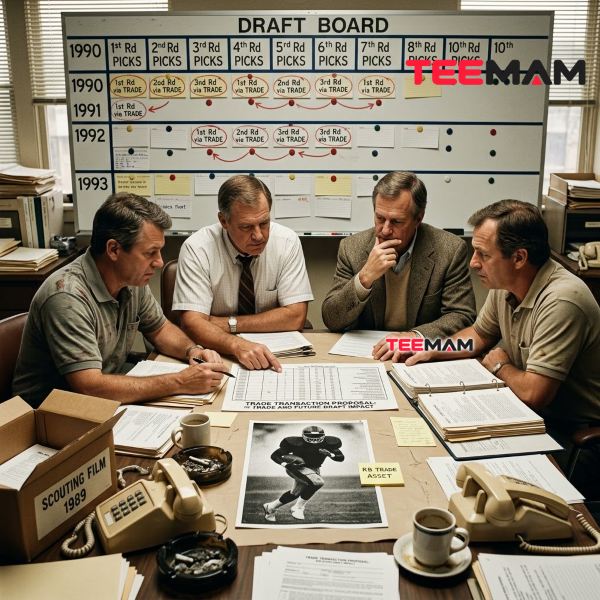
Between the Irvin and Aikman picks sits the single most consequential transaction in Dallas Cowboys draft history, and it wasn’t a draft pick at all. In October 1989, five games into a 1-15 season, Jimmy Johnson traded star running back Herschel Walker to the Minnesota Vikings. The deal eventually expanded to include a third team, the San Diego Chargers, after one of the players Dallas received refused to report and was flipped for an additional pick. The Pro Football Hall of Fame’s breakdown of the trade counts every player and pick that changed hands across all three teams and describes it as an 18-asset transaction, the largest in NFL history.
The core of what Dallas received: Minnesota’s first-, second- and sixth-round picks in 1990, first- and second-round picks in 1991, and first-, second- and third-round picks in 1992, along with linebackers Jesse Solomon and David Howard, cornerback Issiac Holt and defensive end Alex Stewart. The Cowboys sent back Walker plus a handful of their own mid- and late-round selections.
The Walker deal changed the value of draft capital itself. Instead of leaning on one premium selection, Dallas gained several separate opportunities, spread across three future drafts, to add starters. Those Minnesota picks, layered with the Cowboys’ own selections, are what eventually produced Emmitt Smith, Darren Woodson and Russell Maryland, three players who became core pieces of the dynasty.
Emmitt Smith and the Completion of the Core
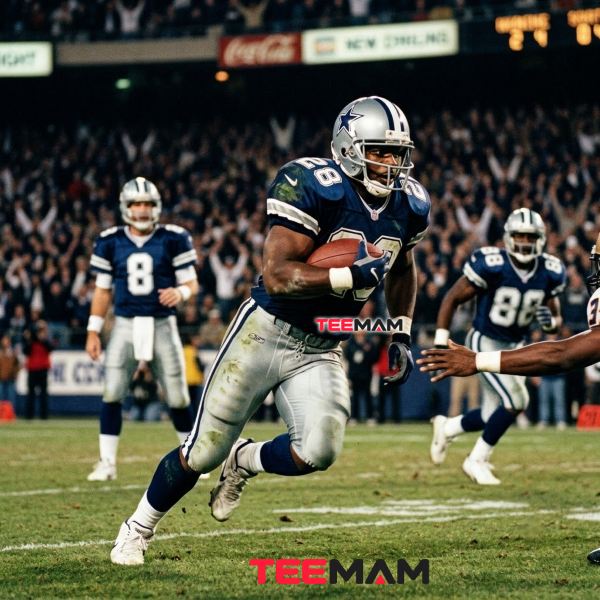
In 1990, Dallas moved from No. 21 to No. 17, sending Pittsburgh a third-round pick to make the jump, and used the selection on Florida running back Emmitt Smith. Dallas selected Emmitt Smith in the first round, 17th overall, in the 1990 NFL Draft, and he retired as the NFL’s all-time leading rusher with 18,355 yards, adding a Super Bowl MVP award along the way. Together with Aikman and Irvin, he completed “The Triplets,” the nickname fans gave the trio that anchored three championship teams in a four-year window. Smith’s legacy is easier to appreciate next to the franchise’s other all-time greats, including the players who defined Dallas before and after the Triplets era. The Greatest Cowboys players in history guide covers that broader comparison.
Why the 1990s Strategy Actually Worked
Three franchise cornerstones at quarterback, running back and wide receiver gave Dallas an identity that outside pressure couldn’t easily dismantle. But this stretch of Dallas Cowboys draft decisions went deeper than star power alone. The Walker trade proved that draft capital, converted patiently over three drafts, can outproduce any single marquee pick. Dallas also hit on role players in these same drafts, guard Nate Newton and fullback Daryl Johnston among them, the kind of picks that never make a highlight reel but make the stars around them better. Draft success in this window wasn’t about first-round hits alone. It was about stacking value across every round and trusting the coaching staff to develop what scouting found.
The Cowboys’ Greatest Late-Round Draft Steals
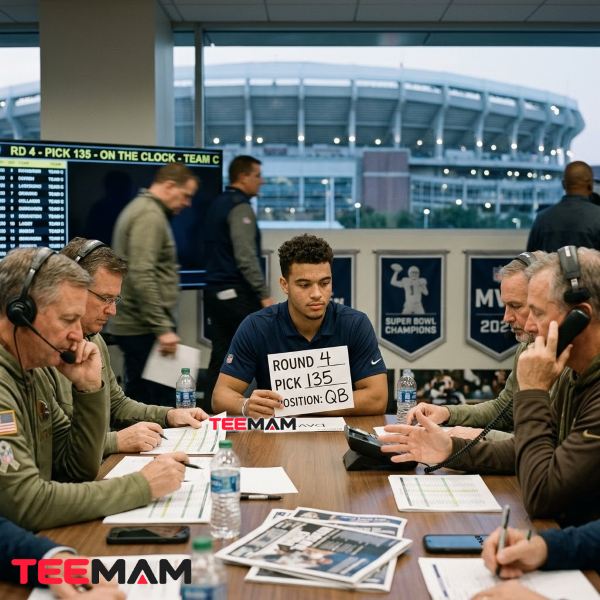
A draft-order list tells you when a player was picked. It doesn’t tell you how much value that pick actually produced, and few examples in Dallas Cowboys draft history make that point more clearly than Staubach and Prescott, two selections separated by more than 50 years.
Dak Prescott: From Round 4 to Franchise Quarterback
What round did the Cowboys draft Dak Prescott? The fourth round, 135th overall, in the 2016 NFL Draft, out of Mississippi State. He was drafted as camp competition behind Tony Romo and Kellen Moore. A preseason injury to Romo forced Prescott into the starting job, and he responded by winning NFL Offensive Rookie of the Year and leading Dallas to an NFC East title as a rookie. He became the franchise’s long-term starting quarterback and, when healthy, has remained the team’s primary starter for a decade, a level of return the middle rounds almost never deliver.
Roger Staubach and the Value of Patience
Staubach’s story, covered earlier, belongs in the same conversation. Both quarterbacks prove that a draft slot and a career arc can diverge sharply, and both became franchise passers despite going almost entirely ignored by other teams on draft day.
When the Draft Did Not Go According to Plan
Not every early pick becomes a cornerstone, and the interesting question isn’t which picks missed, it’s why. High picks typically fall short for a small set of reasons: an injury that never lets a player develop, a scheme change that no longer fits his skill set, or expectations that were tied to draft slot rather than realistic projection.
Defensive end Taco Charlton is a documented example. Dallas took him 28th overall in 2017 out of Michigan, betting on a pass rusher coming off a 10-sack senior season. He started seven of 27 games over two seasons in Dallas, recorded four sacks, missed time with shoulder and ankle injuries, and was released in September 2019 after the team couldn’t find a trade partner. He is a useful counterexample precisely because Dallas’s other first-round picks from that same decade mostly hit, which shows how one missed selection can coexist with a much broader run of successful roster building rather than derailing it.
How Cowboys Draft Picks Shaped Team Identity Across Generations
From Bob Lilly’s Doomsday Defense through the Triplets dynasty and into the Prescott era, drafted talent has repeatedly defined how Dallas plays the game. Aikman and Prescott took opposite paths to the same job, one as the top overall pick, the other as a fourth-round afterthought, and both became the face of their era. That continuity shows up in how fans remember the team, too. Jersey numbers like Aikman’s No. 8, Smith’s No. 22 and Irvin’s No. 88 are inseparable from the players who wore them, and the fact that fans still buy those numbers decades later says something about how deep this history runs. The history behind Cowboys jersey numbers guide breaks down how specific numbers became attached to specific legacies.
The Cultural Legacy of Cowboys Draft Picks
Draft-day excitement rarely stays contained to the football field. A rookie card, a fresh jersey, or a photo from a player’s first minicamp can outlast his entire playing career as a keepsake. Aikman, Smith and Irvin remain instantly recognizable to fans who weren’t even alive during the Cowboys’ 1990s title run. Their jerseys, trading cards and retro graphics have become part of the visual language of Cowboys fandom, which helps explain why that era still shows up in modern football apparel.
That’s also where fan expression through clothing comes in. At TeeMam, we design football-inspired apparel around the visual language of different eras in the game, including the nostalgia that keeps imagery from the Triplets years relevant to fans who follow the Cowboys today.
The Modern Era: What Cowboys Draft History Looks Like Today
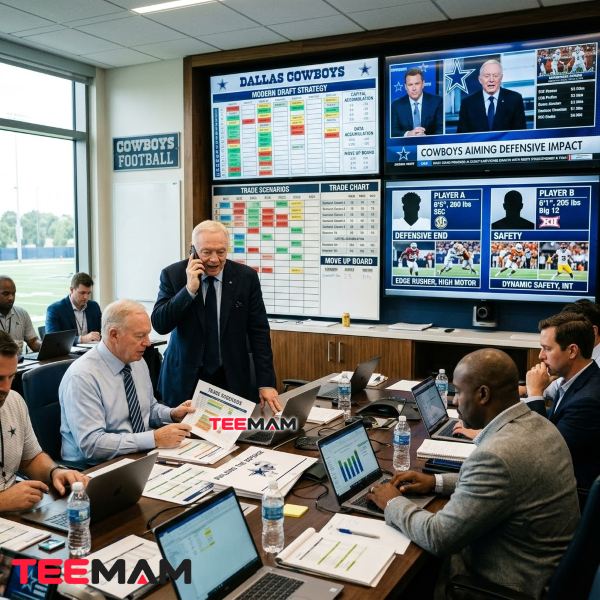
The last decade shows that Dallas Cowboys draft strategy keeps evolving while the underlying philosophy, take the best value and build around it, hasn’t really changed. Prescott’s fourth-round rise reinforced the value of mid-round quarterback bets. In 2020, Dallas selected wide receiver CeeDee Lamb with the 17th overall pick out of Oklahoma, and he has since become the team’s primary offensive weapon.
The clearest recent example of a draft-altering trade, echoing the Walker deal three and a half decades earlier, happened in August 2025. According to the Dallas Cowboys’ own account of the trade, the team sent All-Pro edge rusher Micah Parsons, the 12th overall pick back in 2021, to the Green Bay Packers for defensive tackle Kenny Clark and two future first-round picks, in 2026 and 2027.
That capital, combined with additional trades over the following year, gave Dallas the draft ammunition it used to overhaul its defense in the 2026 NFL Draft. As NFL.com’s coverage of the trade confirmed, Dallas sent its own No. 12 pick and two fifth-round selections, Nos. 177 and 180, to Miami to move up to No. 11 and take Ohio State safety Caleb Downs. The Cowboys then traded down three spots, from No. 20 to No. 23, picking up Philadelphia’s fourth-round pick and a fifth-round selection while sending the Eagles a future seventh-rounder, before using the 23rd pick on UCF edge rusher Malachi Lawrence. It’s the same trade-for-capital logic that built the 1990s dynasty, running through a modern front office instead of Jimmy Johnson’s.
What the Cowboys’ Draft History Teaches About Building a Franchise
Look across the biggest picks and trades, and a handful of patterns stand out:
- A franchise quarterback, whether picked first overall or in the fourth round, can reshape an entire organization.
- Multiple successful picks in a short window can compound into a championship-caliber core.
- Draft-related trades, from the Herschel Walker deal to the Micah Parsons trade, can generate more long-term value than any single selection.
- Late-round value, from Staubach to Prescott, has repeatedly become central to sustained success.
- Draft success depends as much on coaching and player development as it does on the selection itself, a pattern that shows up throughout the Dallas Cowboys coaching legacy, where staffs under Landry and Johnson turned raw prospects into finished players.
Taken together, these players and trades explain the central pattern running through Dallas Cowboys draft history: value can come from an elite pick, from late-round development, or from turning one asset into several future opportunities.
Dallas Cowboys Draft History: Common Questions
Who Was the Cowboys’ First-Ever No. 1 Overall Pick?
Ed “Too Tall” Jones, a defensive end out of Tennessee State, was the Cowboys’ first-ever No. 1 overall selection in 1974. Dallas traded up to get the pick, and Jones went on to make three Pro Bowls and win Super Bowl XII. That’s a different milestone from the franchise’s first-ever draft pick overall, which was Bob Lilly in 1961.
Who Is the Most Famous Late-Round Cowboys Draft Pick?
Roger Staubach and Dak Prescott are the two clearest examples, separated by more than 50 years. Staubach went in the 10th round in 1964, and Prescott went in the fourth round in 2016. Both became franchise quarterbacks despite being passed over by other teams looking for passers.
What Round Did the Cowboys Draft Emmitt Smith?
Dallas selected Emmitt Smith in the first round, 17th overall, in the 1990 NFL Draft after trading up from the 21st spot. He retired as the NFL’s all-time leading rusher.
Who Were the Cowboys’ Most Important 1990s Draft Picks?
Troy Aikman (1989), Emmitt Smith (1990) and Michael Irvin (1988) formed “The Triplets,” the offensive core behind three Super Bowl titles. Their success was also shaped by the Herschel Walker trade, Jimmy Johnson’s coaching, and complementary role players drafted in the same window.
How Did the Herschel Walker Trade Affect Cowboys Draft History?
The October 1989 trade sent Walker to Minnesota in exchange for players and a package of draft picks that eventually included first-, second- and sixth-round selections in 1990, first- and second-round picks in 1991, and first-, second- and third-round picks in 1992. That capital became a central building block of the Cowboys’ 1990s rebuild.
Why Are Cowboys Draft Picks Important to Franchise History?
The most important chapters of Dallas Cowboys draft history combine elite selections, valuable trades and steady player development. Draft picks built every era of Cowboys success, from Bob Lilly and Ed “Too Tall” Jones through the 1990s dynasty to today’s Prescott-led roster, and they shape long-term fan identity too, since jersey numbers and rookie-year moments tied to specific picks tend to outlast the players’ careers.
The Draft Picks That Became Cowboys History
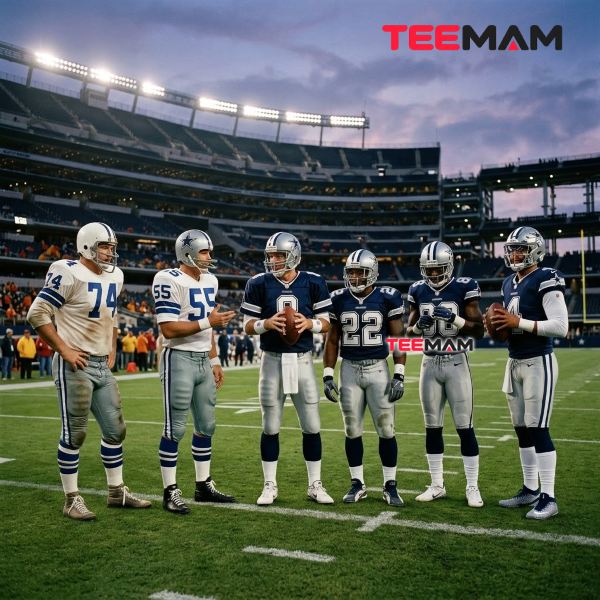
The lasting lesson of Dallas’s draft history is less about finding one perfect prospect than about creating multiple paths to roster value. Bob Lilly in 1961, Ed “Too Tall” Jones in 1974, Roger Staubach in the 10th round, the Triplets in the late 1980s and early 1990s, and Dak Prescott in 2016 all illustrate the same principle: draft position matters, but what a franchise does with the opportunity matters more. That combination of cornerstone selections, late-round development and trades that turned one asset into several future picks, most recently the Parsons-to-Downs pipeline running through 2026, is the clearest thread connecting the most influential eras in Dallas Cowboys draft history.

Hi, I’m Olivia Bennett, a fashion and lifestyle writer at TeeMam with 6 years of experience creating content about fashion, outfits, and lifestyle trends. I enjoy sharing practical style ideas for everyday wear, game days, holidays, and special occasions, helping readers find looks that feel comfortable, fun, and uniquely their own.