Kansas City Chiefs Quarterback History: From Dawson to Mahomes
The Chiefs have rarely had a smooth succession of franchise quarterbacks. Len Dawson established the first championship era in the 1960s, Joe Montana provided a brief revival three decades later, Trent Green delivered the most prolific regular-season passing of the pre-Mahomes era, Alex Smith stabilized the position, and Patrick Mahomes turned it into the centerpiece of a modern dynasty. Kansas City Chiefs quarterback history is really the story of how those five eras connect.
Quick answer: Five quarterbacks provide the clearest way to understand the major eras of Kansas City Chiefs quarterback history: Len Dawson (Super Bowl IV MVP, franchise builder), Joe Montana (1993-94 AFC Championship run), Trent Green (2001-06 passing production), Alex Smith (2013-17 stability), and Patrick Mahomes (2017-present, three Super Bowl titles, franchise’s all-time leading passer).
Who are the most important quarterbacks in Chiefs history?
- Len Dawson – built the franchise’s first championship era and won Super Bowl IV MVP
- Joe Montana – led Kansas City to its first AFC Championship Game appearance since 1969
- Trent Green – produced the most prolific regular-season passing offense the franchise had seen to that point
- Alex Smith – stabilized the roster and set up the transition to Mahomes
- Patrick Mahomes – the franchise’s all-time passing leader and a three-time Super Bowl champion
These five aren’t the only notable names in the franchise’s quarterback room, but they’re the ones who defined entire eras rather than a single strong season.
How the Chiefs Built Their Quarterback Legacy
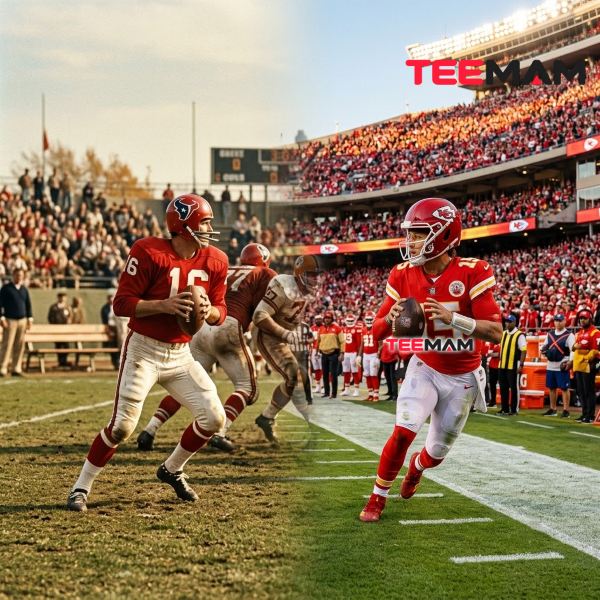
The franchise didn’t start in Kansas City. Lamar Hunt founded the Dallas Texans in 1960 as a charter member of the American Football League, and the team spent three seasons competing for attention in a city that already belonged to the Cowboys. In 1963, Hunt relocated the franchise to Kansas City and renamed it the Chiefs, a move that lined up almost perfectly with the emergence of a young quarterback who’d been buried on two NFL benches before that.
Head coach Hank Stram built an offense around motion, misdirection, and a quarterback who could read a defense pre-snap rather than just execute a called play. That quarterback was Len Dawson, and the fit between Stram’s system and Dawson’s instincts turned the Chiefs into one of the AFL’s flagship franchises. Quarterback continuity, though, would prove to be the exception rather than the rule for most of the franchise’s next six decades. Kansas City won with Dawson, spent years searching for a long-term answer, leaned at times on experienced veteran quarterbacks, and eventually found generational stability with Patrick Mahomes.
For more on how the franchise got here, our Kansas City Chiefs heritage guide covers the Texans-to-Chiefs transition in more depth.
Len Dawson Built the First Great Chiefs Era
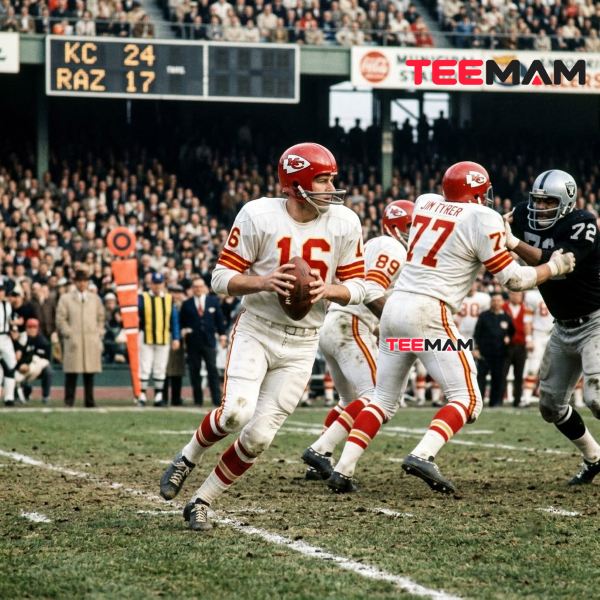
From Dallas Texans Quarterback to Kansas City Icon
Dawson joined the Dallas Texans in 1962 after five frustrating seasons buried on the depth charts in Pittsburgh and Cleveland, and the move unlocked him almost immediately. He won the AFL passing title and was named the league’s Most Valuable Player that first season. Dawson was the quarterback when the franchise won AFL championships in 1962, 1966 and 1969, with the 1962 title coming while the team was still known as the Dallas Texans, before the 1963 move to Kansas City. Over his career he won four AFL passing crowns total, and the Pro Football Hall of Fame’s biography of Dawson credits him as one of the most accurate passers of his era.
Dawson remains one of the most productive passers in Chiefs history, though Patrick Mahomes has since surpassed him in the franchise’s major career passing categories. Dawson finished his Kansas City career with 28,507 passing yards, 237 touchdown passes, 2,115 completions and 3,696 attempts, marks that stood as franchise records for nearly five decades after his 1975 retirement.
Super Bowl IV Changed the Franchise
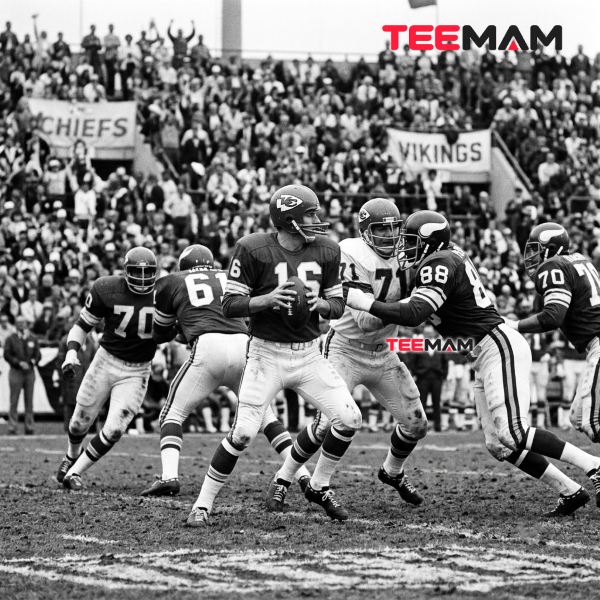
The Chiefs’ first Super Bowl appearance didn’t go well. Dawson and Kansas City lost Super Bowl I to the Green Bay Packers, 35-10, a result that reinforced the perception of the AFL as the NFL’s lesser cousin. Three years later, the Chiefs got another shot, this time against the Minnesota Vikings, and the outcome flipped that assumption on its head. Kansas City beat Minnesota 23-7 in Super Bowl IV, with Dawson completing 12 of 17 passes for 142 yards and a touchdown, including a 46-yard connection to Otis Taylor that sealed the win. He was named Super Bowl MVP.
Dawson’s importance to Kansas City goes beyond Super Bowl IV itself. He became the quarterback most closely associated with the franchise’s first championship era, and his title remained the Chiefs’ only Super Bowl victory for more than five decades.
The Chiefs Quarterback Years After Dawson
Why was the Chiefs quarterback position unstable after Len Dawson? Kansas City spent most of the late 1970s and 1980s cycling through short-term starters, partly because the roster around the position declined as the Dawson era came to an end and partly because the franchise didn’t hit on a long-term answer through the draft during that stretch.
Steve Fuller, Bill Kenney, Steve DeBerg and Dave Krieg all took turns under center during this period. Warren Moon later spent the final two seasons of his career with Kansas City, in 1999 and 2000, but he appeared in only three games as a backup rather than as a long-term starter. Several of these quarterbacks produced strong individual seasons, but none established the kind of sustained answer the franchise was looking for. The result was a long stretch in which Kansas City could stay competitive without having a quarterback who clearly belonged to the franchise’s next long-term era. That context helps explain why the Chiefs were willing to make an aggressive move for Joe Montana in 1993.
Joe Montana Gave the Chiefs a Veteran Quarterback Bridge
Why the Montana Trade Mattered
In April 1993, general manager Carl Peterson and head coach Marty Schottenheimer traded for Joe Montana, bringing him to Kansas City from the San Francisco 49ers. Montana had already won four Super Bowls and set the standard for what a franchise quarterback could look like. His arrival reset expectations for a Chiefs team that hadn’t won a playoff game since Super Bowl IV. According to the Chiefs’ own team history, Montana wore No. 19, a number he’d worn in high school, because Dawson’s No. 16, which Montana had worn throughout his career in San Francisco, was already retired by Kansas City.
The 1993 AFC Championship Run
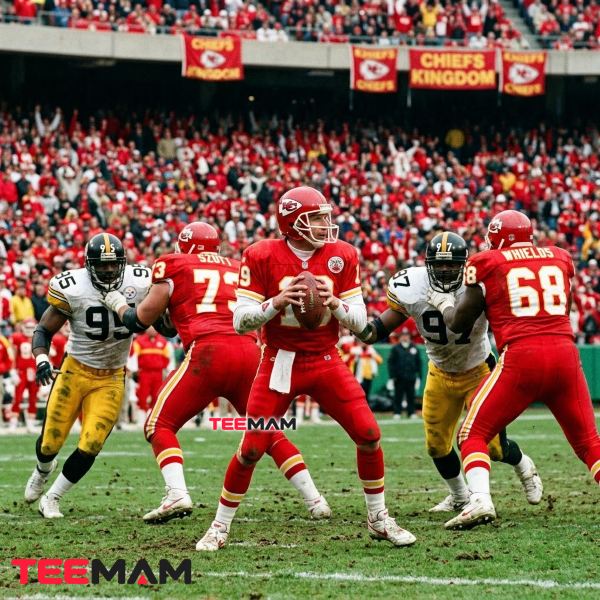
Montana’s first season in Kansas City produced an 11-5 record, the franchise’s first AFC West title in more than two decades, and the deepest playoff run the Chiefs had made since Super Bowl IV. He threw for 5,427 yards and 29 touchdowns across his two Chiefs seasons, going 17-8 as a starter, and made the Pro Bowl in 1993 despite missing time to injury. Kansas City beat the Pittsburgh Steelers in overtime, then the Houston Oilers, to reach the AFC Championship Game for the first time since the AFL-NFL merger. The Buffalo Bills ended the run, beating Kansas City 30-13, after Montana left the game with a concussion in the second half.
Montana’s tenure in Kansas City lasted just two seasons before he retired, but it proved the franchise could compete again after two decades of irrelevance. He arrived as a four-time Super Bowl champion and immediately took Kansas City further into the postseason than it had gone since 1969. Montana was never going to anchor the franchise for another decade, but he gave Kansas City something it had lacked since the Dawson years: a quarterback capable of leading a legitimate postseason run.
Trent Green and the High-Scoring Chiefs Offense
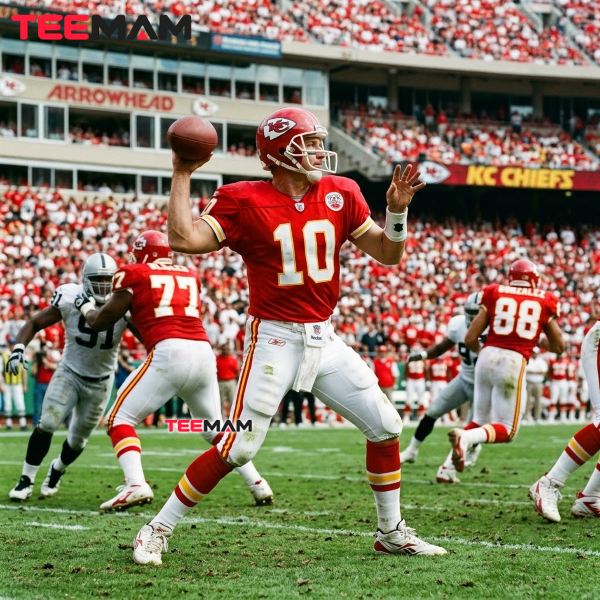
Kansas City traded for Trent Green in 2001. Working with head coach Dick Vermeil and an aggressive offensive system, Green led one of the most productive passing attacks in franchise history, throwing for over 4,000 yards in three separate seasons alongside Priest Holmes, Tony Gonzalez and Dante Hall. He still holds the franchise record for consecutive starts at 80. This stretch is a central chapter in Kansas City Chiefs quarterback history because it shows how much regular-season production the franchise could generate without matching postseason success.
How good was Trent Green with the Chiefs? Across six seasons in Kansas City, Green threw for 21,459 yards and 118 touchdowns while going 48-40 as a starter, numbers that still rank him third on the franchise’s all-time passing list, behind only Mahomes and Dawson. But the playoff results never matched the regular-season output. Green went 0-2 in the postseason with Kansas City, with both losses coming against Peyton Manning’s Indianapolis Colts, including a 38-31 shootout loss in the 2003 divisional round after the Chiefs had gone 13-3. Green’s Chiefs tenure provides a useful contrast with the Mahomes era: Kansas City had elite regular-season production, but it did not turn that production into a deep postseason run.
Alex Smith Stabilized the Franchise Before Mahomes
Andy Reid and the Reset
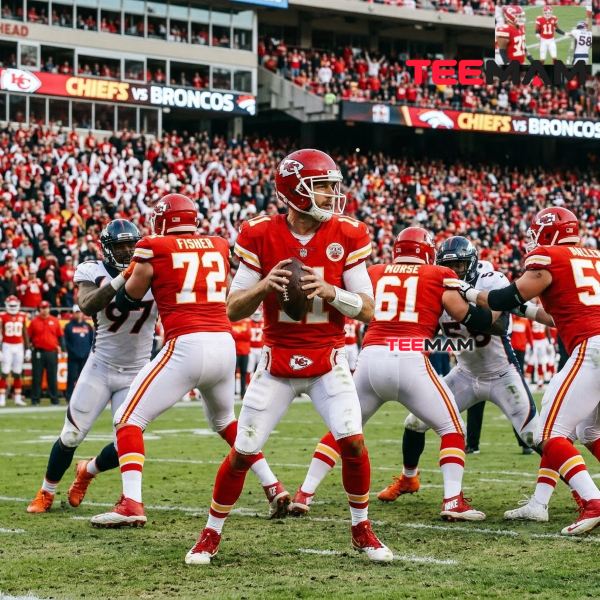
The Chiefs acquired Alex Smith from the San Francisco 49ers in 2013, the same offseason Andy Reid took over as head coach, and the pairing turned Kansas City into a consistent playoff contender almost overnight. Smith started 9-0 in his first season as the Chiefs’ quarterback and went on to throw for 17,608 yards and 102 touchdowns across five seasons in Kansas City, giving the franchise a level of week-to-week reliability it hadn’t had in years.
The Connection to Patrick Mahomes
Alex Smith’s legacy in Kansas City tends to get overshadowed by the quarterback who replaced him, but his steadiness is exactly what let that transition happen on the franchise’s terms rather than by necessity. Kansas City drafted Mahomes 10th overall in 2017 and, rather than throwing him into the starting job as a rookie, let him sit behind Smith for a full season, absorbing Reid’s offense from the sideline. Who was the Chiefs quarterback before Patrick Mahomes? Alex Smith. He started every game in 2017 while Mahomes learned the system, and that year of development is a big reason Mahomes’ jump to starter in 2018 looked so seamless.
The overlooked part of that story is that Kansas City didn’t move on from Smith because he had failed. The Chiefs had a stable starter, a playoff-caliber roster and a coaching staff capable of developing a young quarterback, which made the 2017 decision unusual: Mahomes was drafted as a succession plan rather than an emergency replacement. That distinction is a big part of why the handoff went as smoothly as it did.
Patrick Mahomes and the Chiefs’ Championship Era

The 2017 Draft Decision
Kansas City traded up to the 10th overall pick in the 2017 NFL Draft to select Mahomes out of Texas Tech, then traded Smith to Washington the following spring once the rookie had a full season of preparation behind him. Mahomes became the full-time starter in 2018, and the results were immediate: an MVP season, a 50-touchdown campaign, and a new offensive identity for the franchise.
From MVP to Super Bowl Champion
Mahomes has produced the most successful sustained stretch of quarterback play in franchise history, combining elite regular-season production with three Super Bowl championships. He led the Chiefs to Super Bowl LIV following the 2019 season, a win over the San Francisco 49ers that delivered the franchise’s first championship since Super Bowl IV. He added a second title in Super Bowl LVII and a third in Super Bowl LVIII, giving Kansas City back-to-back championships. That run ended in Super Bowl LIX, where the Philadelphia Eagles beat the Chiefs 40-22, denying Kansas City a shot at a historic three-peat. Mahomes has won three Super Bowls with the Chiefs, not four.
Mahomes Became the Franchise Statistical Leader
Mahomes now leads the Chiefs in the franchise’s major career passing categories, including passing yards (35,939), passing touchdowns (267), completions, attempts and passer rating through the 2025 season. He also became the fastest player in NFL history to reach 300 career touchdown passes, reaching the mark in 139 games when regular-season and postseason totals are combined. His 2025 season ended in Week 15 after he suffered a torn ACL against the Los Angeles Chargers. The loss also eliminated Kansas City from playoff contention, ending the Chiefs’ postseason streak that had continued throughout Mahomes’ run as the full-time starter.
Chiefs Quarterback Records: Dawson vs. Mahomes and the Era in Between
The table below uses one consistent dataset, Chiefs regular-season career passing production, so the comparison is apples-to-apples rather than mixing career totals, single-season peaks and playoff numbers.
| Quarterback | Chiefs Career | Passing Yards | Passing TDs | Chiefs Legacy |
|---|---|---|---|---|
| Patrick Mahomes | 2017-2025 (active) | 35,939 | 267 | Three Super Bowl titles; franchise’s all-time passing leader |
| Len Dawson | 1962-1975 | 28,507 | 237 | Super Bowl IV champion and MVP |
| Trent Green | 2001-2006 | 21,459 | 118 | Franchise’s most prolific pre-Mahomes passing offense |
| Alex Smith | 2013-2017 | 17,608 | 102 | Stabilized the roster and set up the Mahomes transition |
| Joe Montana | 1993-1994 | 5,427 | 29 | Led Kansas City to the 1993 AFC Championship Game |
Figures reflect regular-season Chiefs career passing statistics through the 2025 season, per Chiefs career passing statistics at Pro Football Reference. Montana’s totals cover only his two seasons in Kansas City, not his career with the 49ers.
Chiefs Quarterbacks by Era at a Glance
| Era | Quarterback | Years | Defining Achievement |
|---|---|---|---|
| AFL championship era | Len Dawson | 1962-1975 | Super Bowl IV champion and MVP |
| Veteran revival | Joe Montana | 1993-1994 | 1993 AFC Championship Game |
| High-output offense | Trent Green | 2001-2006 | 21,459 passing yards, three 4,000-yard seasons |
| Bridge to Mahomes | Alex Smith | 2013-2017 | Five-year run of playoff-caliber stability |
| Championship era | Patrick Mahomes | 2017-2025 (active) | Three Super Bowl titles |
Which Chiefs Quarterbacks Left the Biggest Legacy?
These five quarterbacks are difficult to rank on one scale because their value came in different forms. Dawson and Mahomes have the strongest championship cases, Montana had the biggest short-term impact, Green delivered elite regular-season production, and Smith played the key transition role before Mahomes.
Best for franchise-building: Len Dawson, whose partnership with Hank Stram turned an expansion-era AFL club into a perennial contender and delivered the franchise’s first title.
Best veteran acquisition: Joe Montana, who arrived well past his prime and still took a struggling franchise back to conference-title relevance in a single season.
Best offensive production before Mahomes: Trent Green, whose numbers alongside Priest Holmes and Tony Gonzalez remain among the highest in franchise history, even without a playoff win to match them.
Most important transition quarterback: Alex Smith, whose stability created the runway Mahomes needed to develop without being rushed.
Greatest modern franchise quarterback: Patrick Mahomes, based on three Super Bowl titles, two MVP awards, and franchise-leading production across passing yards, touchdowns, completions and attempts.
For more on where Dawson and Mahomes both rank among the franchise’s all-time greats, see our Chiefs Hall of Fame legends breakdown.
Why Chiefs Quarterback Jersey Numbers Became Part of Fan Culture
Jersey numbers carry unusual weight in Kansas City, largely because so many quarterback eras are tied to a specific digit. Dawson’s No. 16 is officially retired by the franchise, which is why Montana wore No. 19 rather than the No. 16 he’d worn in San Francisco. Alex Smith wore No. 11 during the franchise’s return to relevance. Mahomes wears No. 15, already the number most associated with Chiefs football for a new generation of fans.
For Chiefs fans, those numbers can represent an era as much as a player. No. 16 connects directly to the franchise’s AFL championship roots, while No. 19 is tied to a much shorter but historically important revival. No. 15 now carries a different kind of weight because Mahomes has attached it to the most sustained championship run in modern Chiefs history. That makes quarterback numbers useful markers of how the franchise’s identity has changed across generations, not simply identifiers on the back of a jersey. TeeMam approaches that generational context as part of the story behind its Chiefs-inspired designs.
For a full rundown of which numbers carry that kind of weight across the roster, see our Chiefs retired jersey numbers page.
What the Chiefs Quarterback Legacy Means Today
Dawson established the Chiefs’ first championship era. Montana provided a short-lived revival. Green powered one of the franchise’s most productive offenses without matching playoff success. Smith created the stability that made the Mahomes transition possible. Mahomes then turned that foundation into the most successful sustained stretch in Kansas City Chiefs quarterback history, three championships and counting.
Questions Fans Ask About Chiefs Quarterback History
Who was the Chiefs quarterback before Patrick Mahomes?
Alex Smith was Kansas City’s starting quarterback immediately before Mahomes took over in 2018. Smith started every game in 2017 while Mahomes developed behind him as a rookie.
Who was the greatest quarterback in Chiefs history?
It depends on the criteria. Mahomes leads on modern production and championships, with three Super Bowl titles and every major franchise passing record. Dawson leads on historical importance, having built the franchise’s first great era and delivered its first championship in Super Bowl IV.
Did Len Dawson win a Super Bowl with the Chiefs?
Yes. Dawson led Kansas City to a 23-7 win over the Minnesota Vikings in Super Bowl IV and was named the game’s Most Valuable Player.
How many Super Bowls has Patrick Mahomes won with the Chiefs?
Three: Super Bowl LIV, Super Bowl LVII and Super Bowl LVIII. Kansas City fell short of a three-peat when the Philadelphia Eagles beat the Chiefs 40-22 in Super Bowl LIX.
Who is the Chiefs’ all-time passing leader?
Patrick Mahomes. Through the 2025 season, he leads the franchise in career passing yards, passing touchdowns, completions and attempts.
Why is Len Dawson important to Chiefs history?
Dawson was the franchise’s first great quarterback, a four-time AFL passing champion who led Kansas City to its first Super Bowl championship and was named Super Bowl IV MVP. His No. 16 remains retired, and he’s enshrined in the Pro Football Hall of Fame.
How many quarterbacks have defined Chiefs history?
The Chiefs have used many starting quarterbacks since the franchise began in 1960, but five stand out as era-defining figures: Len Dawson, Joe Montana, Trent Green, Alex Smith and Patrick Mahomes. Other starters, including Warren Moon, Steve DeBerg, Bill Kenney and Dave Krieg, filled important gaps in the timeline without defining an era of their own.
From Len Dawson to Patrick Mahomes: The Legacy Continues
Kansas City Chiefs quarterback history comes down to five names who each defined a different version of the franchise: Dawson’s AFL championship teams, Montana’s brief revival, Green’s offensive peak, Smith’s steady transition, and Mahomes’ sustained championship run. Across six decades, the quarterback position has provided the clearest markers of how the Chiefs have changed, from Dawson’s AFL foundation to Mahomes’ championship era.