Kansas City Chiefs Hall of Fame Players: The Legends of the Franchise
The Kansas City Chiefs have 26 Pro Football Hall of Famers, 53 members in their own Hall of Honor, and 10 retired jersey numbers, according to the Pro Football Hall of Fame’s official team page. That’s the short answer. The longer, more interesting answer is why those three lists don’t overlap nearly as much as most fans assume, and why the Kansas City Chiefs Hall of Fame still shapes how this franchise sees itself six decades after it started.
This guide breaks down the full group by era, explains how the three honors differ, and gets into the part most roundups skip: why these names still drive game-day culture at Arrowhead instead of just sitting in a museum case.
What Is the Kansas City Chiefs Hall of Fame?
“Chiefs Hall of Fame” actually covers three separate honors, and mixing them up is the most common mistake in any search on this topic.
- Pro Football Hall of Fame (Canton, Ohio) is the sport’s national institution. Enshrinement is permanent and independent of any one team. A roughly 50-person Selection Committee votes each year, and a candidate needs at least 80% approval to get elected.
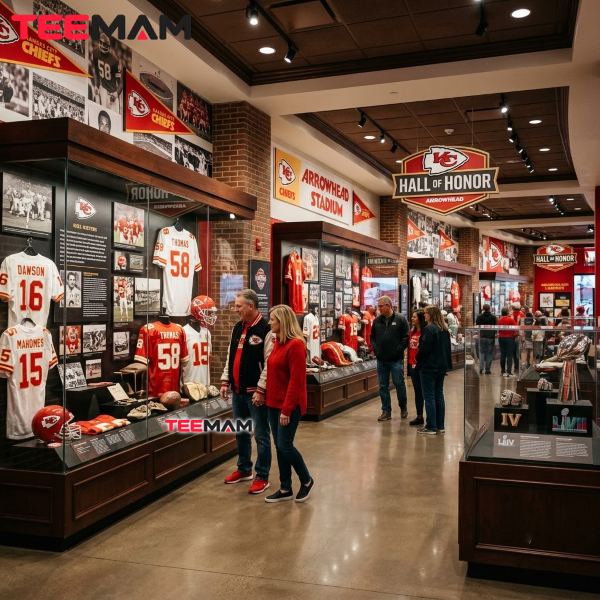
- Chiefs Hall of Honor is the franchise’s own recognition, housed in a dedicated space at GEHA Field at Arrowhead Stadium. It’s a bigger tent than Canton, currently standing at 53 members, and it’s where players who mattered enormously in Kansas City but never got the national call still get their due.
- Retired jersey numbers make up the smallest and most exclusive group of the three: 10 numbers, permanently out of circulation.
The overlap is smaller than people expect. Only 11 names appear in both the Pro Football Hall of Fame and the Chiefs Hall of Honor. A player can be a franchise legend in Kansas City’s eyes without ever getting a bust in Canton, and a Hall of Famer who only played a season or two in Chiefs colors, like Darrelle Revis or Ty Law, isn’t automatically a Hall of Honor fixture either.
Not every Kansas City great reached Canton, and that’s exactly why the Chiefs Hall of Honor matters as its own institution. It preserves the fuller franchise story, including players whose local impact was massive even without a national bust to show for it.
For the full mechanics of how Canton elects someone, the official Hall of Fame selection process covers each round, from the initial nominee list down to the final vote.
Why Hall of Honor and Canton Often Get Confused
The confusion usually comes down to overlapping language. Both institutions use the word “Hall,” both induct people in public ceremonies, and both are covered in the same Chiefs.com press releases each year, so casual fans reasonably assume they’re the same list with two different names. They’re not. Canton is a national honor voted on by a media-based Selection Committee with no direct input from the Chiefs organization, while the Hall of Honor is entirely the franchise’s own call, decided internally with no outside vote required. That’s also why a player like Tamba Hali, inducted into the Chiefs Hall of Honor in 2024, can be a beloved franchise fixture without ever appearing on a Pro Football Hall of Fame ballot. The two systems are measuring different things: one measures a career’s place in NFL history, the other measures a career’s place in Kansas City’s history specifically.
A Timeline of Chiefs Hall of Fame Greatness
AFL Foundations
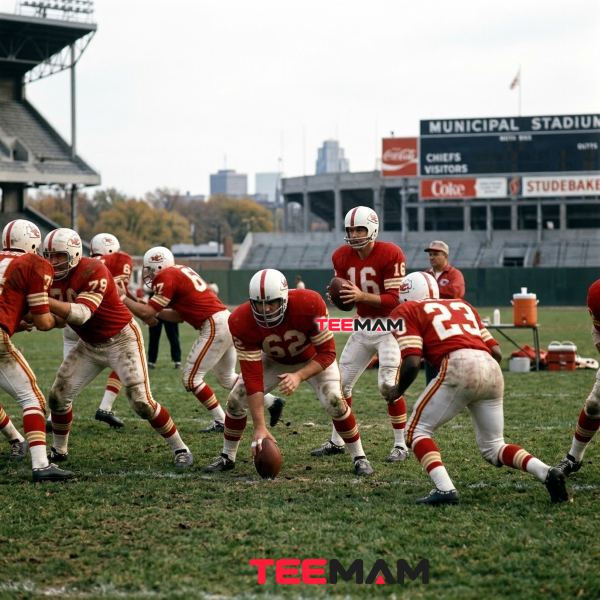
The Kansas City Chiefs Hall of Fame story starts before the NFL merger even happened. Lamar Hunt co-founded the American Football League in 1959 and moved his team from Dallas to Kansas City in 1963, and the roster he and coach Hank Stram built became the class of the old AFL. Len Dawson ran the offense, Bobby Bell and Willie Lanier anchored the defense from opposite ends of the field, Buck Buchanan, the first overall pick in the 1963 AFL Draft, clogged the middle at 6-foot-7, and Jan Stenerud became the first pure placekicker ever enshrined in Canton.
That group delivered Super Bowl IV in January 1970, a 23-7 upset of the heavily favored Minnesota Vikings that still stands as the last Super Bowl win by an AFL team before the full merger. Dawson took home MVP honors. It’s the game that turned “AFL” from a punchline into a legitimate pedigree, and it’s the reason five different Chiefs from that roster eventually got busts in Canton.
Defensive Icons of the 1980s and 1990s
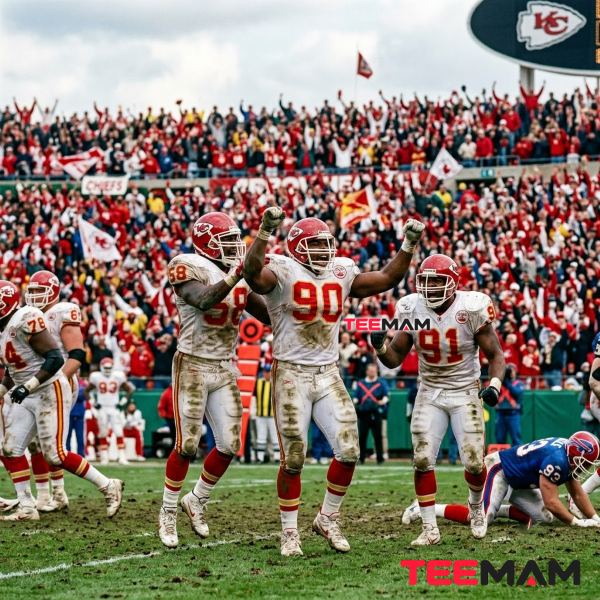
The next major wave of Kansas City Chiefs Hall of Fame talent built its identity in the trenches and off the edge. Derrick Thomas, drafted fourth overall in 1989, redefined what a Chiefs pass rusher could look like. His seven-sack game against the Seattle Seahawks in 1990 remains an NFL single-game record more than three decades later. Curley Culp had already anchored the Super Bowl IV defensive line before a mid-career trade to Houston, where he kept building the résumé that got him to Canton in 2013. Emmitt Thomas spent his entire 13-year career picking off passes in Kansas City and still ranks among the top 10 in career interceptions league-wide. Will Shields quietly strung together 12 straight Pro Bowl seasons at guard from 1993 through 2006, the kind of durable, unglamorous excellence that took longer than it should have to get recognized nationally.
This era mattered because Arrowhead became part of the defense. The crowd noise wasn’t a side note; it was a real edge, and the stadium’s reputation as one of the loudest, most hostile road environments in football took hold during these years.
Modern Era Legends

Tony Gonzalez spent 1997 through 2008 in Kansas City, and he didn’t just play tight end, he broke the positional mold entirely. He left as the position’s all-time leader in catches and receiving yards, records that have since fallen only to players who grew up trying to copy his game. His 2019 Canton induction closed out the pre-Mahomes chapter of Chiefs history.
What’s happened since 2013 under Andy Reid is a different kind of dynasty: three Super Bowl titles, LIV, LVII, and LVIII, and a level of sustained contention the AFL-era Chiefs never matched. Whether Patrick Mahomes, Travis Kelce, or Reid himself eventually add to Canton’s Chiefs count is a real conversation, but it’s better to keep this section focused on what’s already happened rather than what might.
Complete List of Kansas City Chiefs Hall of Fame Players
| Player | Position | Chiefs Years | Hall of Fame Class | Signature Achievement |
|---|---|---|---|---|
| Bobby Bell | LB/DE | 1963-1974 | 1983 | First Chiefs player ever inducted into Canton |
| Len Dawson | QB | 1962-1975 | 1987 | Super Bowl IV MVP, franchise’s all-time passing leader |
| Willie Lanier | LB | 1967-1977 | 1986 | First Black player to start at middle linebacker in NFL history |
| Buck Buchanan | DT | 1963-1975 | 1990 | No. 1 overall pick, 1963 AFL Draft |
| Jan Stenerud | K | 1967-1979 | 1991 | First pure placekicker enshrined in Canton |
| Emmitt Thomas | CB | 1966-1978 | 2008 | Top-10 all-time in career interceptions |
| Curley Culp | DT | 1968-1974 | 2013 | Anchored the Super Bowl IV defensive front |
| Johnny Robinson | S | 1960-1971 | 2019 | Member of both AFL and Super Bowl IV champion Chiefs |
| Derrick Thomas | LB | 1989-1999 | 2009 | NFL single-game record: 7 sacks (1990) |
| Marcus Allen | RB | 1993-1997 | 2003 | Closed his career in KC after becoming NFL’s all-time rushing TD leader |
| Joe Montana | QB | 1993-1994 | 2000 | Led Chiefs to the 1993 AFC Championship Game |
| Will Shields | G | 1993-2006 | 2015 | 12 consecutive Pro Bowl selections |
| Tony Gonzalez | TE | 1997-2008 | 2019 | Left Kansas City as NFL’s all-time leader in TE receptions and yards |
| Willie Roaf | OT | 2002-2005 | 2012 | Anchored the line for the Priest Holmes-era rushing attack |
| Warren Moon | QB | 1999-2000 | 2006 | Career finale after Hall of Fame runs in Houston and Minnesota |
| Morten Andersen | K | 2002-2003 | 2017 | NFL’s all-time leading scorer at retirement |
| Mike Webster | C | 1989-1990 | 1997 | Closed a legendary Steelers career in Kansas City |
| Ty Law | CB | 2009 | 2019 | Final season of a decorated Patriots-built career |
| Darrelle Revis | CB | 2017 | 2023 | Capped his career with a single season in Kansas City |
| Jared Allen | DE | 2004-2007 | 2025 | Drafted by the Chiefs before becoming an elite NFL pass rusher |
Six additional Hall of Famers are tied to the franchise as builders rather than players: founder Lamar Hunt (Class of 1972), and coaches Hank Stram (1993), Marv Levy (2001), and Dick Vermeil (2022), plus contributors Bobby Beathard (2018) and Bill Polian (2015).
The Players Who Changed the Franchise Forever
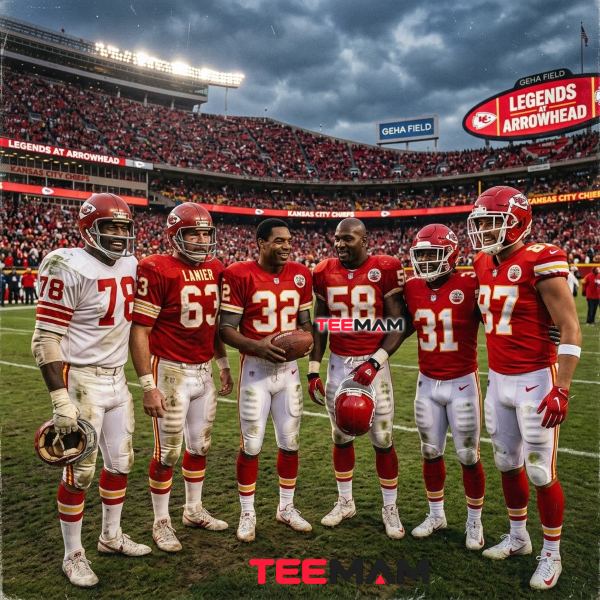
Numbers on a table explain why these players got inducted. They don’t fully explain why a few of them changed the sport itself.
Len Dawson Built the Winning Identity
Before Dawson, the Chiefs were a scrappy AFL upstart nobody outside Kansas City took seriously. After him, they were Super Bowl champions with a quarterback smart enough to pick apart a Vikings defense that had steamrolled the NFC all year. “Lenny the Cool” earned that nickname for a reason. His poise under pressure set the tone for how Chiefs quarterbacks would be judged for the next 50 years.
Derrick Thomas Redefined Defensive Excellence
Thomas played only 11 seasons before a car accident cut his life tragically short in 2000, but in that span he became the standard every Chiefs pass rusher gets measured against. He finished his career with 126.5 sacks, and his single-game record of seven sacks in one contest has now stood for more than 35 years. His No. 58 still hangs retired at Arrowhead. Pro-Football-Reference’s career statistics and honors page lays out the full breakdown of what made him a first-ballot lock.
Willie Lanier Changed the Linebacker Position
Lanier’s presence at middle linebacker broke a barrier the NFL had quietly maintained for years, and he did it while being genuinely one of the best players at his position: a run-stopper with the instincts to also grab 27 career interceptions. Twelve seasons, all with the Chiefs, all Hall of Fame caliber.
Tony Gonzalez Revolutionized the Tight End Role
Gonzalez didn’t just play tight end; he turned it into an unstoppable matchup nightmare that linebackers and safeties both hated covering. Many analysts consider him one of the players most responsible for redefining the modern receiving tight end, a template he built in Kansas City between 1997 and 2008.
How Hall of Fame Legends Shaped Chiefs Culture

Chiefs Kingdom, as a fan identity, didn’t come out of nowhere. It grew out of AFL-era teams giving Kansas City something to rally around before the franchise developed the championship tradition fans know today. That energy carried through the lean stretches of the 1970s and ’80s, through Marty Schottenheimer’s playoff-heavy but championship-light 1990s teams, and into the current run under Reid and Mahomes. Arrowhead tailgating culture, often cited as among the best in the league, traces its roots directly back to fans who started showing up early for Super Bowl IV-era teams and never really stopped.
What makes this history unusually sticky is that fans don’t treat these legends as museum pieces. Retired numbers still show up on jerseys in the parking lot, the names still anchor game-day conversation on sports radio, and the red and gold legacy still shapes how younger fans get introduced to Chiefs Kingdom in the first place.
For the fuller version of how those decades connect, KC’s historic Chiefs team traditions are worth a closer look. A lot of what feels like “just how Chiefs fans are” traces back to specific players and specific seasons.
Legendary Jersey Numbers That Fans Still Celebrate
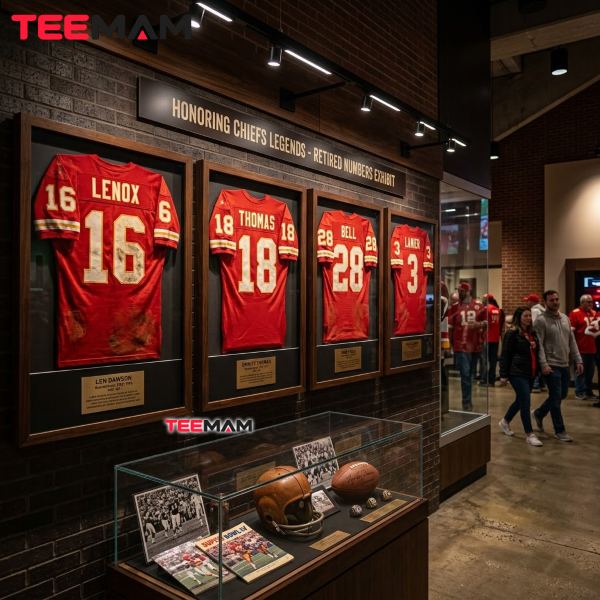
The Chiefs have retired 10 jersey numbers, one of the highest totals among AFL-era franchises. Ownership has said that number makes the team more selective going forward, simply because training camp rosters need enough numbers to go around.
The list starts with the Super Bowl IV core: Jan Stenerud’s No. 3 (retired 1992), Len Dawson’s No. 16, Emmitt Thomas’s No. 18, Willie Lanier’s No. 63, Bobby Bell’s No. 78, and Buck Buchanan’s No. 88. Derrick Thomas’s No. 58 joined them after his death in 2000. Three more numbers honor players who never reached Canton but left an outsized mark on the franchise: Abner Haynes (No. 28), an AFL Rookie of the Year and MVP, and Stone Johnson (No. 33) and Mack Lee Hill (No. 36), both of whom died during their playing careers.
Not every Hall of Famer has a retired number, and not every retired number belongs to a Hall of Famer, which is exactly why fans get the two mixed up so often. A number retirement is a purely internal team decision; Canton induction is a national vote.
For the full breakdown of each number and the story behind it, the iconic retired Chiefs numbers guide covers all 10 in order.
The Coaches and Leaders Behind Hall of Fame Success
Nobody builds a Hall of Fame roster on talent alone. The coaching lineage behind the Kansas City Chiefs Hall of Fame deserves more attention than it usually gets.
Hank Stram coached the franchise from its first season in 1960 through 1974, guiding it through the AFL glory years and the Super Bowl IV win. His mic’d-up sideline call, “matriculate the ball down the field,” from that game is still one of the most replayed moments in NFL Films history. Marty Schottenheimer never reached a Super Bowl in Kansas City, but his 1989-1998 tenure produced the winningest stretch in franchise history to that point and kept the Chiefs relevant through a decade that otherwise lacked marquee playoff runs. Andy Reid, in Kansas City since 2013, has since eclipsed nearly every coaching benchmark the franchise had: three Lombardi Trophies and counting, with Super Bowl LIV, LVII, and LVIII banners now hanging at Arrowhead.
The full coaching legacy through decades traces how each era’s staff set up the next one’s success.
Why Chiefs Quarterbacks Define Different Eras of Greatness
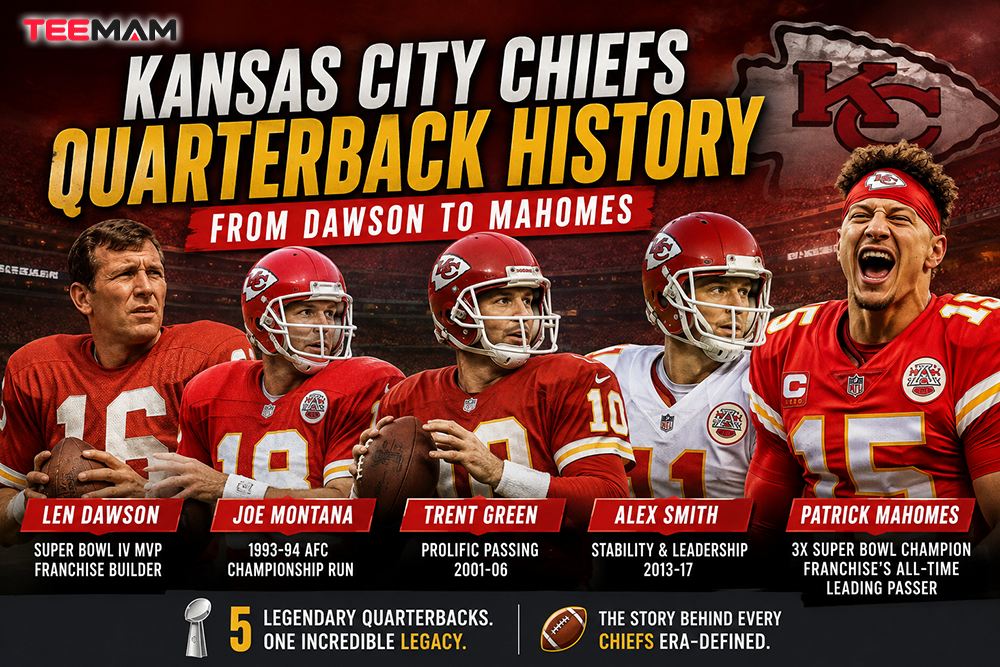
Every era of meaningful Chiefs success traces back to whoever was under center. Len Dawson defined the AFL years and Super Bowl IV. Joe Montana’s two seasons in Kansas City, 1993 and 1994, were brief but real; he took the Chiefs to the AFC Championship Game and proved the franchise could still attract elite talent even in its quieter stretch. Patrick Mahomes has since built the most decorated run of quarterback play the franchise has ever seen, with multiple MVP awards and three Super Bowl rings before turning 30.
Each era had a different quarterback, but the outcome was remarkably similar: whenever Kansas City found elite play under center, sustained success followed. The Chiefs quarterback history timeline covers everyone who filled the gaps in between, too.
Why Hall of Fame History Still Inspires Today’s Fans

There’s a reason grandparents who watched Super Bowl IV on a black-and-white TV are now bringing grandkids to Arrowhead in Mahomes jerseys. Chiefs fandom has always passed down through families, and the Hall of Fame names are usually the connective tissue. A dad who grew up idolizing Derrick Thomas raises a kid who idolizes Chris Jones. A grandmother who remembers Len Dawson’s cool under pressure sees the same thing in Mahomes on a fourth-and-long.
That’s exactly why you’ll still see weathered No. 58 Derrick Thomas jerseys and retro-style Super Bowl IV tees in the parking lot every single Sunday. Wearing a throwback design isn’t just game-day fashion; it’s a nod to the grit and Arrowhead noise those legends built in the first place. TeeMam leans into that same idea, building fan apparel around the idea that this history isn’t just remembered, it’s worn.
Common Questions About Kansas City Chiefs Hall of Fame Players
How many Kansas City Chiefs players are in the Pro Football Hall of Fame?
The Chiefs franchise is represented by 26 Pro Football Hall of Famers. Of those, 20 actually played for the team. The remaining six were inducted as the franchise’s founder, coaches, or front-office contributors rather than as players.
Who was the first Chiefs Hall of Fame player?
Bobby Bell became the first Chiefs player enshrined in Canton, in 1983. The linebacker/defensive end spent all 12 of his professional seasons with the team and had his No. 78 retired the following year.
Which Chiefs Hall of Fame player has the greatest career legacy?
There’s no single right answer here, and fans genuinely split on it. Len Dawson gets the nod for franchise-defining leadership and the Super Bowl IV win. Derrick Thomas gets it for pure individual dominance at his peak. Tony Gonzalez gets it for statistically redefining an entire position. All three arguments hold up.
Are Hall of Fame players different from retired jersey numbers?
Yes. The Chiefs have retired 10 numbers total; seven belong to Pro Football Hall of Famers, while three (Abner Haynes, Stone Johnson, Mack Lee Hill) honor players who never reached Canton but hold major significance to the franchise.
Which current Chiefs players could eventually reach the Hall of Fame?
Patrick Mahomes, Travis Kelce, and head coach Andy Reid are widely considered strong future candidates based on their résumés so far, though nobody is formally eligible until they’ve been retired for at least five seasons. Nothing is guaranteed until the Selection Committee actually votes.
Conclusion
The Kansas City Chiefs Hall of Fame story isn’t really one story; it’s several, stacked on top of each other across six decades. The AFL pioneers built the foundation and delivered Super Bowl IV. The defensive stars of the 1980s and ’90s kept Arrowhead’s reputation intact through leaner years. Tony Gonzalez bridged the gap into the modern era, and the Reid-Mahomes years have already added three more championships that will eventually produce their own new names in Canton.
The names inside Canton may never change, but the meaning of those careers grows every season another generation walks into Arrowhead wearing No. 16, No. 58, or No. 88. That’s why the Kansas City Chiefs Hall of Fame remains a living part of Chiefs Kingdom rather than simply a record of the past.