Kansas City Chiefs Coaching Legacy: From Hank Stram to Andy Reid
The Kansas City Chiefs coaching staff is more than a single job title. It is the product of decades of hires, schemes, and organizational decisions that began in 1960, when Lamar Hunt hired 37-year-old Hank Stram to coach the Dallas Texans, the franchise that became the Chiefs. Three coaches define the eras that matter most. Stram built the original identity and won Super Bowl IV. Marty Schottenheimer made Kansas City a perennial contender through the 1990s. Andy Reid has run the team since 2013 and produced the most successful sustained championship run in franchise history. The coaches in between, including Paul Wiggin and Dick Vermeil, matter too, because none of the big eras happened in isolation.
Who is currently on the Kansas City Chiefs coaching staff? Andy Reid is the head coach entering the 2026 season, his 14th in Kansas City. Eric Bieniemy is back as offensive coordinator, Steve Spagnuolo remains defensive coordinator, and Dave Toub continues as assistant head coach and special teams coordinator. The wider 2026 staff also added running backs coach DeMarco Murray, wide receivers coach Chad O’Shea, and several defensive assistants, following the team’s public announcement of the offseason hires (Chiefs.com). The moves follow a 6-11 finish in 2025, a season further disrupted when Mahomes suffered a season-ending ACL injury in the Week 15 loss to the Chargers (NFL.com). Offensive coordinator Matt Nagy’s contract expired at season’s end, and Kansas City turned back to Bieniemy, who had already spent five seasons running the offense during two Super Bowl-winning campaigns.
How the Chiefs Coaching Legacy Was Built
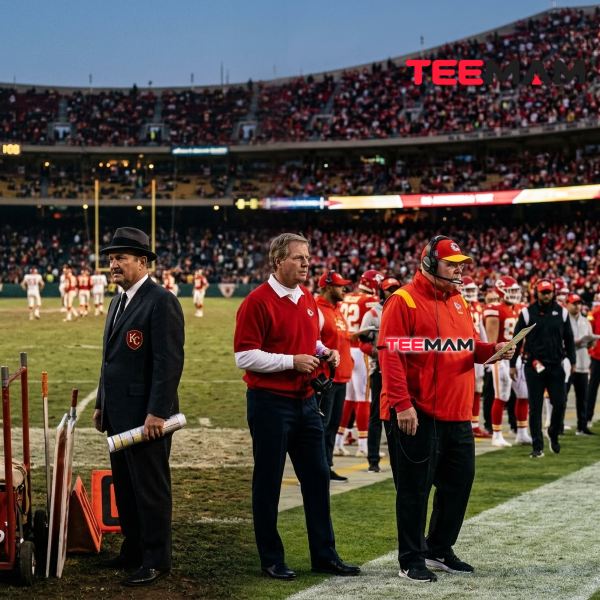
The name on the headset gets remembered first. The people around him usually explain why the system works. The Chiefs coaching staff has always worked in layers: a head coach setting the tone, coordinators translating that into a scheme, and position coaches developing the players who run it. That structure hasn’t changed much since the AFL era. What has changed is how specialized each layer has become.
Follow the timeline from the AFL through today’s NFL and three defining coaching identities stand out, separate from the rebuilding years that connected them. Stram’s Chiefs were an offensive laboratory, running formations nobody else in pro football was using. Schottenheimer’s Chiefs leaned on defense and field position to grind teams down for sixty minutes. Reid’s Chiefs pair West Coast passing principles with a roster built around Patrick Mahomes, a two-time NFL MVP and three-time Super Bowl champion. For the fuller timeline connecting those decades, see our Chiefs franchise history guide.
Who are the most influential Kansas City Chiefs coaches? Hank Stram, Marty Schottenheimer, and Andy Reid stand above the rest. Stram won the franchise’s first title in 1970, Schottenheimer built a decade of sustained contention in the 1990s, and Reid has delivered three Super Bowl championships since 2013, the most successful stretch in team history.
Hank Stram and the Birth of Chiefs Football
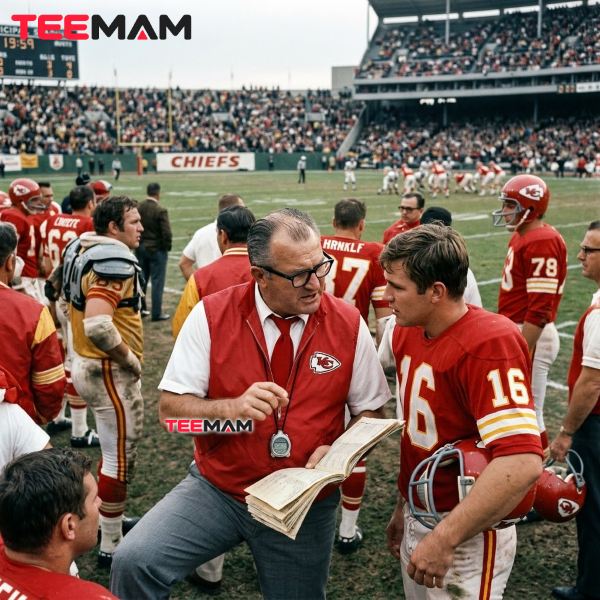
Stram coached the Texans starting in 1960 and moved with the franchise to Kansas City in 1963, spending 15 years total at the helm. His offenses used pre-snap motion, unconventional formations, and misdirection at a time when most NFL teams still ran straightforward power football. He finished his Chiefs tenure with a 124-76-10 regular-season record and was inducted into the Pro Football Hall of Fame in 2003.
What made Hank Stram important to the Chiefs? He delivered the franchise’s first championship and its first real offensive identity, using formations and motion years before they became standard around the league. He also became the emotional voice of that team: when NFL Films wired him for sound during Super Bowl IV, his sideline commentary turned him into one of the most quoted coaches in league history.
The signature moment came on January 11, 1970, when Kansas City beat the Minnesota Vikings 23-7 in Super Bowl IV, a win that gave the AFL real credibility just months before the AFL-NFL merger was completed. The game’s most famous play, “65 Toss Power Trap,” sprung Mike Garrett for a touchdown, and it’s remembered today largely because Stram’s animated call of it was caught on tape. That championship became the first marker in a story Reid would later add three more chapters to; readers curious how those four titles compare can trace the Chiefs’ Super Bowl history.
Marty Schottenheimer and the Rise of Arrowhead Football
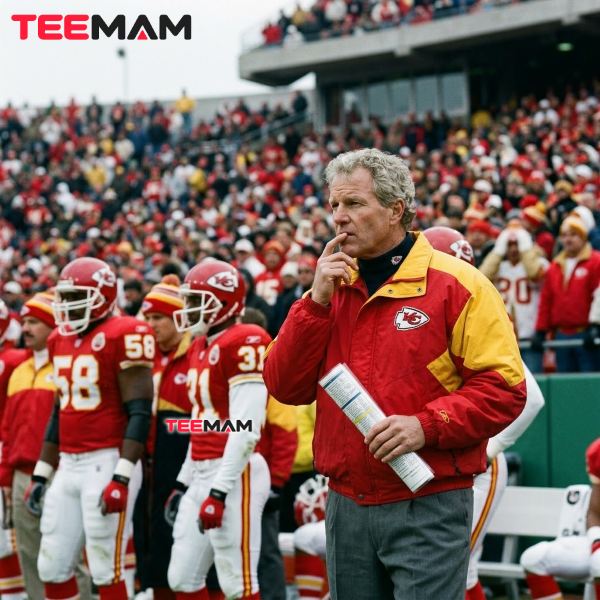
Schottenheimer took over in 1989 after being let go in Cleveland, inheriting a Chiefs team that had made exactly one playoff appearance in the previous 17 years. He rebuilt it around discipline and defense, and the results were immediate: seven playoff appearances across his 10 seasons, a 101-58-1 regular-season record, and three AFC West titles, in 1993, 1995, and 1997.
The style became known as “Martyball,” a conservative, run-first offense paired with a defense built to control field position. It produced the franchise’s first AFC Championship Game appearance, a loss to Buffalo after the 1993 season. The record backs up the reputation Arrowhead built during those years: Kansas City went 62-18 at home under Schottenheimer, the third-best home mark in the NFL over that span, and 55-28 against AFC West opponents, according to the team’s own Hall of Honor profile of his tenure. Martyball didn’t win a ring, but those numbers explain why the era still matters to Chiefs fans. The criticism that followed Schottenheimer was consistent: his teams were built to win in October, not always in January.
What tends to get left out of shorter coaching rundowns is how far Schottenheimer’s influence spread beyond Kansas City. His Chiefs staffs included future NFL head coaches Bill Cowher, Tony Dungy, Bruce Arians, Herman Edwards, and Mike McCarthy, who started as an offensive quality-control assistant in Kansas City in 1993 before becoming quarterbacks coach through 1998. Cowher and Dungy are both now enshrined in the Pro Football Hall of Fame. That’s a coaching tree most “list of Chiefs coaches” pieces skip entirely, and it says a lot about how much talent passed through Kansas City’s staff during the 1990s.
The Transitional Years Between Coaching Eras
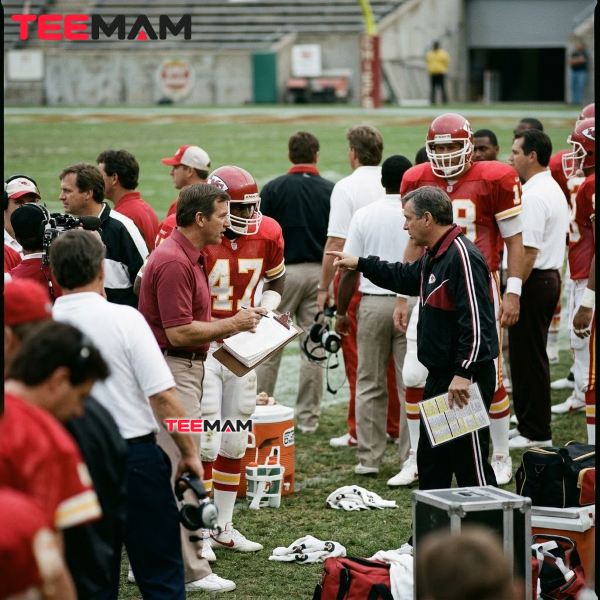
Schottenheimer resigned in January 1999 after a 7-9 season, and the 14 years that followed were the least stable stretch in franchise history. Gunther Cunningham took over first, then Dick Vermeil arrived in 2001 and helped modernize the passing offense around Trent Green and Priest Holmes. Herm Edwards, himself a former Schottenheimer assistant, took over in 2006 and leaned on defense and locker-room culture. Todd Haley’s tenure starting in 2009 focused on developing the offense and the quarterback position but ended abruptly in December 2011, when Romeo Crennel finished the season as interim head coach.
None of those coaches produced a championship, but each one nudged the roster and the organization a step closer to what Reid inherited in 2013. The pattern went back further than most fans realize: Paul Wiggin was fired midway through the 1977 season after an 0-5 start, and longtime assistant Tom Bettis finished the year as interim head coach. Skipping straight from Schottenheimer to Reid, the way a lot of quick-hit coaching articles do, misses how much of this groundwork got laid, unevenly at times, during those in-between years.
Andy Reid and the Modern Chiefs Coaching Staff
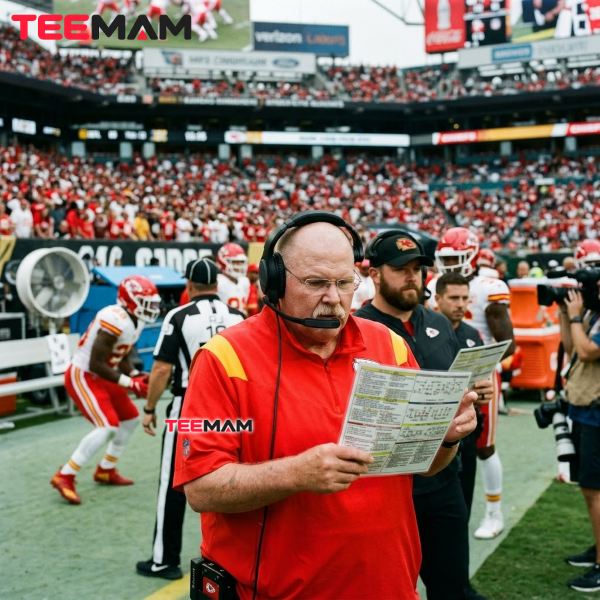
Kansas City hired Andy Reid on January 7, 2013, making him the 13th head coach in franchise history. He inherited a 2-14 team and had it in the playoffs by year one. Entering the 2026 season, his 14th in Kansas City, Reid’s regular-season record with the Chiefs stands at 279-157-1, with a 28-17 postseason mark, for 307 combined wins. The team’s official coaching roster lists that as fourth on the NFL’s all-time wins list and first among currently active head coaches, and it makes him the winningest regular-season coach in the histories of both the Chiefs (149 wins) and the Eagles (130 wins) (Chiefs.com).
Reid’s system is built on West Coast passing principles layered with constant pre-snap movement and a willingness to create mismatches rather than force a scheme onto players who don’t fit it. That flexibility became obvious once Mahomes took over at quarterback in 2018: the offense got faster and more willing to live with some chaos in exchange for explosive plays, a shift that helped produce Super Bowl titles after the 2019 and 2022 seasons, with a third title following the 2023 season. The staff Reid assembled during that stretch became part of the identity of what many fans now regard as the franchise’s golden era, and it represents the latest major chapter in Kansas City’s coaching history.
Key Members of the Chiefs Coaching Staff in 2026
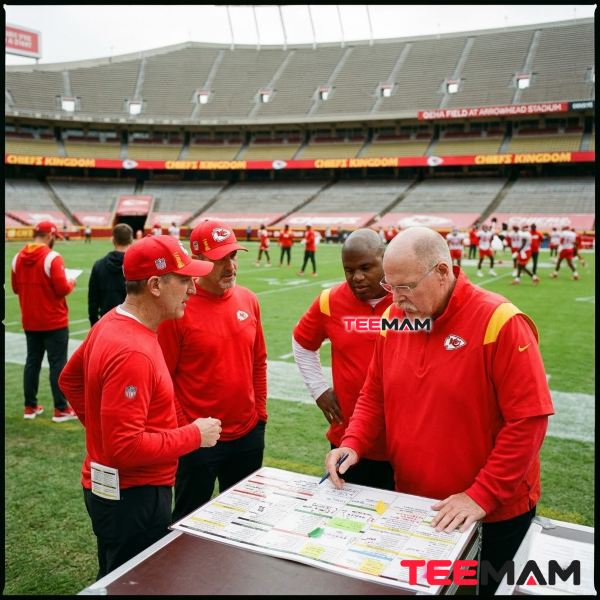
The Chiefs enter 2026 with a reshaped offensive staff after a 6-11 finish in 2025, the franchise’s first losing season since 2012 and first missed playoffs since 2014. Nagy’s contract expired at the end of that season, and Kansas City turned back to Bieniemy, who had already spent five seasons as OC (2018-22) during two Super Bowl-winning campaigns before departing for Washington in 2023.
| Role | Coach | Primary Responsibility |
|---|---|---|
| Head Coach | Andy Reid | Overall team leadership and offensive direction |
| Offensive Coordinator | Eric Bieniemy | Building the offensive system and coordinating game preparation with Reid |
| Defensive Coordinator | Steve Spagnuolo | Defensive scheme and pressure packages |
| Assistant Head Coach / Special Teams Coordinator | Dave Toub | Special teams units and overall staff support |
| Running Backs Coach | DeMarco Murray | Running back development, hired from Oklahoma in 2026 |
| Wide Receivers Coach | Chad O’Shea | Receiver development, returning to Kansas City in 2026 |
| Defensive Line Coach | Joe Cullen | Defensive line technique and rotation |
| Defensive Backs and Safeties Coach | Andre Curtis | Secondary development alongside Dave Merritt |
These are the key roles, not the entire staff. Kansas City also brought in several quality-control and assistant positions for 2026, including Nate Pagan on offense and C.J. Cox on defense (Chiefs.com). The Kansas City Chiefs coaching staff reflects both continuity and change this year: Reid, Spagnuolo, and Toub remain in place, while several new position coaches join a rebuilt offensive room. Because staffs change every offseason, treat this table as a snapshot rather than a permanent list, and check the team’s official coaches roster for the most current names.
What does the Chiefs coaching staff actually do, role by role?
- Head coach: sets the team’s overall strategy and manages the staff
- Coordinators: build the offensive, defensive, and special-teams schemes and adjust them week to week
- Position coaches: handle the daily technique and development work for players at a specific spot on the roster
- Quality-control assistants: break down film and prepare scouting reports that shape the coordinators’ game plans
The Coordinators Behind the Chiefs’ Championship Era
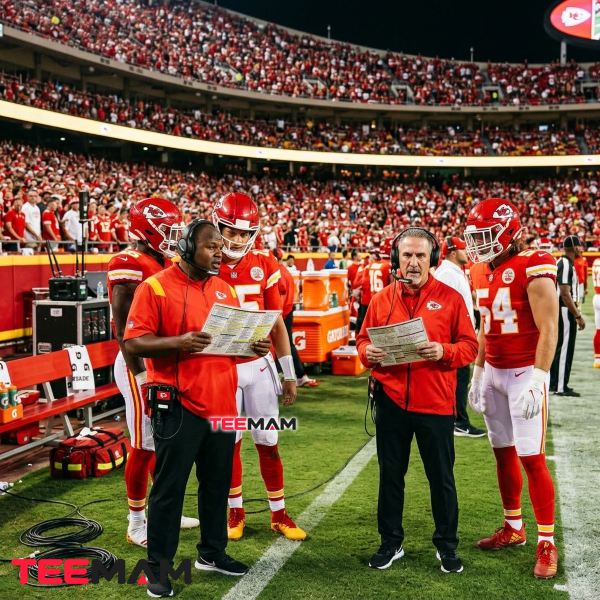
A head coach sets the framework, but coordinators and position coaches determine how that framework actually shows up on Sundays. That distinction matters more than usual for the current Kansas City Chiefs coaching staff, since Reid’s tenure has depended on a rotating group of offensive coordinators (Bieniemy, then Nagy, now Bieniemy again) even as the core coaching philosophy has stayed consistent.
Steve Spagnuolo has been Kansas City’s defensive coordinator since 2019, and his aggressive, blitz-heavy scheme was an important part of the Chiefs’ Super Bowl LIV and Super Bowl LVIII championship teams. His defenses frequently rely on disguised pressure out of the secondary, the same unit Andre Curtis now helps coach alongside Dave Merritt. On the other side of the ball, Bieniemy’s return gives Kansas City a coordinator who already has a working relationship with Mahomes and a track record inside Reid’s system, which the front office is betting will help the offense rebound after a difficult 2025.
How Chiefs Coaching Philosophies Changed Across Generations
| Era | Coaching Identity | Core Strength | Long-Term Impact |
|---|---|---|---|
| Hank Stram (1960-1974) | Offensive innovation | Creativity and misdirection | First title, first real team identity |
| Marty Schottenheimer (1989-1998) | Defensive discipline | Physicality and consistency | Built the Arrowhead-era culture and a notable coaching tree |
| Transitional coaches (1999-2012) | Rebuilding | Adaptation | Laid groundwork for the modern front office structure |
| Andy Reid (2013-present) | Offensive flexibility | Innovation and player development | Sustained, multi-championship modern era |
How has Chiefs coaching changed over time? The Kansas City Chiefs coaching staff has shifted identity three times: from Stram’s offensive creativity in the AFL era, to Schottenheimer’s defensive physicality in the 1990s, to Reid’s flexible, matchup-driven offense today. Each coach was really solving a different organizational problem:
| Coach | Problem He Inherited | Solution He Built |
|---|---|---|
| Hank Stram | A brand-new AFL franchise with no identity | Offensive innovation and a distinct playing style |
| Marty Schottenheimer | A team that had made one playoff appearance in 17 years | Defense, discipline, and week-to-week consistency |
| Andy Reid | A 2-14 roster in need of a sustainable structure | An adaptable offensive system paired with organizational stability |
What Makes a Chiefs Coach Truly Successful?
Who is the greatest Chiefs coach of all time? It depends on the criteria. By championships and sustained winning, Reid has the strongest case, with three Super Bowl titles and the best overall record in franchise history. By cultural transformation and regular-season dominance, Schottenheimer’s 1990s teams have a real claim. By historical significance, nothing tops Stram, who delivered the franchise’s first title and shaped its earliest identity. A few things tend to separate the coaches who mattered most in this history: a winning record that held up over multiple seasons, real playoff success rather than just regular-season wins, genuine player development, and a lasting cultural imprint on how the organization sees itself. Martyball never delivered a ring, but plenty of longtime season-ticket holders will still argue it built the identity everything since has been measured against. Reid’s larger point, proven over and over in the Mahomes era, is that even a winning scheme has to keep evolving or it gets left behind.
Chiefs Coaches and the Players Who Defined Their Eras
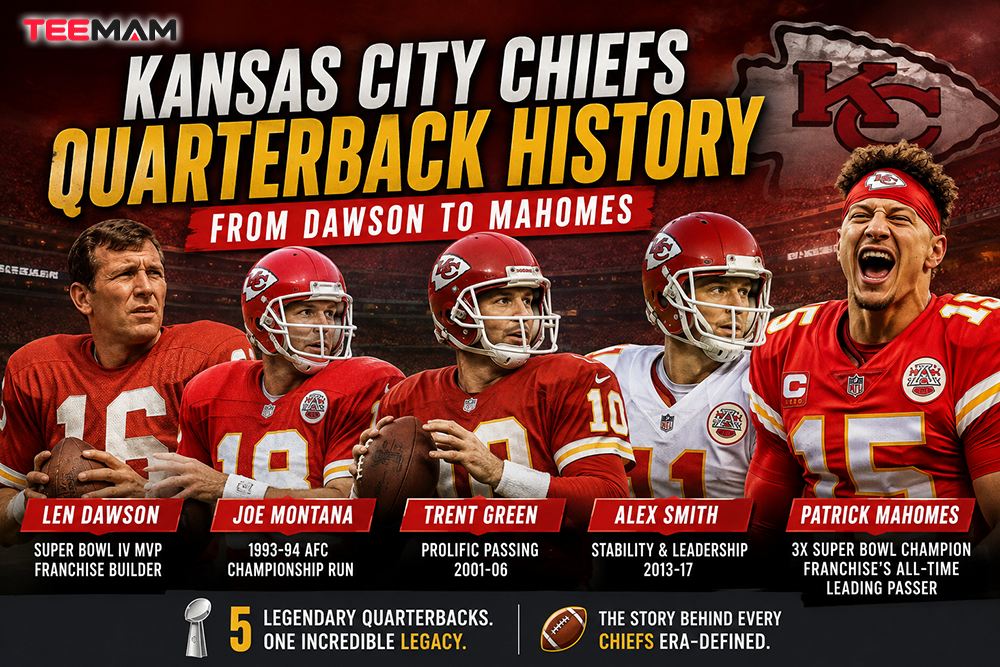
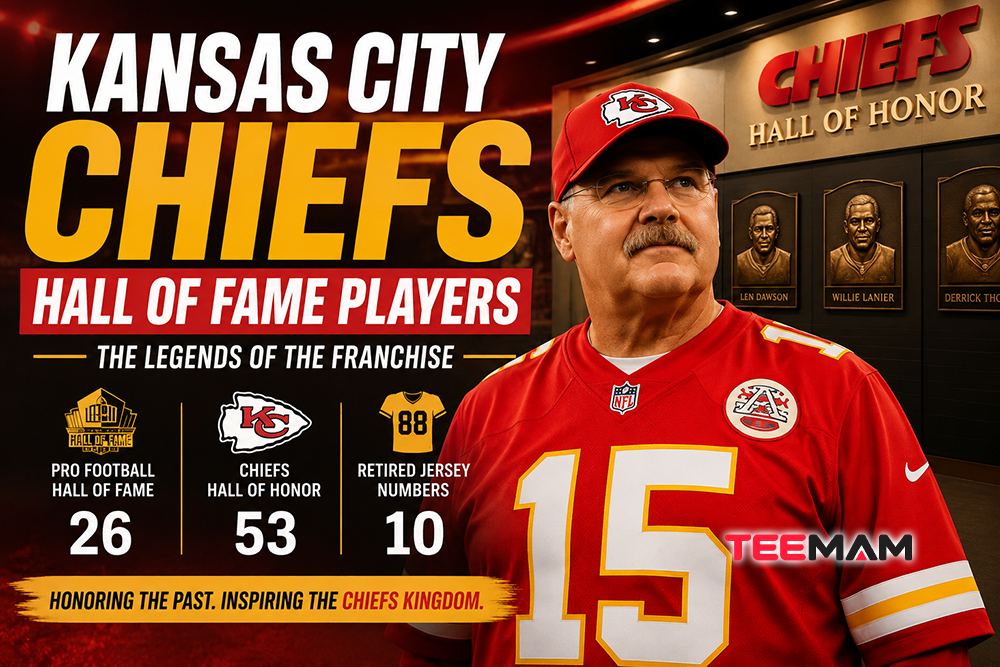
Every coaching era eventually comes back to the players on the field. Stram’s era ran through Len Dawson, Bobby Bell, and Buck Buchanan. Schottenheimer’s Chiefs were built around Derrick Thomas and a defense full of Pro Bowlers. Reid’s modern dynasty runs through Mahomes and Travis Kelce. Readers who want to go deeper on those names can meet the Chiefs Hall of Fame players whose careers overlapped with these coaching staffs.
Chiefs Coaching Legacy in One Timeline
| Coach | Years | Defining Contribution |
|---|---|---|
| Hank Stram | 1960-1974 | Built the franchise, won Super Bowl IV |
| Paul Wiggin | 1975-1977 | Led the team until his midseason dismissal in 1977 |
| Tom Bettis | 1977 | Finished the 1977 season as interim head coach |
| Marv Levy | 1978-1982 | Later a Hall of Fame coach with Buffalo |
| John Mackovic | 1983-1986 | Led Kansas City for four seasons |
| Frank Gansz | 1987-1988 | Special-teams-focused tenure |
| Marty Schottenheimer | 1989-1998 | Built the Arrowhead-era defensive identity |
| Gunther Cunningham | 1999-2000 | First post-Schottenheimer transition |
| Dick Vermeil | 2001-2005 | Modernized the passing offense |
| Herm Edwards | 2006-2008 | Defensive and culture focus |
| Todd Haley | 2009-2011 | Offensive and quarterback development |
| Romeo Crennel | 2011-2012 | Interim bridge to the Reid era |
| Andy Reid | 2013-present | Built the modern championship dynasty |
How Coaching Shaped Chiefs Kingdom Culture

Arrowhead’s reputation as one of the loudest, most physical buildings in football didn’t happen by accident. It grew out of the identity each coaching staff put on the field. Schottenheimer’s grind-it-out teams turned Arrowhead into a fortress in the 1990s, and Reid’s faster, higher-scoring Chiefs turned it into a stage for some of the most memorable playoff games of the last decade. Walk the tailgate lots on a fall Sunday and you can see that history on people’s backs: vintage Stram-era jackets next to modern Super Bowl LVIII gear, red and gold from every decade in between. The uniforms and the coaches change; the identity built on that sideline doesn’t.
The Enduring Legacy of the Chiefs Sideline
Stram gave Kansas City its first recognizable football identity. Schottenheimer made the franchise a regular contender again in the 1990s, while the next group of coaches spent 14 years searching for a formula that could last. Reid eventually provided that stability, but without locking the team into one rigid offensive formula; his system has changed repeatedly as quarterbacks, skill players, and defensive challenges have changed around it. The 2026 staff reflects that same pattern in a more practical way: Bieniemy returns to an offense he already knows, while Reid and Spagnuolo retain the defensive structure that helped define the championship years.
That’s what makes the Chiefs coaching story different from a simple list of names. Stram, Schottenheimer, and Reid didn’t run the same kind of football, but each one left Kansas City with a stronger identity than the one he inherited. The current staff is simply the latest test of whether that tradition can keep evolving. That’s the perspective we bring to Chiefs history at TeeMam: the coaches and championships matter, but so do the traditions and fan culture that grew up around them.
How Chiefs Fans Celebrate the Coaching Legacy
Game days at Arrowhead carry the fingerprints of every era listed above: red-and-gold color schemes with roots in the Stram years, throwback nods to the Schottenheimer teams that packed the stadium every fall, and a newer wave of championship pride built around the Reid-Mahomes run. Fans mark those eras the way sports fans always have, through team colors, gear tied to specific championship seasons, and a shared identity that connects a 1970 title team to a locker room still adding new chapters.