Candy Corn: The Sweet History of a Halloween Icon
Candy corn for Halloween is one of those things that just shows up every October, sitting in a glass bowl by the door before you’ve even noticed the leaves have turned. It’s a small, waxy, three-colored candy shaped like a corn kernel, and it’s been around since the 1880s. What’s less well known is that it wasn’t invented for Halloween at all — it started as a farm-themed novelty, and only became the holiday’s signature candy decades later, once trick-or-treating turned into the candy-driven tradition Americans know today.
What Is Candy Corn, and Why Is It a Halloween Candy?
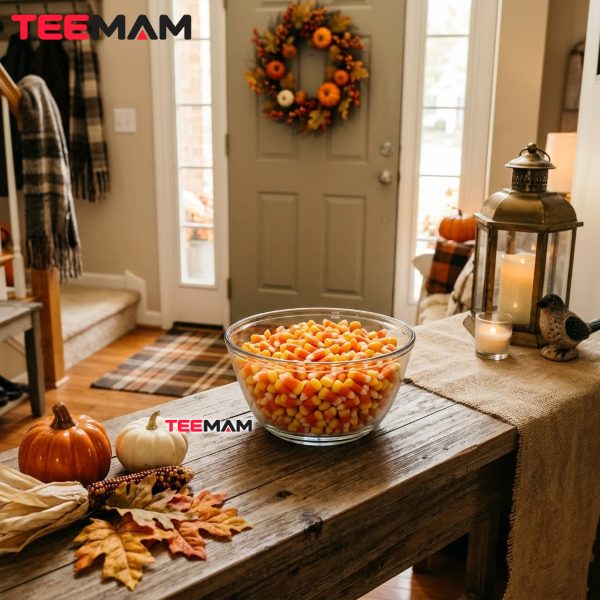
What Does Candy Corn Look Like?
Picture a tiny triangle standing on its base: a broad yellow bottom, a tapered orange middle, and a narrow white tip. That stacked, three-band design is what makes candy corn recognizable from across a room, even before you can smell the sugar. Its flavor is distinctly sweet, with buttery, vanilla-like notes that are very different from the savory taste its name might suggest, and the texture sits somewhere between a soft marshmallow and a firm gumdrop.
Why Is Candy Corn Associated With Halloween?
Candy corn was not originally created as a Halloween candy. It began as one of many agriculture-themed confections — alongside candy pumpkins, turnips, and chestnuts — made for rural and agricultural communities at a time when close to half of American workers were tied to farming. The story of candy corn for Halloween as we know it today only developed later, as trick-or-treating spread nationally and seasonal candy marketing expanded around it. For more on how that broader holiday took shape in America, our piece on the history of All Hallows Eve walks through that evolution.
From “Chicken Feed” to a Halloween Classic: The 1880s Origin
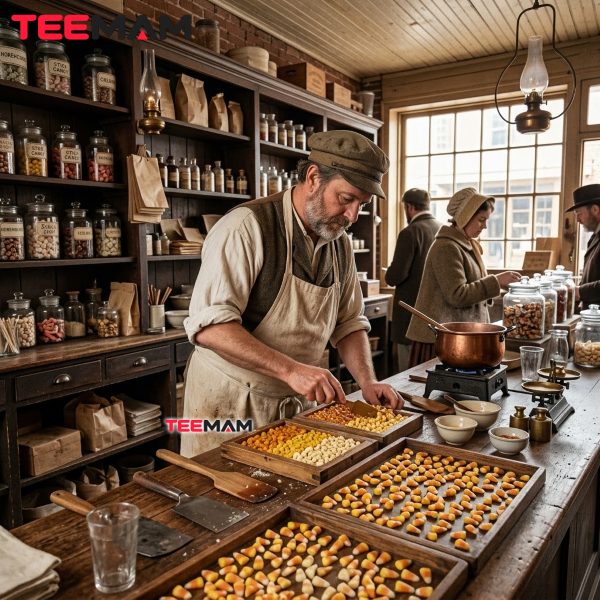
Candy corn’s story starts in Philadelphia, at the Wunderle Candy Company. According to the company’s own history and to accounts collected by the Encyclopedia of Greater Philadelphia, longtime Wunderle employee George Renninger developed the tri-color candy together with company founder Philip Wunderle in 1888, building on Renninger’s earlier work with layered “butter cream” confections. Most general-audience sources simply place the invention “in the 1880s,” since the exact year has been debated by historians, and the Encyclopedia of Greater Philadelphia itself frames the story as “tradition” rather than documented fact.
Who Invented Candy Corn?
George Renninger is the name credited across nearly every historical source, working alongside Wunderle himself. As HISTORY notes, oral company history rather than a formal patent has long been the primary source for that credit. Historical tradition places the candy’s development at the Wunderle Candy Company in Philadelphia in 1888, with George Renninger and Philip Wunderle credited with creating the tri-color confection. The Goelitz Candy Company — which later became Jelly Belly — is a separate, later chapter in the story.
How “Chicken Feed” Became a Familiar Treat
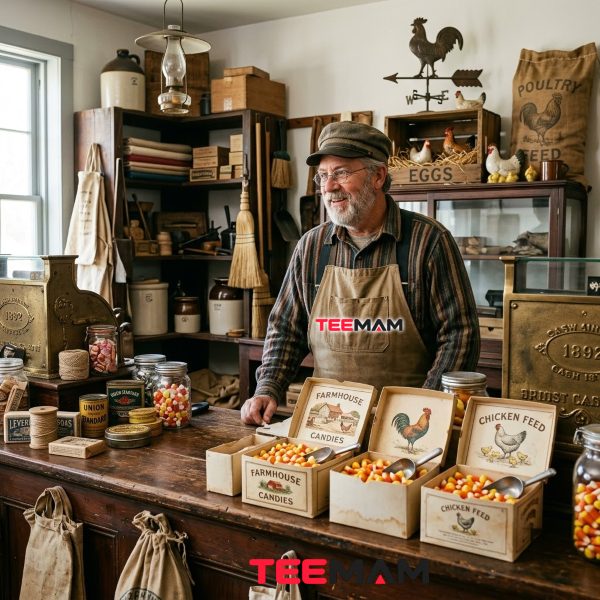
Renninger’s invention wasn’t sold under the name “candy corn” at first. Goelitz began marketing the candy in 1898 under the name “Chicken Feed,” helping bring it to a much wider market, packaging it in boxes stamped with a rooster and the tagline “Something worth crowing for.” The name “Chicken Feed” made sense at the time: before World War I, corn grown in the U.S. was mostly used to feed livestock rather than people, so a corn-shaped candy fit naturally into farmyard branding. Wunderle is generally identified as the first company to commercially sell this type of multi-colored confection — it stayed a rural, seasonal novelty for decades before its identity shifted toward Halloween specifically.
How Did Candy Corn Become a Halloween Tradition?
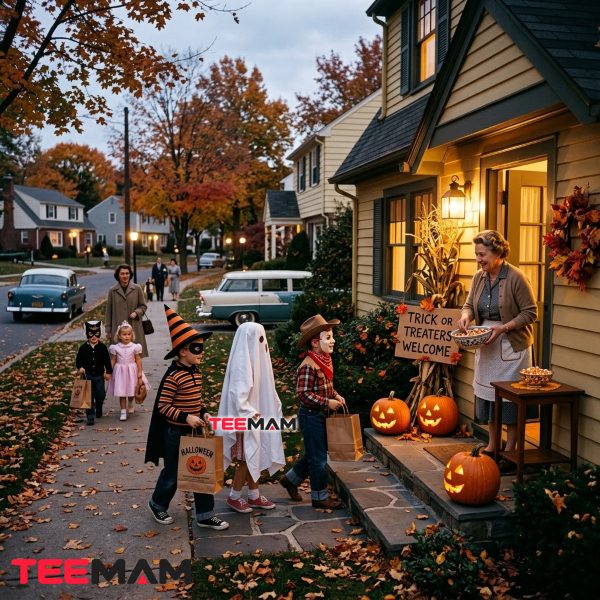
The invention date explains where candy corn came from, but not why Americans came to associate it with Halloween. The shift from farm-themed novelty to Halloween staple took place gradually, alongside the rise of modern trick-or-treating and packaged candy — it didn’t happen because of the candy itself. It happened because Halloween did. Trick-or-treating took recognizable form in the United States by the 1930s, although earlier Halloween celebrations included a much wider range of customs, and what got handed out at the door was just as likely to be fruit, nuts, coins, or homemade cookies as candy. It was only in the 1950s, as postwar suburbs filled with kids and candy companies increasingly marketed small packaged treats for Halloween, that candy corn’s seasonal association began to strengthen. Sealed, commercially packaged candy became increasingly dominant through the 1970s, as parents grew more cautious about homemade treats and sealed, branded candy became the more trusted option. Candy corn’s existing autumn palette and shape made it an easy fit once that shift was underway.
There is no single year when candy corn suddenly became a Halloween candy. Its association developed gradually, as an older seasonal confection met a newer Halloween tradition built around neighborhood trick-or-treating.
When Did Candy Corn Become a Halloween Staple?
- 1888 — Historical tradition credits George Renninger and Philip Wunderle with developing the tri-color candy at the Wunderle Candy Company in Philadelphia.
- 1898 — Goelitz Candy Company begins marketing it as “Chicken Feed,” helping bring it to a much wider market.
- 1930s — Trick-or-treating starts to take shape as an American Halloween custom, though treats still vary widely.
- 1950s — Candy companies increasingly market small packaged treats for Halloween as trick-or-treating grows; candy corn’s seasonal association becomes stronger.
- 1970s — Sealed, commercially packaged candy becomes increasingly dominant as parents grow more cautious about homemade treats.
- Today — Candy corn for Halloween remains one of the season’s most recognizable candies, according to the National Confectioners Association.
The Three Colors That Made Candy Corn an Autumn Icon
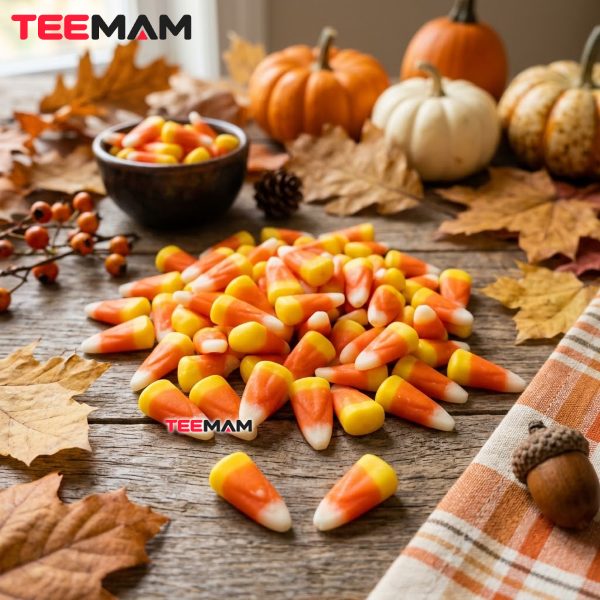
The white, orange, and yellow layers reinforce the candy’s resemblance to a corn kernel, while the warm palette fits naturally into the visual language of fall and Halloween. The triangular shape reinforces that resemblance closely enough that it eventually gave the candy its name.
The Candy Corn Aesthetic Beyond Food
That tri-color palette has outgrown the candy bowl entirely. You’ll spot it on Halloween tote bags, mugs, porch bunting, graphic tees, and party décor — a shorthand for the season that doesn’t need a single word of text to register, and doesn’t require a pumpkin, ghost, or witch drawn next to it to say “Halloween.”
The Great Candy Corn Debate: Love It or Hate It?
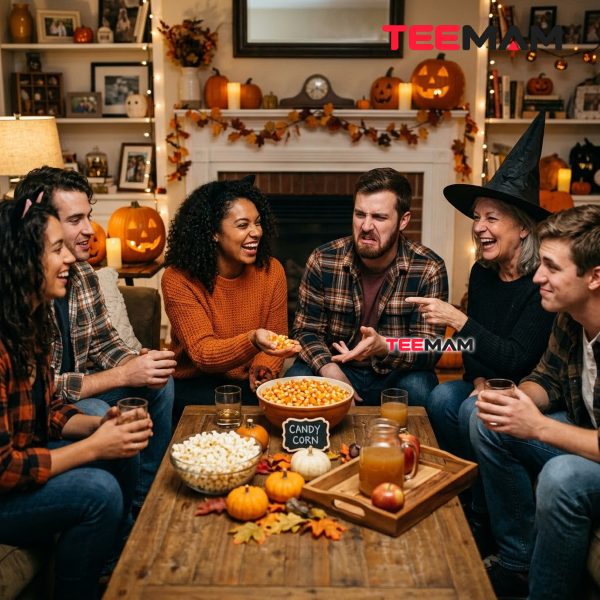
Few candies split a room the way candy corn does. Part of it is texture — that dense, waxy bite isn’t for everyone — and part of it is pure nostalgia; people who grew up with a bowl of it by the door tend to defend it fiercely, while newcomers often find it cloying. It’s become a recurring bit every October, right alongside costume debates and pumpkin-carving mishaps, and it’s a big reason candy corn for Halloween still gets talked about even by people who wouldn’t eat a piece.
Do You Eat the White, Orange, or Yellow Part First?
There’s no official answer, but the debate itself is part of the fun. Some people eat the whole piece in one bite. Others nibble from the narrow white tip toward the wider yellow base, treating it almost like a tiny layered dessert; a smaller camp works from the bottom up. None of these is “correct” — it’s one of those low-stakes disagreements that somehow never gets old.
5 Sweet and Spooky Candy Corn Facts
- It was originally called “Chicken Feed.” The name referenced its farm-country marketing, from a time before corn was widely eaten by people in the U.S.
- It dates back to 1888, when tradition credits George Renninger and Philip Wunderle with developing it at the Wunderle Candy Company in Philadelphia.
- Its three colors are the whole point. White, orange, and yellow were designed to visually echo a corn kernel.
- Its Halloween identity is younger than the candy itself. Candy corn for Halloween mainly took shape as a seasonal pairing between the 1950s and 1970s, as trick-or-treating and packaged candy became standard.
- It’s still widely sold. More than 35 million pounds of candy corn are sold in the U.S. each year, according to the National Confectioners Association.
What Happened to Candy Corn After Its Early Years?

Early candy corn was entirely handmade. Candy corn belongs to a category of confections known as mellowcreme, typically made from a mixture of sugar, corn syrup, gelatin, fondant, and coloring. Workers carried buckets of this hot mixture and poured each color layer separately into kernel-shaped molds — a labor-intensive process that limited production to a few months each year. Modern machinery eventually took over most of that work, which is part of why candy corn became cheap and available enough to fill Halloween candy bowls nationwide rather than staying a regional, seasonal novelty.
The Jelly Belly Candy Corn Connection
Jelly Belly’s role often gets mixed up with the candy’s origin story, so it’s worth separating clearly. The Goelitz Candy Company, the predecessor of today’s Jelly Belly Candy Company, wasn’t the inventor — that credit goes to Renninger and Wunderle. It became an important part of candy corn’s later commercial history after beginning to market the candy in 1898, under the “Chicken Feed” name and rooster branding that made it a recognizable product well beyond Philadelphia.
How Candy Corn Became a Halloween Design Icon
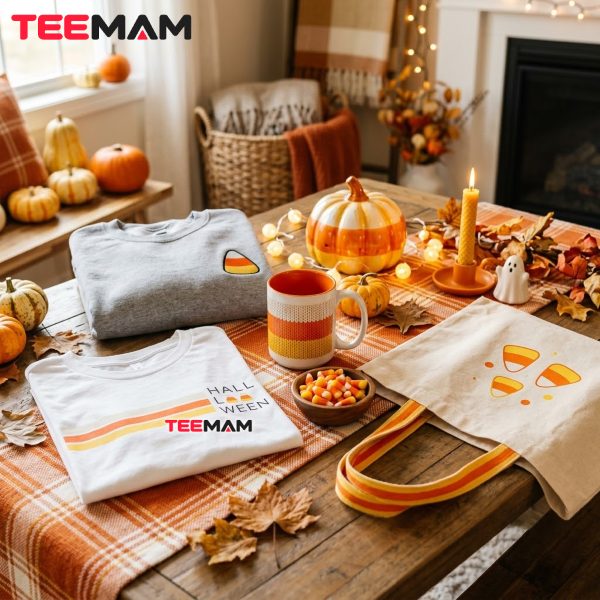
Over time, the candy’s three-color pattern became recognizable well outside the candy aisle. Today, that white-orange-yellow combination can signal Halloween on a T-shirt, a mug, or a porch flag without needing a single spooky character anywhere in sight.
Why Candy Corn Graphics Work So Well for Halloween Merch
The tri-color combination reads instantly, prints cleanly, and works across a wide range of tones — cute, funny, spooky, or retro — without needing much explanation. That’s a rare trait for a seasonal design motif, and it’s a big part of why candy corn for Halloween keeps showing up on apparel and home goods year after year.
Our Take on the Candy Corn Aesthetic
At TeeMam, we see candy corn-inspired colors as a useful example of how a familiar seasonal motif can translate naturally into apparel, mugs, tote bags, and other printed goods. The appeal is simple: the white, orange, and yellow combination is recognizable on its own, without requiring a literal Halloween character or a heavy graphic to make the season obvious.
What Should You Know Before Buying or Serving Candy Corn?
Does Candy Corn Expire?
Candy corn is a shelf-stable confection, but its quality can decline over time. For an opened or older package, follow the manufacturer’s date guidance and discard the candy if its appearance, texture, or smell has noticeably changed.
How Should You Store Candy Corn?
Keep it in a cool, dry spot in an airtight container, away from direct heat or humidity. Heat and humidity can affect the candy’s texture, making it softer, stickier, or grainier over time.
Candy Corn, Halloween, and the Power of Nostalgia
It’s a strange thing for a candy this divisive to have this much staying power. Part of it is genuinely just childhood memory — the specific bowl on a specific porch, the specific bag brought home after trick-or-treating. Candy corn doesn’t have to be anyone’s favorite to be recognizable; it just has to show up every October, the way it always has. Halloween has plenty of icons built the same way — our guide to the story behind the jack-o’-lantern traces a similar path from practical origin to instantly recognizable symbol.
Candy Corn and Other Classic Halloween Symbols
Jack-o’-lanterns, witches, black cats, ghosts, bats, and overflowing candy bowls all share one trait with candy corn: they’re simple enough to recognize at a glance, which is exactly what makes them durable. Candy corn’s edge is that it’s edible and disposable in a way carved pumpkins and costume props aren’t — it gets consumed, replaced, and repurchased every single year, which keeps it circulating in a way static decorations don’t. For a fuller rundown of how these motifs took hold, see our guide to classic Halloween symbols explained.
Candy Corn for Halloween: What Makes It an Icon?
The history becomes clearer when those milestones are viewed together. Historical tradition credits George Renninger and Philip Wunderle with developing candy corn in Philadelphia in 1888, as a farm-themed novelty called “Chicken Feed” — not a Halloween candy. It picked up its Halloween identity gradually, riding the wave of trick-or-treating as the holiday became more candy-centered between the 1950s and 1970s. Its tri-color, kernel-shaped design turned it into a visual shorthand for autumn that outlived its original marketing entirely. Love it or not, candy corn for Halloween remains one of the most recognizable — and most argued-about — treats of the season, and that argument is basically part of the tradition at this point.
Questions People Still Ask About Candy Corn
Was Candy Corn Originally Made for Halloween?
No. Candy corn was originally an agriculture-themed novelty candy marketed to rural communities in the late 19th century. Its close association with Halloween developed later, as trick-or-treating and seasonal candy marketing became more widespread in the United States between the 1950s and 1970s.
Is Candy Corn a Halloween Candy?
Yes. Candy corn for Halloween is widely recognized as a defining seasonal candy today, even though it was not originally created specifically for Halloween. Its association with the holiday developed as trick-or-treating and seasonal candy marketing became more prominent.
Who Invented Candy Corn?
George Renninger, a longtime employee of the Wunderle Candy Company in Philadelphia, is credited with developing candy corn together with company founder Philip Wunderle in 1888, based largely on company history and oral accounts rather than a single dated patent.
Why Is Candy Corn Associated With Halloween?
Its harvest-toned colors and farm-inspired shape already matched autumn imagery, and once mid-20th-century Halloween became more candy-focused, candy corn was relatively inexpensive and well suited to mass production — a natural fit for the growing tradition of trick-or-treating.
What Was Candy Corn Originally Called?
“Chicken Feed,” a name tied to its early farmyard packaging and to the fact that corn was mostly livestock food in the U.S. before World War I.
Does Candy Corn Expire?
It’s a shelf-stable candy, but texture and flavor decline over time — follow the manufacturer’s date guidance and discard it if the appearance, texture, or smell has noticeably changed.
Why Does Candy Corn Have Three Colors?
The white, orange, and yellow bands were designed to visually mimic a kernel of corn — pale tip, ripening middle, and full-color base — which is also where the candy’s name comes from.
Sources: HISTORY, “Who Invented Candy Corn?”; Library of Congress, “The Origins of Halloween Traditions”; Encyclopedia of Greater Philadelphia, “Candy and Candymakers”.

Hi, I’m Olivia Bennett, a fashion and lifestyle writer at TeeMam with 6 years of experience creating content about fashion, outfits, and lifestyle trends. I enjoy sharing practical style ideas for everyday wear, game days, holidays, and special occasions, helping readers find looks that feel comfortable, fun, and uniquely their own.