Classic Halloween Icons: The Story Behind Witches, Skeletons, Vampires & Ghosts
Every October, the same four characters show up everywhere — on porches, on sweatshirts, on the cardboard cutouts taped to grocery store windows. A grinning skeleton. A witch with her hat tipped low. A vampire in a stiff black cape. A ghost that’s really just a sheet with two holes cut out. We’ve seen them so many times that it’s easy to stop wondering where they came from.
Each one has its own long, occasionally strange backstory, and none of them started out as Halloween decorations. Skeletons were a religious teaching device centuries before anyone hung one on a porch railing. Witches carried the weight of real persecution before they became a Halloween costume staple. Vampires grew out of Eastern European folklore about disease and death, not romance novels. And the bedsheet ghost has a more complicated history than the harmless trick-or-treat costume it’s become.
This guide traces how each figure moved from fear to fashion — and how skeletons in particular went from a medieval symbol of death to the skeleton Halloween imagery that now shows up on everything from porch flags to apparel.
Skeletons: From Memento Mori to the Modern Skeleton Halloween Symbol
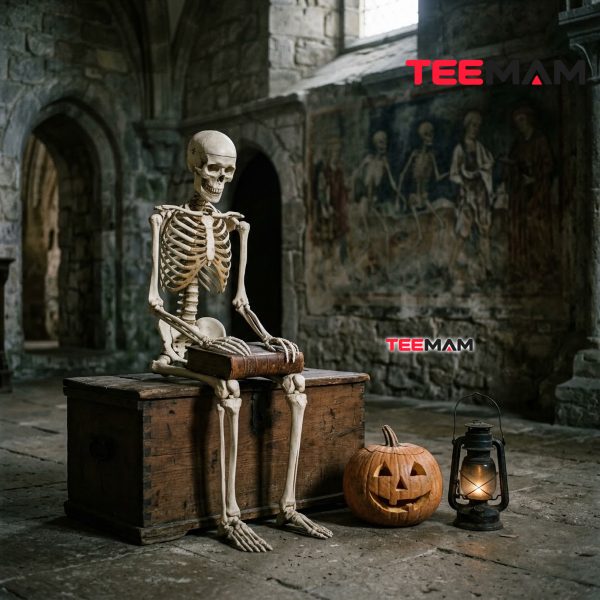
Where Did the Halloween Skeleton Come From?
Long before skeletons decorated a single porch, they were a religious teaching tool. Medieval European art used skulls, bones, and full skeletal figures as memento mori — Latin for “remember you must die” — a visual reminder that death comes for everyone, regardless of rank.
That idea reached its fullest expression in the Danse Macabre, or Dance of Death, an artistic and literary tradition that became widespread in the late Middle Ages, particularly the 14th and 15th centuries. According to HISTORY’s reporting on the subject, the imagery showed people from every social class — king, priest, peasant — being led to the grave by skeletal figures, an argument that status and wealth meant nothing once death arrived. The theme gained particular force during the 14th century, a period marked by the bubonic plague, when death sweeping through every class of society wasn’t an abstraction but daily reality.
The Danse Macabre isn’t a Halloween tradition on its own — it’s a separate medieval art movement. But the skeletal imagery it produced became one of the most influential visual traditions in Western depictions of death, and it’s the imagery that later fed into modern Halloween skeleton design, alongside centuries of other folklore and popular culture.
Why Are Skeletons Associated With Halloween?
Skeletons are associated with Halloween because they’re one of the clearest visual symbols of death and mortality that Western art has produced. Medieval memento mori imagery and the Danse Macabre established the skeleton as an instantly readable image of death long before Halloween adopted it as a symbol of the supernatural. As Halloween developed around themes of spirits and the boundary between the living and the dead, the skeleton was already a ready-made visual shorthand — and popular culture eventually turned that shorthand from solemn to playful.
How the Skeleton Became Playful
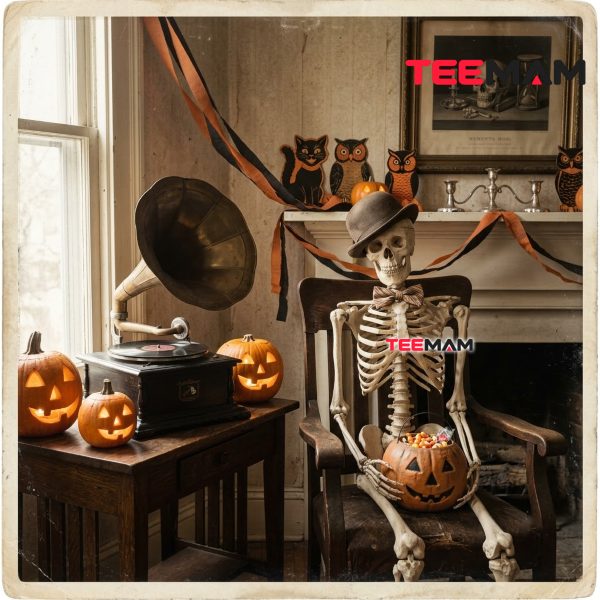
A few specific moments mark that shift from grim to grinning:
- French composer Camille Saint-Saëns wrote the orchestral piece Danse Macabre in 1874, based on an old legend that Death plays the fiddle at midnight and calls the skeletons up from their graves to dance until dawn.
- In 1929, Walt Disney released The Skeleton Dance, the first Silly Symphony, according to the American Film Institute’s catalog, which also confirms the short was directly inspired by Saint-Saëns’ 1874 piece. Four animated skeletons dance and play music in a graveyard — the same Dance of Death concept, recast as slapstick.
- By the mid-20th century, skeleton imagery was firmly established in cartoons, novelty entertainment, and Halloween decorations across the U.S., far removed from its origins as a warning about mortality.
The bones stayed the same. What changed was the mood around them.
Skeletons in Modern Halloween Fashion and Décor
Skeleton Halloween designs today tend to split into a few recognizable lanes: full skeleton versus skull-only (a dancing skeleton reads playful, an isolated skull leans gothic), black-and-white graphic illustrations built for apparel, vintage-style artwork that echoes early 20th-century Halloween postcards, and pairings like skeleton-and-pumpkin or skeleton-and-moon that layer multiple symbols into one design.
Color does a lot of quiet work here, too — the traditional black, orange, purple, and green palette shifts how scary or how cute a skeleton graphic feels. You can explore Halloween color meanings for a closer look at how those choices shape a design’s mood.
Witches: From Folklore and Fear to the Witchy Aesthetic
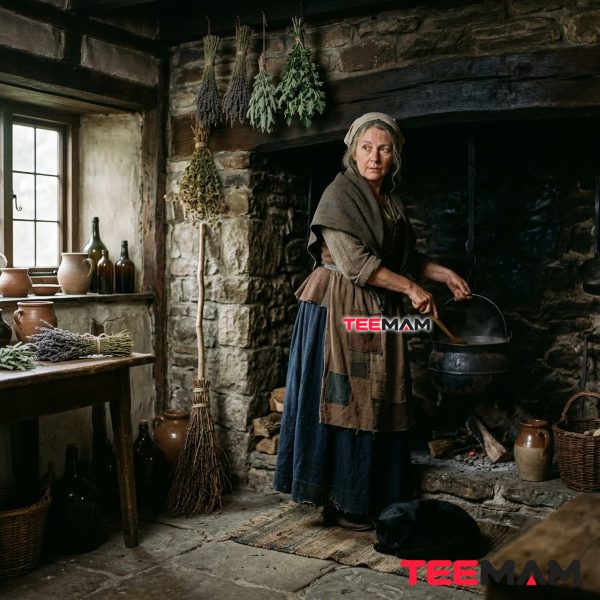
What Is the Historical Origin of the Halloween Witch?
The witch is where it’s easiest to oversimplify. The popular claim that “witches were just misunderstood herbalists and healers” isn’t a settled historical fact — it’s one strand pulled from a much messier history of European folklore, religious belief, and the witch trials that swept parts of Europe, and later colonial America, between the 15th and 18th centuries.
Some women accused of witchcraft during that period were local healers, midwives, or herbalists whose knowledge of plants made them targets of suspicion. But treating every accused woman as a healer — or every healer as an accused witch — flattens a genuinely complicated history that also involved religious anxiety, social scapegoating, and, in many documented cases, no connection to healing at all.
Why Does a Witch Have a Pointed Hat and Broom?
The witch’s now-standard look — pointed hat, broomstick, cauldron, black cat — didn’t come from one single source, and historians don’t fully agree on the details. What’s clearer is that each object had a mundane, everyday origin before folklore attached darker meaning to it:
- The pointed hat may echo tall, conical hats that were simply in fashion for both men and women across parts of Europe in the 15th and 16th centuries.
- The broomstick was an ordinary household tool. National Geographic notes one theory that alewives — women who brewed and sold ale — sometimes displayed a broom outside their door as a sign that ale was for sale, and that this innocuous object gradually became entangled with witchcraft accusations; other historians are skeptical of how directly that practice explains the modern image, so it’s best treated as one contributing theory rather than settled fact.
- The cauldron was simply a cooking pot common in most homes.
- The black cat picked up sinister associations through medieval church writings linking cats to the devil, later reinforced by witch-trial testimony describing accused women’s “familiars.”
None of these objects started out magical. They became witch iconography because ordinary domestic life got reinterpreted through a lens of suspicion and fear.
From Scary Crone to Modern Witchy Style
The old-crone archetype took shape across 19th- and early 20th-century illustration, fairy tales, and theater. Screen depictions later added their own visual conventions: the Evil Queen in Disney’s 1937 Snow White and the Seven Dwarfs reinforced a broader image of sinister female magic, while the green-skinned Wicked Witch of the West in 1939’s The Wizard of Oz helped cement green skin as a familiar part of the American witch look. From there, the aesthetic kept splitting into new directions:
| Witch Style | Visual Cues |
|---|---|
| Classic crone | Warts, hooked nose, cackle |
| Gothic witch | Black lace, dark florals, dramatic makeup |
| Cottagecore witch | Dried herbs, linen, earth tones |
| Celestial/tarot witch | Moon phases, stars, tarot imagery |
Why Witch Imagery Works So Well in Halloween Design
Part of the witch’s staying power as a design motif comes down to pure visual efficiency: the silhouette — pointed hat, flowing cloak — reads clearly even in outline, and it pairs naturally with moons, cats, stars, and potion bottles, giving designers a whole visual vocabulary instead of a single static image.
Vampires: From Eastern European Folklore to Gothic Romance
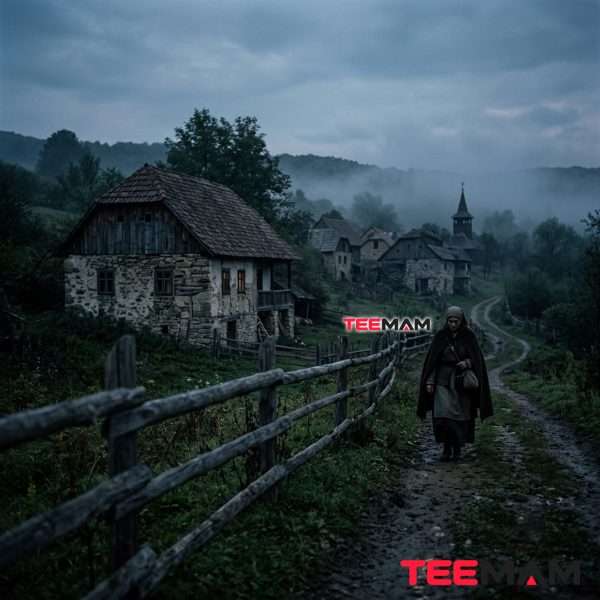
Where Did the Vampire Legend Begin?
Vampire legends originated in Eastern and Southeastern European folklore, where communities sometimes interpreted unexplained deaths, illness, and the visible effects of decomposition as signs that the dead had returned to harm the living. The modern fictional vampire came much later, shaped almost entirely by 19th-century literature — above all Bram Stoker’s 1897 novel Dracula.
Before germ theory offered another explanation, this kind of folk belief gave communities a way to make sense of disease outbreaks that otherwise felt random and frightening: if one death was followed by others nearby, some concluded the first death was somehow causing the rest.
How Dracula Changed the Vampire Forever
Stoker didn’t invent vampire folklore — he synthesized decades of earlier vampire literature and Eastern European legend into one enduring character, drawing partly on the historical figure of Vlad III (“Vlad the Impaler”), a 15th-century Wallachian ruler, for the count’s name and geography. How much of Vlad’s actual history shaped the character is still debated among scholars, so it’s more accurate to call the connection a loose inspiration than a direct biography. What Stoker’s novel did clearly accomplish was setting a template still recognizable today: an aristocratic vampire associated with Transylvania, vulnerable to traditional anti-vampire protections such as religious symbols — a template Britannica credits Dracula with cementing in the popular imagination.
From Horror Monster to Gothic Romantic Icon
Dracula began as a figure readers were meant to fear and ultimately destroy. Film adaptations gradually shifted the emphasis: Nosferatu in 1922, then Bela Lugosi’s performance in 1931, refined the pale face, formal dress, and hypnotic charm that films and popular culture would keep building on for decades, moving the vampire from straightforward horror toward gothic romance.
The Vampire Visual Language in Modern Halloween
Modern vampire-themed design leans on a fairly consistent visual set: black and deep crimson as the dominant palette, silver accents, gothic serif lettering, and recurring motifs like bats and roses.
Ghosts: The Simplest Halloween Shape With the Longest Story
Why Have Ghosts Always Been Part of Halloween?
Ghosts connect to Halloween through the holiday’s oldest roots in Samhain, an ancient Celtic festival marking the end of the harvest, observed at a time when the boundary between the living and the dead was believed to grow thin. According to the Library of Congress’s American Folklife Center, Christian observances — All Saints’ Day on November 1 and All Souls’ Day on November 2 — were later placed around the same time of year, and over the centuries Christian and older Celtic customs blended together into the holiday now known as All Hallows’ Eve, or Halloween. That’s gradual cultural blending across generations, not a single deliberate substitution. For a closer look at how that blending played out, see the history behind Halloween.
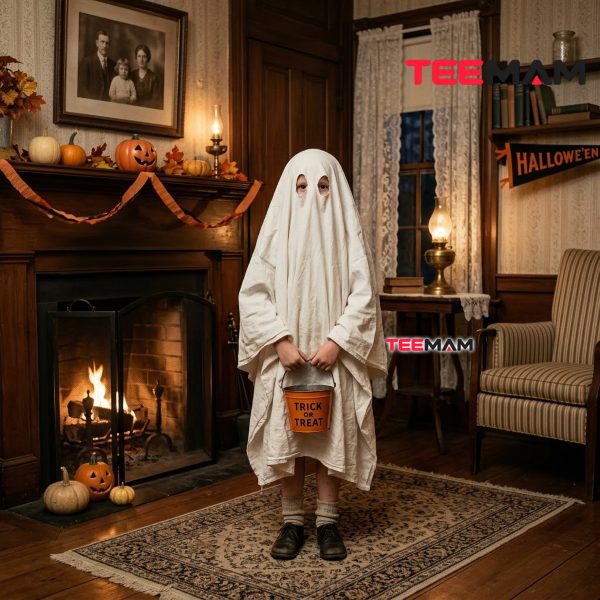
How the Classic Bedsheet Ghost Became a Halloween Icon
Western storytelling and illustration have long depicted ghosts wearing pale, shroud-like coverings — a visual convention tied to burial shrouds and later popular depictions of the dead. By the time Halloween took its modern American shape in the early 20th century, shaped heavily by Irish and Scottish immigrant traditions, that convention had an obvious practical advantage: an ordinary bed sheet could become a ghost costume with almost no sewing or expense. The look caught on quickly — a 1916 children’s book called Halloween at Merryvale shows children in white-sheet ghost costumes, and Norman Rockwell’s October 23, 1920, cover for The Saturday Evening Post features a child in a similar ghostly costume among the issue’s Halloween imagery.
There’s a separate, more difficult American history attached to this silhouette. White hooded robes became closely associated with Ku Klux Klan imagery in the United States, creating a visual overlap with the bedsheet ghost costume. The two traditions developed in different contexts and shouldn’t be treated as the same costume history, but the overlap is significant enough to deserve acknowledgment rather than silence.
From Victorian Spirit Photography to Cute Ghosts
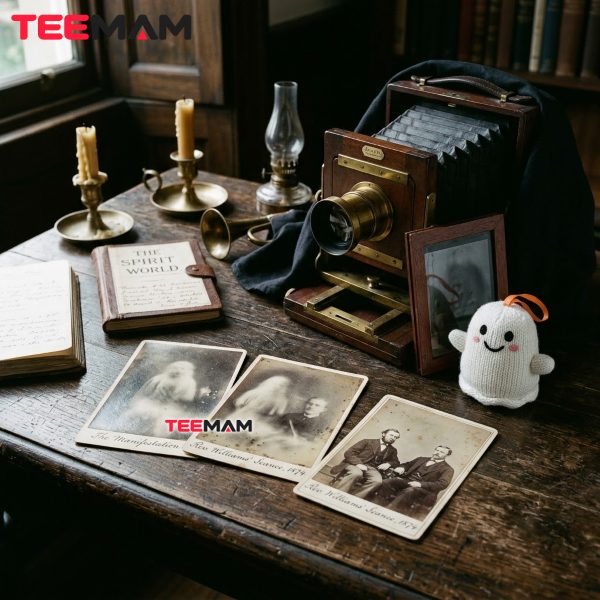
The Victorian era added its own layer to ghost imagery through spirit photography — a practice in which photographers claimed to capture ghostly figures alongside living subjects. The Smithsonian’s National Portrait Gallery has documented how photographer William Mumler built a following creating these images, and how the practice gained traction partly because of the widespread grief following the Civil War. Peter Manseau, curator of American religious history at the Smithsonian’s National Museum of American History, has described spiritualism as a genuine religious movement that resonated with a nation processing loss on an unprecedented scale. That era’s pale, drifting depiction of spirits still shapes how ghost illustrations look today.
Why Cute Ghosts Work So Well in Modern Halloween Design
The modern “cute ghost” trend — a coffee-cup ghost, a ghost paired with a pumpkin or a pet — works largely because the ghost’s shape is already so minimal. A rounded outline with two dot eyes is close to a cartoon face before a designer even starts, which is exactly why it takes so little to push a ghost from spooky toward adorable.
Why These Halloween Icons Work So Well in Design
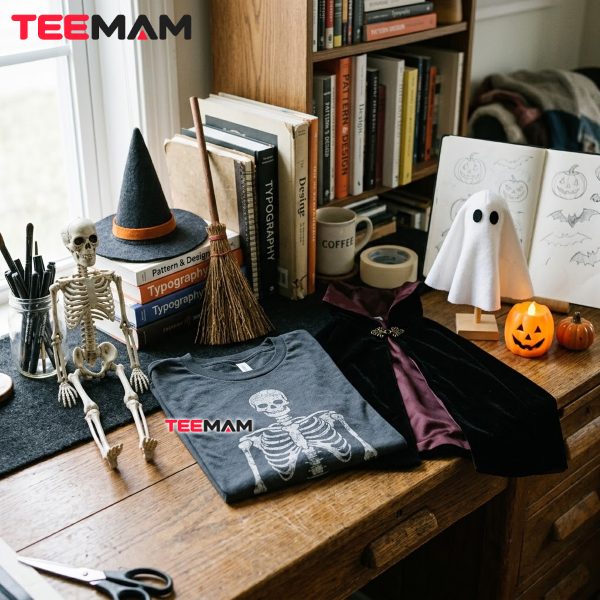
There’s a reason these four figures, out of all the folklore Halloween could have drawn on, are the ones that ended up on every T-shirt and porch flag: each one reduces to a shape a viewer can recognize in under a second, without needing color, detail, or context.
A skeleton needs little more than a skull and a rib cage to read instantly. A witch can be reduced to a pointed hat and a broom silhouette. A vampire needs only a cape collar and two fangs. A ghost can be a single rounded outline with two dots for eyes. None of that is an accident — it’s the same quality that made these symbols work on cheap Halloween postcards a century ago, long before anyone was designing for a T-shirt print or a social feed. A shape that survives being shrunk to a thumbnail and still reads clearly is exactly the kind of shape that also survives being printed on fabric, and that’s a big part of why this specific set of four icons has outlasted so many other Halloween figures.
Four Halloween Icons, Four Different Meanings
| Icon | Historical Association | Modern Meaning | Common Visual Motifs |
|---|---|---|---|
| Skeleton | Mortality, memento mori | Spooky, playful | Bones, skulls, dancing skeletons |
| Witch | Folklore, witch trials | Mystery, magic, independence | Pointed hat, broom, cat, moon |
| Vampire | Eastern European folk belief, later Gothic literature | Elegance, gothic romance | Fangs, cape, deep red accents |
| Ghost | Spirits, burial shrouds | Spooky or cute | White sheet silhouette |
Why We Still Wear Halloween Lore Today
At TeeMam, we use these familiar motifs as visual references when thinking about apparel design: a skeleton, a witch hat, a vampire silhouette, or a ghost can communicate the season before a viewer reads a single word on the shirt. That’s the same principle that made these four symbols work on a Halloween postcard in 1910 — they just carry it onto fabric now instead of paper.
Choosing a Halloween Icon for Your Style
The right pick mostly comes down to the mood you want a design to carry. Skeletons tend to feel playful or gothic; witches lean mystical; vampires bring Victorian drama; ghosts can slide from eerie to cute with almost no change to the basic shape.
Skeleton — a classic pick for vintage, gothic, humorous, or grungy styles, and one of the easiest to keep family-friendly. Witch — suits a mystical or alternative look, from celestial and cottagecore to full gothic. Vampire — best for elegant, dramatic, Victorian-inspired styles rather than cartoonish ones. Ghost — the go-to for minimalist, nostalgic, or classic family-friendly Halloween looks.
Halloween apparel can also work beyond the costume itself: matching family shirts for a group photo, a host’s outfit for a party, or a themed look for movie night, on top of the obvious trick-or-treating use. If you want to see how these four icons show up across ready-to-wear pieces, you can browse Halloween apparel styles and match a motif to whatever mood fits your plans.
Halloween Icons Across Cultures: Similar Symbols, Different Meanings
Skeleton and skull imagery doesn’t carry one universal meaning just because it shows up in more than one holiday. Halloween’s modern skeleton imagery draws on several layers of European death imagery — memento mori, the Danse Macabre, and later popular culture — while Día de los Muertos (Day of the Dead), observed in Mexico on November 1st and 2nd, uses skull and skeleton imagery toward a very different end: honoring and remembering deceased loved ones through altars and offerings, rooted in its own distinct cultural and religious traditions.
The two holidays sometimes get blended together in marketing simply because they land on nearby dates and share a visual element. Treating a Día de los Muertos sugar skull and a Halloween skeleton as interchangeable overlooks real cultural differences in what each tradition is actually doing. For a fuller picture, Halloween and Día de los Muertos explained breaks down where the two holidays diverge.
Common Questions About Classic Halloween Icons
Why Are Skeletons Associated With Halloween?
Skeletons are linked to Halloween because they’ve served as a symbol of death and mortality since medieval European art, especially the memento mori tradition and the Danse Macabre. As Halloween developed around themes of spirits and the supernatural, the skeleton Halloween motif shifted from a solemn warning into a playful, widely used design.
What Do Skeletons Symbolize on Halloween?
Depending on context, a Halloween skeleton can represent mortality and the fragility of life — its older, historical meaning — or simply act as a spooky-but-fun visual with no deeper message intended. A gothic skeleton illustration leans toward the first; a cartoon dancing skeleton leans toward the second.
Why Is a Witch a Symbol of Halloween?
Witches became tied to Halloween through European folklore about witchcraft, reinforced by religious anxiety, the witch trials of the 15th–18th centuries, and later literature and entertainment, which standardized the pointed hat, broom, and black cat into the look used today.
Why Are Ghosts a Halloween Symbol?
Ghosts connect to Halloween’s oldest roots in Samhain and All Hallows’ Eve, both tied to the belief that the boundary between the living and the dead grows thin at this time of year. The bedsheet-ghost costume specifically came later, popularized in early 20th-century America largely because it was cheap and simple to make.
Where Did the Modern Vampire Come From?
The modern vampire comes from Eastern European folk belief that the dead could return to harm the living, sometimes used to explain unexplained deaths and disease. Bram Stoker’s 1897 novel Dracula shaped that folklore into the aristocratic vampire archetype that film and pop culture have built on for over a century.
Are Skeletons and Día de los Muertos the Same Symbol?
No. Skeleton and skull imagery appears in both Halloween and Día de los Muertos, but the cultural meaning behind each is different — Halloween’s skeleton grew out of European memento mori and folklore, while Día de los Muertos skulls are rooted in Mexican tradition and specifically honor deceased loved ones.
Which Classic Halloween Icon Is Yours?
Four figures, four different roads to get here. The skeleton carried centuries of warnings about mortality before it learned to dance. The witch survived real persecution before becoming a symbol of magic and independence. The vampire grew out of folk fear of disease before Bram Stoker turned it into gothic romance. And the ghost, in its simplest form, is a much older idea about the dead — shaped as much by household practicality as by tradition — that happened to be cheap enough to recreate with a bedsheet and a pair of scissors.
So which one matches your skeleton Halloween energy, or is it witch, vampire, or ghost this year?
Sources: Library of Congress, American Folklife Center — Halloween & Día de Muertos Resources; HISTORY — How Skeletons Became Associated with Halloween; Smithsonian National Portrait Gallery — Capturing Ghosts; Britannica — Dracula.

Hi, I’m Olivia Bennett, a fashion and lifestyle writer at TeeMam with 6 years of experience creating content about fashion, outfits, and lifestyle trends. I enjoy sharing practical style ideas for everyday wear, game days, holidays, and special occasions, helping readers find looks that feel comfortable, fun, and uniquely their own.