50+ Spooky Halloween Words for Your Costume, Party, or Design
The right word can do more for a Halloween project than an hour of scrolling through clip art. Put “spooky” on a porch sign and you’ve set a playful, kid-friendly tone before anyone even notices the pumpkins. Swap it for “macabre” and the same sign suddenly feels like it belongs outside a Victorian mansion. A good Halloween word works like visual shorthand: it tells people whether a design is playful, eerie, gothic, or genuinely frightening before they’ve processed anything else on the page.
This guide skips the alphabetical dictionary format you’ll find on most vocabulary sites. Instead, it’s organized around how people actually use Halloween words: to name a costume, write a party invite, cut a Cricut design, or build a t-shirt concept. Whether you want something cute for a classroom party or something unsettling for a haunted house sign, you’ll find the word here — and know where it actually belongs.
Quick answer: Some of the most useful Halloween words include spooky, haunted, eerie, creepy, wicked, bewitched, ghostly, macabre, mysterious, pumpkin, witch, vampire, skeleton, phantom, and trick-or-treat. Which one works best depends on the mood you’re going for — scary, cute, classic, gothic, or playful — and this guide is organized around exactly that.
Why the Right Halloween Word Makes a Design More Memorable
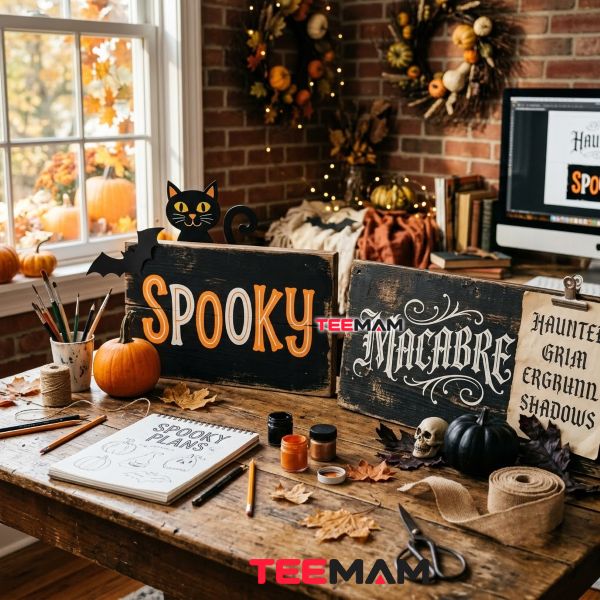
“Spooky” reads as playful and approachable — it’s the word on nearly every kids’ Halloween shirt for a reason. “Macabre” pulls in the opposite direction, signaling something darker and more literary. “Bewitched” adds a hint of magic and romance, while “boo” is about as harmless and family-friendly as Halloween vocabulary gets. “Sinister” tells the viewer a design means business.
These words aren’t interchangeable, even though they all fall under “Halloween vocabulary.” Matching the word to the mood you actually want is what separates a design that feels intentional from one that feels like it was pulled off a generic template.
| Mood | Best Word Style | Example Words |
|---|---|---|
| Classic | Traditional Halloween vocabulary | pumpkin, witch, ghost |
| Scary | Horror-oriented words | sinister, terrifying, bloodcurdling |
| Gothic | Dark, literary vocabulary | macabre, sepulchral, eldritch |
| Cute | Playful vocabulary | boo, spooky, spooktacular |
| Magical | Witchcraft and fantasy vocabulary | bewitched, spellbound, enchanted |
| Party | Social and festive vocabulary | fright night, costume party, trick-or-treat |
50+ Halloween Words and Phrases, Grouped by Mood
This list includes 50+ Halloween words and phrases, organized into six moods so you can browse by feeling rather than the alphabet. Definitions help, but application is where these words earn their keep — a costume, an invitation, and a shirt design rarely need the same vocabulary, even when they’re all “Halloween.”
Not every term below is exclusive to Halloween. Words like “nocturnal,” “moonlight,” and “immortal” are ordinary English vocabulary that happen to work especially well in Halloween costumes, writing, and designs once they’re paired with the right imagery.
| Mood | Recommended Words |
|---|---|
| Cute | Boo, Spooky, Sweet, Pumpkin |
| Classic | Witch, Ghost, Bat, Skeleton |
| Scary | Creepy, Sinister, Ghastly |
| Gothic | Macabre, Eldritch, Sepulchral |
| Magical | Bewitched, Enchanted, Spellbound |
| Party | Fright Night, Boo Crew, Trick or Treat |
Classic and Nostalgic Halloween Words
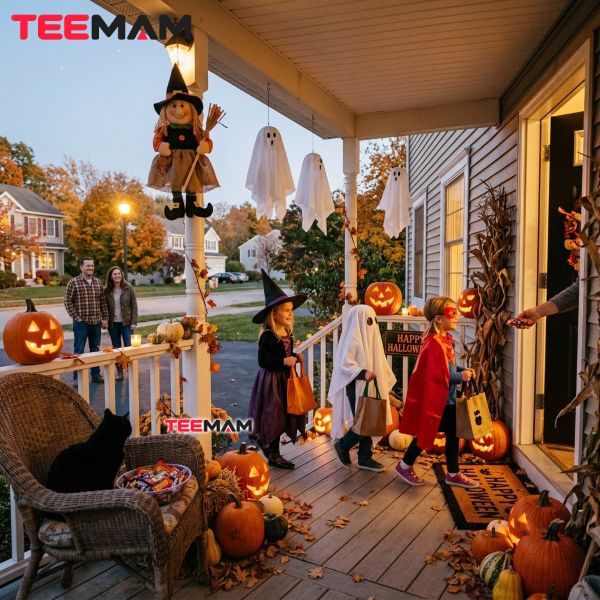
Some of the most recognizable terms in American Halloween culture include Halloween, pumpkin, jack-o’-lantern, trick-or-treat, costume, candy, witch, ghost, skeleton, bat, black cat, and haunted house — vocabulary most people learned before they could spell “supernatural.”
These words carry decades of familiarity, which makes them dependable for family parties, classroom decorations, and any design meant to feel warm and traditional rather than edgy. “Wicked Witch” feels playful and cartoonish; “Sinister Witch” pushes the same costume idea toward horror instead. Word choice, even within one theme, changes the whole read.
Creepy and Scary Halloween Words
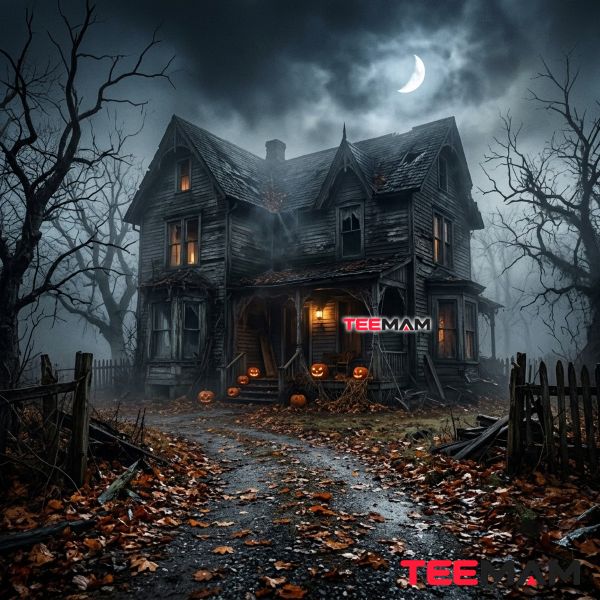
If a design needs to genuinely unsettle rather than simply feel festive, reach for: creepy, eerie, sinister, terrifying, chilling, frightening, gruesome, ghastly, ominous, haunted, horrifying, bloodcurdling, petrifying, spine-chilling, and macabre.
These words aren’t all doing the same job. Some describe how something looks (ghastly, gruesome), some describe a feeling (chilling, petrifying), some describe a setting or condition (haunted, ominous), and some describe an event (horrifying, bloodcurdling). A haunted house sign benefits from a setting word like “haunted” or “ominous”; a costume tag might work better with a feeling word like “chilling.”
Gothic and Dark Halloween Words
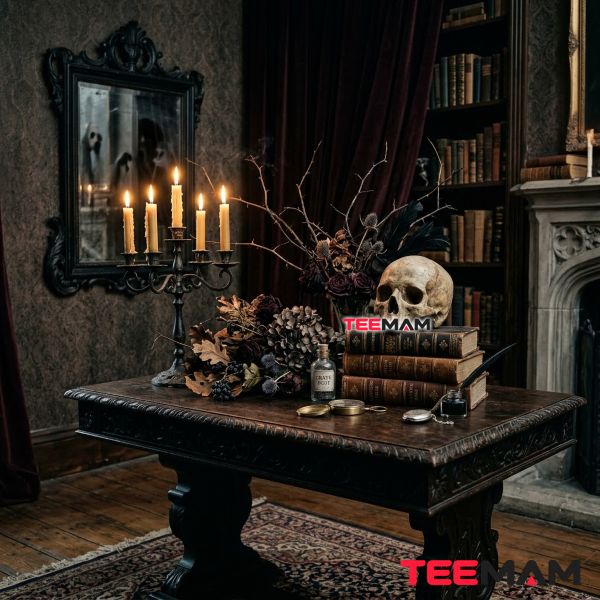
For a more literary, sophisticated horror aesthetic, gothic vocabulary tends to outperform generic scary words: macabre, eldritch, sepulchral, morbid, spectral, phantom, apparition, crypt, mausoleum, wraith, and cursed.
A few of these are worth defining, since they’re less common in everyday speech:
- Sepulchral — associated with tombs, burial places, or the heavy, quiet atmosphere of a crypt.
- Macabre — describes something focused on death or disturbing imagery. The word entered English in the early 15th century by way of the medieval French danse macabre, or “Dance of Death,” a recurring image in medieval art showing Death leading people of every social class in a procession toward the grave. Dictionaries generally note that macabre‘s deeper origin is uncertain; the most commonly cited theory links it to Machabæorum, a Latin reference to the biblical Maccabees, but etymologists treat that connection as a leading hypothesis rather than a settled fact.
- Eldritch — meaning strange, eerie, or otherworldly. It surfaces in Scots English as early as the 1500s, and its origin is genuinely unresolved — dictionaries list it as uncertain, though most trace it to an Old English root associated with “otherness” or a “foreign realm.” That unresolved history is part of what gives the word its old, uncanny feel. Gothic terms like “eldritch” are far older than modern Halloween culture, but 20th-century weird fiction — especially the work of H.P. Lovecraft, who used the word repeatedly to describe cosmic, unknowable horror — helped give it the strong genre association it carries today, well beyond general gothic writing.
Cute and Family-Friendly Halloween Words
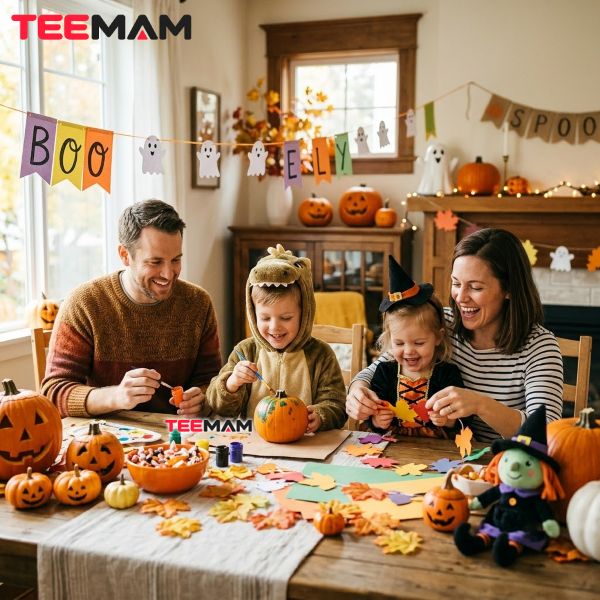
Kids’ costumes, classroom projects, and family gatherings usually call for boo, spooky, spooktacular, pumpkin, magic, sweet, treat, friendly ghost, little monster, and boo-tiful.
These words strip out the fear entirely and keep only the fun. “Spooktacular” is a good example of how Halloween vocabulary keeps evolving — it’s a modern blend of “spooky” and “spectacular” that exists purely to sound festive, not frightening.
Magical and Witchy Halloween Words
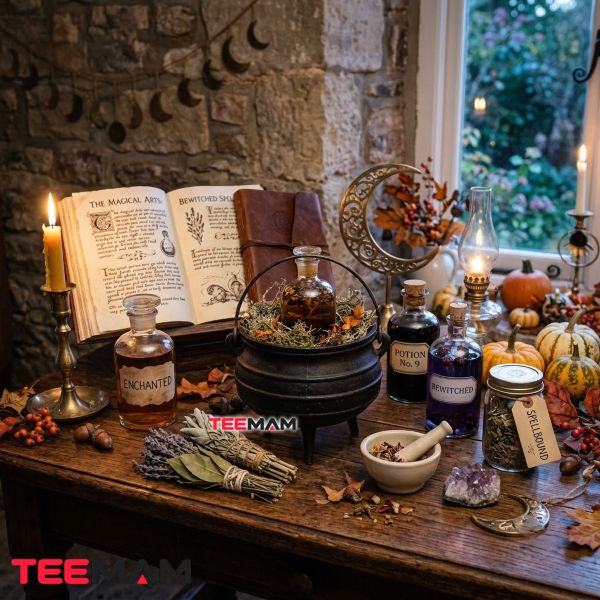
For witch-themed costumes, invitations, or gothic-but-not-gory designs: bewitched, enchanted, spellbound, witchcraft, potion, cauldron, spell, magic, mystical, moonlight, coven, and hocus pocus.
This category works especially well for craft projects, since the imagery (cauldrons, potions, moonlight) gives you an obvious visual to pair with the word.
Halloween Adjectives for Describing a Mood
If you’re specifically after Halloween adjectives rather than nouns or phrases, start with these: spooky, eerie, creepy, haunted, sinister, mysterious, macabre, gothic, magical, wicked, playful, and chilling. Each one describes a mood rather than an object, which makes them useful for captions, taglines, and any copy that needs to set a tone in a single word.
Words That Work for Different Projects
A dictionary definition doesn’t tell you where a word belongs. That part comes from application.
Words That Make a Costume Concept Stronger
Match the word to the character, not just the general theme:
- Witch: bewitched, wicked, spellbound
- Vampire: immortal, nocturnal, bloodthirsty
- Ghost: haunted, spectral, phantom
- Monster: monstrous, terrifying, creature
- Skeleton: bones, skeletal, undead
A word that complements the costume — rather than just restating what it already shows — tends to make for a stronger design. “Nocturnal” on a vampire cape says something a fang emoji can’t.
Finding the Right Words for a Halloween Invitation
For invitations, short and punchy phrasing tends to read better than a full sentence:
- Fright Night
- Come If You Dare
- A Night of Frights
- Boos & Brews
- Spooky Celebration
- Haunted House Party
- Witches’ Night Out
For children’s parties, playful phrasing like “Trick or Treat” or “Boo Crew” fits naturally. For adult gatherings, something like “Boos & Brews” or “Come If You Dare” sets an edgier, more grown-up tone without needing to spell it out.
Short Halloween Words and Phrases for Signs
For small spaces — letter boards, mini signs, mug wraps — one or two words carry more visual weight than a phrase: Boo, Spooky, Eerie, Wicked, Haunted, Bewitched, Fright Night, Trick or Treat, Stay Spooky, and Boo Crew.
Short words matter for legibility as much as design. On a letter board or a small vinyl decal, a long phrase either shrinks past readability or forces an awkward line break. A single strong word, cut large, almost always reads better from across a room.
Words That Work Well for Cricut and DIY Projects
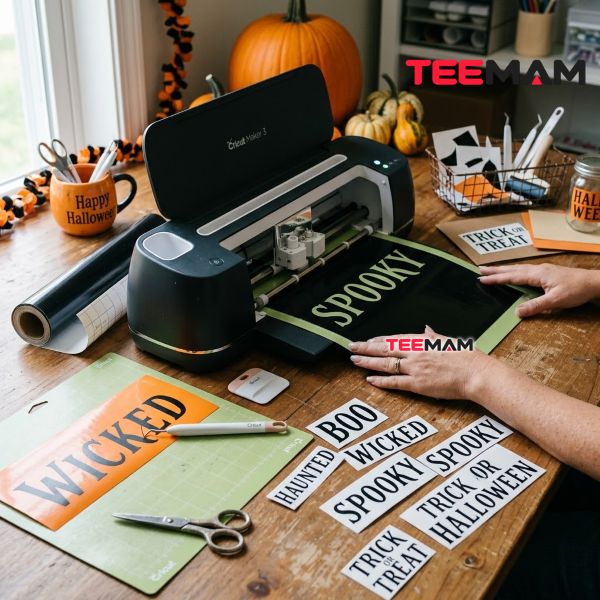
Beyond length, craft-friendly Halloween words share a few practical traits: they tend to be short, they pair naturally with distressed, script, or gothic lettering for Halloween SVG text, and they avoid punctuation that gets lost when weeding vinyl. Words such as “Cursed,” “Witchy,” and “Haunted” are relatively easy to adapt into a Cricut project because they’re short and simple to trace — but how cleanly any word actually cuts still depends on the font, the material, the size, and the machine’s cutting settings, so it’s worth doing a test cut before committing to a full batch.
Short Halloween Phrases for Letter Boards, Shirts, and Party Decor
The list above focuses on individual words; the phrases below are a separate category, useful when you want a little more context than one word can carry.
Cute and playful: Boo Crew · Too Cute to Spook · Hey Boo · Spooky Season · Boo-tiful Night
Scary and gothic: Enter If You Dare · Stay Out After Dark · Welcome to the Haunted House · Something Wicked · Beware the Night
Party-friendly: Fright Night · Let’s Get Spooky · Eat, Drink & Be Scary · Trick or Treat · Come for the Booze
Family-friendly: Little Boo · Happy Haunting · Pumpkin Patch · Trick or Treaters Welcome · Have a Spooktacular Night
Pairing Halloween Words With Fonts, Colors, and Typography Trends
Typography changes how the same Halloween word reads. “Boo” in a rounded, bubbly display font feels playful and harmless; the same word set in a heavy blackletter can suddenly read as gothic or theatrical. The word sets the mood, but the font decides how far that mood goes.
Macabre + distressed serif creates an old-world horror aesthetic, the kind that looks like it belongs on a weathered gravestone rubbing.
Boo + playful rounded font works better for children’s and family designs, since a soft, bubbly typeface removes any lingering edge from the word.
Wicked + vintage script leans witchy and retro — closer to a 1970s Halloween party poster than a modern horror movie.
Eldritch + gothic serif suits sophisticated dark-horror concepts, especially anything referencing cosmic or literary horror.
Spooktacular + bold display font works well for playful party graphics where the goal is energy, not atmosphere.
The word should also echo the visual theme around it — pumpkins, bats, ghosts, skulls, witches, haunted houses, moonlight, and autumn leaves each carry their own natural word pairings. A pumpkin patch scene calls for “cozy” and “harvest” language; a haunted house scene calls for “sinister” and “ominous.”
A Quick Test for Word-and-Font Pairing
Before finalizing a design, it helps to run it through three fast checks:
- Can it be read at a glance? If someone can’t make out the word from a few feet away, the font is competing with the message instead of supporting it.
- Does the word match the font’s personality? “Boo” in a heavy gothic blackletter can read as confusing on a kids’ design, and “Macabre” in a bubbly rounded font tends to feel like a tonal mismatch rather than an intentional contrast.
- Does it work without extra explanation? If the word and font need a caption to make sense together, the pairing probably needs to be simplified.
This isn’t a scientific benchmark — it’s closer to a rule of thumb designers use to catch mismatches before a design goes to print.
How Halloween Words Translate Into Wearable and Seasonal Merch
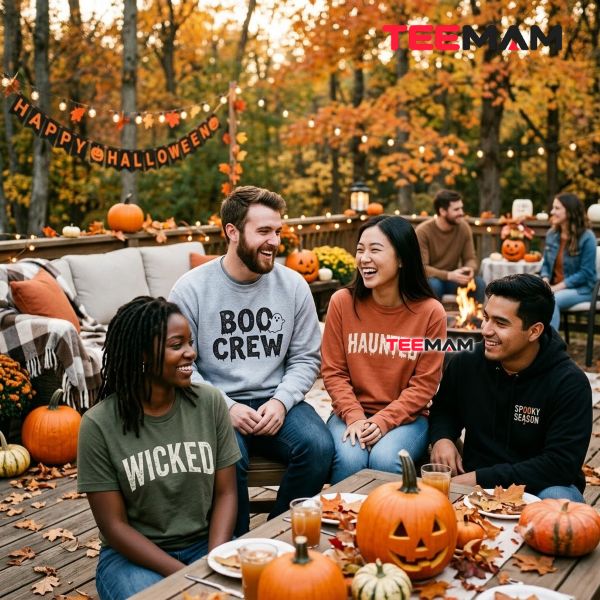
Short words are often easier to work with on apparel because they stay readable at a glance and leave more room for typography to breathe. On a shirt, a single word like “Wicked” or “Haunted” can function as the visual focal point without competing against a busy illustration. A phrase can work perfectly well on a party invitation and still fail on a t-shirt — if the wording needs three lines before it’s readable, it’s usually worth shortening it or picking one word to carry the design.
Word choice also shapes the audience before anyone reads the fine print. “Boo Crew” signals a family shirt; “Something Wicked” signals an adult one — and getting that signal right matters as much as the graphic underneath it.
One practical lesson from designing seasonal apparel at TeeMam is that the shortest word usually creates the strongest focal point. A one-word design like “Wicked” leaves room for larger type, higher contrast, and a cleaner silhouette, while a longer phrase can force the artwork into a smaller, harder-to-read block. That’s why we typically settle on the mood first, then test the shortest word that still communicates it before building out the rest of the design.
Building Your Own Halloween Phrases
You don’t need to start from scratch to land on a good phrase — a few simple patterns make it easy to build your own.
Mood word + Halloween object: Spooky Pumpkin, Haunted House, Wicked Witch, Ghostly Night
Action + Halloween theme: Stay Spooky, Get Bewitched, Enter the Haunted House
Noun + playful modifier: Little Boo, Spooky Crew, Pumpkin Queen, Ghost Squad
Pair a mood word with a Halloween object, read the result out loud, and adjust from there. Most awkward phrases reveal themselves the moment you say them.
Choosing the Right Halloween Word in Three Steps
With more than 50 words on this page, narrowing down to the right one usually comes down to three questions.
1. Who’s the audience? Kids, families, adults, or dedicated horror fans each respond to different vocabulary. “Boo” and “bloodcurdling” are not aimed at the same reader.
2. What’s the emotional temperature? Halloween words run on a rough spectrum from cute to playful to spooky to creepy to genuinely disturbing. Picking a point on that spectrum before browsing the word bank makes the choice faster.
3. Does the word hold up visually? A word that reads well in a sentence doesn’t always read well on a shirt or a sign — test it against the typography pairing guide above to catch that kind of mismatch early.
The short version: if the artwork is already busy, a simple word like “Boo” or “Wicked” is often enough. If the concept is built around a haunted house or a gothic theme, something like “Ominous” or “Spectral” can push the mood further without adding more visual elements. Settle on the feeling first, and the right word — along with the font and layout to match — tends to follow.
Where Halloween Words Come From
Halloween’s vocabulary didn’t arrive all at once — it built up over a long stretch of Celtic, Christian, and later American influence, and the modern holiday isn’t simply an unbroken continuation of any single ancient festival. Its earliest roots trace to Samhain, a pre-Christian Celtic festival marking the end of the harvest season. Centuries later, the Christian church placed All Saints’ Day on November 1st, and the night before it — All Hallows’ Eve — eventually contracted into the name we use today, with elements of the older Celtic observance and the newer Christian feast days blending together over time.
Some of Halloween’s most familiar words carry pieces of that layered history. The jack-o’-lantern tradition, for instance, developed in Ireland and Scotland, where people carved turnips and other root vegetables and set embers or candles inside them. Irish folklore later tied the practice to the tale of “Stingy Jack,” a trickster said to be doomed to wander the earth with only a hollowed turnip to light his way — though, like a lot of folklore, the story exists in multiple versions and the exact history behind the custom isn’t fully settled. Pumpkins became increasingly popular once Irish immigrants brought the tradition to the United States in the 19th century, where pumpkins were more readily available and offered a larger surface for carving than the turnips traditionally used in Ireland and Scotland.
Other words in this list owe far less to folklore and far more to costumes, candy marketing, and horror entertainment. “Spooktacular” and “boo-tiful” are playful modern blends used heavily in contemporary Halloween marketing and seasonal design, built for festive branding rather than tradition. Readers curious about the fuller history can look into the history behind Halloween traditions, and the Library of Congress’s own research guide on Halloween’s historical origins is a solid starting point for the Celtic-to-Christian timeline referenced above.
Halloween Words vs. Día de los Muertos Vocabulary
It’s worth being direct about this: Halloween and Día de los Muertos are related in timing but distinct in origin, tone, and meaning, and treating one as a translation of the other flattens both traditions.
Halloween grew out of Celtic and later European Christian traditions. Día de los Muertos developed through a complex blending of Indigenous Mesoamerican traditions and Catholic observances introduced during Spanish colonization, and practices still vary from region to region today. Where Halloween leans into fright and mischief, Día de los Muertos centers on remembrance: families build ofrendas — altars decorated with marigolds, candles, and photographs — to welcome the memory of loved ones who have passed, typically on November 1st and 2nd. The Smithsonian’s National Museum of American History addresses this directly in its overview of Día de los Muertos as a distinct tradition, noting that the holiday is not simply a Mexican version of Halloween. The skull and skeleton imagery the two holidays share often gets mistaken for a shared origin, but the meaning behind that imagery runs in very different directions — playful spookiness on one side, heartfelt remembrance on the other.
If you’re exploring vocabulary or design work across both holidays, it’s worth reading up on Halloween and Día de los Muertos before mixing symbols from the two — the distinction matters to a lot of people who celebrate one, the other, or both.
Why Costumes Became Part of Halloween
Halloween costuming has more than one historical thread feeding into it. Historical accounts connect Samhain with supernatural beliefs, seasonal rituals, and the use of disguises or costumes, though the details of exactly how and why costumes were worn aren’t fully settled among historians. Later customs such as Scottish and Irish “guising” — dressing in disguise and going house to house for small treats — added another thread to that history, one that eventually helped shape the broader tradition of Halloween costuming and trick-or-treating in the United States. The modern American Halloween costume, with its mix of homemade and store-bought options, took further shape through the 19th and 20th centuries as Irish immigrants brought these customs with them and they blended with local traditions.
That layered history is also why costume vocabulary — disguise, mask, character, monster, witch, vampire, ghost — still carries a trace of transformation and concealment, even in a costume that’s meant to be purely fun. Anyone curious about that fuller timeline can read the history of Halloween costumes.
Why Halloween Songs and Movies Add New Words to the Holiday
Pop culture has added at least as much to Halloween vocabulary as folklore has. Horror films popularized gothic terms like “eldritch” and “spectral” well beyond their literary origins, while novelty songs and animated specials introduced playful coinages like “spooktacular.” Costume trends, in turn, borrow character names and catchphrases from whatever movie or show dominated the cultural conversation that year — which is a good reminder that “Halloween words” isn’t a fixed, closed list. It’s a vocabulary that keeps absorbing new terms every October. For a closer look at how one specific song shaped Halloween language, see the meaning behind Halloween songs.
50+ Halloween Words at a Glance
| Word | Meaning / Mood | Best Use |
|---|---|---|
| Spooky | Playfully scary | Family designs |
| Eerie | Unnaturally unsettling | Gothic designs |
| Macabre | Dark and death-related | Horror designs |
| Bewitched | Under a magical spell | Witch themes |
| Haunted | Associated with ghosts | Party decor |
| Sinister | Suggesting danger | Dark designs |
| Boo | Cute ghostly expression | Kids’ designs |
| Wicked | Mischievous or evil | Witch themes |
| Phantom | Ghostly figure | Gothic designs |
| Spooktacular | Playful Halloween pun | Party designs |
| Creepy | Unsettling in appearance | General horror |
| Chilling | Cold, fear-inducing feeling | Story-driven designs |
| Ghastly | Shockingly frightening | Gothic designs |
| Ominous | Threatening, foreboding | Signage |
| Ghostly | Faint, spirit-like | Ghost themes |
| Mysterious | Unknown, intriguing | General Halloween |
| Cursed | Under a spell or hex | Witch/gothic themes |
| Enchanted | Under magical influence | Fantasy themes |
| Spellbound | Captivated by magic | Witch themes |
| Nocturnal | Active at night | Vampire themes |
| Skeletal | Bone-related | Skeleton designs |
| Undead | Neither living nor dead | Zombie/vampire themes |
| Petrifying | Extremely frightening | Horror designs |
| Bloodcurdling | Terror-inducing | Horror designs |
| Gruesome | Graphically disturbing | Horror designs |
| Terrifying | Deeply frightening | Horror designs |
| Frightening | Causing fear | General horror |
| Spectral | Ghost-like | Gothic designs |
| Apparition | A ghostly appearance | Gothic designs |
| Sepulchral | Tomb-like | Gothic designs |
| Eldritch | Strange, otherworldly | Cosmic horror |
| Morbid | Death-focused | Gothic designs |
| Crypt | Underground burial chamber | Gothic decor |
| Mausoleum | Above-ground tomb | Gothic decor |
| Wraith | A ghost or spirit | Gothic designs |
| Witchcraft | The practice of magic | Witch themes |
| Potion | A magical liquid | Witch/craft projects |
| Cauldron | A witch’s cooking pot | Witch/craft projects |
| Coven | A group of witches | Witch themes |
| Hocus Pocus | Playful magic phrase | Party designs |
| Moonlight | Nighttime magical setting | Witch/gothic themes |
| Trick-or-Treat | Classic Halloween activity | Family designs |
| Jack-o’-Lantern | Carved pumpkin lantern | Classic decor |
| Black Cat | Superstitious Halloween symbol | Classic decor |
| Haunted House | A spirit-filled location | Party/decor |
| Little Monster | Affectionate, playful term | Kids’ designs |
| Boo-tiful | Cute Halloween pun | Kids’ designs |
| Fright Night | A night of scares | Party invitations |
| Immortal | Unable to die | Vampire themes |
| Bloodthirsty | Craving blood | Vampire themes |
| Monstrous | Huge and frightening | Monster themes |
Common Questions About Halloween Vocabulary
What are the most common Halloween words?
The most recognizable Halloween words include spooky, pumpkin, witch, ghost, haunted, skeleton, trick-or-treat, and jack-o’-lantern. These words show up across costumes, decorations, and party invitations because they’re instantly recognizable and don’t require any explanation.
What are the main types of Halloween words?
Halloween vocabulary generally falls into a few groups: classic symbols such as pumpkin and jack-o’-lantern, supernatural terms such as ghost and phantom, scary adjectives such as eerie and sinister, witchcraft terms such as spell and potion, and playful phrases such as “Boo Crew” and “Spooktacular.” Most Halloween design projects end up drawing from more than one group.
What are some spooky words for Halloween?
Common spooky words include creepy, eerie, chilling, and haunted. For a more advanced, gothic-leaning vocabulary, try macabre, spectral, sepulchral, and eldritch — words that carry a similar unsettling mood but read as more literary and deliberate.
What are some cute Halloween words?
Boo, spooky, pumpkin, magic, sweet, and spooktacular are the go-to words for family-friendly designs. They keep the Halloween mood intact while stripping out anything genuinely scary — ideal for kids’ costumes, classroom crafts, and family party decor.
What are some non-scary Halloween words for kids?
Non-scary Halloween words include boo, pumpkin, candy, treat, friendly ghost, little monster, magic, and pumpkin patch. These terms lean on Halloween’s playful, seasonal side — costumes, candy, autumn — rather than anything genuinely frightening, which makes them a safe default for classroom projects and young children’s parties.
What words are good for a Halloween party invitation?
Short phrases work best: Fright Night, Boos & Brews, and Come If You Dare read well for adult parties, while Trick or Treat and Boo Crew fit children’s parties better.
What are some scary words for a Halloween design?
Sinister, macabre, haunted, ghastly, eerie, terrifying, and bloodcurdling all work well for horror-leaning designs, particularly when paired with dark, distressed, or gothic typography.
What are short Halloween words for Cricut projects?
Boo, Spooky, Wicked, Haunted, Eerie, Witchy, and Cursed are strong choices — short enough to cut cleanly and read clearly, even on small letter boards or vinyl decals, though the final result still depends on font, material, and cutting settings.
How do I choose the right Halloween word for a design?
Start with the audience — kids, adults, or a mixed crowd. From there, settle on the emotional temperature: cute, playful, spooky, creepy, or disturbing. Finally, test the word against the typography, since the same word can feel completely different in a playful rounded font versus a distressed gothic one.
Historical and etymological details in this article are drawn from the Library of Congress, the Smithsonian Institution, and standard etymological references (Etymonline, Merriam-Webster, Oxford English Dictionary).

Hi, I’m Olivia Bennett, a fashion and lifestyle writer at TeeMam with 6 years of experience creating content about fashion, outfits, and lifestyle trends. I enjoy sharing practical style ideas for everyday wear, game days, holidays, and special occasions, helping readers find looks that feel comfortable, fun, and uniquely their own.