Meet KC Wolf: The Story Behind the Kansas City Chiefs Mascot
Sit in the stands at GEHA Field at Arrowhead Stadium for one home game, and you’ll notice something before you notice the football: a grey wolf on an ATV, weaving through the tunnel to a wall of noise that rivals the snap count. By the time he’s finished heckling the visiting kicker, you’ve crossed paths with the official Kansas City Chiefs mascot, KC Wolf. He’s been part of the gameday routine since 1989, and for a lot of Chiefs Kingdom, he’s less a costume than a fixture of the family.

This guide covers where KC Wolf actually came from, why the Chiefs picked a wolf instead of leaning further into their own name, the man who wore the suit for 35 years, and what’s happening with the mascot now that his original performer has stepped back.
Who Is KC Wolf? A Quick Answer for New Chiefs Fans
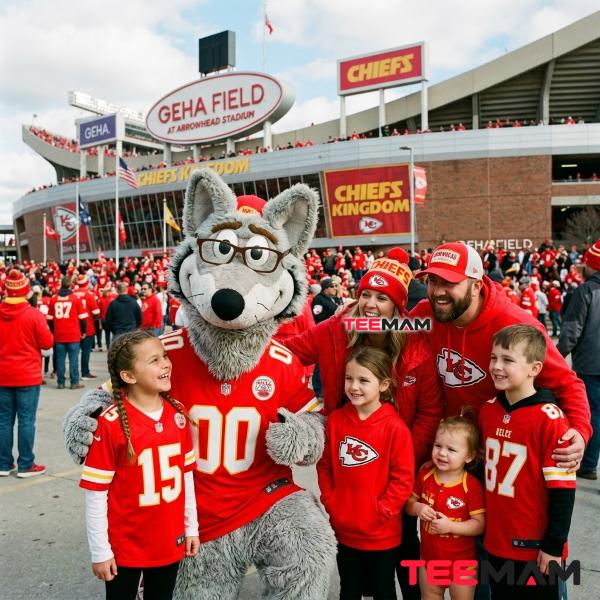
KC Wolf is the official Kansas City Chiefs mascot, introduced on March 23, 1989, as a replacement for Warpaint, the horse-and-rider mascot the team had used through the 1980s. He was named after the “Wolfpack,” a rowdy section of fans who packed the temporary bleachers at old Municipal Stadium in the 1960s. In 2006, KC Wolf became the first NFL mascot ever inducted into the Mascot Hall of Fame, a distinction that still separates him from nearly every other team character in the league.
| Fact | Information |
|---|---|
| First appearance | March 23, 1989 |
| Inspiration | The “Wolfpack” fan section at Municipal Stadium |
| Original performer | Dan Meers (1990 to 2025) |
| Mascot Hall of Fame induction | 2006 (first NFL mascot ever inducted) |
| Costume designer | Harrison/Erickson Inc. (also created the Phillie Phanatic) |
| Home venue | GEHA Field at Arrowhead Stadium |
| Team | Kansas City Chiefs |
One detail most casual fans miss: KC Wolf and the Phillie Phanatic share a designer. Harrison/Erickson, the New York firm behind Philadelphia’s beloved green monster, also built the wolf suit, which explains why KC Wolf has always felt a notch more expressive and physically capable than a lot of late 1980s mascot costumes.
You can read more background in the team’s official KC Wolf biography on Chiefs.com.
Why KC Wolf stands out from other NFL mascots:
- First NFL mascot ever inducted into the Mascot Hall of Fame (2006)
- Named after real fans, not a marketing exercise
- One performer, Dan Meers, held the role for 35 consecutive years
- Longest-tenured mascot in NFL history by more than a decade
- Active well beyond football, with thousands of community appearances
Why Is the Kansas City Chiefs Mascot a Wolf?
KC Wolf is a wolf because he was named after the “Wolfpack,” a famously loud fan section from Municipal Stadium in the 1960s, not because of anything tied to the team’s own name. The franchise founded by Lamar Hunt in 1963, after the team relocated from Dallas following its early years as one of the original AFL clubs, had spent that first decade building an identity around its most passionate supporters. When the Chiefs moved away from Warpaint in the late 1980s, in part because of growing discomfort with a mascot built around Native American imagery, they didn’t invent a new character from scratch. They looked at the stands and turned their loudest fans into a costume.
That decision is the whole reason a wolf, of all animals, ended up representing a team called the Chiefs. It wasn’t a branding committee’s idea. It was a tribute to the people already showing up and making noise every Sunday, and it’s a big part of why KC Wolf connected with fans immediately instead of landing as a corporate afterthought.
From Wolfpack to KC Wolf: How the Mascot Was Created
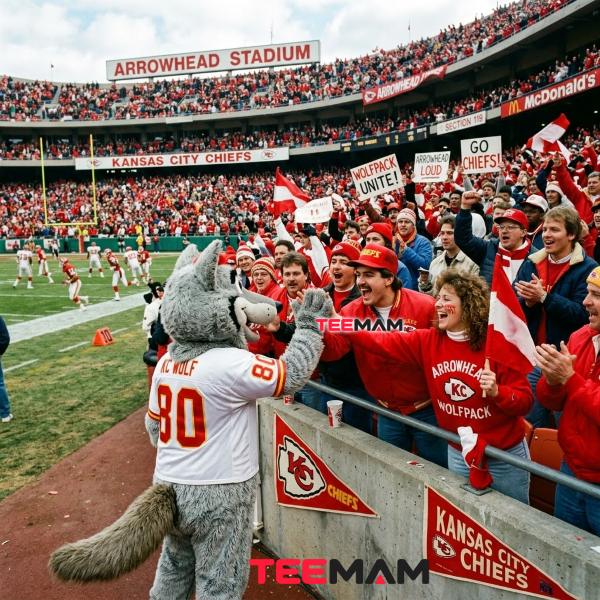
By the mid-1980s, Chiefs fan culture at Arrowhead had already built a reputation for volume, the same energy that would eventually help the stadium set Guinness World Records for crowd noise. The front office wanted a mascot that matched that intensity instead of one that just stood on the sideline and waved.
The team commissioned Harrison/Erickson to design the character, and KC Wolf debuted on March 23, 1989. Dan Meers, a college mascot performer who had spent four years as Truman the Tiger at the University of Missouri and then a season as the St. Louis Cardinals’ Fredbird, joined the Chiefs full-time in 1990. Within a few seasons, he had become the performer nearly every fan associated with KC Wolf.
Early reactions were mixed at first, largely because fans weren’t used to a fully costumed mascot built around physical stunts in the NFL. That changed quickly. KC Wolf’s ATV entrances, in-crowd antics, and willingness to poke fun at opposing teams turned him into one of the most requested appearances in Kansas City, both at games and around the community.
The Meaning Behind KC Wolf’s Appearance
KC Wolf’s look was built to be approachable rather than intimidating, which matters for a character who spends as much time with toddlers at birthday parties as he does riling up 70,000 fans on a Sunday. His fur features a rounded, gray-and-white color scheme with a deliberately cuddly, slightly disheveled texture rather than a sleek, predatory design. He wears a red cap and jersey rather than full pads, keeping the silhouette rounded and cartoonish instead of aggressive.
The personality matches the look. KC Wolf leans into physical comedy: pratfalls, dance routines, playful heckling of opposing players and mascots, rather than menace. That combination of a soft, huggable design with a mischievous, high-energy personality is exactly what makes him work equally well at Arrowhead Stadium and at a children’s hospital.
Dan Meers and the Legacy Behind KC Wolf
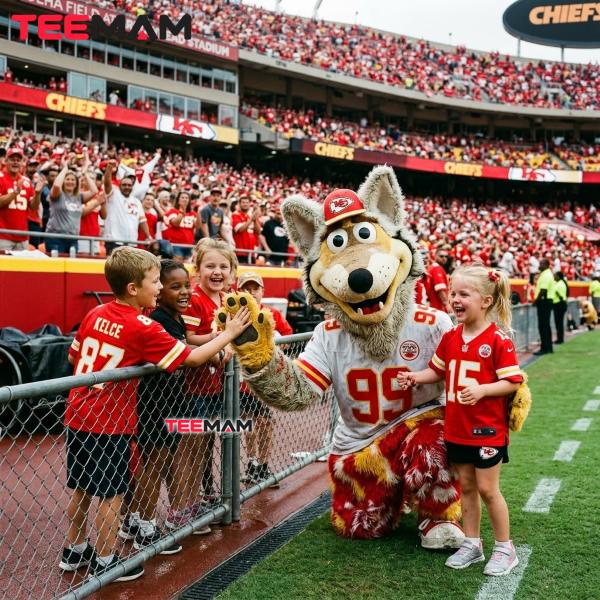
For 35 years, the Kansas City Chiefs mascot had one recognizable performer behind the costume: Dan Meers. He grew up in St. Charles, Missouri, and got his start as Truman the Tiger at Mizzou before a short stretch as Fredbird in St. Louis. He joined the Chiefs organization in 1990 and, by his own account, never intended to make it a career. He figured he’d do it for a couple of years before finding what he called “a real job.”
Instead, Meers became the NFL’s longest-tenured mascot by more than a dozen years over any other performer in the league. He suited up for 307 regular-season and postseason games at Arrowhead and 375 total appearances including preseason, and he was on the sideline for all five of the Chiefs’ Super Bowl trips during the Patrick Mahomes-Andy Reid era, including the team’s Super Bowl LVII and LVIII championship runs.
The physical demands of the job were real, and occasionally dangerous. In November 2013, while rehearsing a zip-line entrance stunt at Arrowhead, Meers fell roughly 75 feet after an equipment malfunction, breaking seven ribs, fracturing his tailbone and a vertebra, and collapsing a lung. He spent nine days in the hospital and months on disability, then turned the experience into material for motivational speaking engagements and two books.
Off the field, Meers built a reputation that went well beyond football. Over three decades he made close to 10,000 appearances outside of games: school visits, hospital rooms, weddings (he’s walked five brides down the aisle in the KC Wolf suit), nursing homes, and community events across the Kansas City area and internationally. A lot of that work ran through the Hunt Family Foundation, the team’s charitable arm founded by Lamar Hunt’s family in 1983, which supports more than 125 area charities each year. That volume of grassroots, largely unpaid-in-goodwill work is a big reason the Chiefs organization has repeatedly pointed to Meers as one of the most community-connected figures in franchise history, not just its mascot.
Meers announced his retirement on June 17, 2025, fittingly, National Mascot Day, closing out a 35-year run. “Dan Meers has been the heart and soul behind KC Wolf for 35 years,” Chiefs Chairman and CEO Clark Hunt said in the team’s announcement, crediting Meers with turning the character into “a symbol of pride and passion for all of Chiefs Kingdom.” Meers has stayed connected to the organization since stepping back from full-time duty, including being honored as a game-day Drum Honoree during the 2025 season, and he’s reportedly consulted on the search for his successor. The Chiefs have not publicly named a permanent full-time replacement, continuing a long-standing habit across the mascot industry of keeping a performer’s identity loosely guarded even after a transition.
You can read the team’s full statement in the Dan Meers retirement announcement on Chiefs.com.
KC Wolf and the Mascot Hall of Fame
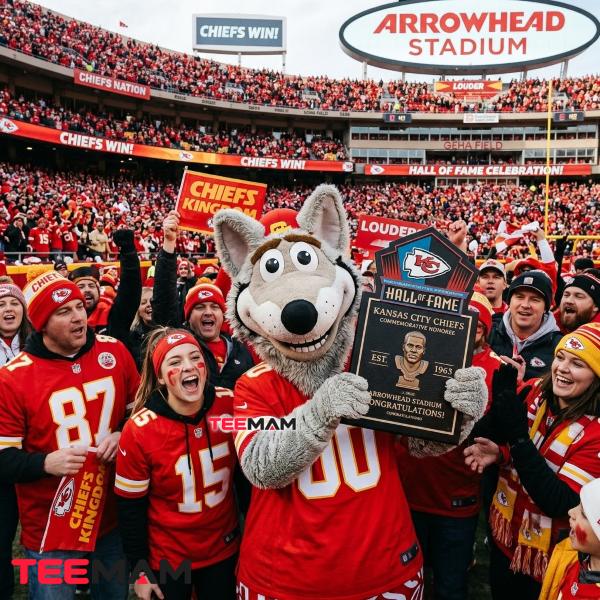
Why was KC Wolf inducted into the Mascot Hall of Fame? Because he was one of the acts that proved a mascot could be a franchise’s most durable piece of marketing.
In the inaugural 2006 class, KC Wolf became the first NFL mascot ever honored by the Mascot Hall of Fame, ahead of every other NFL team character and alongside mascots from MLB and college sports that had been performing for decades longer. The induction wasn’t only about tenure. It reflected KC Wolf’s community footprint, the thousands of non-game appearances, his role in shaping in-stadium entertainment during an era when most NFL teams treated mascots as an afterthought, and the influence his stunts and showmanship had on the wave of costumed NFL characters that followed in the 1990s and 2000s.
That “first NFL mascot in the Hall of Fame” distinction is one of the most cited facts about the Kansas City Chiefs mascot, and it’s a big part of why he’s treated as a franchise institution rather than a gameday prop.
Why KC Wolf Became a Symbol of Chiefs Kingdom
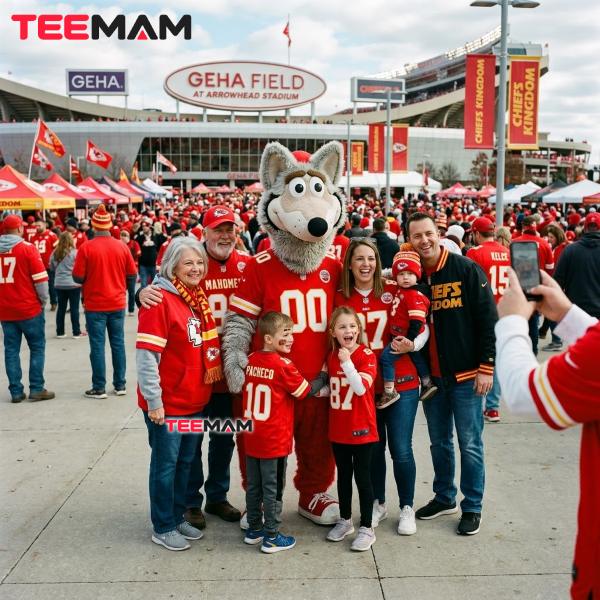
Ask a longtime Chiefs fan about their first favorite player, and plenty of them will mention KC Wolf before they mention a quarterback. Anyone who has taken a kid to their first game at Arrowhead has probably seen it firsthand: a child staring past the players warming up on the field, completely fixated on the wolf riding out on an ATV or tossing a t-shirt into the upper deck. For a lot of kids, that’s the moment football clicks as something fun rather than something abstract they’ve only watched on a screen at home.
Parents who grew up watching Meers perform in the ’90s now bring their own kids to tailgates hoping for a photo with the wolf. Multiple generations of the same household can point to a KC Wolf memory as their entry point into Chiefs Kingdom, which is a rare thing for any mascot to pull off consistently for 35-plus years.
Those memories don’t stop at the stadium gates, either. Around Kansas City, the Kansas City Chiefs mascot shows up at school assemblies, hospital visits, charity events, and neighborhood celebrations throughout the year, which is a large part of why the role reads more like a civic figure than a gameday prop.
How KC Wolf Shapes the Game Day Experience
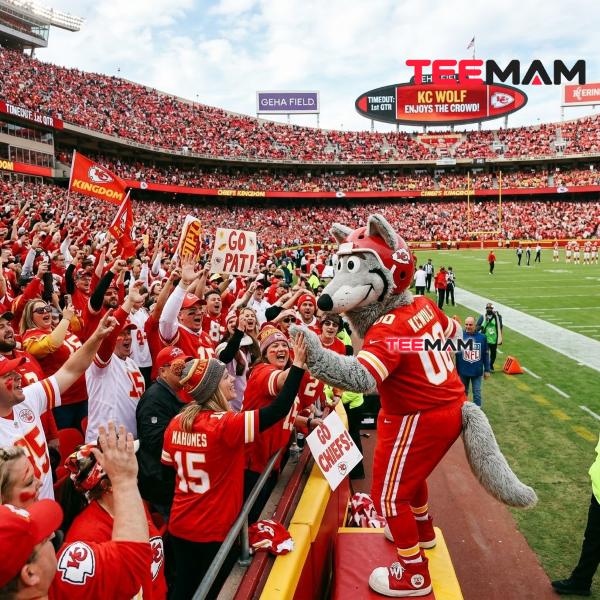
Walk through the Arrowhead parking lots on a Sunday morning and you’ll spot KC Wolf working the tailgates well before kickoff, posing for photos with families setting up grills and getting the crowd loud before anyone’s even through the gates. Once the game starts, he splits his time between pregame hype, in-game entertainment during timeouts, and the kind of crowd-camera antics that have genuinely included tackling a fan who ran onto the field.
Beyond the game itself, the Kansas City Chiefs mascot keeps a packed schedule of youth football clinics, charity fundraisers, and appearances at community events across the metro. If you’re heading to your first game and want the full pregame ritual down, the site’s Chiefs tailgate traditions guide walks through what to expect in the lots before you even get inside.
KC Wolf’s Impact on Chiefs Fan Style and Family Traditions
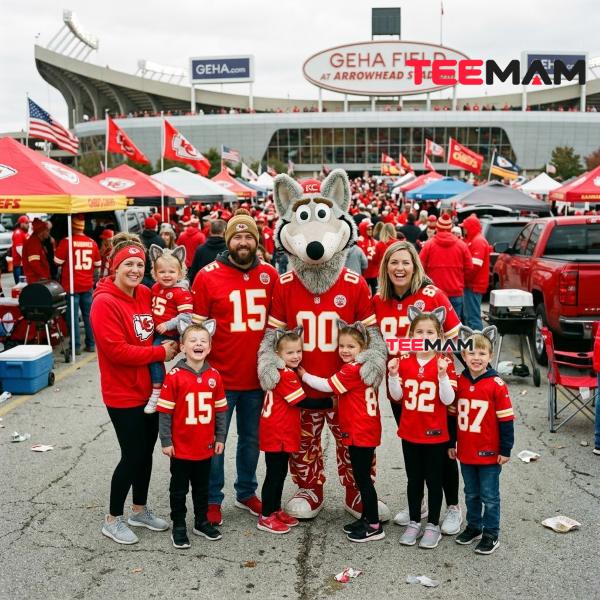
Walk the tailgate lots on a chilly November Sunday and you’ll see the mascot’s influence on what people actually wear to games. Kids show up in wolf ears and red jerseys. Families coordinate matching gray hoodies and Wolfpack novelty tees built for cold-weather tailgating rather than anything overly serious or aggressive. Whether it’s layering up for a December snow game or getting a kid ready for their first trip to Arrowhead, wearing a piece of the mascot’s legacy has become its own small badge of honor within Chiefs Kingdom. You can explore a range of family-ready styles in the Kansas City Chiefs fan apparel collection.
Other Chiefs Traditions Every New Fan Should Know
KC Wolf is one piece of a much bigger Arrowhead experience. The stadium’s noise level, driven originally by that same Wolfpack section, has made it one of the loudest venues in professional sports. The Tomahawk Chop chant remains one of the more discussed and debated traditions among fans and outside observers alike, and it exists alongside cheerleading squads, training camp open practices, and a long list of community programs the organization runs through the Hunt Family Foundation year-round.
New fans looking to go deeper might check out the Chiefs cheer squad traditions, the Kansas City Chiefs heritage guide, or the Chiefs training camp experience for a fuller picture of what makes Chiefs Kingdom distinct from other NFL fanbases.
Common Questions About KC Wolf
Who is inside the KC Wolf costume?
Dan Meers wore the costume from the mascot’s 1989 debut until his retirement in June 2025, a 35-year run that made him the NFL’s longest-tenured mascot. The Chiefs have not publicly identified a permanent full-time successor, though Meers has stayed involved with the organization and reportedly advised on the transition.
Why is the Chiefs mascot a wolf instead of a chief?
The wolf comes from the “Wolfpack,” a group of especially loud fans who sat in the bleachers at Municipal Stadium in the 1960s. The mascot honors that fan section rather than referencing the team name directly.
Is Dan Meers still KC Wolf?
No. Meers retired from the full-time role on June 17, 2025, after 35 years, though he has continued to make occasional appearances connected to the team, including as a game-day Drum Honoree later that season.
When did KC Wolf join the Mascot Hall of Fame?
KC Wolf was inducted in 2006 as part of the Mascot Hall of Fame’s inaugural class, becoming the first NFL mascot ever honored.
Can fans meet KC Wolf at home games?
Yes. KC Wolf regularly works the tailgate lots before kickoff and appears throughout games at GEHA Field at Arrowhead Stadium. He also books appearances for private events, schools, and community gatherings outside of gamedays.
Why KC Wolf Continues to Represent the Heart of Chiefs Kingdom
Thirty-seven years after the front office turned its loudest fans into a costume, KC Wolf still does the same basic job: he makes Arrowhead louder, friendlier, and more fun for the people who show up. The Mascot Hall of Fame induction and the record-setting tenure are the credentials, but the real legacy is simpler: generations of families who count a KC Wolf photo or memory among their first real connections to the team. As the Chiefs work out who carries the suit next, the standard set over 35 years means the Kansas City Chiefs mascot isn’t just a gameday character anymore. He’s a fixture of Chiefs Kingdom itself.

Hi, I’m Olivia Bennett, a fashion and lifestyle writer at TeeMam with 6 years of experience creating content about fashion, outfits, and lifestyle trends. I enjoy sharing practical style ideas for everyday wear, game days, holidays, and special occasions, helping readers find looks that feel comfortable, fun, and uniquely their own.