Irish Halloween Traditions: The Celtic Roots of Samhain
The main Irish Halloween traditions commonly associated with the holiday include turnip lanterns, guising, bonfires, fortune-telling games, barmbrack, colcannon, and folklore storytelling, though the customs varied considerably by region and period. Most trace back to Samhain, a Gaelic festival that marked the end of the harvest and the start of winter. But Samhain and Halloween are not simply the same holiday under two names. These customs grew out of Gaelic seasonal custom, centuries of Christian observance, and a wave of nineteenth-century Irish emigration that carried them across the Atlantic and reshaped them along the way.
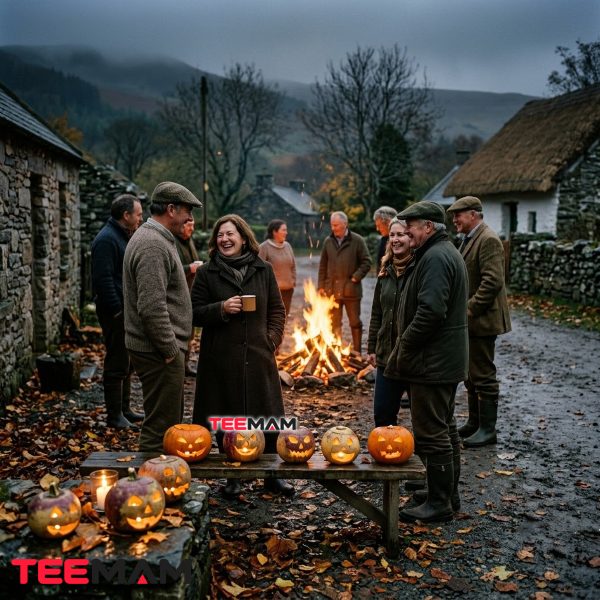
Key takeaway: Irish Halloween traditions are closely tied to Samhain, a Gaelic festival marking the turn from harvest into winter. Modern Halloween, though, is the product of several overlapping influences, including Christian feast days, Irish and Scottish folk custom, and later American adaptation, not a straight line from one ancient ritual to a candy-and-costume holiday.
What Is Samhain, and How Is It Connected to Halloween?
Samhain marked one of the major turning points in the traditional Gaelic calendar, signaling the shift from the harvest season into winter. According to the National Museum of Ireland, Oíche Shamhna, the eve of Samhain, “is still celebrated all over Ireland with feasting and games,” a continuity that stretches back through generations of harvest-time custom.
Folklore held that the boundary between the human world and the otherworld grew thin on this one night. Families believed the spirits of the dead might return home, and that the shape-shifting púca and other mischievous or dangerous beings were unusually active. The Museum’s own folklife records describe people avoiding travel alone that night and protecting their homes with holy water or handmade crosses. These beliefs are folklore passed down through oral tradition, not documented historical events, and are best treated accordingly rather than presented as settled fact.
The Christian layer came later and is genuinely more complicated than the popular one-line version. In the eighth century, Pope Gregory III dedicated an oratory at St. Peter’s in Rome to all the saints. The November 1 date for All Saints’ Day became increasingly established across Western Christianity over the following century, and Pope Gregory IV later helped extend the observance more broadly. All Souls’ Day, dedicated to the wider commemoration of the dead, developed afterward as its own distinct observance. Historians still debate how deliberately the Church’s calendar was set to coincide with existing Gaelic custom, and a fair account leaves that question open rather than declaring that Christianity simply “renamed” Samhain.
7 Irish Halloween Traditions and Their Modern Echoes
| Tradition | Root Custom | Modern Halloween Echo |
|---|---|---|
| Turnip lanterns | Irish and Scottish carving tradition | Pumpkin jack-o’-lanterns |
| Guising | Disguise and seasonal performance | Costumes |
| Bonfires | Samhain fire festivals | Halloween gatherings |
| Fortune-telling games | Marriage and luck divination | Party games |
| Barmbrack | Fortune-telling fruit bread | Fortune cakes and treats |
| Colcannon | Seasonal harvest supper | Family Halloween meals |
| Snap-apple | Traditional autumn game | Party entertainment |
These seven customs are among the best-known examples, but they’re not a complete or uniform list. Irish Halloween traditions varied by county, household, and period, and the folklore behind them was rarely identical from one part of Ireland to the next.
1. Turnip lanterns came before pumpkin jack-o’-lanterns
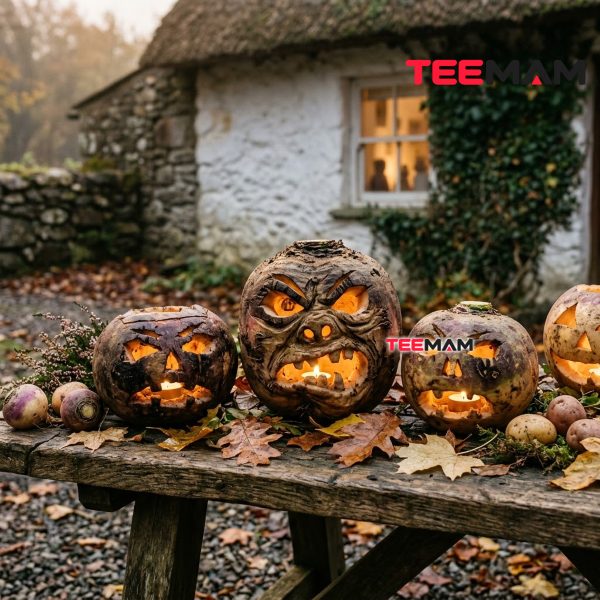
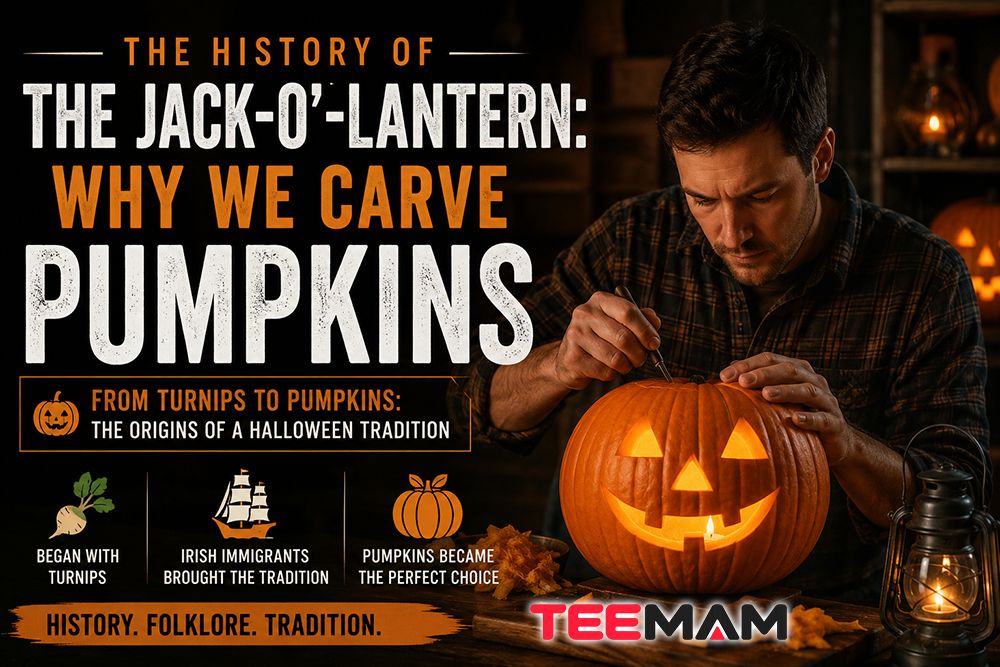
Turnip carving was the traditional Irish form of Halloween lantern-making, long before the pumpkin became the dominant American choice. People in Ireland, and in Scotland too, hollowed out turnips or mangel-wurzels and carved rough faces into them, then set a candle or ember inside. The National Museum of Ireland holds one of these on display at its Castlebar branch in County Mayo: a “Ghost Turnip” dated to around 1900, tied to folklore about a trickster named Jack who outwitted the Devil and was condemned to wander with only a hollowed turnip to light his way.
Turnips made practical sense. They were dense, sturdy, and plentiful after the autumn harvest, although they were genuinely hard to carve, which is part of why the faces in surviving examples look cramped and unsettling. A quick note if you try it yourself: turnips are far tougher than pumpkins, so a thin, sharp paring knife and some patience go a long way, and an LED tea light is a safer choice than an open flame once it’s hollowed out.
As Irish and other immigrants carried lantern-carving customs into North America during the nineteenth century, pumpkins increasingly became the preferred material, since they were larger, more widely available, and easier to carve than a turnip. The pumpkin jack-o’-lantern eventually became the dominant form in American Halloween culture, while the turnip original became something most people outside Ireland have never heard of. For the fuller story of how that transatlantic shift unfolded, we cover it in our complete guide to Halloween’s deeper history.
2. Guising: the older roots behind Halloween costumes
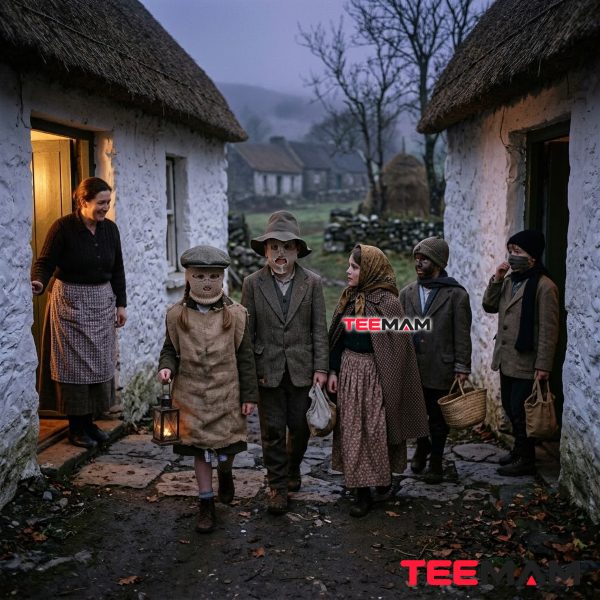
Guising is one of the best-known Irish Halloween traditions connected with disguise and seasonal performance. It meant going door to door in costume, often performing a song, rhyme, or small trick in exchange for food, and was familiar in Ireland and Scotland well before American trick-or-treating existed in anything like its current form. In some Irish communities, the disguises were remarkably simple: people swapped clothes, blackened their faces with soot, changed their voices, or went by false names for the night. Disguise was tied up with the wider folklore of spirits and mischief on Samhain night, though the specific reasons people gave for the practice varied by place and period, so it’s more accurate to call it a related custom than a single, uniform ritual. Guising is one thread among several, including later “souling” customs and American commercialization, that eventually braided together into modern trick-or-treating.
3. Bonfires and the symbolism of fire
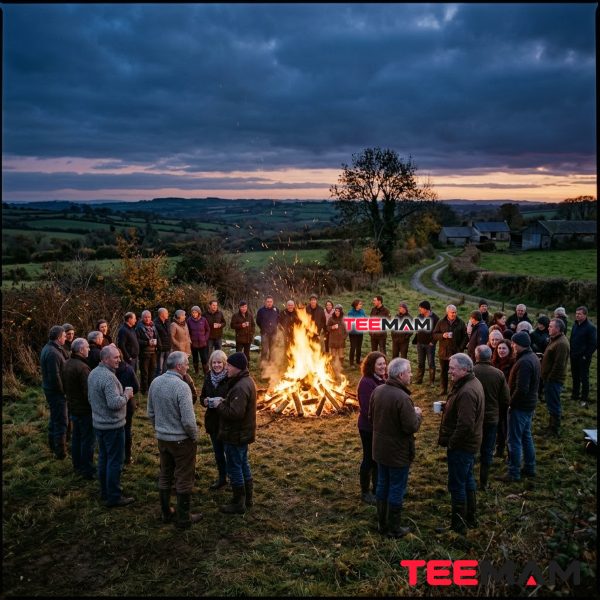
Bonfires remain one of the more recognizable Irish Halloween traditions, and Tlachtga, also known as the Hill of Ward near Athboy in County Meath, holds a particularly strong place in the later historical and folkloric record around the festival. Irish tradition associates the site with a major Samhain fire, from which other fires were said to be lit, and that heritage is now revived each October 31 at the Púca Festival in Athboy and Trim, where a ceremonial fire is lit at the Fair Green to mark the season. In some Irish communities, hearth fires at home were traditionally associated with protection and renewal at this same seasonal turning point. What ties these customs together is less a single supernatural belief than the simple act of marking the season together.
4. Fortune-telling and games
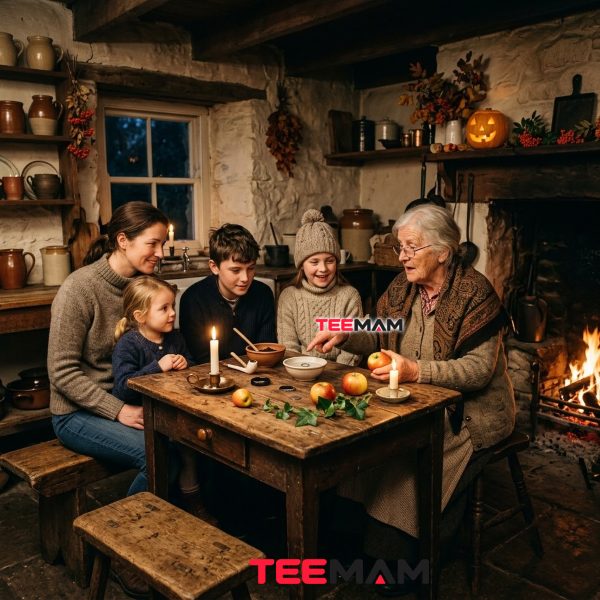
Divination games were a regular feature of the night, mostly built around questions people actually cared about: who they’d marry, and whether the coming year would bring luck or hardship. In parts of Wexford, one game had a blindfolded child dip a hand into saucers holding different objects, a ring, clay, or water among the most common, each one predicting a different fate for the year ahead.
A glimpse from an Irish folklore archive: A record collected in the 1930s by the National Folklore Collection at University College Dublin, from Racomane East, County Kerry, describes a barmbrack cake with a ring baked in, cut into slices at teatime so that whoever received the slice with the ring “will be the first to get married.” The same account describes children catching an apple dropped into a tub of water, or hung on a string, with their hands held behind their backs, and notes plainly that “Hallowe’en is also called ‘Snap Apple Night’ on account of the game.”
Snap-apple, in which players try to bite a swinging apple, is the best-known survivor of these games and still shows up at some Halloween gatherings in Ireland, though far less universally than it once did.
5. Barmbrack and the tradition of hidden fortunes
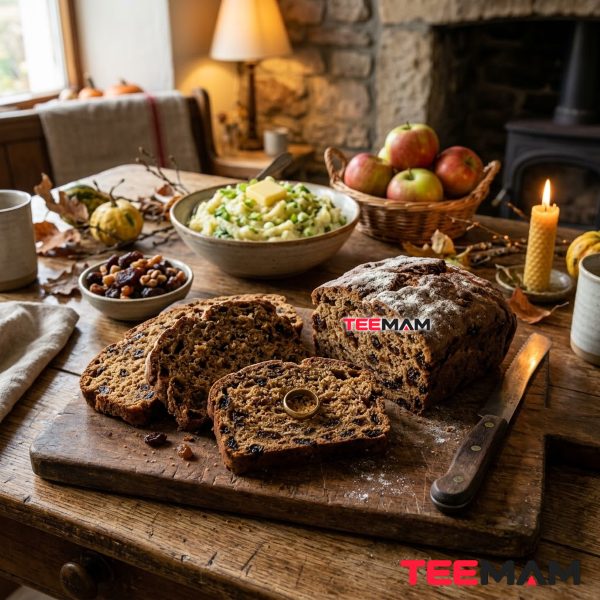
Barmbrack, from the Irish bairín breac (“speckled loaf”), is a spiced fruit bread traditionally baked in the weeks before Halloween, with small objects once baked inside to tell each person’s fortune for the year. Families would slice it and pass it around, half nervous and half laughing, to see what turned up. The specific charms and their meanings varied by family and region: a ring commonly signaled marriage, while other objects, a coin, a rag, a pea, or a thimble, could point toward wealth, poverty, or remaining unmarried, depending on the local tradition. Most commercially sold barmbracks in Ireland today include a single wrapped ring rather than a full set of charms, and the tradition has softened into something closer to a fun holdover than a serious prediction, though the pull of it hasn’t disappeared.
6. Colcannon and seasonal Irish food
Colcannon, a mash of potatoes with cabbage or kale, butter, and often scallions, was widely associated with Halloween supper in Ireland. Food is another important part of Irish Halloween traditions, although the ingredients and even the prominence of the dish varied by region and family. Like barmbrack, it sometimes carried its own hidden charms. It’s a dish built entirely from what was on hand at harvest time, which is a big part of why it fits so naturally into a festival marking the end of the growing season.
7. Storytelling, spirits, and Irish folklore
Halloween night has long been a night for stories, and Irish folklore has its own distinct cast rather than a generic set of monsters. In Irish folklore, the banshee is traditionally associated with certain families and is said to warn of an approaching death through her wail. The púca is a different figure entirely, a shape-shifter capable of taking animal or human form, sometimes helpful and sometimes not. Treating figures like these as distinct pieces of a specific tradition, rather than interchangeable “Celtic monster” set dressing, is part of what keeps the folklore interesting rather than generic.
From Samhain to Halloween: What Actually Changed?
Samhain was a Gaelic seasonal festival with its own internal logic built around harvest, protection, and community. Halloween, as it exists today, is a separate cultural product that absorbed pieces of Samhain and was reshaped again by Christian observance, emigration, and American commercialization. Treating the two as interchangeable skips over most of the actual history in between.
The Christian layer added structure and a fixed calendar date. All Hallows’ Eve, the vigil held the night before All Saints’ Day on November 1, is where the word “Halloween” comes from directly. As covered above, whether the Church’s timing was deliberately meant to coincide with existing Gaelic custom is a real point of historical debate, not a settled fact. For readers who want to dig further into how different faiths and cultures have interpreted the holiday since, we cover that ground in our piece on Halloween’s meaning in the Bible.
The clearest, best-documented link in this whole chain is emigration. When large numbers of Irish people left for the United States, particularly across the nineteenth century, they brought guising, storytelling, divination games, and turnip carving with them. Once in America, turnips gave way to pumpkins, and what had been a home-and-village tradition grew into a much larger, more public, more commercial holiday. Irish and Scottish custom supplied a great deal of the raw material, but American culture is what scaled it into the holiday recognized today.
Irish Halloween Traditions vs. Modern American Halloween
| Traditional Irish Custom | Modern American Equivalent |
|---|---|
| Turnip lanterns | Pumpkin jack-o’-lanterns |
| Guising | Costumes and trick-or-treating |
| Barmbrack | Halloween treats and party cakes |
| Snap-apple | Party games |
| Bonfires | Halloween gatherings and festivals |
| Folklore storytelling | Ghost stories |
| Fortune-telling games | Halloween party games |
Modern American Halloween isn’t a direct copy of Irish Halloween traditions; rather, it’s what happens when a specific set of village customs crossed an ocean, mixed with other communities’ traditions, and eventually turned into a full retail season. If you’re curious how far that transformation has gone, our guide to planning Halloween in Salem is a useful look at just how large-scale American Halloween culture has become.
Traditional Irish Halloween Foods Worth Knowing
| Food | Why It Matters |
|---|---|
| Barmbrack | Fortune-telling bread, the centerpiece of the Halloween table |
| Colcannon | A traditional Halloween supper across much of Ireland |
| Apples | Used fresh and in games like snap-apple and apple bobbing |
If you’re planning your own Irish-inspired Halloween dinner, lean into what was actually seasonal: potatoes, cabbage, apples, and dried fruit, rather than forcing every dish on the table into a “Samhain” theme it never really had.
How to Bring Irish Halloween Traditions Into a Modern Home
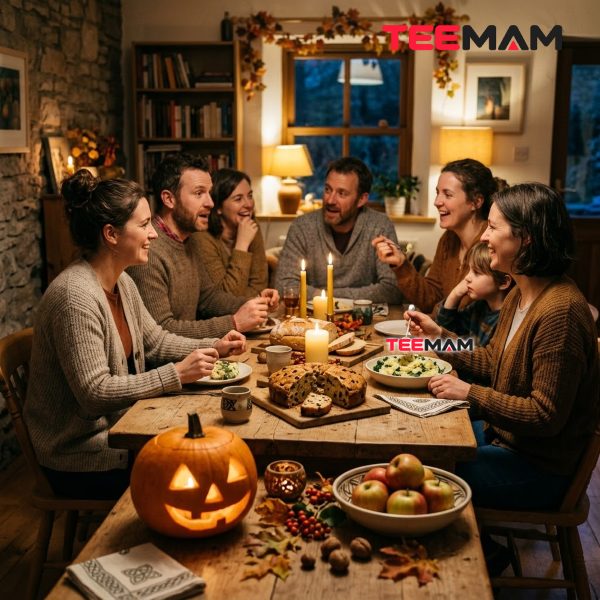
These Irish Halloween traditions can be adapted at home without pretending that a modern celebration is identical to historical Samhain.
Carve a turnip lantern. Use a turnip or a rutabaga, hollow it carefully with a sturdy paring knife, and set a small LED candle inside rather than an open flame.
Set a rustic, harvest-inspired table. Autumn leaves, natural wood, warm candlelight, and earthy colors capture the mood well. It’s fine to draw on Celtic-inspired motifs for the aesthetic, just avoid labeling every knot or spiral pattern as an “ancient Samhain symbol,” since the specific history behind many individual designs is often much less certain than that.
Host an Irish-inspired evening. Bake a barmbrack, play a round of apple bobbing, tell a few ghost stories, and if local rules allow it, build a small fire outside. None of this needs to be elaborate to feel genuine.
Bring the aesthetic into your everyday wardrobe. If you want to carry this rustic, folklore-rooted mood without wearing a full costume, subtle Celtic knotwork, vintage jack-o’-lantern illustrations, or typography honoring Oíche Shamhna are an easy way to wear the season without turning Irish culture into a costume. At TeeMam, we take the same approach with folklore-inspired Halloween designs: seasonal, understated, and meant to complement the holiday rather than turn Irish culture into a costume.
What Is the Difference Between Samhain and Halloween?
Samhain is a Gaelic seasonal festival marking the boundary between harvest and winter. Halloween is a modern holiday that absorbed pieces of Samhain, layered Christian observance from All Hallows’ Eve on top, and was later reshaped by Irish emigration and American commercialization. The two terms get used interchangeably in casual writing, but they aren’t synonyms. Samhain is one of several historical threads that fed into what Halloween eventually became, not an earlier name for the same holiday.
Are Irish Halloween Traditions Still Practiced Today?
Yes, though unevenly. Barmbrack still shows up in Irish bakeries and supermarkets every October.
Folklore accounts collected by the National Folklore Collection preserve just how local these customs could be. RTÉ’s own coverage of the holiday notes that Halloween has gone by strikingly different names depending on the region, Snap Apple Night, Colcannon Night, Púca Night, and Vizzarding Night among them, a good reminder that Irish Halloween traditions were never one uniform practice repeated identically everywhere.
Some of these customs persist as living tradition, some have faded, and some, like the Púca Festival’s ceremonial bonfire at Tlachtga, are conscious modern revivals built on older sites and stories rather than an unbroken thread stretching back centuries. It’s a meaningful distinction, even when the two look similar from the outside.
Frequently Asked Questions About Irish Halloween Customs
What are the main Irish Halloween traditions? The main Irish Halloween traditions commonly associated with the holiday include turnip lanterns, guising, bonfires, fortune-telling games, barmbrack, colcannon, and folklore storytelling, although the customs varied considerably by region and period.
Did Halloween originate in Ireland? Not entirely. Modern Halloween has several historical influences, including the Gaelic festival of Samhain, Christian observances tied to All Saints’ Day, and later customs that developed further in Britain, Ireland, and the United States. Ireland and Scotland supplied much of the raw material, especially the customs that crossed the Atlantic with Irish emigrants, but the modern holiday wasn’t built in Ireland alone.
Why did Irish people carve turnips instead of pumpkins? Pumpkins simply weren’t native to Ireland. Turnips were widely available right after the autumn harvest, so people used what they had. Pumpkins became part of the tradition once Irish emigrants reached North America, where the vegetable was common and considerably easier to carve.
What is the Irish name for Halloween? Oíche Shamhna, meaning “the eve of Samhain,” is the Irish-language name still used today, though regional English-language names like Snap Apple Night and Colcannon Night were also common historically.
What food is traditionally eaten in Ireland on Halloween? Barmbrack and colcannon are the two standout dishes, alongside apples and other seasonal harvest foods.
What is guising in Irish Halloween traditions? Guising means going out in disguise, often performing a song or trick, in exchange for food or treats. It’s an older, more informal relative of modern trick-or-treating and costume culture.
How can I celebrate Irish Halloween traditions at home? Carve a turnip lantern instead of a pumpkin, bake a barmbrack with a hidden charm or two, play a round of apple bobbing or snap-apple, tell a ghost story, and set a table with warm, natural, autumnal touches.
Keeping the Spirit of Irish Halloween Traditions Alive
Beneath the candy, costumes, and inflatable lawn decorations, the older customs are surprisingly simple: a carved turnip, a shared loaf with a fortune baked inside, a communal fire, and stories told as the season turned. Samhain traditions, Christian observance, Irish and Scottish folk custom, emigration, and American culture all played a part in building the Halloween familiar today. The turnip became a pumpkin, guising evolved alongside newer forms of costume play, and a set of village customs became part of a much larger, more commercial holiday. Understanding where Irish Halloween traditions came from, and separating documented history from folklore and modern revival, gives the holiday more depth. What began as a collection of seasonal and local customs has been reshaped many times over, but the impulse to gather, eat, play, tell stories, and mark the turn into winter remains recognizable.

Hi, I’m Olivia Bennett, a fashion and lifestyle writer at TeeMam with 6 years of experience creating content about fashion, outfits, and lifestyle trends. I enjoy sharing practical style ideas for everyday wear, game days, holidays, and special occasions, helping readers find looks that feel comfortable, fun, and uniquely their own.