49ers vs. Seahawks, Rams, and Cowboys: History of the Biggest Rivalries
Quick answer: The Dallas Cowboys are the 49ers’ greatest historical rival, built on legendary 1990s NFC Championship clashes. The Los Angeles Rams are the oldest rival, a California grudge dating back to 1950. The Seattle Seahawks are the fiercest rival right now, having just knocked San Francisco out of the playoffs on the way to a Super Bowl. Depending on which decade you grew up in, the answer to “who do 49ers fans hate most” shifts over time, and that moving target is exactly what keeps the Niner Gang arguing every single season.
Who Is the 49ers’ Biggest Rival Today?
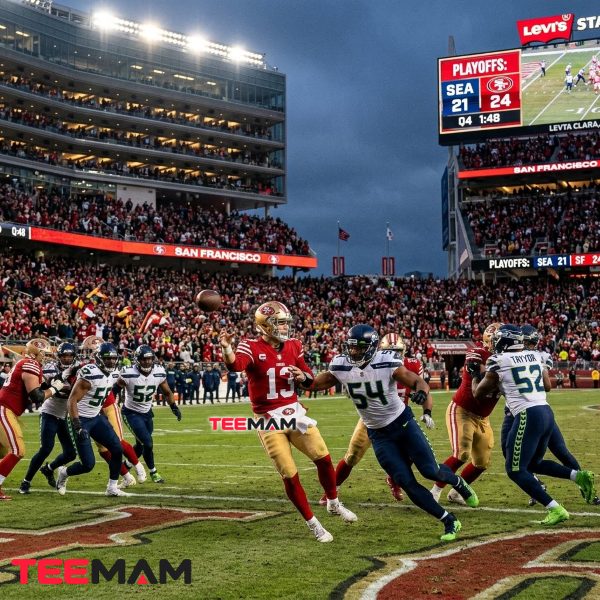
The short answer: As of the 2025 season, Seattle is the answer. The Seahawks eliminated San Francisco 41–6 in the January 2026 divisional round and went on to beat New England in Super Bowl LX, a title won, cruelly enough, at Levi’s Stadium itself. Seattle now leads the all-time series 33–24.
That result stings in a specific way a regular-season loss never does. It’s one thing to drop a game to a division rival in October. It’s another to watch that same rival celebrate a championship on your own home turf three weeks later. Mike Macdonald’s defense, nicknamed the “Dark Side,” has become the new measuring stick for the NFC West, the same way Pete Carroll’s Legion of Boom was a decade earlier.
Dallas still carries the weight of history: the Faithful lead that series 21–19–1, built on the Montana and Young era of Super Bowl runs against the Cowboys dynasty. The Rams carry the geography, a rivalry that started in 1950, before the Seahawks even existed as a franchise. Seattle defines the current era.
| Rival | Unique Identity | Era | Biggest Moments |
|---|---|---|---|
| Dallas Cowboys | Dynasty vs. dynasty | 1970s to 1990s, revived 2021 to 2023 | The Catch (1981 NFC Championship), 1994 NFC title game, 2022 Divisional Round |
| Seattle Seahawks | The modern nemesis | 2011 to present | “The Tip” (2014), 41–6 divisional playoff (2026) |
| Los Angeles Rams | California pride | 1950 to present | 1989 NFC Championship, 2021 NFC Championship |
Why These Grudges Outlive the Championships
Ask any longtime member of the Faithful about Super Bowl XXIX and you’ll get a warm nod and maybe a quick story. Bring up the 2013 NFC Championship in Seattle, and watch their jaw tighten instead. Titles get celebrated for a weekend. Rivalry losses get replayed for decades.
That’s not an accident. Division games decide playoff seeding directly, so every Cowboys, Rams, or Seahawks matchup carries weight that a random Week 9 game against Jacksonville simply doesn’t. But the deeper reason these feuds stick is generational. A grandparent who watched Dwight Clark go up for The Catch at Candlestick Park in January 1982 raised a kid who screamed at the TV during Richard Sherman’s tipped pass in 2014, who’s now raising a kid who watched Seattle blow out San Francisco 41–6 in that January 2026 playoff game on its way to a Super Bowl LX title. That’s three generations sharing the same inherited grudge.
For anyone new to the Faithful trying to catch up on all of it, the fastest way in isn’t memorizing box scores. It’s understanding why these three teams specifically get under the fan base’s skin. Our complete guide for new Faithful fans breaks down the franchise history that makes all of this make sense.
The 90s Bloodbath: Why the Cowboys Remain the Ultimate Playoff Rival
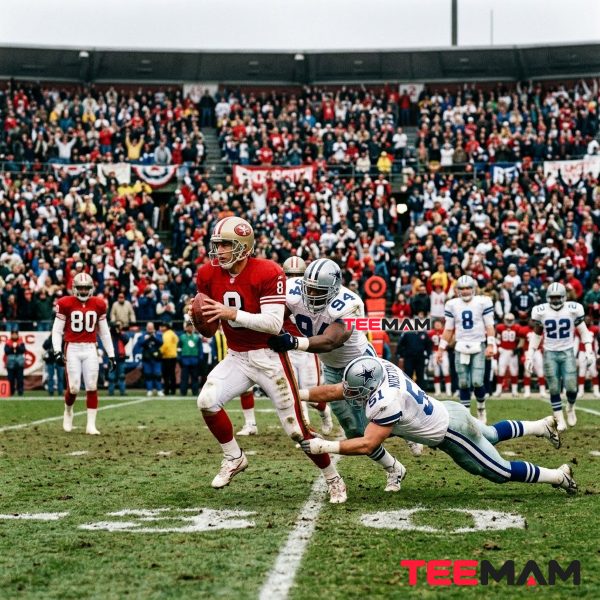
Mention the Cowboys to a longtime 49ers fan and the conversation almost never starts with a stat line. It starts with a specific memory: where they were, who they were with, what the room sounded like.
Timeline: 1970 to 1994
- 1970 to 1972: Dallas beats San Francisco in three straight NFC Championship or Divisional games, denying the 49ers their first Super Bowl trip.
- January 10, 1982: Joe Montana finds Dwight Clark in the back corner of the end zone in the 1981 NFC Championship Game. The Catch. 49ers win 28–27, reach their first Super Bowl.
- 1992 and 1993: Troy Aikman, Emmitt Smith, and Michael Irvin’s Cowboys beat Steve Young’s 49ers in back-to-back NFC Championships, 30–20 and 38–21.
- September 1994: The 49ers sign free-agent cornerback Deion Sanders specifically to solve their Cowboys problem, pairing him with Merton Hanks and Eric Davis in the secondary.
- 1994 NFC Championship: San Francisco finally breaks through, 38–28, powered by Steve Young and Jerry Rice, and goes on to win Super Bowl XXIX.
Sanders’ arrival is one of the most underrated storylines in this entire rivalry. San Francisco had lost two straight conference title games to Dallas and needed an answer for Michael Irvin. They found it in “Prime Time,” who won Defensive Player of the Year that season and helped the 49ers beat Dallas 21–14 at Candlestick Park during the regular season before finishing the job in the NFC title game. He left for Dallas the very next year.
Key takeaways: Nine playoff meetings, more than either of San Francisco’s other two rivals. Hall of Famers on both sidelines nearly every time. And a free-agent signing, Deion Sanders, built entirely around beating one specific opponent.
More recently, the two teams met in consecutive postseasons: a 23–17 Wild Card win for San Francisco in January 2022, then a tighter 19–12 divisional-round slugfest a year later, where Fred Warner smothered the Dallas passing game and Robbie Gould drilled four field goals. Dallas hasn’t reached an NFC Championship Game since January 1996, and every postseason loss to San Francisco since has only added to that drought’s weight in Texas.
The Modern Hatred: 49ers vs. Seahawks
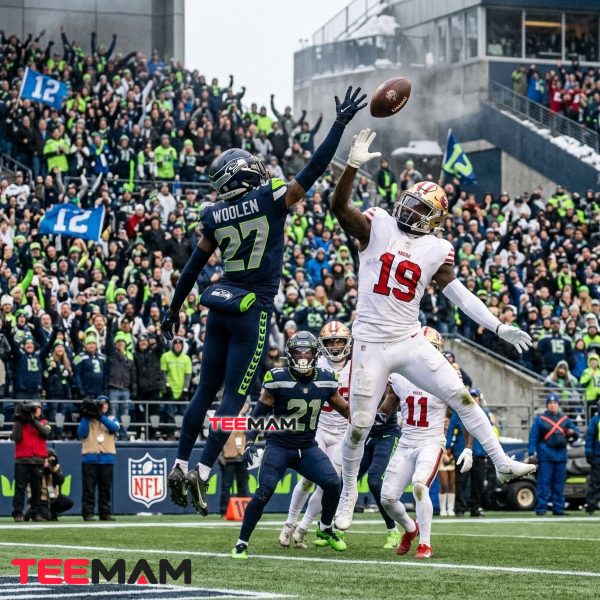
Few rivalries in the NFL went from nothing to full-blown hostility as fast as this one did. Before 2011, Seattle and San Francisco were just two teams sharing a division. Then Jim Harbaugh took over the 49ers, Pete Carroll had already been rebuilding the Seahawks for a year, and both coaches wanted the exact same thing: a physical, bully-ball identity that ran through the other guy’s building.
The short answer: The signature moment is the 2013 NFC Championship Game, played January 19, 2014, at what was then CenturyLink Field. Seattle led 23–17 late when Colin Kaepernick threw toward Michael Crabtree in the end zone. Cornerback Richard Sherman got a hand on it first, deflecting the ball into Malcolm Smith’s arms for the game-sealing interception, a play that’s been replayed as “The Tip” ever since. Sherman’s fired-up, in-your-face postgame interview turned an already-tense rivalry into a cultural flashpoint that outlasted the play itself.
Anyone who’s actually made the trip to Lumen Field for a 49ers-Seahawks game knows what the home fans mean when they call it the loudest building in the league. The cold off Elliott Bay cuts through a jacket by the second quarter, the crowd noise makes it nearly impossible to hear a snap count from the sideline, and Seattle’s defense has built an entire identity around exploiting exactly that discomfort.
That discomfort peaked again in January 2026, when Seattle’s defense, built around Nick Emmanwori, Uchenna Nwosu, and a secondary anchored by Devon Witherspoon, dismantled San Francisco 41–6 in the divisional round, then rode that momentum through the NFC Championship and into a Super Bowl LX win over New England. For a 49ers fan, watching a division rival hoist the Lombardi Trophy inside Levi’s Stadium is about as personal as a loss gets.
Social media has sped this whole thing up compared to the Cowboys rivalry of decades past. A single Sherman rant or a single blown coverage now gets clipped, captioned, and argued about across every platform within the hour, keeping the temperature high for days instead of fading after the postgame press conference.
California Pride: 49ers vs. Rams
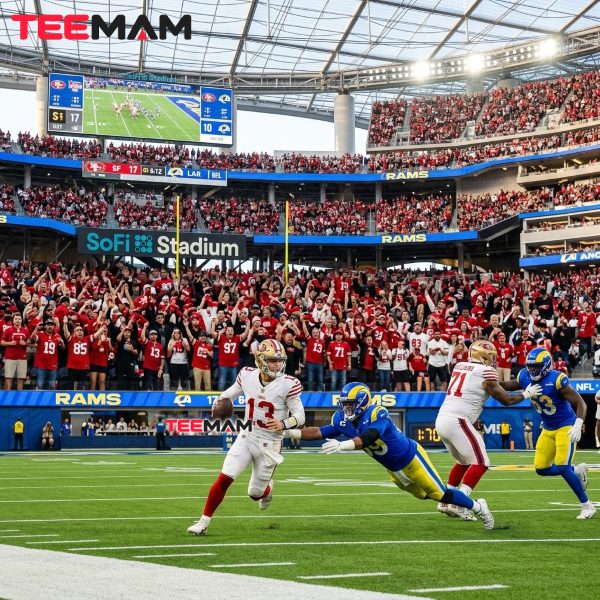
Geography does most of the heavy lifting in this one. Two franchises sharing a state, splitting bragging rights over who actually runs West Coast football.
The short answer: San Francisco and Los Angeles first met in 1950, four years after the 49ers joined the NFL, making this the franchise’s oldest rivalry, older than the Cowboys feud and older than the Seahawks feud combined. Across 154 all-time meetings, San Francisco leads 79–72–3.
The Rams spent 1995 through 2015 in St. Louis, which drained some of the geographic sting out of the series. Their 2016 return to Los Angeles brought the “Battle for California” framing right back, and it hasn’t let up since. The rivalry’s defining modern game came in the 2021 NFC Championship at SoFi Stadium, where Matthew Stafford and Cooper Kupp erased a 10-point deficit to beat San Francisco 20–17, sending the Rams to their own home Super Bowl. It was the first 49ers-Rams playoff meeting since San Francisco’s 30–3 win in the 1989 NFC Championship, a 32-year gap between title-game appearances against the same opponent.
Here’s the part that visiting fans from other cities never quite believe until they see it: SoFi Stadium has earned the nickname “Levi’s South” because 49ers fans routinely make up the majority of the crowd, even in Inglewood. Vivid Seats projected 49ers fans would account for roughly 62% of the crowd for a 2024 matchup, and beat writers covering the game noted red jerseys outnumbering Rams blue and gold from the parking lot onward. Fullback Kyle Juszczyk put it simply after one such trip: playing in front of that many traveling 49ers fans makes it easier to hear the snap count than it does on the road almost anywhere else in the league. Nick Bosa predicted a “takeover” before one 2023 matchup and got exactly that: announced attendance topped the building’s listed capacity, and it looked like a home game from kickoff.
That’s the Beat LA mentality showing up in football form, something Bay Area sports fans have carried across multiple leagues for generations. When the Faithful pack a Southern California stadium three or four hours from home and still out-cheer the home crowd, it’s not really about ticket sales. It’s about making sure Los Angeles knows exactly whose state this is on Sundays.
Comparing the Three Biggest Rivalries
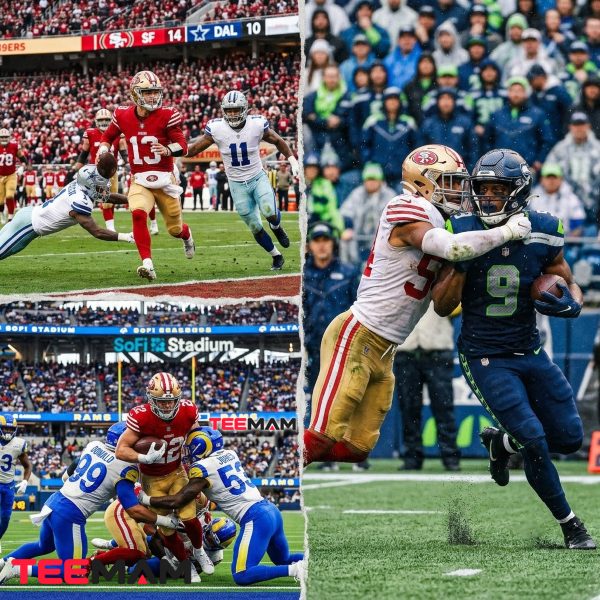
| Category | Cowboys | Seahawks | Rams |
|---|---|---|---|
| History | 1970s to present, non-division | 2011 to present, NFC West | 1950 to present, NFC West |
| Playoff meetings | 9 | 3 | 2 |
| Fan intensity | High, national-media driven | Very high, current NFC power | High, in-state and generational |
| Geographic factor | Low | Moderate (Pacific Northwest) | Very high |
| Current relevance | Moderate | Very high | High |
| Signature stars | Montana, Rice, Aikman, Smith, Sanders | Sherman, Wilson, Kaepernick, Macdonald | Kittle, Kupp, Donald, Stafford |
| All-time series | 49ers lead 21–19–1 | Seahawks lead 33–24 | 49ers lead 79–72–3 |
We crown Seattle with a near-perfect Rivalry Intensity Score of 9 (a 1–10 scale weighing active playoff trauma, current division stakes, and championship weight), followed by the Rams at 7 and the Cowboys at 6. When a division rival hoists the Lombardi on your home turf, the needle breaks.
Rivalry Snapshot
- Cowboys: Oldest playoff rivalry. 9 postseason meetings. Hall of Fame era.
- Seahawks: Modern nemesis. Ignited under Harbaugh vs. Carroll in 2011. Still raging under Shanahan vs. Macdonald.
- Rams: Oldest rivalry overall. Series dates to 1950. Defined by the Battle for California.
Five Games Every 49ers Fan Should Watch
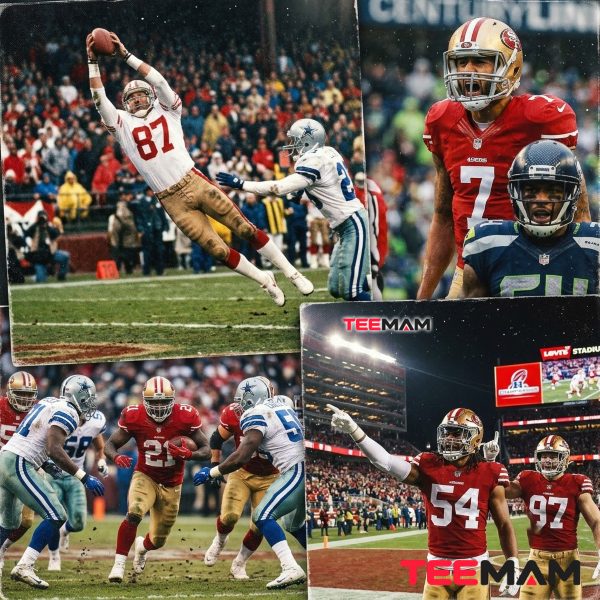
- The Catch, 1981 NFC Championship Game (Jan. 10, 1982): Montana to Clark, 28–27 over Dallas, the play that launched the dynasty.
- 1994 NFC Championship: A 38–28 win over Dallas, with Deion Sanders finally solving a two-year problem, en route to Super Bowl XXIX.
- 2013 NFC Championship vs. Seahawks (Jan. 19, 2014): “The Tip,” a 23–17 loss that still defines the Seattle rivalry over a decade later.
- 2021 NFC Championship vs. Rams: A gut-punch 20–17 defeat at SoFi Stadium that ended an improbable playoff run one game short.
- 2022 Divisional Round vs. Cowboys: A tense 19–12 win, sealed by a blocked extra point and four Robbie Gould field goals.
The moments after wins like these are half the reason fans keep coming back, the way Levi’s Stadium erupts, the way strangers hug in the concourse. Those chaotic, beautiful scenes are rooted in decades of San Francisco history, and our look into the iconic touchdown celebration traditions traces exactly how the Faithful have celebrated silencing their biggest rivals, one generation at a time.
How Rivalry Week Actually Feels on the Ground
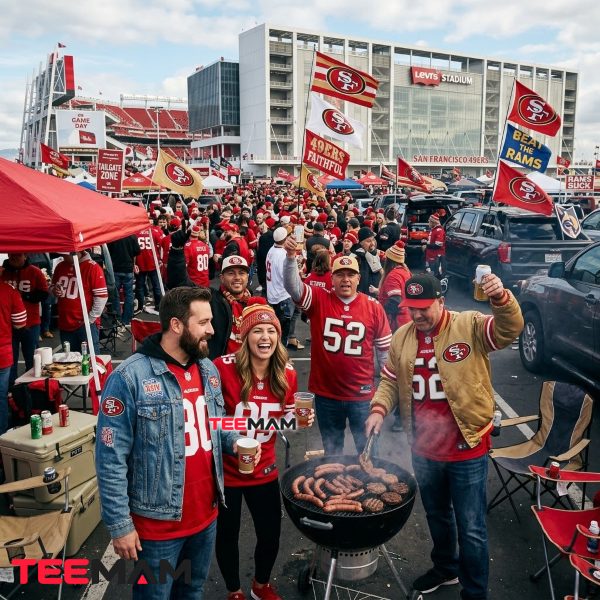
Walk through the parking lots outside Levi’s Stadium three hours before kickoff against Seattle, and something shifts compared to an ordinary Sunday. Tailgates start earlier. Jerseys from four different decades appear at the same table: a faded Steve Young throwback next to a brand-new Brock Purdy jersey. Conversations rarely stay on the current roster for long; someone always brings up Sherman’s interview, or The Catch, or whether Dallas still deserves to be called the “real” rival.
Some fans have their own private rituals for these weeks. A lucky jersey that only comes out for Cowboys games. A specific bar in the city that only fills up for Rams road trips because that’s where the watch party has always been. None of it is officially organized. It’s just what fandom looks like after enough years of showing up.
The gear itself carries meaning during rivalry week in a way it doesn’t the rest of the season. Wearing a faded Mitchell & Ness throwback from the Montana-Rice era outside Levi’s Stadium is a quiet flex, a visual reminder to any visiting Cowboys fan who wasn’t even alive to see the 1994 title game. Dusting off a pristine, silver-buttoned vintage Starter jacket for Cowboys week isn’t just a fashion choice. On rivalry Sundays, gear becomes part of the rivalry itself, worn as a claim on decades of history that every fan in the section recognizes without needing it explained.
Where the Grit Actually Comes From
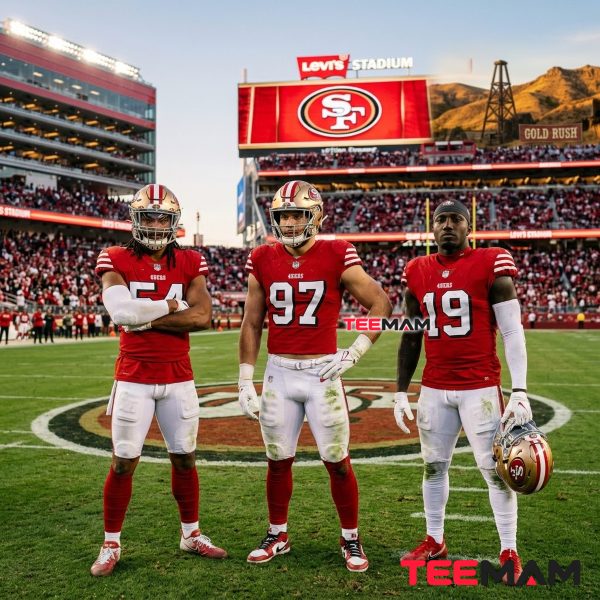
The 49ers name traces back to the 1849 California Gold Rush, when prospectors flooded San Francisco chasing fortune in impossible conditions. That scrappy, stubborn identity has outlived every era of the roster, from Ronnie Lott’s era of physical defense, through Terrell Owens and Frank Gore’s grind-it-out years, to the Kittle-McCaffrey-Purdy core taking the field today. It’s part of why these three rivalries in particular carry so much weight: this has always been a franchise defined as much by its city’s origin story as by any single scoreboard. The story behind the 49ers name covers that Gold Rush history in full, and it’s worth the read before your next rivalry Sunday. The same grit that named the team is still on the field every time Dallas, Seattle, or Los Angeles comes to town.
Common Questions About 49ers Rivalries
Who is the 49ers’ biggest rival right now?
Seattle. The Seahawks lead the all-time series 33–24, eliminated San Francisco from the 2025-season playoffs 41–6, and went on to win Super Bowl LX.
Which rivalry has produced the most playoff games?
Dallas. The 49ers and Cowboys have met nine times in the postseason, well ahead of the Rams (two meetings) or the Seahawks (three meetings).
Why do many fans consider Cowboys vs. 49ers one of the NFL’s greatest rivalries?
Because it stacked Hall of Fame talent against Hall of Fame talent across four NFC Championship Games in the 1980s and ’90s, with a Super Bowl trip on the line nearly every time, and because San Francisco went out and signed a future Hall of Famer in Deion Sanders specifically to solve the Dallas problem.
When did the Seahawks rivalry become so intense?
It sharpened fast once Jim Harbaugh and Pete Carroll built NFC West powerhouses starting in 2011, and it peaked with the 2013 NFC Championship Game and Richard Sherman’s tipped-pass interception.
Why are Rams games especially important inside the NFC West?
They’re division games with direct playoff-seeding implications, layered on top of a rivalry that’s shared California for most of both franchises’ histories, right down to 49ers fans regularly outnumbering Rams fans inside SoFi Stadium.
Which rivalry is the oldest in franchise history?
The Rams rivalry, dating back to 1950, more than 20 years before the Seahawks even joined the league as an expansion team.
Has the biggest rival changed over different eras?
Yes. Dallas dominated the conversation in the 1980s and ’90s. The Rams took over during the 2018 to 2022 stretch when both teams reached Super Bowls. Seattle owns the current era after eliminating San Francisco from the 2025 playoffs on its way to a title.
Which rivalry is most likely to define the next decade?
Seattle looks like the safest bet. Mike Macdonald’s Seahawks are a Super Bowl champion built around a young core, and the NFC West race almost always runs through this specific matchup.
Conclusion
Ask three different generations of 49ers fans to name the team’s biggest rival and you’ll probably get three different answers. Someone who grew up on Joe Montana will almost certainly say Dallas. Fans who came of age during the Harbaugh years usually point to Seattle. Others who never miss the drive down Interstate 5 will swear nothing feels more personal than Los Angeles. That’s what makes this history so compelling: the answer keeps changing, but the passion behind it never does.

Hi, I’m Olivia Bennett, a fashion and lifestyle writer at TeeMam with 6 years of experience creating content about fashion, outfits, and lifestyle trends. I enjoy sharing practical style ideas for everyday wear, game days, holidays, and special occasions, helping readers find looks that feel comfortable, fun, and uniquely their own.