49ers Game Day Chants, Songs, and Catchphrases Every Fan Should Know
Quick answer: The four most recognizable 49ers game day traditions are:
- A’oo — the crowd’s first-down chant, widely believed to be inspired by the movie 300
- DE-FENSE — the classic stomp-clap chant used during defensive stands
- Bang Bang Niner Gang — the catchphrase pulled from E-40’s 2019 anthem
- Faithful to the Bay — the official identity the 49ers organization uses for its fanbase
Everything below explains where each one came from, how it fits into the wider fan rituals and stadium atmosphere at Levi’s Stadium, and exactly when to use it.
Sit in the lower bowl on a third-and-short and you’ll hear it before you see it: a low “Ahh,” then a sharper “Ooo,” building for three full cycles until the whistle blows. Nobody around you checks a scoreboard first. They just know. Guidebooks usually skip that part. These game day traditions weren’t built for tourists. They’re muscle memory carried from Kezar Stadium to Candlestick Park to Santa Clara, generation after generation.
Most gameday guides stop at listing chants. This one focuses on something more useful: knowing when each crowd tradition actually happens, what to scream, when to stay quiet, and how to tell a decades-old ritual from a chant that only trended for one viral clip.
Chant, Song, or Catchphrase? Here’s the Difference
A chant is a short, rhythmic crowd call tied to a specific in-game moment. It starts and dies within seconds and needs no music. A stadium song is a full track played to set a mood rather than react to one play; tailgate music and DJ sets both count. A catchphrase is identity, not reaction. It shows up on a jersey or an Instagram caption with no play required to trigger it.
Mixing the three up is the fastest way to draw a look from the row behind you. Yell a catchphrase mid-snap and people notice. Try to sing along to something meant to be a two-second chant and you’ll always be a beat behind.
Fans scattered from Sacramento to San Diego, plenty of whom have never set foot in Santa Clara, share this exact vocabulary anyway. A season-ticket holder who remembers Candlestick and someone at their first game can stand in the same section and know precisely when to yell. If you want the fundamentals of stadium atmosphere and fan culture first, our complete 49ers fan starter guide walks through stadium basics, gear, and team history from the ground up.
The Chants Every Fan Should Know
The “A’oo” first-down chant
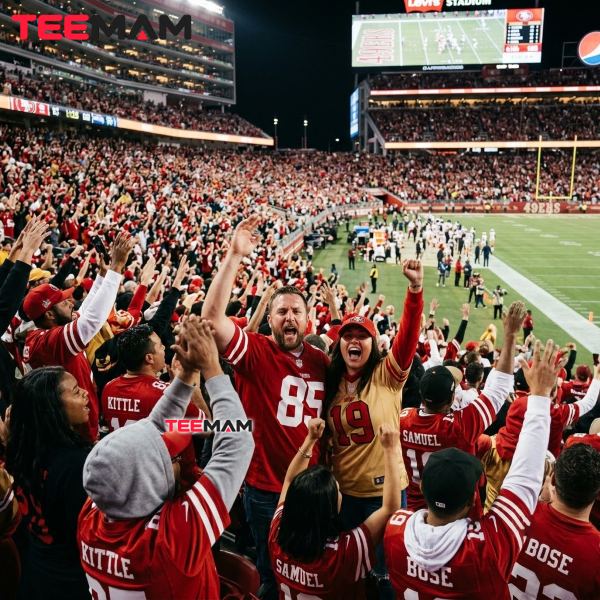
What is the A’oo chant? It’s the 49ers’ signature first-down crowd call, a three-count “Ahh-Ooo” cued by the PA system the instant a first down is confirmed, and it’s become one of the team’s best-known game day rituals.
A lot of gameday explainers get this one wrong: the chant isn’t the crowd yelling “First Down.” It’s a call-and-response that longtime fans widely trace back to the war-cry scene in the 2006 film 300, though the 49ers organization has never issued an official statement pinning down its exact origin. Fan accounts place the tradition’s start around 2012 at Candlestick Park, where the PA system would cue the sound effect right after the announcer confirmed a first down, and the crowd would answer it live. It carried over to Levi’s Stadium and remains the loudest recurring chant in the building on third-down conversions. New fans should listen for the “First Down!” call from the PA announcer, that’s the cue, not the play itself.
The DE-FENSE stomp-clap
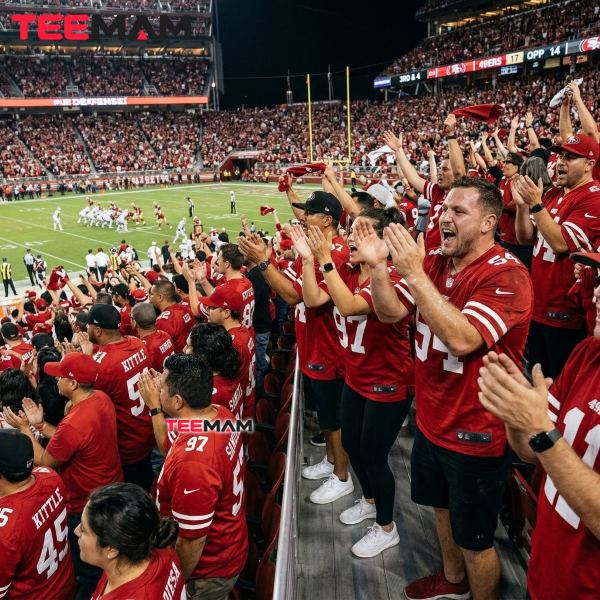
What it is: A two-syllable, stomp-clap chant, “DE” on the downbeat, “FENSE” with a clap, used across the NFL and adopted at full volume by the Faithful as a genuine home-field advantage.
If you’re walking back from the concession stand on a third-and-long, you’ll usually hear DE-FENSE building before you’re even back in your seat. It surges hardest in the red zone and during a visiting offense’s two-minute drill. There’s no learning curve. Just match the clap after the first “DE” and you’re in. Veteran season-ticket holders will tell you the loudest moment of a game often isn’t the touchdown, it’s the defensive stop that keeps a close game alive, and DE-FENSE is the sound of that belief.
Player-specific chants
What it is: A crowd call built around stretching a player’s name or nickname into a rhythmic shout, almost always started spontaneously in one section before it spreads through the rest of the stadium.
Fullback Kyle Juszczyk, nicknamed “Juice” since college, gets a “Juuuuice!” call after a key block or catch, and the team’s own broadcast has highlighted the crowd bringing the Juice on the road as much as at home. Teammate George Kittle once described Juszczyk as the offense’s “fixer,” the guy who patches whatever goes wrong mid-play, which is part of why the chant carries real weight instead of just noise. Names that stretch naturally into three syllables with a hard consonant tend to catch on faster than others. Etiquette matters here too: wait until the play is dead before joining in. Starting a chant during a live snap risks drowning out the cadence the offense needs to hear.
When should you actually join in?
New to the Faithful and unsure when to open your mouth? Join the A’oo chant only after the PA confirms the first down, jump on DE-FENSE during third-down defensive stands, save player chants for after the whistle, and stay completely silent during your own team’s snap count. One habit separates regulars from rookies: veterans rarely start a chant themselves. They wait for the stadium’s own cue, whether that’s the PA system or a section a few rows over, and let it build naturally instead of forcing it. Home crowd noise is a real weapon on defense; don’t hand it to the other sideline by accident.
The Songs That Set the Levi’s Stadium Atmosphere
Tailgate playlists before kickoff
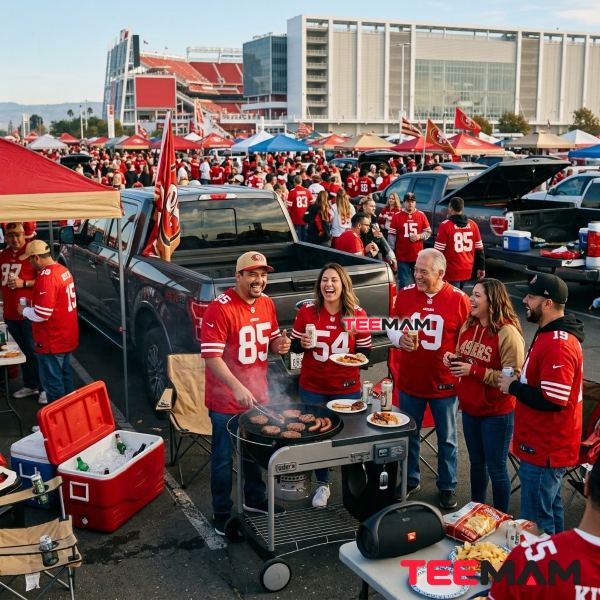
The lots outside Levi’s Stadium sound distinctly like the Bay, heavy on hyphy-era staples and Bay Area hip-hop rather than generic stadium rock. That’s by design: the 49ers organization has partnered directly with Bay Area artists, including E-40 and P-Lo, to build official Faithful to the Bay playlists distributed on Spotify, Pandora, and Apple Music, so the tailgate soundtrack and the in-stadium sound are, for once, actually the same songs.
In-game music: the Amp Squad
Between drives, Levi’s Stadium hands the mic to the Amp Squad, a rotating crew of professional DJs who also work clubs and radio outside of football season. It’s a deliberate booking choice that keeps timeouts from sounding like every other NFL broadcast.
The song that became an accidental anthem
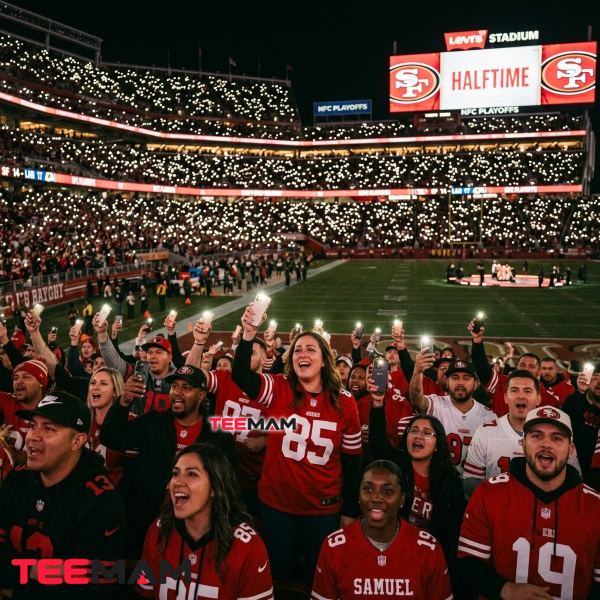
Some traditions get built on purpose. This one happened by accident. During halftime of the January 2024 NFC Championship Game against the Detroit Lions, Journey performed live at Levi’s Stadium and closed with “Don’t Stop Believin'” while San Francisco trailed 24-7. The 49ers scored 27 unanswered points in the second half to win 34-31 and reach Super Bowl LVIII. Fans who were there don’t hear that song the same way anymore. It’s become the unofficial soundtrack for a comeback, the one that starts playing in Bay Area bars the moment a game looks like it’s slipping away.
Where the music tradition actually started
Modern fans usually associate 49ers music with E-40, but the franchise’s musical tradition actually stretches back to the early 1950s. Bay Area musician Martin Judnich wrote a 49ers fight song in 1952 for KSFO radio broadcasts, decades before Levi’s Stadium existed, making it one of the earliest team-specific anthems in the NFL. Most fans have never heard it, but it’s proof the tradition of 49ers music didn’t start with E-40. It just got a lot louder with him.
Music isn’t a side note to the day, it’s half the reason people show up early. Our full breakdown of tailgate traditions every fan follows covers what to bring, what to play, and how the lots actually run before kickoff.
The Catchphrases and What They Actually Mean
Bang Bang Niner Gang
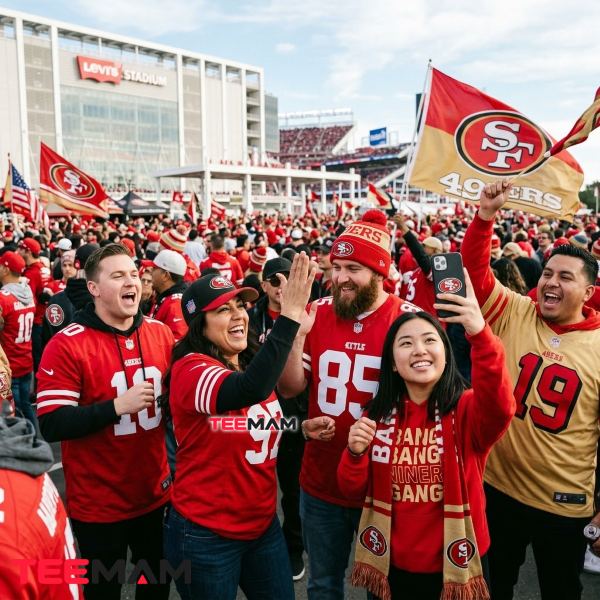
What is “Bang Bang Niner Gang”? It’s the chorus of E-40’s 2019 song “Niner Gang,” adopted by the 49ers organization as an unofficial stadium call and now one of the most common catchphrases in the fanbase’s social media vocabulary.
The catchphrase has a documented origin, unlike most fan sayings that just sort of appear. E-40 released “Niner Gang” in December 2019, produced by his son Droop-E, name-checking franchise legends like Jerry Rice and Ronnie Lott. “It’s an honor and a pleasure to create the official anthem for my home team,” E-40 said at the time, and the 49ers organization embraced the chorus line as a stadium-ready call. It shows up constantly on 49ers social content: red-and-gold crowds, sideline cuts, gameday edits, all captioned the same three words.
Faithful to the Bay
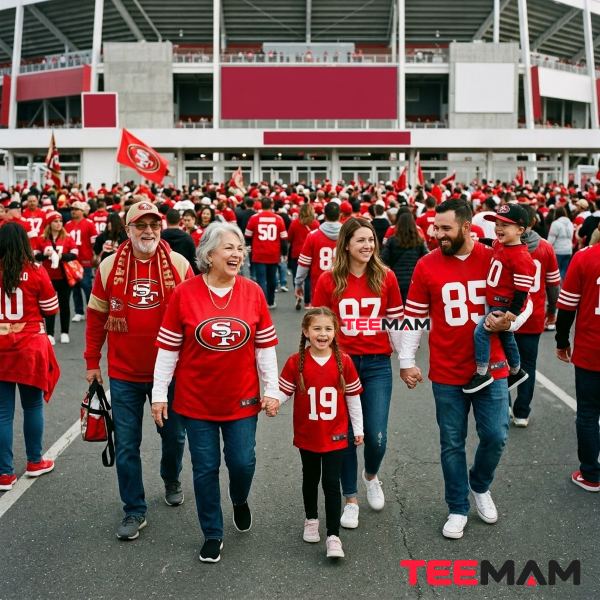
What is “Faithful to the Bay”? It’s the official brand campaign the 49ers use to describe their fanbase, framing regional loyalty across the Bay Area as central to what it means to be one of the Faithful.
Walk through Levi’s Stadium and you’ll spot “Faithful to the Bay” almost everywhere, on field wraps, banners above the concourse, and signage near the gates. The campaign was narrated in its launch video by team legend Keena Turner and carries the hashtag #FTTB. The team describes the Faithful as more than a team’s supporters, calling them part of “a way of life” tied to the entire Bay Area.
Niner Empire
Unlike official slogans handed down from a marketing department, “Niner Empire” grew from the stands up. It traces back to a 1994 Monday Night Football broadcast, when John Madden compared the 49ers’ dynasty-era dominance to the Roman Empire as Jerry Rice broke a career touchdown record. The nickname stuck with talk radio callers through the 2000s, and by 2005 it had grown into a grassroots fan movement founded by a diehard named AJ Esperanza at Candlestick Park, one that now runs chapters worldwide and organizes what its members call “Invasions” of opposing stadiums.
Did you know? The Niner Empire movement has spread well past California. A chapter in Germany, founded in 2013 by a fan who goes by “Keiner,” now serves as the group’s official liaison for 49ers fans across Europe.
Red and Gold forever
A generational marker more than a campaign. Fans use it to signal loyalty that predates any single quarterback era, the kind passed down from people who watched Joe Montana and Steve Young to kids who’ve only known Brock Purdy under center.
Other expressions you’ll hear around the lot
“Do It For The Bay” became an official rally phrase printed on towels handed out to fans entering playoff games. “The Faithful” itself is the collective noun the organization uses across every piece of branding, from the team website to the museum inside the stadium. And don’t be surprised if you see “Gold Rush,” the name of the 49ers’ cheerleading squad since 1983, referenced as its own piece of team identity separate from the players; they were called the Niner Nuggets back at Kezar Stadium.
Want the deeper story behind why the organization built an entire campaign around one word? Read our explainer on the meaning behind Niner Faithful for the full history of the term and how the 49ers use it today.
How the Traditions Compare
| Tradition | When It’s Used | Why Fans Use It | Unique to the 49ers? |
|---|---|---|---|
| A’oo chant | Every confirmed first down | Builds momentum, adds pressure | Yes, though other teams have borrowed variations |
| DE-FENSE | Third-and-long, red zone stands | Disrupts the offense’s rhythm | No, shared across the NFL |
| Bang Bang Niner Gang | Big plays, social captions, tailgates | Signals identity and pride | Yes, tied directly to E-40’s 2019 song |
| Faithful to the Bay | Branding, banners, campaigns | Frames fandom as regional loyalty | Yes, official 49ers trademark identity |
| Niner Empire | Away-game “Invasions,” fan chapters | Unites traveling fans as one group | Yes, grassroots fan-built movement |
A Game Day Timeline: What Fans Chant From Kickoff to Final Whistle
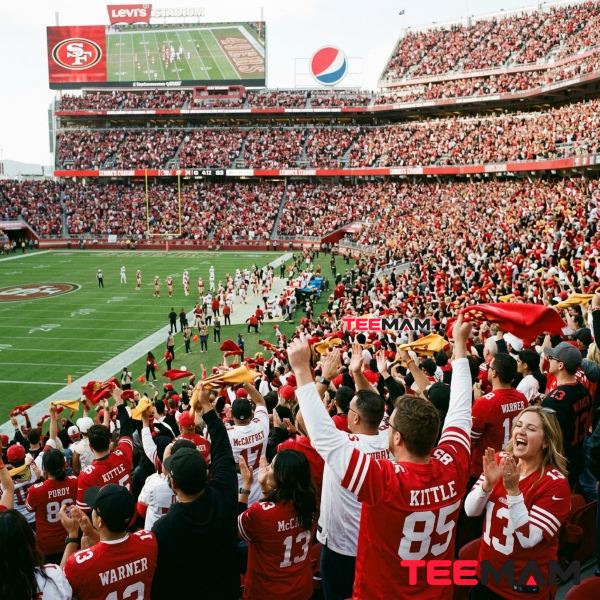
Most gameday guides list chants in isolation, useful as a reference, but they skip the order things actually happen in. Here’s the real sequence, broken into stages.
Before kickoff. Gates open three and a half hours early, and the lots fill fast, with the Faithful to the Bay playlist and local hip-hop providing the soundtrack while fans grill. One thing first-time visitors usually notice is that the tailgate lots have their own personality separate from the stadium, live music included. Longtime season-ticket holders still talk about a local banjo player who spent over four decades performing outside games, first at Candlestick and later at Levi’s Stadium, purely because he loved the team.
Player introductions. The Amp Squad brings out its biggest hype tracks here, and crowd noise is already building well before the coin toss.
First downs and defensive stands. Once the offense takes the field, the A’oo chant fires on the first successful conversion. Force a stop on defense, especially third down, and DE-FENSE takes over, growing louder the more critical the situation gets.
Halftime. Expect the Amp Squad to keep the energy up between performances, though on rare occasions the 49ers bring in a live act, which is exactly what turned a 2024 playoff game into the Journey singalong fans still bring up.
Touchdowns and the fourth quarter. Scores bring the loudest, least structured noise of the day, more raw roar than organized chant, usually followed by fireworks and a DJ hype cut. In a close fourth quarter, don’t be shocked if scattered singing breaks out, a direct legacy of that NFC Championship comeback.
Victory formation. As the clock winds down on a win, the stadium hits its loudest sustained volume of the entire game, something beat writers have flagged repeatedly during the team’s deeper playoff runs.
For a closer look at exactly what happens in that scoring window, our piece on favorite touchdown celebration traditions covers the fireworks, the music cues, and the fan rituals that follow every 49ers score.
Quick Chant Cheat Sheet
| Situation | What Fans Do | Purpose |
|---|---|---|
| First Down | “A’oo! A’oo! A’oo!” on the PA cue | Momentum, crowd pressure |
| 3rd Down (Defense) | “DE-FENSE” stomp-clap | Disrupts the offense’s cadence |
| Big Defensive Stop | Roar, sometimes into a player chant | Rewards the individual play |
| Touchdown | Unstructured roar + fireworks + DJ cut | Marks the biggest moment of the drive |
| Victory / Final Whistle | Loudest sustained crowd noise of the game | Closes out the win together |
Mistakes Rookies Make (and How Not to Be One)
Jumping into the A’oo chant before the PA actually cues it is the single most common tell of a first-timer—wait for the sound cue, not the play. Confusing a chant with a song trips people up too: chants are reactive and short, songs are longer and mood-setting, and singing along to a two-second call just puts you a beat behind everyone else. Shouting a catchphrase like Bang Bang Niner Gang mid-play instead of after a big moment breaks the section’s rhythm. Basic etiquette still applies as well: staying seated during a chant that calls for standing, or being buried in your phone on a critical third down, is the fastest way to feel like you’re watching from outside the tribe instead of inside it. It also carries over to road trips: fans who travel for away games often coordinate seating in the visitor’s section ahead of time specifically so chants like A’oo and DE-FENSE still land with enough voices behind them to be heard over a hostile crowd.
Looking the Part on Game Day
There’s a reason you don’t see many plain jackets in the lower bowl. When tens of thousands of fans roar the A’oo chant in unison, a sea of red and gold makes the whole section look, and sound, twice as intimidating. By the time the sun drops behind Levi’s Stadium in a late-season game, temperatures fall fast enough that fans coordinating matching hoodies isn’t just about looking sharp, it’s about staying warm through the fourth quarter. At TeeMam, we think about apparel the same way longtime fans do: it’s one small part of a bigger day. For a lot of fans, a hoodie worn to a big win ends up as a keepsake long after the final whistle, a reminder of the game itself more than anything bought at a counter.
If you want to add a personal touch before your next trip to Santa Clara, our personalized 49ers fan hoodie lets you put your own name into the red and gold. For everything else, from everyday wear to full gameday fits, browse our official inspired fan apparel collection for more ways to represent the Faithful.
Common Questions About 49ers Chants and Songs
Why do 49ers fans say “Bang Bang”? It’s the chorus of E-40’s 2019 song “Niner Gang,” which the 49ers organization adopted as an unofficial stadium chant. It’s now used as a catchphrase far beyond the stadium, especially in social media captions.
What is the most famous 49ers chant? The “A’oo” first-down chant is the most recognizable in-stadium chant. DE-FENSE is close behind, though it’s shared across the NFL rather than unique to San Francisco.
Why is the first-down chant called A’oo? Fans widely credit the call to the war-cry scene in the 2006 film 300, adapted into a stadium sound effect that plays after every confirmed first down. The 49ers organization has never issued an official statement confirming that origin, but it’s the explanation longtime fans consistently point to.
What songs are played at Levi’s Stadium? There’s no single fixed playlist. The Amp Squad DJs rotate hype tracks between drives, the official Faithful to the Bay playlist (built with E-40 and P-Lo) dominates the tailgate lots, and Journey’s “Don’t Stop Believin'” has taken on unofficial anthem status since the 2024 NFC Championship comeback.
Is there a 49ers fight song? Yes, though most fans have never heard it. Bay Area musician Martin Judnich wrote a 49ers fight song in 1952 for KSFO radio broadcasts, decades before Levi’s Stadium or even the team’s Super Bowl era.
Can first-time visitors join the chants? Yes, every chant here is open to anyone in the crowd. The only skill required is timing: wait for the trigger, whether that’s a PA cue, a confirmed stop, or a dead play, rather than guessing.
Are chants different during playoff games? The core chants stay the same, but the volume and frequency spike, and playoff games add extras like the “Do It For The Bay” rally towels handed out to fans at the gates.
One Last Thing Before Kickoff
Seventy years separate that 1952 KSFO fight song from E-40’s rap anthem, and yet both exist for the exact same reason: giving strangers something to do together for three hours. The next time the PA announcer calls for a first down, don’t hesitate. Join in. By the time the final whistle blows, you’ll realize the chants were never just noise. They’re how a stadium full of strangers becomes the Faithful, four quarters at a time.

Hi, I’m Olivia Bennett, a fashion and lifestyle writer at TeeMam with 6 years of experience creating content about fashion, outfits, and lifestyle trends. I enjoy sharing practical style ideas for everyday wear, game days, holidays, and special occasions, helping readers find looks that feel comfortable, fun, and uniquely their own.