How to Make the Perfect 49ers Game Day Sign to Get on TV
Walk around Levi’s Stadium before kickoff and you’ll spot the same thing every home game: dozens of poster boards, most of them packed with text nobody past the first ten rows will ever make out. Camera operators typically scan the crowd for bold shapes, readable text, and visible reactions rather than reading every sign word by word. A sign that ends up on the Sunday broadcast is usually the one that’s legible from fifty rows away, ties into what’s happening on the field, and goes up for a few seconds at the right moment rather than the whole drive.
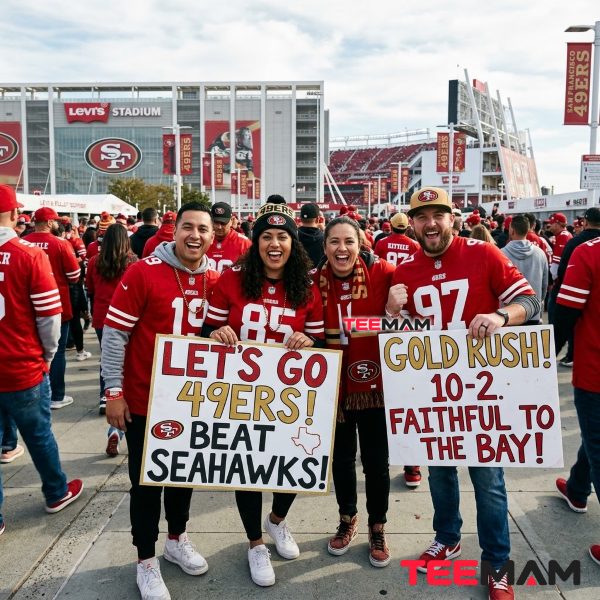
Key takeaways:
- Keep the sign under 2′ x 3′ with no pole — Levi’s Stadium’s hard limit
- Use matte foam core, not glossy poster board
- Limit the message to six words or fewer
- Raise it for five to ten seconds right after a big play
- Match your outfit to the sign instead of letting the two clash
How Can You Make a 49ers Fan Sign That Actually Gets on TV?
In short: a broadcast-friendly sign is short, high-contrast, legible from a distance, timed to the moments cameras actually sweep the crowd, and fully compliant with Levi’s Stadium’s size rules.
What actually shows up on a broadcast camera
Most in-stadium broadcast cameras run fairly fast shutter speeds to keep motion sharp, and that has a side effect: it exaggerates glare off any reflective surface, glossy poster board included. A sign that looks fine in a phone photo can wash into a flare on the actual feed. That’s a detail most fan-sign guides never mention, and it’s the reason material choice carries as much weight as the words on the board.
Telephoto lenses also compress distance, flattening the visual gap between letters once a shot is past midfield. Spacing between words ends up mattering almost as much as letter height.
The three elements every successful sign shares
Short copy, strong contrast, and a message tied to something happening in that specific game — a player milestone, a rivalry storyline, a chant the section just started. Generic “Go Niners” boards are everywhere; a sign built around the actual moment stands out from the pack.
Common mistakes that make signs invisible
Cramming too much text onto one board forces the lettering down to a size nobody past row 20 can make out. Dark ink on a dark board is nearly as bad. Holding a sign at chest height, below where the sideline camera platforms are aimed, keeps it out of frame no matter how good the design is.
Know the Stadium Rules Before You Start
Building a sign that never makes it past the gate is a wasted afternoon, so this comes before any design talk.
Levi’s Stadium and NFL sign guidelines
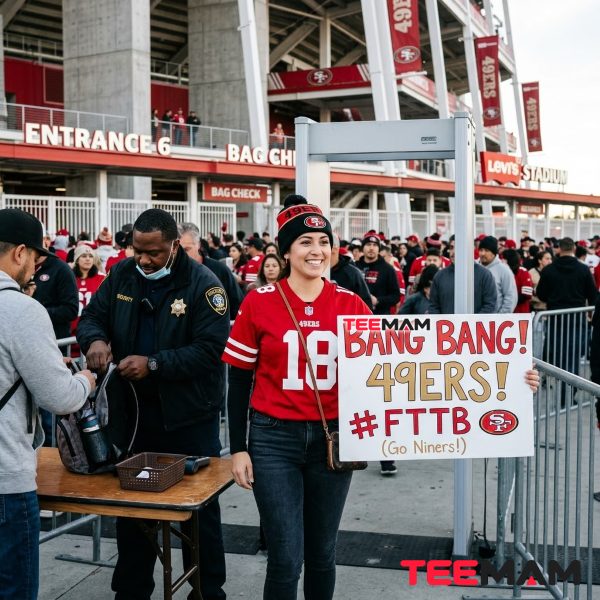
Levi’s Stadium’s official permitted-and-prohibited list caps flags, signs, and banners at 2 feet by 3 feet, with poles barred under any circumstance. Light-up signs and battery packs bigger than a cell phone aren’t allowed either, along with klaxons, bullhorns, and laser pointers. All guests and belongings are subject to search at the gate, so building to that size from the start beats trimming a board down in the parking lot.
The sweet spot for stadium poster size
Staying just under the 2′ x 3′ ceiling — something like 20 by 28 inches — gives room for large lettering without becoming a hassle to carry through a packed concourse. Bigger isn’t automatically better on camera; a tighter, well-designed board often comes across more clearly than an oversized one held at an angle.
What messages and materials to avoid
The stadium’s code of conduct prohibits offensive language and imagery, and anything glowing, oversized on batteries, or mounted on a pole gets turned away regardless of what it says. Skip glass, metal grommets, and rigid frames too — anything that could be mistaken for a weapon or projectile risk isn’t getting through security.
How to confirm game day policies before arriving
Stadium policies get updated, so check the current Levi’s Stadium permitted and prohibited items page the week of the game rather than going off what worked last season.
Common reasons signs get rejected at the gate
Most signs that get turned away at security fall into a short list of avoidable problems:
- A wooden stick, dowel, or PVC pipe attached as a handle (any pole is barred)
- Cardboard reinforced with wire, metal grommets, or a rigid frame
- Battery packs or LED strips larger than a cell phone
- Language or imagery that violates the stadium’s code of conduct
- Multiple boards taped or tied together to make one oversized sign
Checking a board against this list before leaving home avoids a last-minute redo in the parking lot.
Choose Materials That Look Great on Camera
Best poster boards for bright outdoor lighting
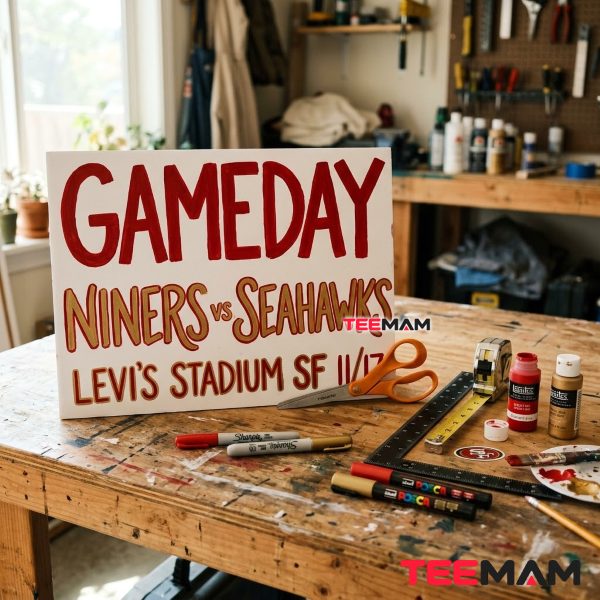
Foam core board holds its shape far better than standard poster board after a few hours of Santa Clara sun and wind. It stays flat when held up, which matters more than most fans expect — a board that’s bowing or fluttering scatters light unevenly and blurs under stadium lighting.
Why matte finishes beat glossy on broadcast
One detail regular fans notice after a few games under the lights: glossy poster board reflects afternoon sun and floodlights more aggressively than it looks in person. Paired with the fast shutter speeds broadcast cameras run, that reflection shows up on the feed as a washed-out flare rather than a legible sign.
Matte board absorbs that light instead of bouncing it at the lens, holding up no matter which direction the sun is coming from.
Best materials for different situations
| Goal | Best choice |
|---|---|
| Getting seen on TV | Matte foam core |
| Rain in the forecast | Laminated or taped board |
| Night or primetime games | Thick paint marker, not fine-line pen |
| A kid-made sign | Oversized letters, one hand-drawn detail |
| A rivalry or playoff game | Short, sharp slogan over a long joke |
Markers and paint that stay visible from a distance
Thick chisel-tip paint markers — a Sharpie thick-point or similar — hold up at a distance in a way fine-line pens don’t. The stroke stays wide enough that letters don’t thin out once a camera is fifty-plus rows away. Acrylic paint with a wide brush works even better for block lettering; it dries opaque and doesn’t bleed into foam core the way some markers do.
Weatherproofing for wind and rain
A layer of clear packing tape or laminate sheet over painted lettering stops rain and hand sweat from smearing mid-game, and it stiffens the board slightly against wind gusts that show up more than people expect during evening games near the Bay. Reinforcing the back corners with tape also keeps the board from folding after being passed down a packed row.
Design Your Sign for Maximum Visibility
Letters cameras can make out from midfield
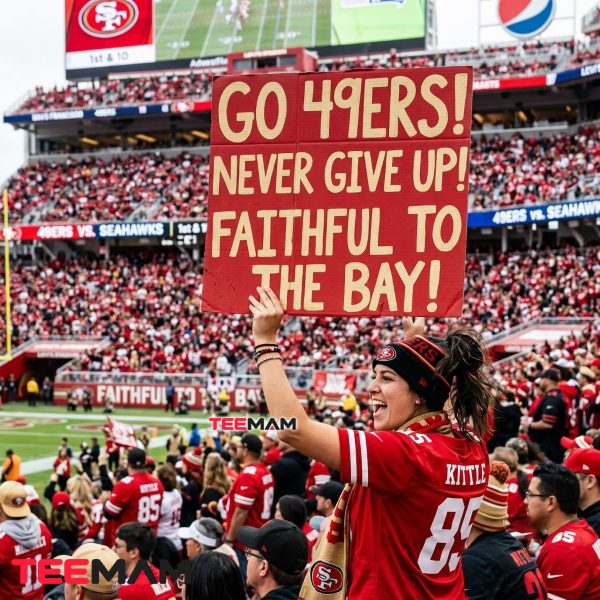
Letters should run at least four to six inches tall to stay legible from field level up into the upper bowl, taller in a standing section holding the sign overhead. Thin, cursive, or decorative fonts look nice up close; block capitals survive the trip from your seat to a broadcast truck.
Strong color contrast: Scarlet and Gold
The 49ers’ Scarlet and Gold reads well on camera because it contrasts against the grays and blues that dominate most stadium seating. Gold lettering on scarlet, or the reverse, stands out next to muted or pastel combinations that blend into the crowd around them.
Leave white space instead of filling the board
A board packed edge to edge gives the eye nowhere to land and forces the lettering smaller. A visible border and space between words help the message register in the half-second a camera passes over it, and that spacing matters even more given how telephoto compression flattens it at a distance.
Sign design comparison
| Good Sign | Bad Sign |
|---|---|
| Six words or fewer | Full sentence or paragraph |
| Matte foam core | Glossy poster board |
| Gold on scarlet (or reverse) | Pastel or low-contrast colors |
| Block capital letters, 4″+ tall | Cursive or thin script font |
| Held up for 5-10 seconds at the right moment | Held up the entire drive |
Photos, logos, or illustrations — worth it?
A small helmet icon or a player’s number next to bold lettering can work on TV. A full detailed portrait usually competes with the text and loses. Keep any graphic secondary to the words.
49ers Sign Ideas That Stand Out Without Trying Too Hard
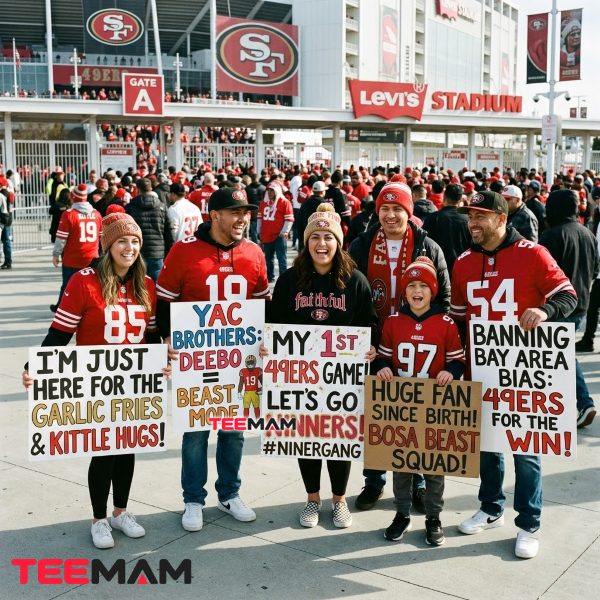
Funny signs that fit game day culture
A funny sign only lands if the whole section gets the joke instantly. Inside references every 49ers fan recognizes usually draw a louder reaction from the row around you than a generic pun would, and crowd reaction shows up on camera even when the sign itself doesn’t fill the whole frame.
Player inspired messages for current stars
Signs built around a current star’s number, nickname, or a recent highlight give broadcast crews an obvious storyline to show. Brock Purdy, Christian McCaffrey, George Kittle, Nick Bosa, and Fred Warner remain the faces of the roster year to year, and any newer addition to the offense or defense tends to earn its own wave of signs the first season they’re in scarlet and gold.
Classic Faithful themed slogans
Leaning into “the Faithful” — the long-running nickname for 49ers fans — gives a sign built-in recognition in the stadium. Something like “Brock & Roll” or “Bang Bang Niner Gang” carries more identity than a generic “Go Niners.”
Family friendly signs for kids
Bright colors, simple words, and a favorite player’s name work well for younger fans, and kid-made signs often earn a longer look on camera for a straightforward reason: a crowd shot showing genuine excitement, especially from a kid, tends to read better on air than another adult holding a slogan. Keep the lettering oversized, let the child draw one element by hand, and skip trying to make the board look professionally designed.
Creative signs for first time stadium visitors
First-game signs have an advantage a lot of fans overlook: they hand a camera crew a story in a single glance, instead of one more generic cheer in a sea of them.
Examples of Great 49ers Game Day Signs
Short one-liners
“Brock & Roll,” “This Is My Church,” “Bang Bang Niner Gang.”
Funny crowd favorites
A jab at a rival’s recent losing streak, or a callback to a viral moment from earlier in the season, usually draws the loudest reaction from both the section and the broadcast truck.
Signs built for national broadcasts
On games carried by FOX, CBS, or NBC’s Sunday Night Football, a short sign referencing the broadcast itself — the announcers, or the primetime slot — often gets extra attention because it acknowledges the audience at home, not just the stadium.
Signs for rivalry and playoff games
Matchups against the Seahawks, Rams, or Cowboys — and anything in the NFC West race — reward sharper, more pointed messaging than a typical regular-season game. Playoff games raise the stakes further, since national audiences and NFL RedZone cut-ins mean more eyes on the crowd than a standard Sunday slot.
| Category | Example |
|---|---|
| Funny | “My Wife Thinks I’m at Work” |
| Player-inspired | “CMC for MVP” |
| Kid-made | “My Dad Says We Can Win” |
| Rivalry | “Beat LA (Again)” |
| Primetime | “Hi Al Michaels” |
| Playoffs | “Faithful ‘Til It Hurts” |
Where Should You Stand to Improve Your Chances of Getting on TV?
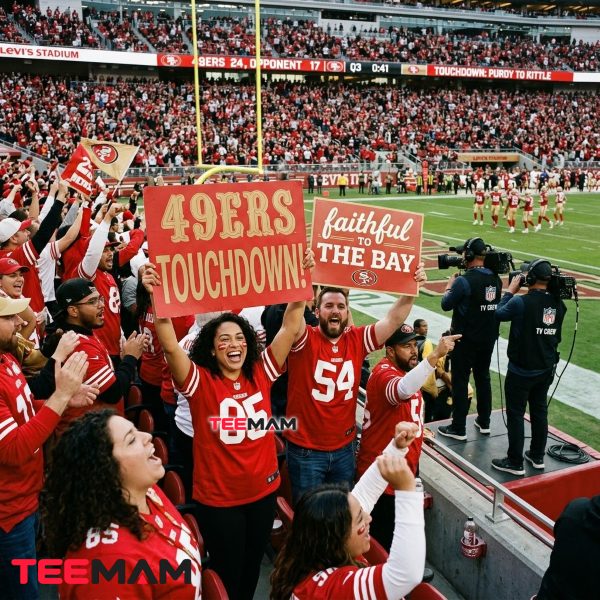
Camera zones that get scanned most
The lower bowl and the end zones sit closest to the main sideline camera platforms, so those sections get swept more often during broadcasts. Sections behind the goalposts also get picked up during field goals and extra points, and the tunnel entrance draws a camera during pregame introductions and halftime.
Best moments to raise your sign, ranked
Not every stoppage in play is an equal opportunity. Replay reviews are worth calling out specifically — broadcasts commonly cut to crowd shots to fill that dead air, which makes a review stoppage a decent window even though it doesn’t involve a live snap. As a rough guide to when a raised sign has the best shot at screen time:
| Moment | Odds of a crowd shot |
|---|---|
| Right after a touchdown | Highest |
| Coming out of a TV timeout | High |
| At halftime introductions | Moderate |
| During a kickoff | Moderate |
| While the ball is live | Lowest — often waved off by ushers |
How long to hold it up
Five to ten seconds is usually enough to register on camera. It’s the considerate move too — holding a sign up for minutes at a time blocks whoever’s sitting behind you, which draws complaints faster than it draws airtime.
Mistakes experienced fans avoid
Veteran sign-makers don’t stand during live plays — stadium staff will ask you to sit anyway — and they don’t hold boards over the heads of people in front of them. That gets you noticed by an usher, not a producer.
Coordinate Your Outfit With Your Sign for a Stronger Visual Impact
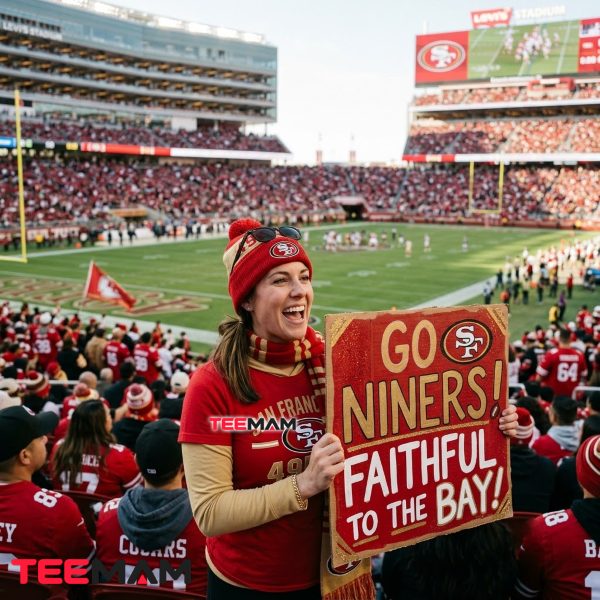
A wide crowd shot doesn’t isolate the poster from the person holding it. The whole frame reads at once, so mismatched colors between your sign and your outfit register as visual noise. A scarlet jersey or gold jacket pairs well with a board as long as the two aren’t both fighting for attention with bold text or graphics; on a crowded shot, matching colors read faster than a busy sign next to a busier outfit. If you want the layering worked out for a cold Bay Area night game without looking bulky on camera, our 49ers game day outfit formula breaks down what actually works.
Face paint, a foam finger, or a themed hat round out the look without pulling attention away, as long as they stay in the same color family as the accent piece.
Your outfit as a second sign
Some of the fans who get noticed on camera aren’t holding the loudest sign — they’re wearing one. A custom hoodie or team-colored jacket that echoes whatever the poster says creates a single coordinated image on television, rather than two unrelated ones splitting the same half-second of screen time.
Complete Your Full 49ers Game Day Experience
A sign is one piece of a much bigger day. Parking, tailgating, kickoff timing, and knowing your way around the stadium shape whether the whole trip feels like a win, camera or not. Our complete 49ers fan game guide walks through the rest of it, from lot numbers to gate lines.
Fans who plan the whole day tend to enjoy it more, whether the sign makes the broadcast or not. That’s the approach behind TeeMam too: helping fans enjoy the entire game day experience, not just the few seconds a camera might catch.
Preparing everything before leaving home
Build the sign a day or two ahead of time so paint and adhesive have room to fully dry, rather than rushing it the morning of the game and smearing it on the walk from the parking lot.
Packing essentials beyond your sign
Sunscreen, a portable phone charger, and a bag that actually meets Levi’s Stadium’s clear-bag policy round out what’s worth bringing. Bags that don’t meet the size and material rules get turned away at the gate, no exceptions.
Making the most of the stadium atmosphere
Getting there early enough to catch pregame warmups and tailgate lot energy adds more to the day than the sign ever will on its own, and it means skipping the last-minute rush through the security line.
Bring More Energy With the Right Chants
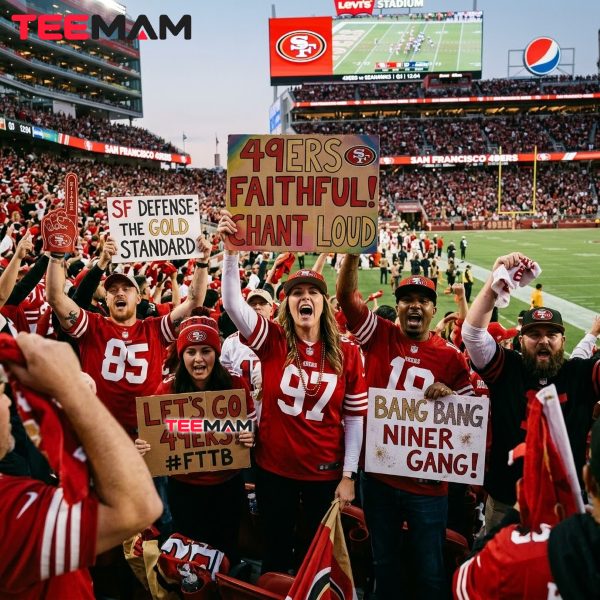
A great sign paired with a section chanting in rhythm pulls in more camera attention than either one alone — crowd shots usually favor sections that are visibly and audibly engaged, not just holding up a board. Our page on 49ers chants and songs rounds up what actually gets sung at Levi’s Stadium.
Chants that build after a big defensive stop or a long touchdown drive often line up with the moments broadcast directors are already cutting to, which is also a decent window for a sign to get its shot. Loud and coordinated is one thing; bullhorns, whistles, and other noisemakers aren’t allowed inside the stadium, so keep the energy vocal.
Frequently Asked Questions About Making 49ers Game Day Signs
What is the best size for a 49ers game day sign? Levi’s Stadium allows signs up to 2 feet by 3 feet with no pole, so staying just under that — around 20 by 28 inches — keeps you compliant while leaving room for large lettering.
Can I bring a homemade sign into Levi’s Stadium? Yes. It just needs to meet the 2′ x 3′ size limit, have no pole, skip anything battery-powered or light-up, and avoid offensive language or imagery under the stadium’s code of conduct.
What colors show up best on television? High-contrast pairings — gold on scarlet, or scarlet on gold — stand out most clearly against the neutral tones of stadium seating and crowd clothing.
Should my sign be funny or supportive? Both work, but a sign tied to something specific happening in that game — a milestone, a rivalry storyline, an in-game moment — usually beats a generic message that could apply to any matchup.
Can kids bring signs into NFL games? Yes, and kid-made signs often perform well on camera precisely because their simplicity avoids the overcrowded design mistakes adults sometimes make.
What materials hold up best outdoors? Foam core board with matte paint or thick paint markers, sealed with clear tape or laminate, holds up best against sun glare, wind, and the wear of being passed through a packed row.
Do camera crews skip certain signs? Camera operators tend to pass over signs with excessive small text, offensive content, or cluttered graphics — none of that comes through clearly in the brief window a camera lingers on a section.
How early should I arrive if I want to be on TV? Early enough to clear security without rushing and settle into a seat in one of the higher-visibility sections before pregame coverage starts. Gates typically open well ahead of kickoff for exactly this reason.
Can I use LED lights on my sign? No. Light-up signs and battery packs larger than a cell phone aren’t permitted at Levi’s Stadium, regardless of the message.
Can I bring cardboard instead of foam core? Cardboard is allowed as far as stadium policy goes, but it sags in humidity and wind, and it doesn’t hold paint as evenly. Foam core is sturdier and reads more consistently on camera.
Are wooden sticks or handles allowed on a sign? No. Poles of any kind, including wooden dowels or PVC handles, aren’t permitted — the sign has to be held flat by hand.
Can security confiscate my sign? Yes, if it exceeds the 2′ x 3′ limit, has a pole, is battery-powered beyond phone-size, or contains prohibited language or imagery. Staff will typically ask you to return it to your car or leave it at an amnesty box rather than let you carry it in.
Final Thoughts
You can’t control whether a camera lands on your section. You can control whether your sign is easy to read, follows the stadium’s rules, and goes up at the right moment instead of the wrong one. Keep it under 2′ x 3′, keep it matte, keep the colors high-contrast, and make sure the rest of your game day look matches the effort you put into the board — that’s what gives you the best shot when the cameras finally swing your way.

Hi, I’m Olivia Bennett, a fashion and lifestyle writer at TeeMam with 6 years of experience creating content about fashion, outfits, and lifestyle trends. I enjoy sharing practical style ideas for everyday wear, game days, holidays, and special occasions, helping readers find looks that feel comfortable, fun, and uniquely their own.