The Most Iconic 49ers Touchdown Celebrations in Franchise History
Candlestick Park used to shake when a 49ers receiver crossed the goal line. Levi’s Stadium does the same thing now, minus the wind that used to knock down punts. For about three seconds after the ball hits the turf, a player stops being a football player and becomes a performer with 70,000 people as his audience.
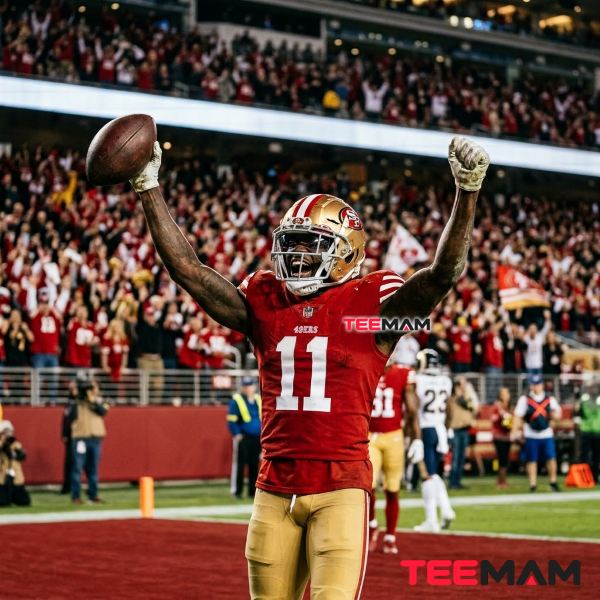
Not every 49ers touchdown celebration earns a spot in franchise memory. Most disappear by the next commercial break. The ones that stick share a few things in common: fans can still describe them years later, they reveal something true about the player, or they get folded into how the team talks about itself.
The most iconic 49ers touchdown celebrations include Terrell Owens’ Sharpie moment against Seattle, his star-stomping duel with George Teague in Dallas, Merton Hanks’ chicken dance, George Kittle’s Zero Miedo hand sign, and Vernon Davis’ raw reaction after The Catch III. Each became memorable for a different reason, and none of them needed the same ingredients to last.
This is not a ranking of the greatest 49ers touchdowns ever. The Catch, The Catch II, and The Catch III belong to a different conversation. This list is about what happened after the ball crossed the goal line, and why some players turned those few seconds into franchise folklore.
For a wider look at how that energy carries over into game day itself, 49ers fan culture and traditions covers the rest of the picture, from tailgate rituals to the gear fans wear to claim a piece of it.
What Actually Makes a Celebration Iconic
There is no official formula, but the same pattern keeps showing up. The player has to be instantly identifiable, even with the sound off. The moment needs a game that mattered, not a garbage-time score against a team already down 30. And the celebration has to become repeatable in the minds of fans, something they can imitate at a tailgate or bring up mid-argument years later. That is why a strange neck movement from a defensive back can outlive a much more athletic touchdown from a star receiver.
A simple gut check works too. Can you name the player without hearing his name? Can the whole moment fit in one sentence? Does it still start an argument at a bar today? If yes on all three, it has earned its place in team lore.
The Candlestick Era’s Original End Zone Showmen
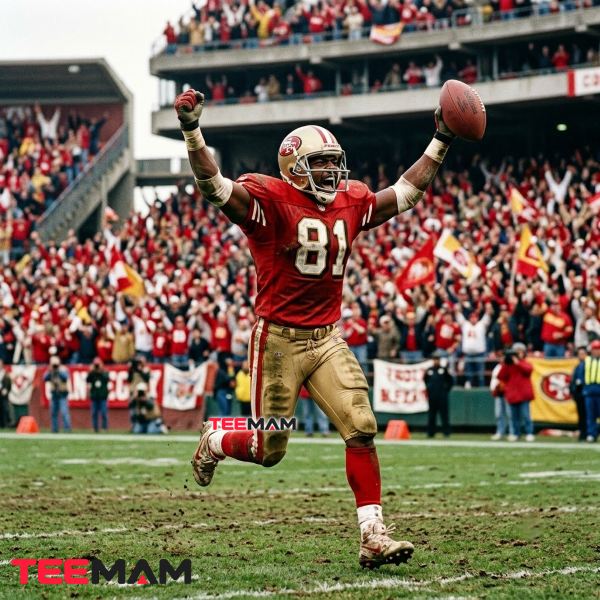
Long before touchdown celebrations were built for a highlight reel, 49ers players were already finding ways to make a moment last using nothing but a prop, a gesture, or their own strange sense of rhythm.
Terrell Owens and the Sharpie
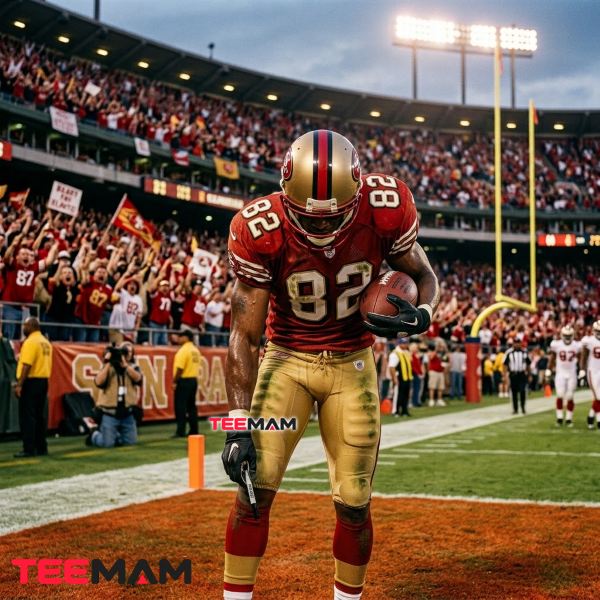
October 14, 2002. Monday Night Football. Owens catches a 37-yard game-winner from Jeff Garcia to beat the Seattle Seahawks 28-21. Before the celebration even starts, he already knows what he is going to do, because he planned it ahead of time. He pulls a Sharpie out of his sock, signs the ball, and hands it to a man in a luxury suite: his financial adviser, who also happens to advise Shawn Springs, the Seahawks corner who had just been beaten on the play. Seahawks coach Mike Holmgren was livid. The league was not much happier, and within weeks it banned players from carrying “foreign objects” onto the field.
The Sharpie is the detail that survives. The 2002 final score is background; Owens pulling the pen from his sock is the image fans still bring up first. A celebration this deliberate turned a touchdown into a piece of theater, and it nudged the entire league toward an era where individual branding became as much a part of the show as the play itself.
Merton Hanks’ Chicken Dance
If the Sharpie was calculated theater, Merton Hanks’ celebration was an accident that turned into a signature. Hanks, a lanky, long-necked safety who anchored the 49ers secondary through most of the 1990s, developed a jerking, bobbing dance that fans nicknamed the chicken dance almost the moment they saw it. It debuted in 1995 against the Dallas Cowboys, right after Hanks scooped up a Michael Irvin fumble and ran it in.
The origin is stranger than most fans realize. Hanks later told NBC Sports Bay Area that the movement started nowhere near a football field. He was watching Sesame Street with his daughter and saw Bert doing “Doin’ the Pigeon,” started messing around with the neck motion in practice, and it eventually found its way onto the field during a game against Dallas.
The dance worked because it had zero polish. It was odd, simple, and belonged to nobody else. Shaquille O’Neal borrowed it during his early Lakers years, and more recently Detroit safety Kerby Joseph broke it out against the 49ers in December 2024 after picking off Brock Purdy twice, drawing an on-air callout from Troy Aikman. Even a Hall of Famer copying the move never carried the weight of the original.
Why the Montana Years Barely Show Up on This List
Notice how little of this list comes from the Joe Montana and Jerry Rice years, the most successful stretch in franchise history. That is not an oversight. Bill Walsh’s 49ers built their identity around precision and team execution, not individual end-zone theater. Players still celebrated, but the culture rewarded a quiet nod or a handoff to the official over a full performance. The Sharpie and the chicken dance both belong to the decade right after that dynasty, when personalities started to matter as much as championships. That shift, from restrained professionalism to loud personal identity, is really the throughline of this entire piece.
The Most Iconic 49ers Celebrations of the Modern Era
George Kittle’s Zero Miedo
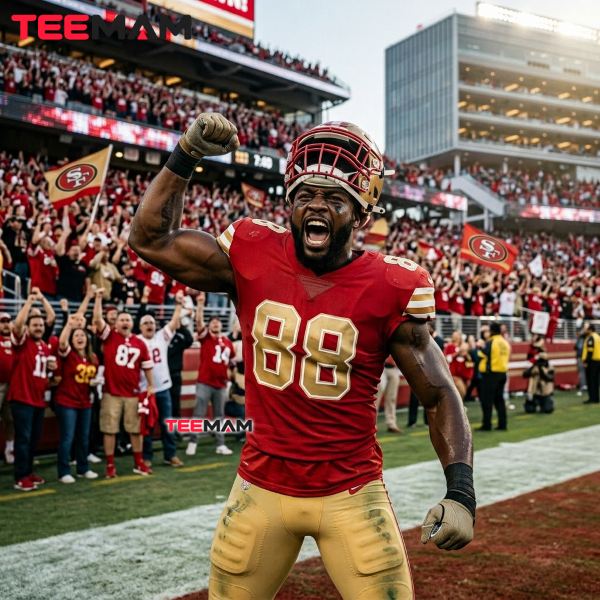
George Kittle did not look to the gridiron for his signature move. He looked to the wrestling ring. The gesture, forming a zero with his thumb and index finger before flipping the rest of his fingers down, belongs to Mexican luchador Penta, and it comes paired with the phrase “Zero Miedo,” Spanish for zero fear.
The connection is not a marketing bit. Kittle and Penta became friends after meeting at WrestleMania 34 in New Orleans in 2018, where Kittle watched Penta wrestle several times over one weekend and came away hooked on his aggression and showmanship. The two have swapped gifts, a lucha mask for a 49ers jersey, and Kittle has carried the gesture into some of the biggest moments of his career, Super Bowl LIV included. It works because it does not require any football context to land. A fan who has never watched a lucha libre card still gets the message: no fear, go all out.
Deebo Samuel and the Signature Presence
Deebo is where the usual celebration conversation breaks down. Across six seasons in San Francisco, from his 2019 draft night through the 2024 season, he never needed a single trademark dance. The way he played was the signature. He finished his run with 334 catches for 4,792 yards and 22 receiving touchdowns, plus 202 carries for 1,143 yards and 20 more on the ground, numbers that explain why fans rarely needed a specific gesture to know a Deebo touchdown when they saw one. After a score, the question was never “what did he just do.” It was closer to “how did anyone think they were going to bring that guy down.”
That is the line between a move and a presence. A signature celebration is a single repeatable gesture, like a Sharpie or a hand sign. A signature presence is when the entire way a player plays becomes the celebration itself, no prop required.
Other 49ers Celebrations That Still Define Fan Memory
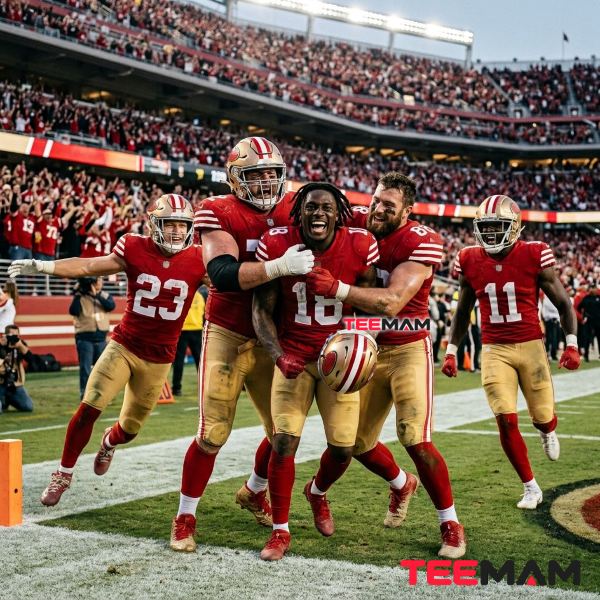
Some of the best memories are collective. Some of the moments fans replay most are the ones where the whole sideline erupts at once, a quarterback sprints twenty yards to jump on a teammate, or a defensive back’s celebration turns into half the roster piling in. Those group reactions remind fans that Niner Gang is not cheering for one personality. It is cheering for a locker room that feels connected to the crowd watching from home.
| Player | Iconic moment | Why it lasted |
|---|---|---|
| Terrell Owens | The Sharpie | Planned, premeditated, and it changed a league rule |
| Terrell Owens | The Dallas star incident | A rivalry flashpoint that escalated into a brawl |
| Merton Hanks | The chicken dance | Instantly recognizable and almost impossible to imitate |
| George Kittle | Zero Miedo | A personal wrestling reference that became a football signature |
| Deebo Samuel | Signature presence | The playing style was the celebration |
| Vernon Davis | Raw emotion | A playoff moment with no performance in it at all |
Vernon Davis and The Catch III
January 14, 2012. NFC Divisional round against the New Orleans Saints. Davis catches a 14-yard game-winner from Alex Smith with nine seconds left, capping a night where he set what was then a playoff record for receiving yards by a tight end with 180. He is crying on the sideline before the celebration even really starts, hugging teammates and coaches. No choreography, no prop, no rehearsed motion. Just a guy who had waited years for a signature playoff moment finally getting one.
The Rivalry Memory Multiplier
Why are touchdown celebrations more memorable in rivalry games? A celebration gets remembered once. A rivalry makes people remember it twice, from opposite sides of the same story.
Owens’ star celebration is the clearest proof. On September 24, 2000, during a 41-24 win in Dallas, he ran to the Cowboys’ midfield logo after his first touchdown and got away with it. After his second, Cowboys safety George Teague sprinted fifty yards across the field and leveled him, igniting a full sideline brawl. Head coach Steve Mariucci fined Owens $24,000 and suspended him a game, and Teague was ejected. More than two decades later, Teague still gets recognized in airports for that one hit. The celebration itself was not especially elaborate, arms raised, standing on a logo, but it poured gasoline on one of the NFL’s deepest 49ers rivalry history and traditions, and that context is the entire reason it still gets replayed today.
Some fans will put the Dallas star incident ahead of the Sharpie. They are arguing about two different kinds of iconic, one built on a prop and a rule change, the other built on a fight everyone remembers watching, but the case is not ridiculous.
How These Moments Became Part of Niner Gang Culture
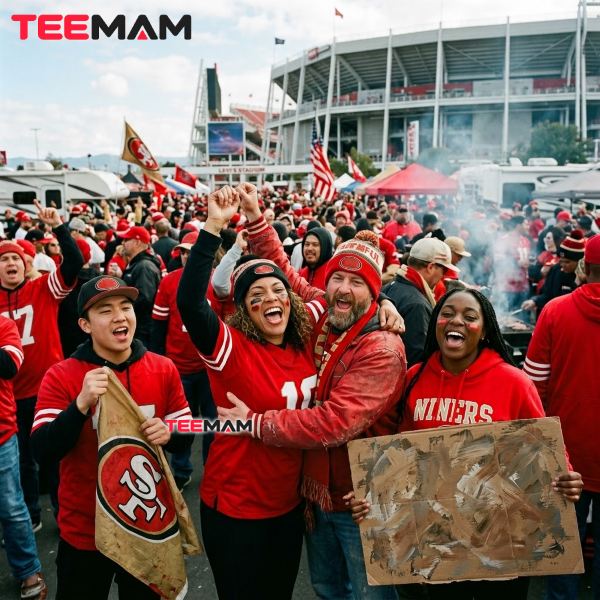
A great 49ers touchdown celebration rarely stays in the end zone. At Levi’s Stadium, it becomes a sign in the stands within a quarter, a tailgate story by the next home game, and the kind of game-day swagger fans still reference long after the roster has turned over. Fans do not just root for a jersey number. They attach themselves to the attitude that number carried, which is why a defensive back known for one dance can end up more beloved in some corners of the fan base than a player with better career stats and no identity attached to his highlights.
That instinct shows up in what fans choose to wear, too. A logo tells people which team you support. A reference to a Sharpie, a chicken dance, or Zero Miedo tells them which part of 49ers history you actually remember. Once fans can name the reference, the field is no longer the boundary. For the right moment, that reference can move from the field into tailgate conversation and what fans choose to wear on game day. That is the instinct we follow at TeeMam too: start with the story fans already care about, then let the visual idea come from the moment instead of forcing a generic team reference onto it.
A player’s signature gesture also works almost exactly like the team’s oldest visual symbol. If you look back at Sourdough Sam’s 49ers origin story, the same pattern shows up: a simple, repeatable image doing more to hold fan identity together than any stat sheet ever could.
The Pattern, Side by Side
Put the celebrations next to each other and the pattern is hard to miss. Owens had the prop. Hanks had the movement. Kittle has the reference. Davis had the emotion. None of them are interchangeable, and that is exactly the point. The best 49ers celebrations were never about who scored the most or celebrated the loudest. They were about which players managed to make a three-second moment feel like it belonged only to them, then watched it get repeated by strangers in the stands for years afterward.
What Comes Next
Celebration culture in the NFL keeps evolving, and the 49ers roster keeps turning over. Every new draft class brings players with interests and references that have not yet found their way onto the field in front of a national audience. The next signature moment could come from a rookie nobody expects, built around something that has nothing to do with football at all, the same way Kittle’s gesture borrowed from lucha libre and Hanks’ borrowed from a children’s show.
Which 49ers celebration do you consider the most iconic? Who is the current celebration king on the roster? Whether it is matching a player’s dance from the bleachers or belting out the 49ers chants fans sing on game day, celebration culture is a big part of what turns 70,000 strangers into one crowd on a Sunday.
Quick Answers
Most famous 49ers touchdown celebration? Terrell Owens’ 2002 Sharpie moment against Seattle, mostly because of the prop and the rule change it caused. Some fans will argue for the Cowboys star celebration instead, and they have a decent case.
Merton Hanks’ celebration, explained. The chicken dance, a jerking neck motion he first broke out in 1995 against Dallas, inspired by Bert’s “Doin’ the Pigeon” bit on Sesame Street.
George Kittle’s Zero Miedo, explained. A hand sign and catchphrase borrowed from wrestler Penta, meaning zero fear, reflecting a real friendship that started at WrestleMania 34 in 2018.
Why do these moments stick around? Personality, a clear visual image, and something fans can repeat. Statistics fade. A gesture people can picture and imitate does not.
Sources: ESPN, NFL.com, 49ers.com, NBC Sports Bay Area, Sports Illustrated, Yahoo Sports, Wikipedia.

Hi, I’m Olivia Bennett, a fashion and lifestyle writer at TeeMam with 6 years of experience creating content about fashion, outfits, and lifestyle trends. I enjoy sharing practical style ideas for everyday wear, game days, holidays, and special occasions, helping readers find looks that feel comfortable, fun, and uniquely their own.