Halloween Trunk-or-Treat: What It Is and How to Plan One
If you’ve ever seen families gathered around decorated cars in a parking lot on Halloween, you’ve probably encountered a trunk or treat. From the outside it can look like organized chaos: kids weaving between cars, string lights everywhere, someone’s fog machine going a little too hard. Once you’re standing in the middle of it, it’s clear how much planning usually goes into making it look effortless.
A Halloween trunk or treat is a community event where families decorate parked vehicles and children walk from trunk to trunk to collect candy, instead of going door to door. It has become a familiar alternative to traditional trick-or-treating, especially for churches, schools, and neighborhood groups that want a centralized, easier-to-supervise version of the holiday. This guide covers what the event actually involves, where it came from, how to plan one from scratch, how to decorate a trunk without wrecking your paint job, how to coordinate costumes and family outfits, and how to keep the whole thing safe and inclusive.
What Is Trunk-or-Treat?
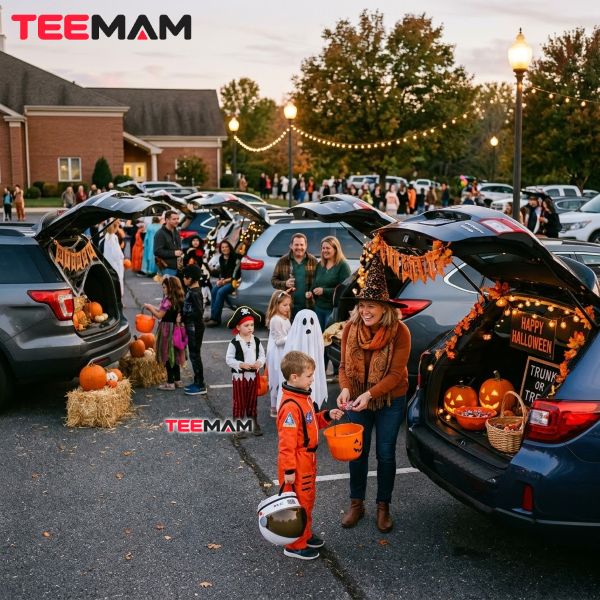
Trunk-or-treat is a Halloween community event where families decorate parked vehicles and children walk from car to car to collect candy and other treats. Unlike traditional trick-or-treating, it happens in one centralized location, such as a church, school, or community parking lot, rather than spread across a neighborhood.
Quick answer: A Halloween trunk or treat is a centralized version of trick-or-treating where children collect candy from decorated vehicles parked in one lot instead of visiting individual homes. Churches, schools, PTOs, and neighborhood groups commonly organize these events because a single location is easier to staff, light, and supervise than a stretch of neighborhood streets.
| Question | Quick answer |
|---|---|
| What is a trunk-or-treat? | A centralized Halloween event that uses decorated, parked cars as candy stops. |
| When is it held? | On October 31 or on another date the organizer chooses. |
| Where is it held? | Usually a parking lot or another designated outdoor space. |
| Who organizes it? | Churches, schools, PTOs, neighborhoods, and community groups. |
| What do kids do? | Walk between parked vehicles and collect treats from the trunks. |
How Does a Trunk-or-Treat Event Work?
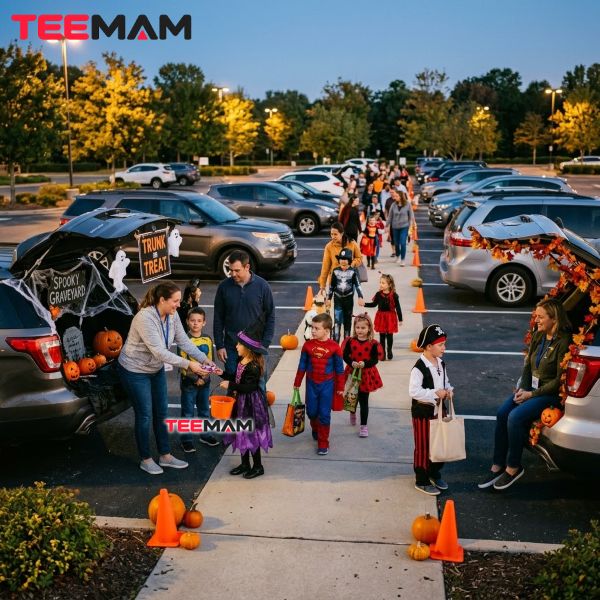
The format breaks down into a few simple steps:
- Vehicles arrive at a designated parking area and get assigned a spot.
- Hosts decorate their trunks before the event opens.
- Children move from car to car instead of house to house.
- Hosts hand out candy or small treats from their trunk.
- The event wraps up at a set time, and everyone packs out together.
Because everything happens in one lot instead of across several streets, parents can usually see most of the action from wherever they’re standing, and organizers have an easier time keeping track of who’s on site.
When Did Trunk-or-Treat Start?
Trunk-or-treat is a relatively modern tradition. Reporting by NPR traces early documented mentions of the format to the 1990s, including a 1994 newspaper account of a Baptist church event in Center Point, Alabama.
According to Halloween historian Lesley Bannatyne, who spoke with NPR, churches were among the early adopters, using trunk-or-treat in the late 1990s as a Halloween-adjacent gathering they felt more comfortable hosting, while also keeping kids away from car traffic on the street. The format later spread beyond churches to schools, PTOs, neighborhood groups, and other community organizations. There’s no single confirmed inventor, and different regions report separate local origin stories, so it’s more accurate to describe trunk-or-treat as a tradition that developed in multiple communities than as the invention of one person or organization.
When Is Trunk-or-Treat Usually Held?
There’s no fixed date. Some churches and community groups hold their event on October 31 itself, often alongside or instead of neighborhood trick-or-treating; others schedule it a weekend or a few days earlier to work around volunteer availability or a school calendar. The right date for your event depends entirely on the organizer, the venue, and local tradition, so it’s worth checking with your specific church, school, or neighborhood group rather than assuming it falls on Halloween night.
Trunk-or-Treat vs. Traditional Trick-or-Treat
| Trunk-or-Treat | Traditional Trick-or-Treat |
|---|---|
| Usually held in one designated location | Spreads out across a neighborhood |
| Decorated cars become the “houses” | Homes become the destinations |
| Easier for a group to organize and staff | Families manage their own route |
| A natural fit for churches, schools, and PTOs | Typically organized informally, block by block |
| Built around a themed vehicle | Built around an individual costume |
How to Plan a Halloween Trunk or Treat
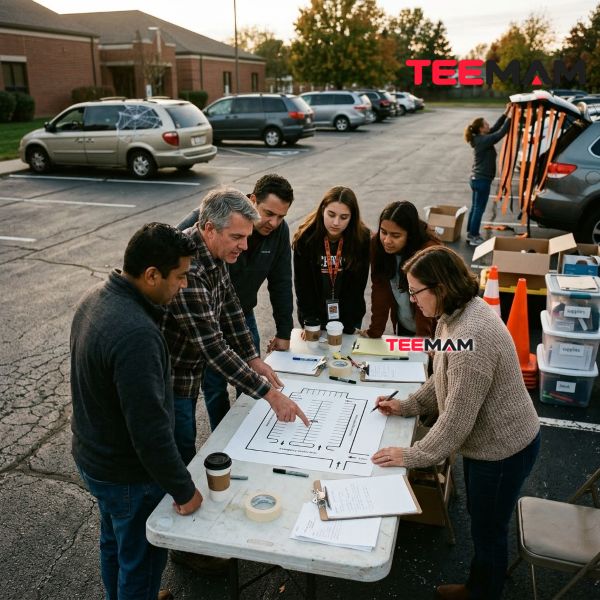
Before anyone decorates a trunk, settle four things first: the venue, how vehicles will move, the rules families need to know ahead of time, and how much candy to bring.
Choose the Date, Location, and Format
Church and school parking lots can work well because they often already have established entrances, exits, and lighting. Community centers and larger private lots are solid backups. Whichever you choose, walk the space in advance and think through expected attendance, a backup plan for rain or cold, and how long the event will realistically run.
What Rules Should a Trunk-or-Treat Have?
At minimum, set arrival and departure windows, a rule against moving vehicles once parked, clear guidelines for what can and can’t be handed out, and an expectation for cleanup. Spelling these out in advance, ideally in a short email or flyer to participating families, heads off most of the confusion that shows up on event day.
Beyond the basics, cover a few more items:
- Parking direction and a single check-in point
- Decoration limits (no open flames, nothing that blocks neighboring trunks)
- An emergency access lane that stays clear the entire time
- Who’s supervising, and where they’ll be stationed
A practical planning tip: treat the parking layout as part of the event design, not an afterthought. A beautifully decorated trunk doesn’t help much if families still have to cross a vehicle lane to get from one row to another.
Quick Halloween Trunk or Treat Checklist
Before event day, confirm the following:
- Venue booked and parking layout mapped
- Volunteer roles assigned (check-in, traffic, cleanup)
- Emergency access lane identified and marked
- Lighting arranged for dusk or after-dark hours
- Decorations, candy, and non-food treats on hand
- Weather backup plan in place
- Cleanup supplies ready
- Arrival instructions sent to participating families
A short checklist like this catches most logistical problems before families ever show up.
A Simple Trunk-or-Treat Planning Timeline
Two to four weeks before: choose the venue, confirm the date, recruit volunteers, and estimate attendance.
One week before: confirm participating vehicles, buy candy and non-food treats, finalize the parking layout, and check the weather forecast.
One to two days before: confirm the weather plan, volunteer attendance, candy supply, lighting equipment, and final vehicle count.
Event day: mark the pedestrian route, set up lighting, park vehicles, brief volunteers, and open the event on schedule.
Trunk-or-Treat Safety and Inclusive Planning
Keep Vehicles and Pedestrians Separate
Cars should be parked and settled before children are allowed into the lot, and nothing should move again until the event ends. A marked pedestrian lane, a few volunteers stationed at key points, and a clear emergency lane cover most of the risk.
Halloween carries increased pedestrian risk, particularly for children, which is one reason organizers should take vehicle movement, lighting, and pedestrian flow seriously. A widely cited JAMA Pediatrics study that analyzed 42 years of National Highway Traffic Safety Administration crash data found the risk of pedestrian fatality to be roughly 43 percent higher on Halloween night than on comparable evenings, with children ages 4 to 8 facing a substantially higher risk.
A closed lot can reduce exposure to moving traffic, but it doesn’t make the event automatically safe. Entrances, exits, lighting, and pedestrian flow still need to be actively managed for that safety advantage to actually hold up.
Create a Safe Parking Layout
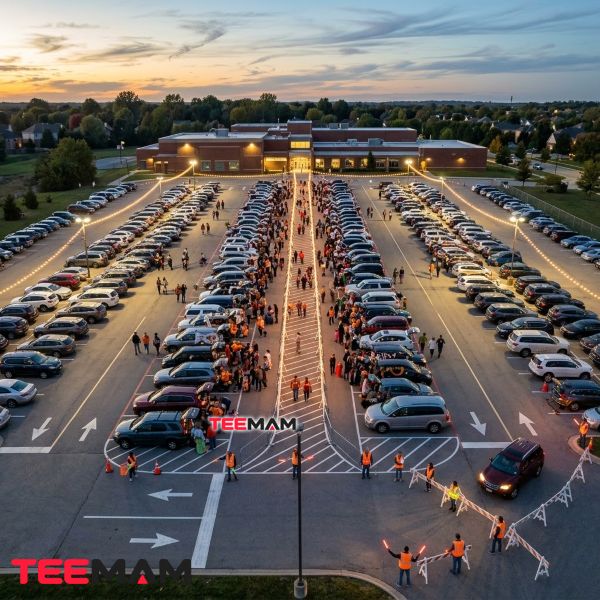
This is the part that’s easy to overlook and the one that matters most. A workable layout keeps a one-way flow for cars entering and exiting, marks a pedestrian-only lane between rows, and reserves a lane for emergency access at all times. Good lighting and a couple of volunteers stationed at the entrance go a long way toward keeping things orderly once the lot fills up. For more general guidance on managing pedestrian risk around a seasonal event, the National Safety Council’s Halloween safety resources are a solid reference for organizers.
Make Candy Distribution Safer
Stick to sealed, pre-packaged treats, keep candy separated from any non-food decorations, and be mindful of age-appropriate items for younger kids in the crowd. Avoid handing out homemade food unless the event’s organizers have specifically approved it.
What Is the Teal Pumpkin Project?
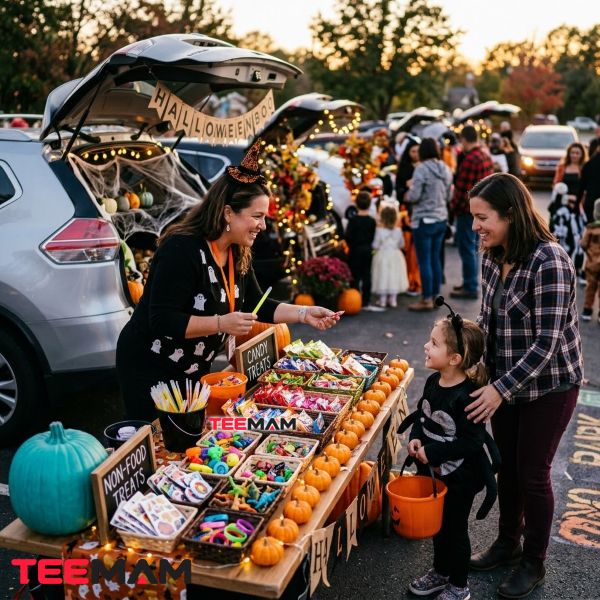
The Teal Pumpkin Project is a campaign launched in 2014 by the nonprofit Food Allergy Research & Education (FARE) that asks hosts to offer non-food treats, like stickers, small toys, or glow sticks, alongside candy, and to mark their table or trunk with something teal so families know at a glance. FARE cites a figure of roughly one in 13 children in the United States living with a food allergy, which is a meaningful share of any crowd at a larger community event.
Offering a separate non-food option gives families managing food allergies another way to take part, instead of having to sit an event out. It’s not a guarantee against every allergen, so keep ingredient labels visible and let parents decide what’s appropriate for their own child. You can find current Teal Pumpkin Project resources from FARE directly on the organization’s site.
How to Decorate a Trunk-or-Treat Vehicle
Start With One Clear Theme
Pick one visual idea and let it do most of the work. A few large pieces that clearly establish a theme will usually read better from ten feet away than a trunk crowded with unrelated decorations. Keep the color palette consistent, and build around the trunk opening itself rather than trying to cover the whole vehicle.
Five Easy Trunk-or-Treat Themes
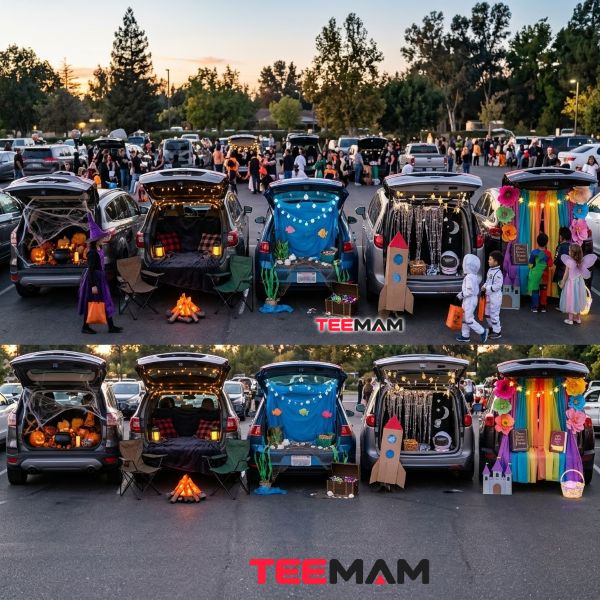
- Classic Halloween – cobwebs, string lights, a fog machine if you’re feeling ambitious. If you do use a fog machine, keep visibility clear around walking paths and entrances.
- Spooky Campground – camp chairs, a fake fire pit, flannel and lanterns.
- Under-the-Sea – blue fabric backdrop, string lights as bubbles, fish cutouts.
- Space Adventure – silver streamers, glow sticks, a cardboard rocket at the trunk.
- Movie or Storybook-Inspired – built around a public-domain fairy tale so the whole family can dress the part.
Each of these scales down to a small SUV or up to a full-size truck bed without much extra effort.
How Can You Decorate a Car Without Damaging It?
Stick to removable hooks, painter’s tape rated for the surface you’re using, and fabric backdrops draped over a frame rather than taped directly to paint. Avoid strong adhesives near the body, and secure any lights or extension cords so they’re not a trip hazard or dragging across the finish. Test any adhesive or hook on an inconspicuous area first, and follow the vehicle and product manufacturer’s instructions.
Coordinate the Car, Costumes, and Family Outfits
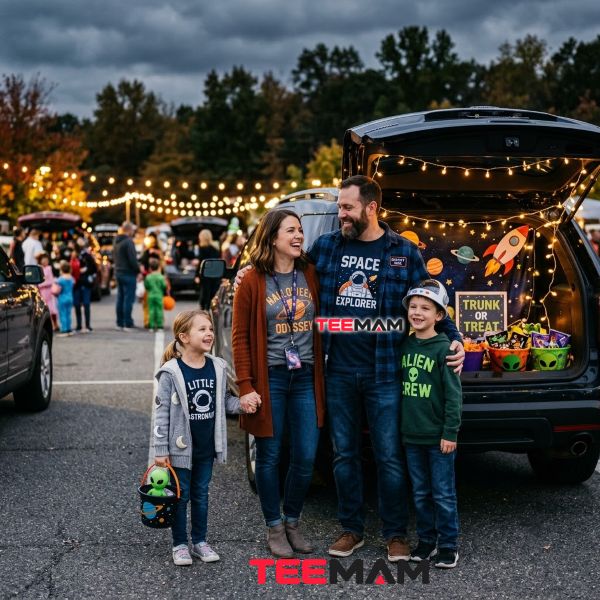
A space-themed trunk feels more cohesive when the family standing beside it follows the same theme instead of showing up in mismatched everyday clothes.
If you’re handing out candy for the whole event, test your outfit before you leave the house: can you bend down, reach into a candy bowl, and move around the trunk comfortably? A shirt-and-layer combination often works better for hosts than a bulky costume that looks great in photos but turns awkward after an hour standing outside. Matching graphic tees, layered under a flannel shirt or cardigan for the cooler October air, tend to hold up better for that stretch of time. They’re also easier to layer as the temperature drops, and they still tie your whole group to the trunk’s theme in photos.
At TeeMam, we see coordinated Halloween apparel as a practical way for families and groups to carry one theme from the decorated trunk into what they wear. If your group is leaning toward full costumes instead, there’s a broader set of creative group Halloween outfit ideas worth a look before you settle on a direction. And if you want a small extra to hand out or keep as a memento of the night, we’ve also put together a list of thoughtful Halloween gift ideas.
Ideas for Churches, Schools, and Neighborhoods
Churches tend to do well with a volunteer sign-up sheet, themed parking sections, and a couple of simple activity stations beyond just candy. Schools and PTOs benefit from advance registration, assigned volunteer roles for traffic and cleanup, and a clear arrival window communicated to parents ahead of time. Smaller neighborhood groups can keep it lighter: a shared decoration theme across two or three driveways, an informal RSVP, and a plan for who’s bringing what.
For organizers who want more background on the holiday itself, our guide to Halloween traditions and history offers a useful place to start.
Common Trunk-or-Treat Mistakes to Avoid
- Overdecorating the vehicle to the point it blocks movement around the trunk.
- Skipping a traffic plan, leaving no clear entrance or exit once the lot fills.
- Underestimating candy, without a plan for higher-than-expected turnout.
- Ignoring weather, with no backup for wind, rain, or an early cold snap.
- Overcomplicating the theme, past what can realistically get built in an afternoon.
- Forgetting the person behind the trunk, whose outfit needs to survive standing, bending, and reaching for the length of the event.
Frequently Asked Questions About Trunk-or-Treat
What is the purpose of trunk-or-treat? It gives families a centralized, easier-to-supervise version of Halloween, usually hosted by a church, school, or community group, where decorated vehicles replace individual houses as the candy stops.
Can you have a trunk-or-treat on Halloween night? Yes. Trunk-or-treat events can take place on October 31 or on another date the organizer chooses. Some churches and community groups hold theirs on Halloween itself, while others schedule it a few days earlier to fit local activities and volunteer availability.
What should you bring to a Halloween trunk or treat? Hosts typically need decorations, candy or non-food treats, trash bags, and portable lighting. Attendees generally just need a costume, a candy bag, water, and a layer for cooler weather.
How many pieces of candy do you need for a trunk-or-treat? There’s no universal candy-per-child standard, but you can estimate it with a simple formula: expected children multiplied by the number of pieces each participating trunk plans to hand out per child, plus a modest reserve for walk-ins. For example, if 150 children are expected and each of 20 participating trunks plans to give out two pieces per child, that’s roughly 300 pieces total per trunk theme group, with some extra held back for unexpected turnout.
How many cars do you need for a trunk-or-treat? It depends on expected attendance and how long you want the event to run. Smaller neighborhood or classroom events can work with as few as 10 to 15 decorated vehicles, while larger church or school events often recruit 30 or more so lines stay short and volunteers aren’t handing out candy nonstop.
How long should a trunk-or-treat last? A trunk-or-treat often works best as a short, defined event rather than an open-ended gathering. For many community groups, a one to two hour window gives families enough time to visit the trunks without keeping volunteers standing outside for too long. The right length depends on attendance, the number of participating vehicles, and whether activities are included alongside the candy.
What are good trunk-or-treat themes? Classic Halloween, spooky campground, under-the-sea, space adventure, and movie or storybook-inspired themes all scale well to a single vehicle without requiring a big budget.
Is trunk-or-treat safer than trick-or-treat? A centralized, closed lot with a marked pedestrian area and no moving vehicles removes some of the traffic risk that makes Halloween statistically dangerous for pedestrians. That doesn’t make the event automatically safe, though: parked vehicles, entrances, exits, lighting, and pedestrian movement still need to be actively managed, and how safe any individual event turns out to be still depends on how well it’s planned and supervised.
What should you wear to a Halloween trunk or treat? Comfortable, weather-layered clothing that lets you move freely tends to work better than a bulky costume, especially if you’re the one standing behind the trunk handing out candy for the whole event.
Plan a More Fun, Safer Halloween Trunk or Treat
The easiest way to keep a Halloween trunk or treat manageable is to design the event backward from the parking lot: decide where children will walk, where cars will enter and exit, and then fit the decorations and activities around that layout. Handle the venue, the rules, and the candy supply early, keep pedestrians and vehicles separated the whole night, and pick a theme your group can actually finish. The decorated trunks are what catch people’s attention, but the planning underneath is what actually keeps the night running smoothly.
Appendix: Image Plan (for production, not for publishing as-is)
Note: these images have not been generated. The prompts below are provided for whoever runs them through an actual image-generation tool. Do not publish this appendix section itself; it’s a production reference only and should not be included in the live page or indexed by search engines.
| # | Insert after this heading | SEO Image Title | Filename | Alt text |
|---|---|---|---|---|
| 1 | What Is Trunk-or-Treat? | Halloween Trunk or Treat Community Event | halloween-trunk-or-treat-community-event.webp | Families at a Halloween trunk or treat event in a decorated parking lot |
| 2 | How Does a Trunk-or-Treat Event Work? | How Halloween Trunk or Treat Works | how-halloween-trunk-or-treat-works.webp | Children walking a pedestrian path between decorated trunks collecting treats |
| 3 | How to Plan a Halloween Trunk or Treat | Halloween Trunk or Treat Event Planning | halloween-trunk-or-treat-event-planning.webp | Volunteers reviewing a site plan for a trunk-or-treat event |
| 4 | Create a Safe Parking Layout | Safe Halloween Trunk or Treat Parking Layout | safe-trunk-or-treat-parking-layout.webp | Elevated view of a parking lot arranged with a pedestrian lane and emergency access |
| 5 | Five Easy Trunk-or-Treat Themes | Easy Halloween Trunk or Treat Theme Ideas | easy-trunk-or-treat-theme-ideas.webp | Several decorated vehicle trunks showing different Halloween themes |
| 6 | Coordinate the Car, Costumes, and Family Outfits | Coordinated Family Halloween Outfits | matching-family-halloween-outfits.webp | Family in coordinated Halloween outfits beside a decorated SUV |
| 7 | What Is the Teal Pumpkin Project? | Teal Pumpkin Project Trunk or Treat | teal-pumpkin-project-trunk-or-treat.webp | A teal pumpkin beside candy and non-food treats at a trunk-or-treat station |
Image prompts (photorealistic, 1:1 square composition, 1024×1024, no text/logos/watermarks, no illustration or 3D render, no copyrighted characters):
- What Is Trunk-or-Treat? — Photorealistic lifestyle photo of a suburban American community Halloween trunk-or-treat event in a well-lit school or church parking lot at dusk. Family vehicles parked in organized rows with decorated open trunks; children in age-appropriate costumes walking between stationary cars collecting candy from friendly adults. Warm string lights, tasteful decorations, pumpkins, candy bowls. Candid, documentary-style, realistic people and vehicles, subtle autumn atmosphere.
- How Does a Trunk-or-Treat Event Work? — Photorealistic documentary-style photo of a Halloween trunk-or-treat event at dusk, showing several decorated vehicles parked in organized rows while children in age-appropriate costumes walk along a clearly separated pedestrian path collecting sealed treats from adults at open trunks. Parents and volunteers visible supervising. Warm realistic parking lot lighting, natural candid expressions, authentic suburban community setting, realistic cars and decorations. No text, no logos, no watermark, no illustration, no 3D render.
- How to Plan a Halloween Trunk or Treat — Photorealistic photo of parents and volunteers planning the event around a folding table with a simple printed site map, discussing parking rows, pedestrian paths, entrances, and emergency access. Parked cars in the background, decorations being prepared nearby. No readable text on any signage or paper.
- Create a Safe Parking Layout — Photorealistic elevated wide-angle photo, square composition, of a school parking lot prepared for the event, with the entire pedestrian route and emergency lane clearly visible within frame: vehicles in orderly rows, a clearly separated pedestrian lane, volunteers positioned at entry and crossing points, an unobstructed emergency lane, and temporary lighting. Children and parents remain in the pedestrian area while all vehicles are stationary. No readable signage.
- Five Easy Trunk-or-Treat Themes — Photorealistic photo of several decorated trunks, each showing a different simple, original theme (classic Halloween, spooky campground, under-the-sea, space adventure, storybook-inspired). Decorations made from accessible materials (fabric, cardboard, string lights, pumpkins). No copyrighted characters or brand logos.
- Coordinate the Car, Costumes, and Family Outfits — Photorealistic photo of a family of four beside their decorated SUV, wearing coordinated Halloween outfits that visually match the vehicle’s theme: graphic tees layered with flannel or a cardigan for cool weather. Natural, candid interaction. No visible brand logos or readable text.
- What Is the Teal Pumpkin Project? — Photorealistic photo of a treat station at a trunk-or-treat event with a visible teal-painted pumpkin beside sealed candy and separate non-food treats (stickers, small toys, glow sticks). A parent and child approaching while a host offers choices. Decorated trunk in the background. No readable text, no visible brand names on packaging.
Placement rule: 7 images for a roughly 1,800 to 2,000 word article keeps a reasonable text-to-image ratio for a primarily instructional, FAQ-driven piece like this one; more would dilute the hierarchy without adding real value.

Hi, I’m Olivia Bennett, a fashion and lifestyle writer at TeeMam with 6 years of experience creating content about fashion, outfits, and lifestyle trends. I enjoy sharing practical style ideas for everyday wear, game days, holidays, and special occasions, helping readers find looks that feel comfortable, fun, and uniquely their own.